Another bout of insomnia last night; I managed to get about five hours of sleep all told. To recover this morning, I'm having a cup of tea and a bowl of cereal. But as my cereal of choice was nearly empty, I've had to resort to blending. This has created an unholy alliance between the two arch-rival producers of breakfast cereals -- Kellogg's and General Mills. I've got a bowl half full of Pops ("Big Yellow Taste, Sweet Corn Crunch!") and half full of Honey Nut Cheerios ("Whole Grain Oat Goodness With A Touch of Honey and Almond"). It's like the Superfriends of breakfast -- when Superman from the DC universe gets together with Batman from the Marvel universe... look out, evil! There's nothing like a bowl of SuperCereal to kick-start a day and great way to get ready for cleaning out the garage!
April 8, 2006
Recovery from Sleep Deprivation
Another bout of insomnia last night; I managed to get about five hours of sleep all told. To recover this morning, I'm having a cup of tea and a bowl of cereal. But as my cereal of choice was nearly empty, I've had to resort to blending. This has created an unholy alliance between the two arch-rival producers of breakfast cereals -- Kellogg's and General Mills. I've got a bowl half full of Pops ("Big Yellow Taste, Sweet Corn Crunch!") and half full of Honey Nut Cheerios ("Whole Grain Oat Goodness With A Touch of Honey and Almond"). It's like the Superfriends of breakfast -- when Superman from the DC universe gets together with Batman from the Marvel universe... look out, evil! There's nothing like a bowl of SuperCereal to kick-start a day and great way to get ready for cleaning out the garage!


April 7, 2006
Defense Verdict in Britain and Missionaries in Knoxville
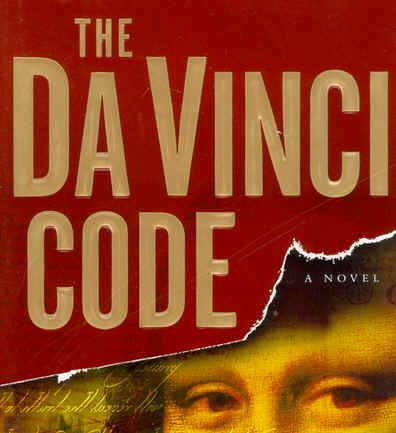 How odd that Michael Baigent and Richard Leigh chose the two months before the release of the movie The Da Vinci Code to sue Dan Brown for copyright infringement. Their claim was that Brown ripped off their idea that Jesus survived his crucifixion, married Mary Magdelene, had children, and that their descendents eventually became French royalty. To some Christians, this seems like an off-the-wall theory indeed, but there is some meat behind the idea.
 I read both Brown's The Da Vinci Code and Baigent and Leigh's Holy Blood, Holy Grail. There is no doubt that Brown was influenced by Baigent and Leigh -- Brown admitted as much and he named a character in his book after the two researchers whose earlier work popularized an otherwise-esoteric theory.
Brown did a lot more than Baigent and Leigh in his book and does not claim that his book is historically accurate or even that his book presents a historically accurate theory. Brown added a lot of art history and contemporary politics. And some car chases and anagram puzzles. And his research for the book undoubtedly included more scholarship and historical speculation than just Baigent and Leigh. While Baigent and Leigh's book was the first book I ever read to point out that the figure sitting to
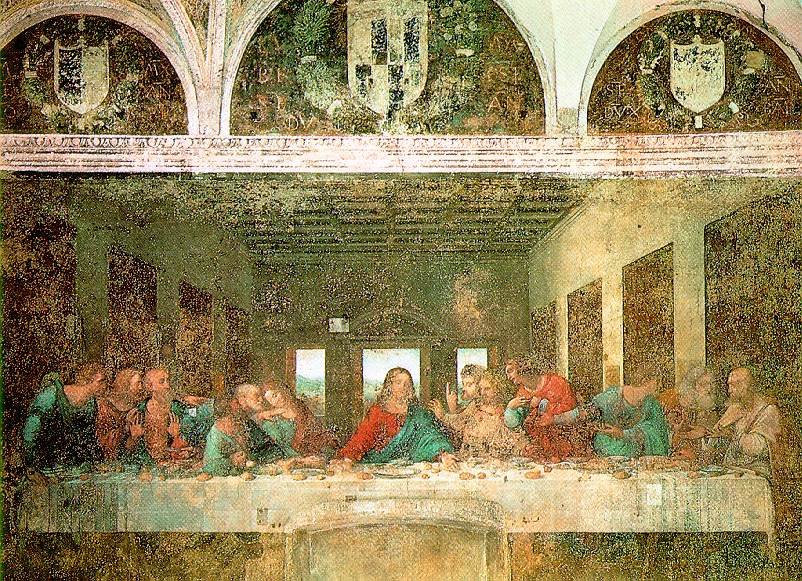 Jesus' right in The Last Supper is very feminine in appearance, Baigent and Leigh can't copyright that -- The Last Supper is a work of art that is in the public domain.
 Baigent and Leigh lost their lawsuit because at the end of the day, what Brown took from their book was an idea, not a part of their writing. Under British copyright law, as is the case under American copyright law, an idea cannot be copyrighted. A way of expressing that idea can be, but not the idea itself. The distinction is subtle, and I wrestled with it somewhat when I first learned copyright law -- a friend on the law review drilled the fundamentals into me one afternoon.
What's more, The Da Vinci Code is a work of fiction and intended strictly for entertainment purposes only. Baigent and Leigh engaged in an intriguing bit of historical research and reconstruction of available evidence. But at the end of the day, even they must admit ultimately that despite all of the research they put in to the subject, their work is speculation and not history.
What's astonishing to me is the virulence that this idea has generated. Next month, there will no doubt be protests and calls for boycotts of the movie (which will only increase the movie's box office appeal, I might add). For nearly two years now, there have been "explain-it-away" books published by very religious people attempting to point out all of the historical flaws and inaccuracies in The Da Vinci Code, and some religious leaders have exhorted their congregations to not read this book. Dan Brown doesn't care -- he wrote a work of fiction. He purports to have accurately described art and architecture, some of which I have seen with my own eyes and can verify is accurate; he also purports to describe certain rituals performed by a quasi-fundamentalist sect of the Catholic Church with accuracy, and there is at least some scholarly support for those claims. But as for the underlying theory, Brown has been clear that it is, at best, speculative, and that the novel is not intended to be anything more than a good read. So I have to ask myself -- how could these people be so threatened by what is admittedly a work of fiction?
 Now, I see fiction which is contrary to my own world view all the time, and I find it immensely entertaining. I like Harry Potter, but my world view is not challenged by their portrayal of British teenagers in jeans and sweatshirts performing magic or riding dragons. I liked The Lord of the Rings immensely but I know perfectly well that there are not Balrogs living underneath the mountains or elves in the forests. I like the Star Wars movies but I don't think that I, or anybody else, can really use The Force to telekinetically make lightsabres fly around the room during duels. I liked The X-Files even though it always seemed to be that there really was a paranormal explanation for the mysteries rather than a naturalistic one. None of these pieces of fiction -- fiction -- ever threatened my skepticism to religion and the paranormal; none of them offended me in any appreciable way. The reason for this is that none of this fiction was ever presented as reality.
If someone seriously wanted me to believe that there really are Vulcans and warp drives and Klingons and Borg, it might be a different story -- I would demand proof and when the proof wasn't forthcoming, I'd either dismiss the person as a lunatic or tell them to peddle their imaginative goods elsewhere. If they just urged me to believe, I'd be polite about it; if they tried to threaten me ("You're going to hell if you don't believe this") or change the laws based on their beliefs ("We're going to teach kids in public schools that God created human beings instead of evolution") then I'm going to inject some more steel and acid in my response.
Just yesterday I had occasion to do this, as a matter of fact -- two Mormon missionaries came to the house. They asked me what I would say if they could tell me there was a living prophet here on Earth. "I'm an atheist, so I don't find that a particularly convincing sort of statement," I said.
 "Really? You mean you don't believe in God at all?"
"Nope. Not at all."
"So you, like, believe in evolution, then?"
"That's right. I think intelligent design is a bunch of nonsense. Look, you seem like nice enough guys, but there's just not anything you can say that will make me start believing."
"Nothing? Well, okay then, thank you and have a nice day."
I suppose that seems close-minded of me. But while I think it's important to not be scared of ideas, and to be open-minded to new ideas, that does not mean that all ideas deserve equal treatment. I've heard plenty about the LDS theology and quite a lot of really scary things about the LDS establishment. When you've already considered and rejected an idea, then there's probably not a whole lot that can be done to make you re-consider.
These guys weren't going to have any evidence, just a copy of the book of Mormon to wave in my face. A book I would give as much credence to historical reality as I would The Da Vinci Code -- the only thing being that The Da Vinci Code admits that it is a work of fiction, where I was going to be asked to accept the contents of the Book of Mormon on nothing but faith. I only need to suspend my disbelief to enjoy Dan Brown's book; Joseph Smith asks me to surrender my disbelief entirely.
The truly faithful will not be threatened by The Da Vinci Code any more than I was threatened by the Mormons' attempt to proseltize me; they will treat The Da Vinci Code as pure entertainment, just as I treat Harry Potter as pure entertainment.
April 5, 2006
Italian Soul Food
 Ingredients -- pasta shells, marinara sauce, and filling, consisting of:
oregano
basil
parsley
black pepper
rosemary
1 egg
12 oz. ricotta cheese
3 oz. mozarella cheese
1 oz. parmasean cheese
2 oz. cut spinach
2 cloves roasted garlic
Boil 7-10 large pasta shells for about 10 minutes in salted water at a rolling boil. Meanwhile, mix all ingredients above in a mixing bowl. When pasta is al dente, remove from water. Spoon stuffing mixture into each shell; arrange shells in baking pan. When complete, pour marinara sauce on top of pasta. Cover with aluminum foil and bake at 350º for 25 minutes. Remove foil and increase heat to 450º. Grate a layer of mozzarella cheese on top of pasta and sauce, return to oven for 10 minutes or until cheese begins to toast. Allow to cool for 5 minutes before serving. Shown here with grilled Italian sausage.
No Joy In It
 I've just finished up the least proficient class I've ever taught at University of Phoenix. Their level of comprehension of the subject matter was astonishingly low. Remarks from their final papers included: "Business firms must be aware of liability such as respondent superior such as: vicarious liability" and "One of the ways deterrence can happen is through preventitive measures."
What's astonishing is that five of these students were really quite bright. I have no doubt that due to the "team learning" model UoP requires me to use, seven of my students did not fail when they otherwise would have, thanks to the efforts of their classmates. The five good students could easily have aced the class; as it is, they got A- and B+ grades. I say this because I give my students objective tests each week and the class average was 67.8% correct, or a D+. The five good students averaged 85.2% correct on the tests (B), the remaining twelve average 59.7% correct (F).
It's immensely frustrating to see good students held back by poor ones, and there's no joy in seeing students simply do nothing and expect to be given a good grade. I don't like failing students one bit but that's what I have to do sometimes. It shouldn't be so hard for students to pass an online class, but every time either the administration or I do something to make it easier on the students, their performance seems to decrease to even lower depths.
I guess I'm just doing it for the money, and the break that The Wife gets on her tuition. Once she graduates, I doubt if I'll continue to bash my head against the wall like this any longer.
April 4, 2006
Updated Entry
I wrote last weekend about my concerns with respect to President Bush's overreaching signing statements. I've updated that post, and there is a lot of meat in my exchange with an anonymous commenter.
Padres Fans Greet Barry Bonds
 San Diego has always struck me as a classy city. The touch of class here was that before mocking Bonds by throwing objects into left field during play, the fan had the courtesy to remove the needle from the syringe. That's how you know it was meant in good fun.
April 2, 2006
Convicted Felon Paid To Access Guns
 As we read in a link first seen on FARK, Tennessee's Emergency Management Agency went out of its way to hire a disbarred lawyer -- who was convicted of taking out a hit on his own wife to get the life insurance money and still serving time for that crime -- in a job which gave him unattended access to guns and other weapons.
Unlike yesterday's post, this is not an April Fool's joke.
April 1, 2006
Reason To Stay
This is a very surprising and pleasant development -- powerful enough to motivate The Wife and I to stay in Tennessee! Since this is such a big deal, I've reprinted most of the article below.
Bipartisan Ceremony Marks Dedication of Tennessee Secular Studies Center
Knoxville, Tennessee, April 1, 2006 (AP):
Bipartisan Ceremony Marks Dedication of Tennessee Secular Studies Center
Knoxville, Tennessee, April 1, 2006 (AP):
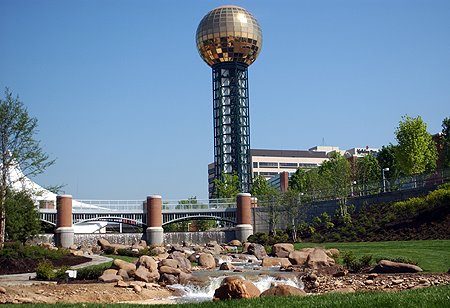
This is great news. With any luck, I can find work at the legal clinic, and work every day in that beautiful building! We'll miss California, to be sure, but an opportunity like this cannot be passed up.In a pleasant and genial ceremony today cohosted by Tennessee's governor, Phil Bredesen, and Senate Majority Leader Bill Frist, the leaders of the state officially dedicated the previously-unused Knoxville Sunsphere to a new organization, the Tennessee Secular Studies Center, or TSSC.
TSSC will be not-for-profit corporation dedicated to educating the public about the role of secularism in modern America, the history of secularist Americans, and promoting moral behavior for all regardless of adherence to any organized religion.
TSSC will base its operations in the Knoxville Sunsphere, a legacy of the highly-successful 1982 World's Fair held in Knoxville and the most prominent building in the city's skyline."Knoxvillians should be proud that their city's most significant landmark is being dedicated to the millions of secular Americans and their contributions to American culture," said Senator Frist in prepared remarks. "They will be glad to know that the base of this previously-unused structure will be surrounded by a sculpture garden in years to come, featuring a reproduction of The Ascent of Man carved from locally-quarried marble, and busts of prominent Americans of secular background, including Abraham Lincoln, Andrew Carnegie, Albert Einstein, Ernest Hemingway, and Benjamin Franklin."
Governor Bredesen, a Democrat, opened the ceremony with a nod to Republican Frist, by noting that the presence of prominent leaders from both political parties demonstrated the full acceptance of non-religious Tennesseans by the leadership of the state. He then announced that he was sponsoring an initiative to amend Tennessee's Constitution to repeal the state's ban on atheists holding public office and serving on juries (Tenn. Const. Article IX, Section 2). "For too long, the antiquated Constitution of this great state has diminished the importance of these good people," Bredesen said. "It is high time that Tennessee enters the twenty-first century and recongizes that all of its citizens are called to public service, and that we welcome the contributions of everyone." Bredesen's remarks were greeted with thunderous applause by the gathered crowd of in excess of half a dozen local secular people.
Dan Wilson, pastor of the Church of the One True God in Knoxville, said after the ceremony, "I'm glad they found such a good use for the Sunsphere, which was just a wasted space other than that. My church has no need of that kind of public prominence and there's more than enough room in Knoxville for my parishioners and those who do not hear the call to believe in God. Of course, they're all going to Hell and eternal torment in the afterlife, but that's none of my business."
TSSC will have a scholarly research arm, a public relations unit, and a legal action clinic to address concerns regarding separation of church and state. There will also be a museum describing the process of evolution, profiling prominent secular and atheist figures from history, and rotating science exhibits. The museum and public education center will be on the center and largest floor of the Sunsphere, which provides a spectacular view of the Knoxville skyline, Tennessee River valley, and the nearby Smoky Mountains. The legal clinic, scholar's center, PR, and executive offices are to occupy the first and third floors of the building. Applications to fill these positions are currently being accepted.


March 31, 2006
Disregard of the Judiciary
We see it right here in Knox County. In spite of a recent ruling of the Tennessee Supreme Court affirming that term limits can apply to county commisioners, 12 of the 15 Knox County commissioners are running for re-election despite being term-limited out of office. Whatever the Supreme Court says apparenty just doesn't matter to the local oligarchs.
So perhaps I've been too hard on President Bush. Institutional arrogance is not limited to the highest levels of government.
So perhaps I've been too hard on President Bush. Institutional arrogance is not limited to the highest levels of government.
Subversive to Intelligence
I recently discussed with The Wife the appalling state of high level academia, infected as it is with deconstructionism, critical theory, postmodernism, and other such nonsense. She didn't believe me until I was able to show her the random postmodernist essay generator, and explained that a longer article, written by the same program, was published in a peer-reviewed journal. In an age when scholars take seriously the idea that E=mc² is a bulwark of sexism and when an appropriately leftist-toned article condemning physics, admittedly nothing but meaningless nonsense, is published in prestigious, peer-reviewed journals, the prestige of all of the upper levels of academia should be questioned.
Far more intelligent and humorous, and equally subversive, is the recent series on Alien Loves Predator, in which Predator's "psychic" ex-girlfriend has a date with Bill Clinton.
Far more intelligent and humorous, and equally subversive, is the recent series on Alien Loves Predator, in which Predator's "psychic" ex-girlfriend has a date with Bill Clinton.
Hey, you Politicians! Quit Trying To Score Political Points Over There!
John Dean testified before the Senate today, recommending that the Congress issue some form of official rebuke to President Bush for the domestic surveillance program which the White House maintains is not subject to any form of accountability to either the judicial or legislative branches of government. Dean testified: "The president needs to be reminded that separation of powers does not mean an isolation of powers ... He needs to be told he cannot simply ignore a law with no consequences." Quite so.
 The response of arch-Republican Senator Orrin Hatch was a whining demand that Democrats should "quit trying to score political points" with this issue. What? Telling politicians to not try to score political points is like telling an accountant to stop doing math. It's what they do.
I also didn't know that only one President (Andrew Jackson) had ever been censured in U.S. history. More Presidents have been impeached than censured. Given the depth of disagreements between the executive and legislative branches that have come up throughout our history, it's remarkable that there has been such deference on the part of Congress. And the censure doesn't really have any teeth to it; it simply expresses the sense of the Congress that the President has gone too far. It doesn't purport to restrict the President's powers or remove him from office. It's not the equivalent of a "no confidence" vote in a parliamentary system, precisely because the U.S. does not have a parliamentary system.
If the censure resolution passes Congress, George Bush will still be President. His political authority will be undermined somewhat. But then again, he's on his way out of office anyway; there are less than a thousand days of the Bush Administration left no matter what. It's not like this has been a Golden Age for America. It has been an age of increased political polarization and it sure looks like Bush is surrounding himself with "yes" men. So if the President has screwed up, someone's got to tell him so. Does this mean "weakening" the Presidency? No -- it might weaken this particular President, but so what? We've had Presidents in wartime who lack strong political backng before. Lincoln, Truman, McKinley. Nor are we at "war" in the traditional sense of the word -- we are in a state of heightened military activity in ostensibly friendly territories (Iraq, Afghanistan, Pakistan, and at home).
And as for the President's political strength, here's the reality: the President has got a hard core of supporters who would back him up no matter what. Seriously -- if he held a joint press conference in the Rose Garden with the Prime Minister of Ireland, and halfway through taking questions from the press took out a knife and slit the Prime Minister's throat on live TV in front of the entire world, something like 25% of Americans would defend the President and say "Well, the guy must have had it coming; and hey Presidents sometimes have to do things like this."
Another aspect of political reality: there is another hard core of people who would criticize the President no matter what he did or didn't do. If Bush were to personally don combat fatigues, fly out to Afghanistan, and troop out into the mountains armed with nothing more than a Bowie knife, a compass, and a couple sticks of chewing gum, and emerge three days later in Islamabad with Osama bin Laden himself bound and gagged as a prisoner, about 20% of Americans would complain that he hadn't done it fast enough, complain that Osama had picked up a few bruises along the way, and demand the appointment of a special counsel to inquire into whether the President had committed prisoner abuse.
 An aside: I'm no fan of prisoner abuse, and I think Americans who abuse prisoners deserve to become prisoners themselves. But if it's Osama we're talking about, I think I could relax my idealism just a little bit. Should we capture him alive (big assumption), I would be pleased to see Osama get a trial. But when he's convicted (not if -- he's confessed many times in situations which would be wholly admissible), he should get executed by being thrown off the top of the newly-rebuilt World Trade Center. We can write a check to his family for the Eighth Amendment violation after the fact.
So the question of whether the President is weakened is a question of whether people who are neither Bush-haters nor Bush-lovers will support him on a particular policy. It is not unpatriotic to disagree with the President on a particular policy, even one relating to the "war" effort. Bush has said so himself.
While it seems to me the hard core of Bush-haters is smaller than the hard core of Bush-lovers, they also seem to be louder. Both groups are equally unthinking in their responses to various activities; and therefore both groups are detestable and ultimately harmful to the political health of the country. We need a healthy political debate, because having a healthy political debate is part of what it is to be a free people.
That means that testimony like Dean's needs to be heard and evaluated. That I agree with Dean on this point is only part of the point. The point is, of course the Democrats are trying to score political points. So are the Republicans. That's what it's all about. When the Green Bay Packers play the Chicago Bears, and the Bears score a touchdown, Green Bay don't say, "Hey, quit it!" Instead, they go out on the field and try and score more points themselves. Sometimes they succeed, sometimes they don't. It wouldn't be much of a game if one team didn't play.
And it wouldn't be much of a democracy if one point of view were not expressed.
 The response of arch-Republican Senator Orrin Hatch was a whining demand that Democrats should "quit trying to score political points" with this issue. What? Telling politicians to not try to score political points is like telling an accountant to stop doing math. It's what they do.
I also didn't know that only one President (Andrew Jackson) had ever been censured in U.S. history. More Presidents have been impeached than censured. Given the depth of disagreements between the executive and legislative branches that have come up throughout our history, it's remarkable that there has been such deference on the part of Congress. And the censure doesn't really have any teeth to it; it simply expresses the sense of the Congress that the President has gone too far. It doesn't purport to restrict the President's powers or remove him from office. It's not the equivalent of a
 "no confidence" vote in a parliamentary system, precisely because the U.S. does not have a parliamentary system.
If the censure resolution passes Congress, George Bush will still be President. His political authority will be undermined somewhat. But then again, he's on his way out of office anyway; there are less than a thousand days of the Bush Administration left no matter what. It's not like this has been a Golden Age for America. It has been an age of increased political polarization and it sure looks like Bush is surrounding himself with "yes" men. So if the President has screwed up, someone's got to tell him so. Does this mean "weakening" the Presidency? No -- it might weaken this particular President, but so what? We've had Presidents in wartime who lack strong political backng before. Lincoln, Truman, McKinley. Nor are we at "war" in the traditional sense of the word -- we are in a state of heightened military activity in ostensibly friendly territories (Iraq, Afghanistan, Pakistan, and at home).
And as for the President's political strength, here's the reality: the President has got a hard core of supporters who would back him up no matter what. Seriously -- if he held a joint press conference in the Rose Garden with the Prime Minister of Ireland, and halfway through taking questions from the press took out a knife and slit the Prime Minister's throat on live TV in front of the entire world, something like 25% of Americans would defend the President and say "Well, the guy must have had it coming; and hey Presidents sometimes have to do things like this."
Another aspect of political reality: there is another hard core of people who would criticize the President no matter what he did or didn't do. If Bush were to personally don combat fatigues, fly out to Afghanistan, and troop out into the mountains armed with nothing more than a Bowie knife, a compass, and a couple sticks of chewing gum, and emerge three days later in Islamabad with Osama bin Laden himself bound and gagged as a prisoner, about 20% of Americans would complain that he hadn't done it fast enough, complain that Osama had picked up a few bruises along the way, and demand the appointment of a special counsel to inquire into whether the President had committed prisoner abuse.
 An aside: I'm no fan of prisoner abuse, and I think Americans who abuse prisoners deserve to become prisoners themselves. But if it's Osama we're talking about, I think I could relax my idealism just a little bit. Should we capture him alive (big assumption), I would be pleased to see Osama get a trial. But when he's convicted (not if -- he's confessed many times in situations which would be wholly admissible), he should get executed by being thrown off the top of the newly-rebuilt World Trade Center. We can write a check to his family for the Eighth Amendment violation after the fact.
So the question of whether the President is weakened is a question of whether people who are neither Bush-haters nor Bush-lovers will support him on a particular policy. It is not unpatriotic to disagree with the President on a particular policy, even one relating to the "war" effort. Bush has said so himself.
While it seems to me the hard core of Bush-haters is smaller than the hard core of Bush-lovers, they also seem to be louder. Both groups are equally unthinking in their responses to various activities; and therefore both groups are detestable and ultimately harmful to the political health of the country. We need a healthy political debate, because having a healthy political debate is part of what it is to be a free people.
That means that testimony like Dean's needs to be heard and evaluated. That I agree with Dean on this point is only part of the point. The point is, of course the Democrats are trying to score political points. So are the Republicans. That's what it's all about. When the Green Bay Packers play the Chicago Bears, and the Bears score a touchdown, Green Bay don't say, "Hey, quit it!" Instead, they go out on the field and try and score more points themselves. Sometimes they succeed, sometimes they don't. It wouldn't be much of a game if one team didn't play.
And it wouldn't be much of a democracy if one point of view were not expressed.
March 30, 2006
Double Standard?
Jack and Jill want to get married on Cape Cod, and then return to their home in Cleveland. They can do so.
Jane and Jill want to get married on Cape Cod, and then return to their home in Boston. They can do so.
But, Jack and Jim want to get married in Cape Cod, and then return to their home in Nashville. As of today, they can't.
Does this make even the remotest bit of sense? This is an illogical reading of the Full Faith and Credit clause of the Constitution, if you ask me. A legal arrangement made in one state must be honored in another. That's why a non-competition covenant made in Minnesota can be enforced in California, even when California law would otherwise render that contract void.
Gov. Romney is quoted in the article as saying "We don't want Massachusetts to become the Las Vegas of same-sex marriage." As The Wife sarcastically asked, "Oh, so he must want all the gays in the country to move up there and stay." She also points out in a more serious tone that weddings are big business, and by discouraging them, Massachusetts is foregoing substantial amounts of income. Of course, this is not the Supreme Court's concern, but the point stands nevertheless.
I expected different from the court that was in the vanguard of recongizing equal rights for homosexuals.
UPDATE: I still haven't found the opinion, but I have seen further discussion. It appears that the ruling was not based on the Full Faith and Credit Clause, but rather on a 1913 Massachusetts statute deferring to other states' anti-miscegenation laws. That law says what it says and after reading the statute (MGL 207-11), it certainly seems that the Supreme Judicial Court could not reach any other result without overturning that statute. Since the Court properly labored to find a way to interpret that staute without requiring its reversal, that's the result -- because Massachusetts voluntarily deferred to other states' restrictions on marriage back in 1913, a same-sex marriage in Massachusetts is only valid in another state that recognizes same-sex marriages on its own.
Prof. Dale Carpenter at Volokh Conspiracy suggests that while this is something of a setback for same-sex marriage advocates, it may be the lost battle that wins the war -- because it takes a lot of the wind out of the sails of those who argue that a Constitutional amendment defining marriage is necessary to stop same-sex couples from using Massachusetts law and the Full Faith and Credit Clause to demand recognition for their same-sex marriage license from Massachusetts, despite their own state's laws refusing to do so. Since it appears that the Supreme Judicial Court of Massachusetts has used MGL 207-11 to limiting its same-sex marriage right to Massachusetts residents only, there is no real need for this Constitutional amendment. Perhaps Prof. Carpenter has a point here.
Jane and Jill want to get married on Cape Cod, and then return to their home in Boston. They can do so.
But, Jack and Jim want to get married in Cape Cod, and then return to their home in Nashville. As of today, they can't.
Does this make even the remotest bit of sense? This is an illogical reading of the Full Faith and Credit clause of the Constitution, if you ask me. A legal arrangement made in one state must be honored in another. That's why a non-competition covenant made in Minnesota can be enforced in California, even when California law would otherwise render that contract void.
Gov. Romney is quoted in the article as saying "We don't want Massachusetts to become the Las Vegas of same-sex marriage." As The Wife sarcastically asked, "Oh, so he must want all the gays in the country to move up there and stay." She also points out in a more serious tone that weddings are big business, and by discouraging them, Massachusetts is foregoing substantial amounts of income. Of course, this is not the Supreme Court's concern, but the point stands nevertheless.
I expected different from the court that was in the vanguard of recongizing equal rights for homosexuals.
UPDATE: I still haven't found the opinion, but I have seen further discussion. It appears that the ruling was not based on the Full Faith and Credit Clause, but rather on a 1913 Massachusetts statute deferring to other states' anti-miscegenation laws. That law says what it says and after reading the statute (MGL 207-11), it certainly seems that the Supreme Judicial Court could not reach any other result without overturning that statute. Since the Court properly labored to find a way to interpret that staute without requiring its reversal, that's the result -- because Massachusetts voluntarily deferred to other states' restrictions on marriage back in 1913, a same-sex marriage in Massachusetts is only valid in another state that recognizes same-sex marriages on its own.
Prof. Dale Carpenter at Volokh Conspiracy suggests that while this is something of a setback for same-sex marriage advocates, it may be the lost battle that wins the war -- because it takes a lot of the wind out of the sails of those who argue that a Constitutional amendment defining marriage is necessary to stop same-sex couples from using Massachusetts law and the Full Faith and Credit Clause to demand recognition for their same-sex marriage license from Massachusetts, despite their own state's laws refusing to do so. Since it appears that the Supreme Judicial Court of Massachusetts has used MGL 207-11 to limiting its same-sex marriage right to Massachusetts residents only, there is no real need for this Constitutional amendment. Perhaps Prof. Carpenter has a point here.
March 29, 2006
La Ley del Derechos al Voto
 The Voting Rights Act is up for debate and renewal. When it was first passed, this law was badly needed to end abuses of voting registration laws that disenfranchised millions of Americans, particularly African-Americans in the southern states. Its (now) non-controversial provisions include bans on property requirements, literacy tests, and poll taxes as preconditions to voting. It is saddening to think that as recently as forty years ago, people were excluded from exercising their most crucial and fundamental right as citizens with this sort of nonsense.
The question is not whether the Voting Rights Act will be renewed, but how much of it will be. The debate reaches the issue of racial gerrymandering -- carving up Congressional districts to prevent or enable members of particular racial groups to be elected. Not much is likely to change; if anything, the law is likely to become more liberal than it currently is, so that Republicans are not hit with racial politics in the upcoming cycle.
One of the controversial sections of the law requires states to provide multilingual assistance to voting in districts and precincts where there are substantial numbers of non-English speakers. There is no doubt that English is the dominant language of America, and generally widespread agreement that this need not have been the case. The point, English-only advocates say, is not what our common langauge is but that we have a common language at all.
 Having travelled not too long ago to Barcelona, I can submit that society there is able to function despite the presence of more than one language in the area. The dominant language of Spain is, of course, Spanish. But in Barcelona, most people speak Catalan instead of Spanish as their primary language. That strange, lisping language was much more alien to me when The Wife and I were there than I thought it would be. "Eixample," an area of the city I much admired, is pronounced "EYES-am-pull" and the word translates roughly to "expansion." This is unlike Spanish ("extensión"), French ("expansion"), or Latin ("dilator"); Catalan is its own language. But there is no doubt that Barcelona, and the entire Catalan region, is very much part of Spain. While Barcelonans speak Catalan, they consider themselves Spaniards.
Canada has done just fine with two national languages, although the Francophones still seem to want to break away. Switzerland has four languages (German, French, Italian, and Romansch) and also does not lack for a national identity or cohesiveness. Few Swiss speak all three of the dominant languages of German, French, and Italian.
So I don't have any problems with non-English speakers being part of America and making accomodations to allow non-English speakers to participate in American society, and that includes voting.
 To a large degree, enabling non-English speakers to vote and review voting materials in their native language means assisting Latino voters. It's difficult to overestimate the power of the demographic shift going on around the country as our Latino population explodes. Twelve percent of American citizens, and about 30,000,000 residents of the United States, use Spanish, not English, as their first language. Stereotypically, these are working-class people who are not politically active. But that stereotype is not borne out in reality. Latinos, and Spanish speakers generally, are all over the board in terms of wealth, profession, and political behavior.
While I'm not a fan of the President, I still consider myself a nominal Republican. And it really bothers me to learn that Republicans are going to resist this -- and I can't address the issue in an intellectually honest fashion without giving credit to George W. Bush for actually doing what other Republicans have only talked about -- reaching out to and successfully appealing to Latino voters. Whatever party fails to do this will labor under a significant handicap in the future.
Republicans will be fools to resist helping Latinos vote, just because for the time being, more of them vote Democrat than Republican. Latinos could be good Republican voters -- demographic data suggests that Latinos are upwardly-mobile economically, come from large families and tend to be religious, moreso than members of other racial groups. There are opportunities for Republicans here to make inroads into this growing constituency. The President has always been sensitive to this, and has demonstrated to his fellow Republicans that it is possible to appeal to Latino voters to a degree large enough to at least neutralize the group in the struggle for primacy in large-scale elections. Bush appeals to Latinos because he seems to value them. Too many Republicans dismiss Latinos as lost to the Democrats by circumstance of racial grandstanding and economic classification; and there is an undercurrent of fear and distrust of Latinos amongst a portion of the Republican party that resents the changes to society, including language, that Latino immigration represents. I won't go so far as to call it racism, but it comes close.
These are hard-working American citizens; the kind of people we want to attract as immigrants and that we want to maintain as workers and entrepreneurs. It's bad policy, and bad politics, to treat them as second-class citizens and not make them feel welcome here. And the importance of a single national language is overrated, as the experience of so many of our friends and allies around the world demonstrates. It's not so frightening to learn un poquito de español, is it?
So I say, renew the Voting Rights Act, as-is, and if you're smart (Democrats and Republicans) you'll use it to reach out to new voters. Sadly, I don't think there are a lot of politicians, particularly Republicans, who 1) are smart enough to do this, 2) want to do this, and 3) have the ability to do so with some degree of credibility. This is bothersome to me as I contemplate the upcoming move back to California; one of the things I dislike about California is that there is one-party rule there (Republican movie star governor nothwithstanding) and a big factor in that state of affairs is the fact that Latino voters are polarized against the Republicans, many of whom seem only too happy to return the sentiment. I don't know what Republican figure in California has the cajones to try and change that.
March 28, 2006
Do I Change The Blog's Name?

The Wife and I have done a lot of talking over the last week or so. We've decided that it's just not happening for us in Tennessee the way we hoped it would -- it's not even working out halfway as well as it should for us to survive here in the long run. East Tennessee is too cliquish. You have to be in the club to get anywhere here, and we're not in the club. Some people we've met who ought to be in the club aren't doing a whole lot better than we are.
 So that's it. We're going home. We're aiming to be back in mid-June; July at the latest. It's the high desert, which I once swore I'd never go back to, but damn it, it's better than where I'm at now. There's work there and I have a responsibility to provide for my family. No one here in Tennessee in a position to help me do that has done so; instead, both The Wife and I get treated like we have extra arms growing out of our foreheads. With some exceptions, native Tennesseans have treated us very poorly upon learning that we are from the Golden State, and pretty much only our money has been welcome here.
 We broke the news to my folks, who are disappointed but supporting our decision. I'm disappointed for them; I know they were looking forward to living near us for once. But it's not in the cards. We let my friend, who has the law firm where I will work, know that we were going to take him up on his offer. He's thrilled, and so am I. It will be good to work with a close friend again; it will be good to work with laws and procedures that make sense; it will be good to have a full plate of work again.
The trip to Florida was sort of a reminder of what life was like. Florida was warm, comfortable, and relaxed. Fewer people put on airs and they cared less about their appearances than about their friends and family. California was like that. Tennesseeans have not proven to be that way -- other than our fellow transplants. There, in Florida, we heard Spanish being spoken by people who did not see any reason at all to be self-conscious about speaking that language in public. There, in Florida, we ate fresh fruits and vegetables without a second thought as to what time of year it was. Even now, a gallon and a half of fresh Florida strawberries sit in our freezer, awaiting their ultimate fate (specifically, transformation into margaritas). In Florida, we were reminded that there doesn't have to be a massive chunk of time spent every year shivering in the cold, wondering if the heating unit is ever going to work properly.
 When we moved out here, we thought, "If we do ever have kids, we'd want to bring them up in a nice, safe place, and Tennessee offers much more of that than California." We were wrong. Our kids would grow up less well-educated, and much more likely to be badly hurt in an auto accident here in Tennessee. The lack of diversity -- and the lack of desire for diversity -- made both of us question just what kind of people our kids would turn into if they grew up here. There's physical danger, drugs, and bad role models everywhere, but in California, there is better health, more opportunities to provide good education, and a more diverse set of peers with whom our children could become acquainted.
 It's not just that California is what we know and are familiar with. It's that the quality of life there is simply so much better than what we've found here. We'll miss the friends we've made here, and we'll miss my parents. We'll miss the low cost of living and affordable housing. But getting a taste, even a tiny taste which was not the real thing by a long shot, was enough to remind me of what we've missed so much the past year and a half.
 Trader Joe's. Fresh fruit and vegetables, year-round. No asinine blue laws restricting when I can buy beer. Pulling over for ambulances, with living people who need help inside, insted of hearses, with people inside who are already dead. Identifying freeways with the definite article and the assigned number rather than references to a long-gone landmark. Finally making good on my promise to show The Wife around San Francisco. A system of laws and civil procedure that make sense, and a well-developed library of practice guides to explain things for when it doesn't. Outlandish political figures, who propose ideas that no longer appear so outlandish, and who for the most part are substantially less corrupt. The great "In-N-Out versus Fatburger" debate. Wine sold in grocery stores. Golden poppies and ocean coastlines. Real skiing. Diving with sea lions in kelp forests.
California is where we belong. I can't wait.
March 25, 2006
Family Day
 This morning, we drove down to Ruskin for what I thought was going to be a visit that would last until the mid-afternoon. Instead, my parents and my father's cousin Jackie and The Wife and I piled into a rental SUV and drove up to St. Pete Beach. We ate conch fritters, saw dolphins in the bay, and had dinner at Crabby Jack's. It was pretty late when we got back to the hotel here in Lakeland. Good, fresh seafood and a few drinks made for a relaxing afternoon. It helps that I didn't have to do a lot of driving around the busy, crowded streets of the barrier islands. There was a bus fire on the Sunshine Skyway Bridge, and we were the first ones stopped at the toll plaza to wait for the FHP to clear traffic. While waiting, I got a great picture of The Wife with the sun setting into the Gulf of Mexico and the keys of Tampa Bay.
Blue Sunglasses
 On the way down here, I bought a pair of new, cheap sunglasses. These are blue tinted. They look a little odd but I've gotta say -- they do wonders. They cut the brown ugliness of haze out of the sky, provide relief from the sunlight, and make everything appear just a little bit sharper and clearer.
Obviously Failed Con Law
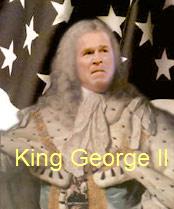 I've complained previously that President Bush does not feel constrained by the need to show respect for the courts in getting warrants to conduct surveillance on American citizens, within the United States, when there is not even reason to suspect criminal activity taking place. Now, I read that he does not feel constrained by Congress' explicit condition of oversight over surveillance activities for renewing the USA PATRIOT Act.
It makes me wonder: did Attorney General Gonzales fail Constitutional Law in law school by just a little bit, or did he really, really bomb it? Do these people understand that 230 years ago, we revolted against a monarchy? What makes them think we want one now?
UPDATE: I found an excellent column by Dahlia Lithwick at Slate explaining why this is such a pernicious issue. Other readers may also be interested in my exchange with an anonymous commenter from the Jersey side of the river, near Philadelphia.
Very Depressing News
As a member of America's most distrusted minority, I have to say -- it's not Christians who are being oppressed in this country.
March 24, 2006
Beverly Hills to Homosassa Springs
 After a ten-hour drive yesterday that took us much further than I thought it would, The Wife and I spent the night in Ocala, Florida, and then drove about an hour and a half this morning to Homosassa Springs State Wildlife Park. There, we were surrounded by snowbirds with extraordinarily ill-behaved children, and the parents were not much better. Sample conversation:
(At top volume:) "What are they doing?"
"They're waiting for the manatees."
(At top volume:) "Hey, what's a manatee?"
"It's like a fish."
(Screeching hyserically:) "I wanna see a manatee!"
"They won't be here until 11:30, like the man said."
Ugh. These kids were so out of control that The Wife and I vowed to buy stock in contraceptive manufacturers then and there.
The manatees were there; the park has six of them. Three are pictured above. The keepers feed the manatees a diet of lettuce, radishes, spinach, and for special treats, carrots. One is kept in a separation tank for some reason, and we got to see the keepers feed her a Caesar salad. Well, a lot of romaine lettuce. They were a little smaller than I remembered from having seen them several years ago in river inlets back when I visited my parents, back in the day when they lived on the Atlantic coast.
 There is also a very impressive hippo whose sex I misidentified. We named the hippo "Gloria" but upon seeing the hippo from another angle, it was evident the hippo was male. The park guide spoke to the assembled tour group and said his name was Lucifer. I think it's a charming name for a charming beast. He didn't have nearly as much room to play as other hippos I've seein zoos and preserves, and unlike the other animals in the preserve, Lucifer is not going to be released back into the wild eventually; hippos are not indigenous to Florida, obviously.
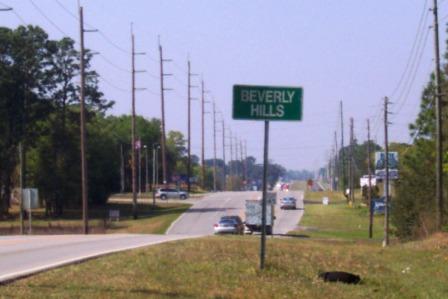 Also on the way to Homosassa Springs, we passed through the small Florida hamlet of Beverly Hills. It wasn't exactly the same thing as its namesake in California. Since The Wife and I had been talking a long time about how much we've been missing California, it was quite amusing to drive through this place.
A longer drive later took us through some Florida farm country. We bought some farm-fresh strawberries, which are sweet and delicious. They're small and only sold by the quart. That means we've got a lot of strawberries to eat tonight! On the way back up to Tennessee, we're going to have to find another farm stand and get some of those really big, sweet Florida onions.
Now we're going to figure out what to do about dinner, and make some calls to start family time for the weekend. So far the trip is going pretty well.
March 22, 2006
A Strong Christian Woman
 There are lots of jokes floating around the Internet right now about how Debra LaFave did not really do anything so awful -- what 14-year-old boy wouldn't have wanted to have sex with her? (The gay ones.) LaFave is obviously very attractive, and 14-year-olds are, for the most part, well aware of what sex is and ravenously curious about it. But the law says what it says, and she performed a number of sex acts on one of her students.
I think that her prosecution was proper, although I question the validity of the media's coverage of it. We've seen as much of this "news event" as we have simply because this is a salacious story with a attractive young woman playing the role of the sexual aggressor. The motif could be described as a Hot For Teacher myth, which in turn is nothing more than the affirmance of an adolescent fantasy. A GIS for a picture of Debra LeFave brings you to a website called "Free Debra," and the intended audience for the site can be readily divined from the advertisements found thereon.
But seriously, folks. LeFave's behavior suggests that there is something wrong with her. Well-adjusted 26 year-old women are not attracted to 14 year-old boys. And, LeFave has admitted that she suffers from bipolar disorder, and says that she is getting treatment for it. It's a credible explanation -- a bipolar person will do all sorts of things under the influence of the disease. One wonders how her husband could deal with her behavior and stay with her; I don't know how I would react to that situation. If her behavior was caused by bipolar disorder, and she stays on her meds, she should be OK from here on out. That ought to end it.
But at the end of the article linked in the title, Ms. LeFave makes a comment that is very interesting to me. In the context of discussing her desire to explore a new career in journalism, she says, "I am a strong Christian woman ... I believe that God has a path for me, and this was just a bump in the road."
This is interesting to me not to point out any degree of hypocrisy. I see no hypocrisy here at all -- Christians readily admit that they sin from time to time, and sometimes badly; and one of the big points of Christianity is that there is forgiveness for sins. Nobody's perfect, people make mistakes, and assuming she truly does suffer from bipolar disorder, she was not as able as others to control her own behavior and therefore more likely to make a mistake of this magnitude. If she is Christian and is truly doing the things her religion tells her to do to seek forgiveness for what she did, that's all for the good in my opinion.
No, it's interesting to me because it looks like she went well out of her way to mention it. It looks like this is a plea for others to accept her because she professes a popular belief. This is one of the things that really bothers me about a certain flavor of Christianity: the idea that "I'm a Christian, so I'm a good person." Being Christian doesn't mean a thing about whether you're a good person or not. Whether you go to church regularly or not is irrelevant to the question of your morality. It is your behavior which defines your character, not your religion. And in this case, we are talking about an adult who had sex with a 14-year-old.
I have seen quite a lot of this in my law practice -- about equal amounts in California and Tennessee, meaning that I've seen it about ten times as often in Tennessee as I did in California since I practiced for ten years there and one year here. A lot of my clients have assured me that what they are telling me is the truth even when their stories are patently unbelievable. When I confront them on it, I am told "Well, I'm a Christian, so I cannot tell a lie; that's how you know I'm telling you the truth." Survey says: "Not good enough. " Or, I get, "Yes, I did do that bad thing, but I asked for forgiveness in the name of Jesus Christ, so that's all in my past now." That's super, my friend, but let me guarantee one thing to you -- the jury isn't going to see things the same way. And personally, I look at things more like a jury than like Jesus apparently does.
When you are asked to morally justify your behavior, a reference to your religion is a misdirection, indeed, it borders on being a deception.
That's not to say that there aren't circumstances where I might overlook, forgive, or (most likely) consider someone's past misdeeds as superceded by subsequent good deeds. It's certainly possible that someone could do a lot of good things and those good things define their character much more than past misdeeds. But that tends not to be the case. Instead, too many people use "finding God" as a proxy for true redemption.
I won't go so far as to say that, for the truly faithful, religion cannot lead them down the path to good moral behavior. Surely, it can; religion provides an elaborate structure of incentives for doing good and an even more elaborate strucutre of disincentives for bad acts. It's an interesting and open question as to whether one who intends and desires to do a bad act, but does not do so solely out of fear of divine retribution, is truly a good person.
But I will say that claiming you are a "strong Christian" (or a faithful Muslim, or a practicing Jew, or whatever other religion you want) should carry zero weight in evaluating your moral worth.
Subscribe to:
Posts (Atom)

 Posts
Posts