Watching the protests in Egypt last month descend into violence, especially seeing video from the BBC and CNN of pro-democracy protesters clashing with agents of the authoritarian status quo in one of Cairo's most important open spaces near its center of government reminds me of an incident from my own nation's history. It is a reminder that democracy is rarely achieved without paying a cost in blood. Today is a good day to commemorate the anniversary of that awful incident, a reminder of what our freedom is built upon.
In Boston on March 5, 1770, a young man named Edward Gerrish, who was the apprentice of a wig maker, confronted a British soldier, Captain John Goldfinch, near Goldfinch's post guarding the customs house. Gerrish said that Goldfinch had not settled up his bill with Gerrish's master. In fact, Captain Goldfinch's account was good, so he ignored the request for money. Gerrish came back later with some friends and renewed the claim that Goldfinch owed money. A low-ranking British soldier named "Private White" then hit Gerrish, either with his fist or the butt of his rifle. One of Gerrish's friends tried to retaliate, and a fistfight broke out between the civilians and the redcoats.
The fight grew, and attracted the attention of both Bostonians who were already upset enough that there were active-duty military troops in Boston to collect taxes, and the soldiers who felt their paramount duty was to keep the peace. One of Goldfinch's superiors sent a squadron of eight soldiers with fixed bayonets in to the growing fight to try and regain control of a chaotic situation. This did not work, as the crowd responded to the escalation of force from the redcoats by throwing so many snowballs at them that they could not advance to join the other soldiers.
They also taunted the British soldiers as having no right to be in the colonies and said that they should go back to England where they belonged. While crudely expressed in the riot, this mirrored an argument made by patriot leaders like Samuel Adams, who had publicly denounced King George's government for putting a standing army in the peaceful civilian city of Boston. Characteristically, the troops remained stoically silent in response to the jeers of the crowd, but it is hard to imagine that being accused of acting lawlessly had no emotional effect on the soldiers.
Then, a few people in the crowd produced clubs and began physically attacking the relief soldiers. The soldiers responded by using the butts of their rifles to club back, and the situation deteriorated into a general melee. Someone -- it does not seem likely to have been the commander of the relief troops -- shouted "fire!" and five of the soldiers fired their rifles into the crowd. We know that it was at least five, because five people died, three of them instantly. These are thought to be the first casualties of the American Revolution.
After the shots were fired, the crowd sobered up quickly, many running away in panic. The next day, the military commanders withdrew troops from the area to barracks, waiting for the mood of the town to die down. The growing patriot movement, however, was not content to allow the situation to end, and pressed for murder charges to be filed against the soldiers who had used their rifles on the crowd.
It is doubtful that any legal action would have been taken if it were not for Paul Revere. Americans celebrate Paul Revere for his famous "midnight ride" from Boston to Lexington in 1775, alerting people along the way that British troops were moving to secure a cache of small arms and cannon stored in a depot inland. But Revere's biggest contribution to the cause of independence was his creation of a colored woodcut depicting what came to be known as the "Boston Massacre," showing in graphic detail (and with a little editorial license) the moment of March 5, 1770, when the redcoats opened fire on the rioting colonists. Revere's illustration was reprinted, first in newspapers in Boston and over the course of several days, in papers from Quebec to Augusta, and eventually found its way to London. The graphic illustration of a line of British soldiers firing their rifles into a crowd of unarmed American colonists outraged nearly everyone who saw it.
Revere's woodcut is also one of the first uses of the mass media and the distribution of visual arts which mobilized significant political movement -- and an example of the slowness and clumsiness of the government thus challenged in realizing what was going on. The power of a new media expression of such an event to move hearts and minds is immense. Revere's woodcut has echoes through the ages in the graphic photographs of the horrors of the U.S. civil war, FDR's fireside chats, the indelible images of terrified students at Kent State University and the execution of NVA infilatrators in Saigon during the Vietnam War, the Rodney King videotape, and now in twitters and blog posts from the Muslim World throughout the past several years.
In any event, the political pressure brought to a boil in part by this use of a new form of media raised pressure on the government, which agreed to allow the prosecution of murder charges against the soldiers. By itself, this was a significant concession -- the colonial government was admitting that there was a possibility that the soldiers had acted unlawfully. Public sentiment against them was very high and they had to be confined for their own safety during the trial. It appeared that convictions were a foregone conclusion.
That was when John Adams, the man who later would be the second President of the United States, stepped in. He volunteered to defend the soldiers at no cost. He was already a prominent citizen of Boston and was identified with the patriot movement -- which at the time did not want formal independence from England but rather what we would today call "local autonomy." John Adams and his cousin Samuel Adams had a bitter falling-out over the first man's offer to defend the soldiers in the high-pressure trial. The firey patriot Samuel Adams said that this was a betrayal of the cause of freedom; the future President said that the reasons the colonists wanted independence was to free themselves from the lawless actions of the government, so their first duty must be to ensure the rule of law, and that required that the defendants be able to present the best legal defenses to the charges against them that the evidence would support.
In the trial, argued that the confusion of the fight, the initiation of violence by civilians against the soldiers, and the simple fact that the soldiers were being physically attacked all meant that they had the right to defend themselves from immediate attack. Adams put the blame solidly on King George for having sent a standing army to be stationed amongst civilians in the first place -- Adams said that if this incident had not happened, then something else very much like it would inevitably have happened. The fault, he argued, lay not with the soldiers but with the orders they had been given from London.
The defense worked. Of the eight soldiers who were charged with murder, six were acquitted and two convicted only of manslaughter because of their own admissions that they had fired their rifles directly into the crowd. Adams reduced the sentence for these two by invoking the ancient rule of "benefit of the clergy," by having the two soldiers in question demonstrate that they could read from the Bible. While this looks like sort of a cheap trick to modern eyes, it also helped demonstrate the very frivolity of that ancient and outmoded rule -- these men were obviously not priests but soldiers. Nevertheless, Adams' maneuver reduced their sentence from death to a branding of their thumbs. All eight defendants were sent home to England alive.
Along the way, Adams risked a substantial loss of political standing for defending these very unpopular men, and doing so vigorously. It took him some time to recover from many of his friends and clients turning against him in retaliation for having taken the case, and Adams was very sensitive about public approval to begin with. But history has vindicated the lawyer over the brewer. John Adams' defense of the soldiers in the Boston Massacre trial is a powerful example of a man putting principle first, above even his own politics. He made it clear that he believed the soldiers should go home, too, and that the King had no legal right to have stationed the soldiers there in the first place -- but even if George Hanover would not respect the rule of law in London, John Adams would respect the rule of law in Boston, and so should the jury.
Adams demonstrated in the trial that even the military was subject to the rule of law, and that the law demanded that even the King could be criticized in court with impunity if the rule of law were to be upheld. He showed the world that the King's policy of having active-duty troops in a civilian city to maintain order and collect taxes was very bad idea indeed and a legitimate cause for grievance by the colonists against the King. And in so doing, he ensured that the deaths of the five civilians would culminate in the independence of the United States of America and the founding of a Constitutional republic on the western shores of the Atlantic.
Whether a similar result can be achieved on the banks of the Nile in 2011 remains to be seen. Sadly, not all nations can experience velvet revolutions and Egypt will look more like the former colony of Massachusetts than the former Czechoslovakia in that now, the blood of martyrs has watered the tree of liberty. Let us hope that the tree flowers and blossoms, without need of any further nutrition.
Coates tells the story of Robert Smalls, an escaped slave who commandeered a confederate warship, four pieces of artillery, and a naval code book and turned them over to the Union Navy, and then went on to accept a commission in the Union Navy, to take command of a vessel under heavy enemy fire and steer it to safety. Captain Smalls was the first Black man to command a ship in the United States Navy, and received a medal for his bravery. He also received a $1,500 share of the prize money for the captured Confederate ship, which it seems he plowed into a successful campaign for the U.S. Congress, where he served for at least three terms.
Go read the whole thing. Then wonder as to why it is that he did what he did if the Civil War wasn't about slavery, if the Confederate propaganda about how good the southerners were to their darkies was worth any credibility.
You've never heard of Captain Robert Smalls before. This guy is a massive American hero and what he did must have took some massive stones.
Stephen Decatur was, perhaps, the first war hero of an independent United States. He was born in 1779 and when he was 17 he found himself working for a shipbuilder and then serving on board a U.S. navy ship. He liked it and joined the navy outright, and with his studies in college he quickly became an officer.
In 1803, he was a Lieutenant in the Navy serving on board a ship in the Mediterranean, patrolling against pirates. Some of the pirates were sponsored by the Sultan of Algiers and they captured a U.S. ship called the Philadelphia. Stephen took command of a smaller ship called the Enterprise and used it to capture a pirate ship which he re-named Intrepid. He then sailed Intrepid into the harbor where the pirates were trying to take the guns and other supplies off the Philadelphia. After steering a course directly for the captured ship, he lit the Intrepid on fire and jumped off at the last second, swimming back to the Enterprise before sailing away to safety. For his heroics he was made captain at age 25.
He saw action again in the War of 1812. He was the only person in the Navy to capture a British ship, and sailed it home safely so the U.S. Navy could use it in the war; after that, he sailed again and this time captured an entire British squadron. Then peace was made between England and the U.S., and Stephen was sent back to the Mediterranean, where he captured more pirate ships.
In the last few years of his life, he was a commissioner of the Navy, working to make the military strong and able to handle threats against the country. It was at this time that he said of the country he loved so very much, "may she always be in the right, but our country right or wrong!"
The Sixty-Second Patriot series of posts is intended to provide teachers who are required to engage in patriotic exercises with truthful, age-appropriate, meaningful, educationally-rich, non-controversial, secular alternatives to rote recital of the Pledge of Allegiance, as well as brief meditations on American history, civics, and values accessible to all people. Suggestions and contributions to this series from Readers are welcome.
Alvin C. York was born in 1887 to a very poor family in Tennessee. His father died when Alvin was 24 years old, and Alvin had to help his mother raise eight of his younger brothers and sisters. He was drafted into the Army at age 29 and fought in World War I. Alvin didn't want to go to Europe and fight, but eventually, he decided that he had to answer the country's call to duty along with everyone else.
On October 8, 1918, Alvin's squad of seventeen men had to find a route to a railroad line in France that the Germans were using to supply their troops. To get there, they had to cross a valley and the Germans had defended it with machine-gun nests and over two hundred troops. Half the soldiers were killed by the German troops, leaving Corporal Alvin York in charge.
He stormed the German machine guns head-on. Imagine what it's like to run directly at a machine gun that an enemy soldier is firing at you. But Alvin got to the nest, only to find eight Germans coming at him with bayonets, long knives at the end of their rifles. He kept on fighting until he ran out of ammunition, and then the Germans surrendered. He took 132 prisoners and opened up the rail line for the U.S. and its allies.
When Alvin came home after the war he got married and had five children. He founded a school for young farm boys in Tennessee, and a movie was made of his life. He tried to enlist for combat duty again in World War II even though he was 55 years old, but the Army said he was too old and would more do good for the country helping recruit younger soldiers. He lived to be 75 years old and is one of America's greatest war heroes.
The Sixty-Second Patriot series of posts is intended to provide teachers who are required to engage in patriotic exercises with truthful, age-appropriate, meaningful, educationally-rich, non-controversial, secular alternatives to rote recital of the Pledge of Allegiance, as well as brief meditations on American history, civics, and values accessible to all people. Suggestions and contributions to this series from Readers are welcome.
From several of my favorite blogs comes a story that I find very touching. A ten-year-old boy in Arkansas, with early ambitions of becoming a lawyer, said he starting thinking about the words in the Pledge of Allegiance, and decided that he could not in good conscience make that pledge. The Pledge says that the flag and the nation stand for "liberty and justice for all," and he doesn't think that we do such a good job of providing liberty and justice to gays and lesbians.
In doing this, he has risked discipline from his teachers (the Constitution forbids disciplining a student for not reciting the pledge in a public school -- although he doesn't have a right to tell his teacher to "jump off a bridge," so his detention was a righteous one), teaching and harassment from his peers (who have called him "gay," and he says he's a straight ally -- I say, how do such phrases have meaning when you're ten?) and perhaps even the obloquy of his community. Seeing as he showed up for his CNN interview wearing a T-shirt that says "Geeks 22 ever," maybe he's used to a little teasing. The kid is obviously very bright and articulate, and old enough to start forming his own opinions about the world around him. I think he'll do well in life.
How many Pledge advocates have ever really thought about what it says? Let's break it down, why don't we?
"...to the flag of the United States of America," -- The object of your loyalty and fidelity is a flag. What is a "flag?" It is "a piece of cloth, varying in size, shape, color, and design, usually attached at one edge to a staff or cord, and used as the symbol of a nation, state, or organization, as a means of signaling, etc.; ensign; standard; banner; pennant." You are offering your loyalty to a piece of cloth. Note that the piece of cloth is a symbol of an inchoate entity. You can't touch or feel the United States of America; the nation is not the same thing as the land that it controls politically, it is not a document (even the Constitution), it is not a person or a group of people. It is an idea. But the Pledge of Allegiance (sometimes incorrectly called the "Flag Salute") at this point does not promise loyalty to that idea, it promises loyalty directly to the symbol of that idea. But, of course, it doesn't end there.
"...one nation," -- Recall the history of the Pledge. It was first written in 1892 by a Christian Socialist named Francis Bellamy. (Oh noes, creeping socialism!) In 1892, the Civil War was still within living memory, much as the Cold War is within living memory today. Those among you Readers who believe that the United States should be referred to with the verb "are" rather than the verb "is," cannot in good conscience take this Pledge. By taking the Pledge you acknowledge that the several States are ultimately subordinate to the Federal government, that they are part of a larger, unitary whole -- in the same way that your lung is an inseparable part of your entire body. Federalism as practiced in American constitutional law is a subtle and sometimes slippery concept and always has been. Balancing the Supremacy Clause and the Tenth Amendment is an intellectual tightrope, but faithfulness to the Constitution requires that we walk it. The states are the repository of the vestigal power of the King of England and hold plenary power. But ultimate power is in the national government.
"...under God," -- Again, recall your history. This phrase was not in the 1892 draft of the Pledge; it was added in 1954 as part of an effort to root out "godless Communists" from within the ranks of the American citizenry. (Never mind that Americans have a Constitutional right to be godless, and under a principled analysis of the document, a Constitutional right to be Communists, if they wish.) I need not elaborately go over the fact that the Constitution does not reference "God," and even the Declaration of Independence (an important document although not one containing any legal authority) references a "Creator" rather than the simpler and less ambiguous word "God." The 1954 amendment to the Pledge corrupts its core meaning because Americans who do not believe in God cannot in good faith recite it, and it therefore excludes a category of Americans from those whose loyalty is welcome.
"...indivisible," -- Remember, the original Pledge was written in 1892, when there were still plenty of people around who had fought in the Civil War. If you're like me and think that the Civil War was the worst time in American history, a darker, bloodier, and more evil hour in hour history even than the early days of WWII, then you should be anxious to affirm with me the belief that our nation is at the end of the day a unitary whole and that we should never again see Americans fighting Americans. On the other hand, if you'd like to see your state have the power to secede from the socialism that is infecting our government, perhaps you ought to leave the Pledge out of your next Tea Party.
"...with liberty and justice for all." "Liberty" is "freedom from arbitrary or despotic government or control" and "justice" is "righteousness, equitableness, or moral rightness, lawfulness". Now, at last, we get to the real ideas that are the United States of America. The rule of law. A government that protects the rights of the individual. Equality and equity. Due process. Deeply libertarian ideals. And ideals to which we will always fall short. If I can fault this brave and intelligent young man from Arkansas, it is that he is allowing his frustration that in practice we fall short of this ideal to obstruct his view of the fact that as a nation we strive and struggle every day to bring ourselves closer to it. Like a rainbow, this can only ever be a beautiful vision, always just out of reach, no matter how hard or fast we pursue it. We do not deliver on our promise of liberty and justice for all, it is true. But within the confines of our peaceful, democratic, and lawful government, we work as a people and a nation to chase that rainbow and the trend is to always move closer to it.
It is sad that so many Americans cannot look past the unpopularity of individuals who ask for this sort of treatment -- communists and atheists in the fifties, gays and lesbians in the particular case today -- and ironically, that these sorts of people have gone so far as to write their own bigotry and selective exclusion from these ideals into the Pledge itself.
For myself, I recite the old Pledge, the one without the phrase "under God." I do not believe in God and it is my right as an American to not believe in God. That Pledge was good enough for many generations of Americans and it's good enough for me. I think swearing loyalty to a piece of cloth is silly, but swearing loyalty to a government that protects individual rights and the rule of law is not. So long as that flag symbolizes a nation that truly and fundamentally stands for those ideals, I have no problem avowing loyalty to it.
And as a means of forswearing the possibility of return to the bloody days of the Civil War, the Pledge strikes me as worthy indeed.
And most importantly, I have no problem at all with a bright and brave young man who is righteously outraged to see that the nation to which he too would like to give his loyalty falls short of its own ideals and is making his own stand to make it better, to make us chase that rainbow. That is the mark of the truest sort of patriot our country can produce, and for making that stand, Will Phillips, a fifth-grader from West Fork, Arkansas, earns this blog's particular mark of esteem, the Big Brass Ones Award.
Hat tips to, inter alia, Preaching to the Choir and Debate Link. And a hearty round of "boos" to the CNN anchors, who seemed condescending towards this remarkable young man after the interview was done.
UPDATE: Inspired by this story, another kid, a teenager from Wasila, Alaska, refused to stand for the pledge and got in big trouble, up to and including a threat by the principal to withhold his high school diploma. Kind of a big deal. As it turned out, his parents told him that they wanted him to stand, if not necessarily say the words out loud, and he decided to respect his parents' decision. I guess I can understand that. The blatant ignorance of the law displayed by his principal is appalling -- Alaska Statute 14.03.130(b) provides that:
A school district shall inform all affected persons at the school of their right not to participate in the pledge of allegiance. The exercise of the right not to participate in the pledge of allegiance may not be used to evaluate a student or employee or for any other purpose.
I know not reciting the Pledge is not a popular thing to do, and not standing for the pledge is a decision a lot of people will disagree with. But freedom means you must tolerate people who do things with which you disagree.
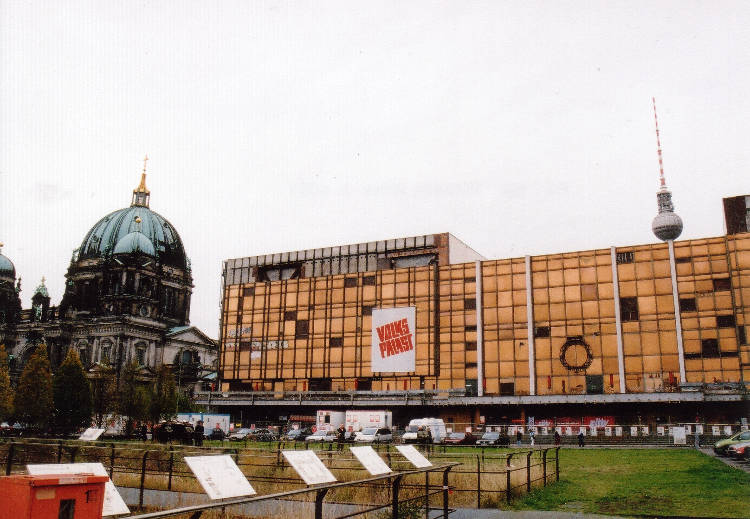
On November 9, 1989, an obscure post commander in the (perversely-named) German Democratic Republic named Harald Jäger, perhaps unwittingly, ended European Communism as a global political force, setting in motion unleashing a chain of events that led to the collapse of the Soviet Union.
Earlier in the day, a spokesman for the Politboro, Günter Schabowski, received a note just before briefing a few members of the press. The note indicated that the East German government would be easing some travel restrictions for Berliners, to appease protestors. When asked when those eased travel restrictions would go into effect and liberalized visas to the west would be issued, the confused and apparently misinformed Schabowski said, “As far as I know, immediately, without delay,” and the word got out to some people who very much wanted to go visit their families on the other side of the Berlin Wall. They began lining up at border crossings and demanding to go across.
There was no such policy; Schabowski had been given a garbled instruction to indicate that the Politboro was considering more liberal travel visas but no decision had been made by the Soviet stooges who were running the show in Europe's most ugly governmental building.
Harald Jäger was the post commander for the GDR at the Bornholmer Gate, which is not as well-known as the Brandenburg Gate or Checkpoint Charlie, but was one of several authorized crossing-points in the Berlin Wall.* Jäger's role in these events is succinctly described by Dana at Edge of the American West:
In a nearby possible world, this story ends with a bloody riot. Armed guards shoot the boldest of the misinformed citizens; the uninjured retaliate. Guards are killed, the police put down the riot, and the Wall stands, not forever, but for a little while longer as the Soviets eased into openness.
In this world, Harald Jäger, in command at the Bornholmer Gate, decided not to shoot. He called his superiors, who of course had heard of no such policy change, and faced with the gathering, chanting crowds, decided to let a few cross the border; by midnight, he simply opened the gate to all, not taking names or checking identification.
What happened next seems to be well-known history but especially if you are still in your twenties, it's going to be difficult for you to understand just how momentous it was. The crowds of East Berliners were heard and West Berliners also gathered at the wall. Seeing that the GDR's guards were doing nothing to stop them from crossing, more went across, then in the crush a group of Berliners removed a gate, and from there a kind of mania took hold. Ordinary people began to literally tear down the Berlin Wall, brick by brick, one fist-sized lump of ugly gray concrete decorated with graffiti after another.
If East Germany's political leaders had their acts together, they'd have put a stop to this, Dana's sour description of the alternative world was what would have happened. By letting the easterners cross the border, Harald Jäger was putting his career and maybe his very life at risk. If this had been 1988 instead of 1989 -- or if the GDR's government had been able to get its act together -- Jäger would have been court-martialled for dereliction of duty and possibly executed as a deterrent to others in similar positions.
But they didn't have their act together.
East Germany's political leaders were paralyzed by a deep economic failure that their political ideology had told them was not even possible and which their politically-slanted educations had not armed with tools to address. They were still reeling from the political success of Solidarity in next-door Poland, stunned that the ordinary people of an enlightened Socialist regime would so thoroughly reject Communism in the face of its political promises and overwhelming power. So when the East Berliners showed up and demanded that they be allowed to see their cousins in the west because of a bureaucratic mistake, the sad old gray men driving a rusted tank the wrong way down history's path simply had no way to really understand even that such a thing could happen in the first place, much less what to do or what orders to give.
So Harald Jäger's instruction to let the people pass stood in place. The border guards did not shoot. Most likely, they hated the wall as much as any other German did. Most likely, they envied the prosperity and freedoms of the West as much as did the citizens they were supposed to be controlling. In some cases, they joined in the efforts to break through the wall and tear down the division in their city, in their nation, their world.
The Germans tearing the wall down chanted "Wir sind das Volk!" ("We are the people!") and the leaders of the Second World trembled and dithered. Within weeks, Solidarity was openly challenging the legitimacy of a paralyzed Communist dictatorship in Poland that had kept power after Solidarity had won overwhelming majorities in the first elections of their kind earlier in the year. The Velvet Revolution brought down the Czchoslovakian government. Hungary had also bowed to popular demands for actual multi-party elections earlier in the year, and the government there also faced the inevitable. The Soviets yanked their stooge Todor Zhikov from power in Bulgaria. In Romania, Nicolae Ceauşescu held on to power after it had rotted and suffered a violent end.
The Fall of the Wall was perhaps the high-water mark and the most visible symbol of the Revolutions of 1989. It was not the start; the movement started with Lech Walesa in Poland in 1981. It was not the end; that happened on December 26, 1991, when the Soviet Union dissolved, spinning off its constituent republics into autonomous nations and ending the bi-polar world that two generations had grown up with. But today the event is being largely ignored. There will be a ceremony with a few celebrities at Bornholmerbrucke, and U2 gave a free concert at the Brandenburg Gate Saturday. The President of the United States may note the anniversary in a public address, or he may not.
And it's not just we in the USA who are studiously ignoring what ought to be an important anniversary -- the Germans themselves have given the moment scant attention. "Tourists don't visit Bornholmer Strasse and the locals who use the bridge don’t pay the place much mind, so no one much notices that the unlit plaque is impossible to read after dusk." They can perhaps be forgiven for this; they've spent the past twenty years integrating the eastern provinces of their split nation into a single political and economic unit, while struggling with the heavy legacies of the history that caused Germany to have been split in the first place. Along the way, they've also become the heavy-hitters and the first among equals within the European Union.
And perhaps we can be forgiven a little bit, too -- 1989 was a time before the media had adopted "narratives" to allow us to interpret events and the man most identified with bringing down Communism, Ronald Reagan, was out of office and therefore not personally presiding over the Fall of the Wall. So historically short-sighted are we Americans that Reagan's departure from office a mere ten months previous was not associated with the momentous events that started in Berlin twenty years ago today. But it was Ronald Reagan who dealt the knockout blow to the Soviet Union by forcing it to spend itself into oblivion to compete with the USA in the military sphere. While it took that giant a year or more to stagger, totter, and fall from the force of those blows, fall it did. Mikhail Gorbachev, for his part, gets credit for realizing what was happening and ensuring that it would happen peacefully and not with the military seizing power and doing what a military does when it has no other option. Gorbachev was informed by a deep sense of history in his actions.
But at the end of the day, the Revolution of 1989 was the work of the eastern European people, not the work of Gorbachev or Reagan. It began with Harald Jäger -- a man who decided to exercise his humanity in the face of a senseless bureaucratic mistake. For all of the problems Europe and Russia have had to confront since then, the world is a better, safer place because of it.
* Bornholmerbrücke can be seen at Google Earth coordinates 52.55488 N, 13.398274 E. The gate was on the east side of the bridge along Borhnolmerstraße.
If anyone deserves an award with the thoroughly awesome name "Badass of the Week," it's got to be this 18-year-old Kashmiri woman named Rukhsana Kauser. Abigail Adams once wrote to her husband while he was at the Continental Congress, "Remember the ladies!" Rukhsana Kauser would have added to that, "Yeah, because if you don't, we'll jack you up like prison bitches." The world has one less shithead to deal with, and at least one rape and likely four or more murders prevented because of Ms. Kauser.
The write-up of her story is quite entertaining, too. She should pursue a career in the military and if India won't have her, we should make her an offer.
The human rights hate speech law that has been used of late to investigate and punish people who say things that the commissars do not like has been found to violate that nation's Constitution. You'll recall a particular magazine publisher, Ezra Levant, was made to answer and potentially faced incarceration for reprinting the Mohammed cartoons. He earned this blog's Big Brass Ones Award for this exchange with his interrogator, in which he demonstrated, in the most forceful possible manner permissible by a society governed by laws, what freedom really is.
I've been really, really busy with that trial so I haven't done a ton of writing here these past several days. But I look back on the news of this week and last, and I see a lot of hand-wringing about healthcare but not a lot of comprehension about what the hand-wringing is all about. Not much else -- which tells me to look for something that isn't there. What's not there in the news is any significant memorialization of a recently-passed hero. No, not Michael Jackson or Walter Cronkite. I'm talking about Corazon Aquino.
Corazon Aquino died last week, and while the people of her nation turned out in huge numbers to memorialize her, pretty much the rest of the world could only be bothered to have their diplomats write some nice things about her in telegrams. It seems that nearly no heads of any state (except for East Timor's) took the time to attend her funeral. I can't even find evidence that the U.S. ambassador to the Philippines even went to the event.
We should be ashamed of ourselves, and Philippine citizens have a right to be irritated with us for this omission of honor. Political reform in the Philippines may seem like old news. The Philippines may seem like they are a long way away and not all that important to the U.S.A. But those impressions are profoundly incorrect.
Here's why we should care about the Philippines. With nearly a hundred million people living within its borders, the Philippines are the world's thirteenth-most populous nation (more people than Iran, Germany, the UK, or Vietnam) and the world's tenth-largest state governed through generally free elections. The Philippines is an emerging industrial power whose economy is expanding at a healthy and apparently sustainable rate of 4.2% per year even while our economy is contracting. The nation's location is strategic to both the safety of the Pacific and Indian Oceans and to access and support for military (particularly naval) activities in southeast Asia and the Straits of Malacca. There is a significant insurgency underway there with ties to al-Qaeda. Globally, the Philippines provide a significant portion of the labor pool of maritime and construction workers -- these are the people who are moving our stuff around the world and building our buildings.
But more than that, the Philippines has a long and complex history as a concession, colony, dependency, and ultimately ally and trading partner of the United States. The two nations' fates, interests, and even identities have become intertwined; to be sure, the U.S. is the wealtheir and more powerful of the two but that does not mean the Philippines can be disregarded. There are millions and millions of Filipino immigrants to the United States and countless people in the U.S. have close personal, family, or friendship ties to Philippine nationals. Our friendship and partnership with the Philippines is a significant diplomatic and economic issue.
So I think we've not given enough attention to the death of Corazon Aquino. Ms. Aquino was a pivotal figure in the recent history of this important ally of ours. Besides, anyone who, within a year of her husband's assassination, emerges as the leader of a peaceful reform movement that throws out a corrupt military dictatorship and replaces it with a (mostly) honest Constitutional democracy with significant protection for individual liberties, maintains good relations with the United States while doing it, and whose popularity enables her government to survive coup attempts from both Communist rebels and right-wing military hard-liners, earned the title "Woman of the Year" and probably should have earned the Nobel Peace Prize (she lost by several votes to Elie Weisel). Along the way she survived multiple assassination attempts on herself and her family, and led her country through the recovery of Mount Pinatubo's eruption.
This was a remarkable woman who accomplished remarkable things. The nearest political and historical analogy to the United States that I can think of is Abraham Lincoln -- she did not found the independent Philippines, but she substantially re-created and reformed the government to make them a fair place for all of its citizens, in the midst of and at the cost of tremendous personal grief and despite multiple attempts to use violence and rebellion to overthrow her. Her "People Power" movement in 1986 presaged by three years the series of sometimes-peaceful and sometimes-not revolutions that liberated eastern Europe and reunified Germany in 1989.
It would be true to note that not everything she did earned approval from the U.S., especially more than twenty years later. But that's in the nature of politics and international relations. So while she ruffled feathers with land reform and she made some efforts to reduce the U.S. military profile in her country, she nevertheless did more than anyone in three generations to propel her country into the modern economy, set up a legitimate government, and protect the rights of her nation's citizens. Whatever flaws she may have had as a leader and whatever twenty-year-old policy disagreements we may have had with her government -- and they were not hugely significant even back in the late 1980's -- hers was a life worth celebrating and holding up as an examplar for other politicians in emerging democracies.
She should have been celebrated the way we celebrate figures like Nelson Mandela, Vaclav Havel or Lech Walesa, and for the same reasons. Instead, I think most Americans confuse President Aquino with retifist Imelda Marcos. We should have at least sent Vice-President Biden to President Aquino's funeral because while maybe the President himself has a lot on his place, Corazon Aquino was a hero to the modern world and she should have been recognized as one. The woman deserved more respect from us than she got.
It's rare for me to make Big Brass Ones Awards in rapid succession. But after seeing this video, I've gotta hand it to these Israeli soldiers who found a very creative way to take a couple of the bad guys out with astonishing bravery.
When I travel by plane, I do not pay all that much attention to the part of the safety briefing about a water landing. Frankly, I've always assumed that if a plane went down in the water, it would simply sink -- it's a big, heavy, metal object and it has never seemed to me that it could possibly displace enough water to keep afloat. So if the plane goes down in the water, I figured, your chances of surviving are effectively zero.
Well, it seems I'm wrong. A US Airways flight from New York to Charlotte went down in the Hudson River today after apparently taking two bird strikes on takeoff. (Um, no, the birds did not survive.) The pilots, displaying remarkable coolness in a tense situation, basically landed the plane on the river, bringing it slowly in contact with the water and keeping it up as long as possible so the plane wouldn't get caught and flip or submerge. It didn't. The picture on CNN shows the nose and the top half of the fuselage floating above the surface of the water.
All 148 passengers and the entire crew escaped with only minor injuries and a few cases of hypothermia (it was 20 degrees today in New York and the river water had to have been seriously cold.) And a Big Brass Ones Award to the pilots and crew for guiding their passengers to safety in an extraordinary and difficult situation.
In February of this year, Lance Corporal Matthew Croucher, H.M. Royal Marines, was assigned with the rest of his unit to Afghanistan. While out on a raid on a Taliban compound, he felt a wire move against his leg and heard something drop right ahead of him. Realizing that he'd just set off a tripwire and activated a grenade, he threw himself forward to put his body in between the explosive and his three buddies.
Thinking quickly, he twisted in midair and landed with his back on the grenade. His rucksack took the main force of the blow when the grenade exploded. Croucher was thrown across the compound. Despite a profusely bloody nose and hearing loss, "the 24-year-old Marine survived and within minutes was on his feet, refusing evacuation and demanding to be allowed to stay with the patrol. He helped set an ambush and shot dead a Taliban insurgent in the ensuing gunfight."
Shrapnel was embedded in his body armor and helmet. His rucksack did not fare so well.
Croucher is to be awarded the George Cross, which is the equivalent of the Victoria Cross, the highest award possible, for "acts of the greatest heroism or of the most conspicuous courage in circumstances of extreme danger." His citation will read:
Lance Corporal Matthew Croucher showed extraordinary bravery, self-sacrifice and devotion to duty. He acted to save his comrades in the almost certain knowledge that he would not himself survive. His exemplary behaviour and supreme heroism are fully deserving of the nation's highest recognition.
The only reason he is not being awarded the technically-higher award of the Victoria Cross is that there were no enemies present. While admittedly less prestigious, Croucher also earns this blog's highest award for bravery and remarkable achievement.
About the worst thing I can imagine would be to lose my family. That's what happened to Dong Yun Yoon yesterday, in a freak accident when a Navy pilot had to eject and his F/A-18D crash-landed in Yoon's house, killing his wife, his mother-in-law, and possibly worst of all, his two children.
"Please pray for him not to suffer from this accident, ... He is one of our treasures for the country ... I don't blame him. I don't have any hard feelings. I know he did everything he could."
I can't imagine having a heart that big. I want all Readers to pay huge props to this guy. He'd deserve props anyway for naturalizing to the U.S.A. from his native Korea; that's a journey that takes some courage all by itself. But now, in what is surely the very worst time of his life, it would be very, very easy for him to blame the pilot, blame the Navy, blame someone. But rather than lash out at a target, he prefers to mourn his family and comes to grips with the realization that it was a terrible accident and to show concern for the pilot as well.
May we all be so noble in our times of distress. For my part, Mr. Yoon, I recognize your bravery during an awful time and award you this blog's highest recognition of class and honor.
If you don’t remember the Tank Man, watch the video below. If you’re too young to remember the Tiananmen Square protests of 1989, then you must watch the video. If you have managed to stumble on this blog from China, please watch the video. Remember what he did. I write to help you remember why he did it -- I say he is the greatest hero in China's five-thousand year history.
At the end of his hundred and fifty seconds of distilled and pure bravery, a number of other people came out and grabbed him and pulled him out of the way of the tanks. He seemed to go willingly and these people do not appear to have been police. They seem to have been people who became convinced that this guy was about to get shot and tried to save his life. They may have been his friends; they may have been strangers to him. Here's the background.
On April 15, 1989, young people, particularly including college students, began gathering in public places around China. The protests were precipitated by the death of the former Secretary General of the Chinese Communist Party, Hu Yaobang. Hu had, in his years after stepping down from party leadership, condemned the harsh and authoritarian practices of the government under the stewardship of Deng Xiaoping. Hu openly admired the policy of glasnost pursued by Mikhail Gorbachev in the Soviety Union and called for implementation of “rapid reform” of the Chinese government. Because his policies were seen as critical of Deng and his clique of pro-authoritarian leaders, Hu had been forced to resign and to publish a humiliating “self-criticism,” which was circulated as another example of the evils of the repressive regime within the universities of China. So his death marked an opportunity for pro-democracy students to stage public memorial services in his honor.
Starting early on April 15, the day he died, and gaining force over the next several days, students began to congregate in Tiananmen Square, and by April 18, 10,000 of them demanded that the government revise the official obituary of Hu. For a day or so, they were dispersed, but after Hu’s funeral, more than a hundred thousand protestors gathered to march back on Beijing’s only major open space near the centers of government.
This was thought by the government to be too many people to disperse using the city’s available police force. So the government tried to use its favorite weapon – propaganda. Official state newspapers distributed an op-ed piece written by Deng, who wrote:
This only added fuel to the first and half again as many people came to Tiananmen Square to raise their voices in favor of reform and against repression. Some leaders emerged out of the crowds, and they issued a written demand to the government for freedom of the press, an end to corruption within the state, the resignation of Deng Xiaopang, and abolition of the Chinese Communist Party.
When propaganda did not work, the Party tried persuasion (and, we may assume, some level of intimidation as well). Protestors were identified as much as possible and overt representatives of the Party were sent to go speak with their families. Although the official line is that the Party tried to explain what kinds of benefits would be available to the protestors if they gave up the ghost and returned to their daily, ordinary lives, it seems safe to assume that along with the many carrots dangled there were also a few sticks raised. Implied in promises to provide medical care for ailing family members and opportunities for further educational and career advancement are the threats that such benefits can be withheld.
But this national network of party activity was so extensive that it actually strained the resources of the party and its network of informants and secret police (many of whom could not be contacted and activated for fear of revealing their identities to the friends and family they were supposed to be spying on. So party apparatchiks who were tapped to do the work were diverted from their main jobs of censoring the media. Although it took the Chinese media a few days to realize that suddenly, their minders had left them unattended, they figured it out soon enough and began broadcasting live coverage of the protests in Tiananmen Square across the country. This would prove decisive in making the protests a truly national symbol and a truly national crisis.
The protestors were, by contrast to what we might expect to have seen in Europe or the United States, orderly and law-abiding. There was peace, and the majority of the crowd demonstrated great respect to the government by seizing and handing over to police on the fringes of the square a man who, in an excess of contempt, had thrown ink on a poster of Mao Zedong. On the day that Mikhail Gorbachev came for a previously-scheduled state visit, the protestors sang socialist songs.
The hunger strike began at some point in mid-May. The leaders of the protest began to not eat and display their starvation to show solidarity with the lower classes of the cities, who they claimed had been neglected by a corrupt and elitist government. When Gorbachev came, the world media came with him and extensive coverage of the protests was broadcast around the world. Gorbachev had his meetings and left, but the global media stayed on to cover this most dramatic of events -- China appeared poised on the precipice of a popular revolution.
Immediately after Gorbachev departed, a significant dispute about how to handle the protests arose within the ranks of the governmental leadership. One faction, led by a Hu’s successor Zhao Ziyang, urged a soft response, while another group, led by Li Peng, urged a forceful crackdown. Zhao went so far as to wade into the protests with a megaphone, urging the students to end their hunger strike and not give up their lives so cheaply. The point at which he probably cut his own throat politically was when he told the protestors to look to their own futures, saying of his generation (the ones holding the reins of power), "We are already old, it doesn't matter to us any more." It mattered to Li and his group, and they eventually persuaded Deng to go along with their preferred response to the situation.
Li had martial law declared on May 20, 1989. Zhao protested that this was not necessary, and Li called for a vote of no confidence. Zhao lost and was unceremoniously ousted from power. However, the heavy-handed consolidation of power in the hands of the hard-liners threatened to cause rifts in the army itself; the regular army detachments stationed near Beijing were thought to be sympathetic to Zhao and unreliable against the civilian protesters now blocking entrance into the city as part of their demands for democratic reform. So the 27th and 28th People's Liberation Armies, which then combined infantry and armor divisions based in a more westerly province, were mobilized and given orders to enter Beijing and restore order.
On May 29, a statue, called the “Goddess of Democracy,” was brought into the square, to the amazement of the international media. She was more than thirty feet tall and constructed of papier-mache over a light metal skeleton by art students at Beijing Central Academy of Fine Arts. The government threatened to take the license away from any truck driver who hauled the Goddess to Tiananmen Square, so the art students hired six rickshaws instead. For six days, the Goddess held court in Tiananmen Square, and something like three hundred thousand people gathered in the square to see her unveiling. The sculptors of the statute proclaimed at the unveiling:
At this grim moment, what we need most is to remain calm and united in a single purpose. We need a powerful cementing force to strengthen our resolve: That is the Goddess of Democracy. Democracy…You are the symbol of every student in the Square, of the hearts of millions of people. …Today, here in the People’s Square, the people’s Goddess stands tall and announces to the whole world: A consciousness of democracy has awakened among the Chinese people! The new era has begun! …The statue of the Goddess of Democracy is made of plaster, and of course cannot stand here forever. But as the symbol of the people’s hearts, she is divine and inviolate. Let those who would sully her beware: the people will not permit this! …On the day when real democracy and freedom come to China, we must erect another Goddess of Democracy here in the Square, monumental, towering, and permanent. We have strong faith that that day will come at last. We have still another hope: Chinese people, arise! Erect the statue of the Goddess of Democracy in your millions of hearts! Long live the people! Long live freedom! Long live democracy!
The 27th People's Liberation Army arrived on the scene on June 2. Its entry to the city was actively resisted by civilians, who overturned buses and other cars and set them on fire to prevent the entry of the military vehicles. The 27th responded by shooting tear gas and live ammunition into crowds of civilians, and firing tank shells at oncoming vehicles and the makeshift barricades. Awaiting arrival of the lighter infantry from the 28th PLA, the armored columns positioned themselves strategically throughout the city, encircling Tiananmen Square and the universities. There were some civilian victories caused by the massive number of protests -- one armored personnel carrier was actually overturned by a mob and set on fire; the soldiers inside were killed by the mob.
In the square itself, black armbands began circulating amongst the protesters, and some slipped away in fear of what might happen next. They were prescient. The first wave came in the form of a light infantry maneuver on the morning of June 3, from three armored personnel carriers deployed at the primary entry and exit points for the square. The soldiers were given orders to fire on the crowd, and they executed them. When they ran out of ammunition, they conducted bayonet charges. Some print reporters described seeing soldiers with AK-47s hosing down the crowd with live fire. Some sought refuge from the hail of bullets and blades in the makeshift bus barricades; when the soldiers approached and removed these people, they were savagely beaten with truncheons, and much of this violence was captured on video. (You can find it on the internet if you care to look for it; I'll not embed it here.) Some of the protesters fought back with Molotov cocktails, but there were few, if any, firearms.
Once the firing began, the streets surrounding Tiananmen Square cleared in a hurry. That's when the tanks moved in. An American reporter on the scene described seeing tanks actually crushing protesters to death under their treads. By the early morning hours of June 4, Tiananmen Square was cleared. Hundreds had died in the square, and thousands more -- their parents, who came hours later to try and find their missing children -- were fired upon indiscriminately, in multiple waves, by the infantry occupying the square. The soldiers killed the driver of an ambulance that came to tend to the wounded. The China Red Cross initially published a figure of 2,600 dead on June 4, but that figure was retracted after the government threatened to arrest the leaders of the China Red Cross. The official figure is about 200 dead and about 500 wounded on June 4 in Beijing. It is thought the true number of casualties is between 7,000 to 10,000.
Scenes of slaughter like this were replicated in every city in China on June 4. No one knows how many people died, how many were shot and wounded.
More tanks and infantry continues to pour into the city as the remaining portions of the 27th and 28th PLA arrived on the morning of June 5. That's when Tank Man stood in front of the advancing column and, armed only with what looks like a shopping bag or a briefcase, briefly caused an advancing column of armor to stop on its deadly mission.
Newsweek photojournalist Charlie Cole is morally convinced, but lacks hard evidence to prove, that Tank Man was taken away from the scene by secret police, and executed within a few days of his unbelievable showdown. Other journalists who were on the scene point out that the people who took Tank Man away from the advancing column did not use physical force but instead guided him by the arm, a degree of gentleness unlike the more violent means employed by police when apprehending someone. A government official could not identify him when challenged by Time Magazine to do so, offering only the comment "I think never killed." Cole's leads have suggested Tank Man's name was Wang Wei Lin, but he cannot confirm that. Another author researching the incident came up with the name Wang Ai-Min, but again, this relies on some dubious sources. Regardless of his name, if those were secret police who spirited the man away, it's hard to imagine that he was not executed. China was put under intense diplomatic pressure to prove that the man was still alive and all right after things calmed down, and it has never done so.
But it's hard to say. We should not forget that the protests in Beijing were being duplicated in nearly every major city in China at the time. This was a very serious crisis -- not just several hundred college students smoking dope and engaged in hippie talk. Literally millions of people were demanding the immediate deposition of the government and its leaders. Cries of "down with the government" and "fascists stop killing" were frequently heard in protests around the nation. Deng and Li were right about one thing -- China was on the brink of a revolution. Tens, if not hundreds, of police and soldiers were killed by pro-democracy protesters.
Had a charismatic leader with sufficient ambition stepped forward to lead it, it seems likely that portions of the PLA would have defected to the rebel side and there could very well have been civil war. A possibility exists, we will never be able to know how probable, that this revolution could have actually succeeded. The PRC may well have found itself deposed and replaced with a new form of government -- one that would have had to have been more democratic than its predecessor, based on the strength and pervasiveness of the protests.
But that did not happen. The bad guys won. The Goddess of Liberty was rolled underneath the treads of a Chinese tank.
They won through the direct and brutal application of military force on innocent civilians. More people were killed trying to find loved ones in Tiananmen Square than had been killed in the square itself, even when soldiers were hosing down the crowd with automatic weapons. Parents paid a higher price in blood for daring to approach the square to learn their children were still alive or slain at the hands of their government than did the students who had been at the receiving end of the AK-47s and bayonets earlier that day.
They won by arresting a significant number of the intelligentsia that had formed the original core of the democracy movement. Thousands of college professors and student leaders around the country were rounded up and arrested, never to be heard from again. Many were able to plead for exile instead, and all have been refused re-entry into China to this day, even for short visits with their families.
They won by executing tens of thousands of arrested protesters from around the country after trials in kangaroo courts lacking even the most rudimentary forms of due process.
They won by purging any hint of sympathy for the protesters from within their own ranks. Zhao was not only stripped of his position within the Communist Party, he remained under house arrest until his death in 1991. Other reform-sympathetic leaders within the Party were arrested as well until they wrote public "self-criticisms" and other statements describing how they had "changed their minds" about the events of June 1989, and assigned to mid-level jobs in the western provinces. Journalists who expressed emotions of sadness or regret for the executions were fired from their jobs in state-run media.
They won by purging the event from their nation's history. No one will talk about the Tiananmen Square massacre. Discussion of the summer of 1989 is not permitted in schools or universities. Simply put, the PRC has marshaled all of its available resources into attempting to erase the memory of those days from its history in an eerie replication of Winston Smith's job editing history books for Oceania in George Orwell's dystopian novel 1984. Journalists touring Beijing University have shown pictures of the Tank Man facing down the armored column to students in 2006, to be met with blank stares and uncomprehending comments. They'd never heard anything about Tiananmen Square as the site of a protest against the government. They have heard of the chaos and violence of the Cultural Revolution, but the Revolution of 1989 is, for them, a purely European even; what happened then is dismissed as an insignificant counterrevolutionary demonstration of a small group of malcontents. An anniversary protest in Hong Kong just ten weeks ago was reported in mainland China as a rally in support of the earthquake victims in Sichuan. If you grew up in China in the 1990's, you might never know it happened at all.
The bad guys won. They killed so many innocent people, people who wanted the freedom to think and write as they chose, people who wanted the right to vote for their own leaders, people who wanted a government more or less free from corruption and one-party control. Things that most Americans take for granted.
I haven't cried much when writing this blog, ever. I can't help but cry putting these words down, re-learning better now what was learned twenty years ago through shadows and fog and clouds of gunpowder. China's leaders may try to edit Tiananmen Square from their country's official memory. But let the rest of the world never forget it. If I haven't made you cry about this, this episode of Nightline will.
Tank Man is a profound symbol of protest to repression. He demanded something from the tank – he is visibly shouting at the tank, asking a question or telling the tank to go away. I have always fancied that he said something like “Get out of my city! You’re not going to drive into the Square and attack all those kids!” And despite everything that had happened already, the tank driver hesitated, at least three times. For a few unbelievably pregnant seconds, the overwhelming military force of a brutally repressive government was stopped, by common decency, and nearly toppled a government.
Tank Man stands for all those kids, all those young people, all those Chinese citizens who stood up to their evil, repressive government, built a Goddess of Democracy and for seven glorious weeks made the Revolutions of 1989 a global, not just a European, world event. His identity has been lost to history forever, but if there was anyone, anywhere, who deserves the Big Brass Ones Award periodically dispensed from this blog, the Tank Man is him.
Hat tip to the incredibly funny but sadly slowly-updated Crap-Based Medicine. And kudos to the little girl who stood up to some adults with a lot of money to lose and exposed them for the frauds they are.
Mildred Loving passed away Friday, at the age of 68. Mrs. Loving, and her husband Richard, successfully challenged the Commonwealth of Virginia's legal ban on miscegenation, and won for themselves the right to marry, in 1967.
Her husband, Richard, died in an automobile accident in 1975. They were only legally married for those eight years before Richard Loving died. Richard began to take an interest in Mildred when they were quite young -- but they waited until she was eighteen to get married, and they lived in Washington State, where there was no law against interracial marriages, for a few years before returning to Virginia and demanding that Virginia recognize their Washington marriage license. It's clear from the old file photographs that they loved one another and were as good a couple as any. They had children together, they had a home together, they had a life full of love together.
Today, most Americans do not consider a multi-racial marriage to be particularly remarkable. But while the Lovings today seem remarkable only because they were the plaintiffs in a landmark Supreme Court case, it would be easy to give all the credit to the lawyers and judges who handled that decision. But let's not take anything away from the Lovings themselves; it was not always so unremarkable that people of different races could fall in love and marry. They lived in rural Virginia in the 1950's and 1960's when they fell in love, courted, and married. In order to be with one another, they must have faced many challenges, whether in the form of probably endurable sidelong glances and social shunning by their friends and family, all the way to the very real threats of imprisonment (which resulted in a two-year exile from their homes to avoid prosecution) and the all-too-easy-to-imagine threats of violence at the hands of their ignorant, predjucided neighbors. And it's always intimidating standing against the government, no matter how plainly wrong the government might seem to be.
For being willing to stand up to all of that, the Lovings get this irregular installment of the Big Brass Ones Award.
Surrounded as I am now by wonderful children and grandchildren, not a day goes by that I don't think of Richard and our love, our right to marry, and how much it meant to me to have that freedom to marry the person precious to me, even if others thought he was the "wrong kind of person" for me to marry. I believe all Americans, no matter their race, no matter their sex, no matter their sexual orientation, should have that same freedom to marry. Government has no business imposing some people's religious beliefs over others. Especially if it denies people's civil rights. I am still not a political person, but I am proud that Richard's and my name is on a court case that can help reinforce the love, the commitment, the fairness, and the family that so many people, black or white, young or old, gay or straight seek in life. I support the freedom to marry for all. That's what Loving, and loving, are all about.
I think it's particularly interesting that she remembers that the miscegenation law in Virginia was justified by religious belief. Maybe it was.
And it's also worth remembering that their struggle is not yet over. It is still the case that some peoples' religious prejudices are enshrined in law and prevent Americans who love one another from getting married. That needs to come to an end; the struggle of gay Americans to marry today is no different from that of the Lovings a generation ago.
The pilot announced, "I'll just have to glide her in" and did exactly that. Somehow, he kept his Boeing 777 above the houses and cars, and cleared the security fence on the perimeter of the airport by five feet. The plane crashed into the dirt short of the runway, ripping the (apparently inactive) engines off the wings, and tearing up the bottom of the fuselage. The trail of debris ended at the point the plane came to rest just short of the beginning of the actual runway. Nineteen passengers suffered minor injuries.
The pilot, Peter Burkill, kept his cool and did everything in his power to keep his 136 passengers and 19 crewmembers alive. For this, he earns the Big Brass Ones Award. (SEE UPDATE BELOW, PLEASE.)
This is a bit eerie for me because of a conversation I had yesterday with another attorney up in Stinking Bakersfield. I said that a modern aircraft has very sophisticated computers, and it links with more sophisticated computers with various ground control authorities, so much so that if a pilot wanted to, as soon as the jetway disconnects from his plane, he could turn the autopilot on and the airplane would become a giant robot, taking off, flying to its destination, and landing all without any human input. But then I asked, "Would you want to be on that plane?" The obvious answer was no, and this incident illustrates why.
Computers are very good at storing information and following programmed instructions. But the real world is infinitely more complex than our computers and programmers can handle, and will be so for the foreseeable future. That's why humans and not computers are who we pick to fly airplanes, deliver babies, and sit in judgment over criminals. For computers to handle complex tasks, elaborate measures have to be taken to control external variables. The human mind is more supple and adaptable and it's worth nothing that while we can create computers that are really good at things like playing chess or building cars, the universe sometimes requires that we recognize and adapt to something entirely new. Fast. Computers that can emulate this ability of the human brain are still relegated to the world of science fiction, and likely will be for quite some time to come.
And because a human, not a computer which would have been deactivated with the loss of electricity was at the controls of this airplane in London today, 150 people are alive and suffering from minor bruises and neck sprains instead of being dead in a plane that would otherwise have dropped like a stone from the sky onto someone's house.
UPDATE: The guy at the controls seems to have been the co-pilot, John Coward. I see no reason to strip Mr. Burkill of his award while awarding another award to Mr. Coward -- whose name is ironic indeed, considering the bravery and cool which kept a frightening situation from becoming a disaster. Both contributed to the situation.
One wife, two dogs, two cats. Childless by choice.
Attorney (licensed in California and formerly in Tennessee). Aspirations to the bench.
Likes: professional football, cooking, good wine, bad science fiction movies, long walks on the beach.
Dislikes: People who struggle to accomplish tasks of ordinary difficulty, most country music, willful ignorance, magical thinking, and weak-ass barley pop beer.
Q: Why do you write under a pseudonym? And why did you pick “Burt Likko” as that pseudonym? A: If I were writing under my real name, I might have to be more circumspect in offering provocative opinions. “Burt Likko” is an inside joke left over from an old friend of mine’s name being mangled by a careless person over the phone. If you don't get the joke, you aren't intended to. Move along, please.
Q: Where have you been transplanted from? A: I started out in California. Then I went to Tennessee. Then I came back to California.
Q: What’s the “Potted Plant” thing all about? A: The phrase “not a potted plant” comes from a famous quip made by a prominent lawyer named Brendan Sullivan while representing Oliver North, before a Congressional hearing in the late 1980's. It stuck with me.
Q: Why do you write such long posts? A: Not all my posts are long. But when I start exploring an idea, I want to do it completely.
Q: How much time do you spend writing all this stuff? A: It varies, of course. But probably less time than you think; I’m both a glib writer and a fast typist.
Q: Why do you write so many posts? A: I like it.
Q: I like to read your new stuff every day. But some days you don’t write anything at all! A: That’s not a question.
Q: Jeez, you really are a lawyer. Why don’t you write every day? A: Some days I don’t feel like it. Some days I don’t have time. Other days, I do, and on those days, I write.
Q: I don’t find the [insert subject here] posts interesting. A: So don’t read them. By the way, this is a list of “Frequently Asked Questions,” and that wasn’t a question. Q: Why didn't you write about [insert subject here]? A: There might by any of a number of reasons for that. Likely candidates include: 1) I haven't gathered enough information about [subject] to feel I have anything intelligent to say about it, 2) [subject] does not interest me at the moment, 3) I haven't found the time to write about [subject], or 4) pretty much everything that's needed to be said about [subject] can be found easily elsewhere. The internet is a big place and you should be able to easily find some discussion or coverage of [subject] if you can't find it here. I reject any moral judgments, whether explicit or implicit, concerning any failure, whether real or imagined, whole or partial, to comment on [subject]. If you think [subject] requires commentary that you do not believe is forthcoming here, well, Blogger and other similar services are 100% free and there is nothing to stop you from commenting on it yourself in your own forum.
Q: You’re not really an atheist, are you? A: I swear to God I am.
Q: Are you a member of the ACLU? A: No.
Q: Are you a member of Americans United for Separation of Church and State? A: No.
Q: Why don’t you refer to your wife by name? A: For the same reason I don’t refer to myself by name.
Q: What do you mean by “childless by choice?” A: I thought that was pretty obvious. I do not want to have or raise children.
Q: Oh, come on. Everybody wants kids. A: Incorrect. Also, that wasn’t a question.
Q: How much of this stuff about yourself is true? A: I don’t see how that matters. To the vast majority of you, I’m a pseudonymous blog author whom you will never meet or interact with. To those Readers, my personal life just isn’t all that big an issue.
Q: So why do you write about personal stuff at all? A: Because some of my friends and family do read the blog and for them, it’s a good way to stay in touch with me. If you don’t know me personally, then I would expect that my day-to-day personal affairs are uninteresting to you.
Q: Do you make money off this blog? A: Not a penny. Nor am I interested in doing so. The blog is a labor of love, not a commercial venture.
Q: Can I post on your blog? A: Maybe. We should talk (or e-mail) first, but it’s not out of the question.
Q: If I don’t want to comment but I have something to say about what you wrote, what can I do? A: Send me an e-mail. I won’t reprint our conversation without your permission and if I do reference what we’ve discussed, it will be in such a way that no one could possibly figure out who you are.
Q: Why do you delete comments? A: For the most part, I don’t. I do not delete comments for the reason that they reflect a point of view with which I disagree. But I do delete comments that 1) contain advertising or spam, 2) are overtly abusive, or 3) are apparently so unrelated to the topic of the post as to be non-sequiturs. And I reserve the right to delete any other comment for any reason that I, in my sole and complete discretion, choose to. If you believe a comment has been deleted wrongfully, I encourage you to rephrase your comment with the above in mind and try again.
Q: I hate you and think you’re an awful person because [insert reason, usually based on a political disagreement, here]. So why won’t you let me say so? A: It’s your right to disagree with me and even to hate me – but that doesn't make you special. The manner in which you express yourself is different than the viewpoint which you express. Respectful, intelligent disagreement is welcome. Trolling is not.
Q: Jesus Christ is my lord and personal savior. Can I give you my testimony? A: No.
Q: What would convince you that God was real? A: I strongly doubt that you can. Please don't try; I find such efforts tiresome.
Q: Why do you refer to God as Jehovah? A: It's the proper name of the diety most people are referring to when they talk about "God." I use the name despite the Biblical injunction against doing so because I do not believe in or fear magic spells or incantations in any form.
Q: You sometimes capitalize “God” and “Jesus.” That’s proof that you think they’re real and that they’re divine, isn’t it? A: No, it’s not.
Q: So you were a Catholic, is that why you don’t believe in God anymore? A: What exactly does that question imply? As far as I can tell, Catholics are every bit as likely as Protestants to be morally good people. If you can understand why I would reject the Roman Catholic Church’s particular flavor of mumbo-jumbo, then it shouldn’t be that big a leap for you to understand why I disbelieve in your church’s mumbo-jumbo, too.
Q: Evolution is just another kind of religion. Believe in it if you want, but it isn’t real. A: You’re entitled to your opinion, of course. But you’re profoundly incorrect. A “religion” by definition involves the relationship of a person with at least one supernatural entity. Evolution, by its very terms, eschews reference to supernatural causal factors with respect to the question of the manner in which biological organisms speciate over time. Evolution enjoys overwhelming support in the forms of the fossil record, species diversity, and the ongoing, observable phenomenon of speciation.
Q: Speciation has never happened. A: Yes it has.
Q: Where do you get your pictures? A: Generally from Wikimedia Commons, XKCD or FARK.
Q: Don’t you think that Feedjit thing is creepy? A: No. I think it’s cool.
Q: Didn’t your recent post on [subject] overlook [important fact]? A: Maybe it did. That’s what the “comments” section is for.
Q: Do you ever admit that you’re wrong? A: Yes.
Q: Why the Green Bay Packers? A: Because my family’s roots are in Wisconsin. I’ve rooted for the Packers since I was a little boy.
Q: I think you’re really a [something]. A: Oh.
Q: Why do you post recipes? A: Life is lived best with good food and good wine enjoyed amongst good friends. When I cook, and it turns out well, I like to share the joy that brings. If food, cooking, and recipes do not interest you, skip the posts about them.
Q: You really hate Sarah Palin, don’t you? A: No, I don’t. I admire that she achieved high political office at a relatively young age. She has charisma above and beyond her good looks and seems to be a basically likeable and appealing person and would probably be a great dinner guest. I respect that she is protective of her family. But she’s a) too socially conservative for my taste, and b) not been able to demonstrate a thorough enough grasp of public policy issues I care about to be the kind of President I would like.
Q: Do you think this blog got you dooced out of your job in Tennessee? A: It certainly didn’t help. But I've no regrets about that.
Q: Why do you hate Tennessee so much? A: I don’t hate Tennessee at all! Tennessee had some really good things going for it. Its politicians have figured out how to provide for an adequate state government without any income tax -- California should take a lesson from them. It’s beautiful and green. Housing was affordable. We made and still have some very good friends. I think it's something of a disadvantage there to not be (or at least claim to be) a Baptist, though. And I got a great offer to return to California.
Q: If you could be any kind of a tree, what would it be, and why? A: Anything in a national park. That would minimize my chances of being turned into furniture.
Q: For someone who claims to not have a television, you sure seem to know a lot about what’s happening on TV. A: The internet is a remarkable thing.
You may freely quote portions of the writing here in any non-commercial context, provided that attribution to this blog is given. By commenting on this blog, you agree that your comments are also published under a similar license. Full text of the limited copyright license may be reviewed here. No portion of this blog is commercial in nature in any fashion, nor operated for profit. Absolutely no advertising or other commercial activity is permitted or authorized herein. Any commercial advertisements placed in comments will be promptly deleted by the administrator. This blog uses tracking cookies. Side effects of repeated readings of this blog may include disagreement with your existing world view and a frustrating inabilty to pigeonhole the author as "liberal" or "conservative." All copyrighted material reproduced herein appears under a claim of fair use. Nothing herein constitutes legal advice, in any state; those seeking legal advice should consult with an attorney licensed to practice law in the appropriate jurisdiction. All opinions expressed in the primary text of this blog are solely those of the author and not of any other person or entity. No guarantee made of updates at any rate of frequency or periodicity. All statements of fact in this blog are derived from sources reasonably and in good faith believed to be true and accurate. Author not responsible for any harm arising from following anything construed as advice herein. No anonymous comments are permitted. Author reserves the right to delete any and all comments at his sole and complete discretion. Some posts are written in advance of posting and some posts are edited after publication for readability and correction of grammatical mistakes. An erection lasting more than four hours is a serious medical condition which requires immediate medical attention. Thank you for your cooperation and always remember that the Computer is your friend.




 Posts
Posts