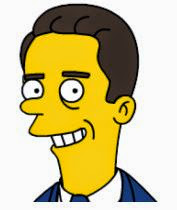
Jon Huntsman is a possible candidate for President in 2012? I'd not really thought about it, but I have to admit that he's stepping up to say something in a real leadership capacity today. (People have to start getting his name right, for starters.) Politico calls him the fastest-rising Republican you've never heard of, and that's about right because he seems to have kept a very low profile despite providing what appears to be pretty competent government to his state.
My point today is, he's the guy who's saying, "You can't just say no. You can't just obstruct or obfuscate." Republicans need to actually come up with new ideas of their own. They need to show that, if given power back, they will actually do something that could potentially be beneficial with that power. Otherwise, they'll be reduced to doing what Democrats did for a long time -- waiting for the party in power to screw the pooch so badly that the public will grow disgusted with them and hand things off to anyone else on general principles.
In fact, even that's a halfway unfair characterization of how the Democrats got their mojo back -- they did say they were going to change and then end the war in Iraq. But it only worked because the public had grown so disgusted with the way the war was going that they were looking for anything, any strategy, anyone, who would effect a meaningful change.
This is why the Tea Party movement is not proving particularly useful or effective in terms of effecting political change (as many people, including me, predicted). It's fun to say "no" all the time because it's easy to criticize and it's easy to get party unity and strong discipline on opposing someone. And it's a valid political point to be against something. But when you're just opposed to something, it sort of ends there. (And your message gets co-opted pretty easily.)
The trick is to channel that energy into being in favor of something. That's how real change happens. Huntsman is dead on right about that. That's something that Barack Obama did when he ran for President, and in retrospect it's amazing how effective he was at it. He managed to advocate a whole constellation of policy ideas, at a very high level of generalization, by talking constantly about "hope" and "change." Yes, I know it's not like he only said those words on his campaign but he never really offered much by way of specifics. Really, he did little more than identify a set of problems and indicated that it would be a priority in his White House.
Now is the time when the rubber meets the road. Now is the time for specifics. Obama is still short on actual, substantive policy ideas. You want proof? Take a look at his budget report. I did yesterday and I was astonished. On the surface, it looks great. There's all sorts of policy statements that sound good; it's difficult to disagree with much of what's there. But look closer. It's about 170 pages long. Twelve pages are a "don't blame me for the crappy economy" argument, which blithely ignores that as a Senator, Obama was part of the team that created the budgets the country's been running on for the past two years and he personally did nothing to help. A sin of omission, to be sure.
Then, the next twenty-six pages are a wish list of policy changes that have apparently not been thought through all the way, dressed up as intellectual justifications for optimistic economic projections. After that, you get more policy wish lists, going department by department through the whole Federal government. You don't get to any real numbers until you hit the appendix. Even then, the numbers are presented in a summary fashion, making it very difficult to figure out exactly what these departments are going to do with all this money. You're better off using this third-party produced interactive budget toy to break down where money is going to go.
This creates an opportunity for Republicans. Obama needs actual ideas. Once you get past the wish lists, he's really short on specifics. Repubicans, step up to the plate and plunk your ideas down on the table. Do it now, and argue for them now. Don't "save" them for a rainy day when the Democrats have flubbed things up so badly you get back in power by default.
If you do this, one of two things will happen. First possibility -- Obama and the Democrats will actually adopt the ideas you argue for. If this happens, you get credit as the originator of the idea and as someone who offers "bipartisan" solutions to problems. Second possibility -- Obama and the Democrats will reject your ideas. If this happens, you get credit as having offered a solution to a problem, and you get to lambaste the Democrats as the real obstructionists. Either way, you win politically.
But you have to have actual ideas to offer, first. Here, let me help you -- I've offered ten substantive ideas that are at least defensible from a policy standpoint and not already occupied as Democratic turf. They could make for bright points in a comprehensive Republican policy platform. Some young (that is, in his or her 50's) Republican holding a Governor's seat or a Senator's seat or some other prominent elective office, to fashion that policy platform and combine that with his or her political machinery and charisma. Right now, the closest things to leaders that Republicans have are a talk show host who cheers on defections from the party, a former Congressman who's been out of office for over ten years, and a floor leader in the House whose policy contributions so far consist of complaints of nausea. So the floor's wide open, as far as I can see it.
But it's not enough to look good and criticize the incumbent. You have to have some actual ideas in your head. Ah, but that's always the hard part, isn't it?
Showing posts with label 2006 Election. Show all posts
Showing posts with label 2006 Election. Show all posts
April 30, 2009
November 4, 2008
Good Job, Secretary Bowen
Apparently, the Secretary of State, Debra Bowen, forgot to get extra bandwidth for her website and election tracker tonight. So here it is, 8:30, and my website is getting pinged with about ten hits a minute in response to the Google search "Did Proposition 8 Pass?" and I have no way of answering that question with reliable data.
I've sort of disliked Bowen ever since she was my State Senator way back when I lived in the South Bay and was dismayed to see her rise to the position of Secretary of State in the 2006 election.
I've been saying for a long time that Secretary Bowen is, shall we say, not my first choice for that job. Actually, what I've been saying that I think a stalk of celery would do a better job than her, but the nature of the job is so esoteric it's difficult for the general public to judge. We haven't had a good Secretary of State since Bill Jones. McPherson was okay.
But this is one thing that the public can figure out -- it didn't take a genius to know that data about Proposition 8 would be much in demand tonight. And maybe this wasn't really her fault. But I'd like to blame her anyway.
It seems that the most recent information is available from CNN. The initial results -- about an hour after the polls closed -- are not good. "Yes" looks like it's leading by about 250,00 votes with 10% of the precincts reporting. That's depressing to see. No returns yet from San Francisco, Contra Costa, or Alameda County and only about 10% from Los Angeles County. An optimistic poll this morning, but on the other hand this has been a difficult issue to poll.
And turth be told, the "Yes" campaign has obviously done a much better job than the "No" campaign -- they had better graphics, more money, more organization, and a broader reach. Oh, and lies. They had lies going for them, too. Politically, they've managed to obtain a lot of advantages for their side. What bugs me most, if they win, is that they'll now be able to add a truthful argument to their side of the dispute should the issue ever arise again -- "We already voted on that, and our side won." It is important for the losing side in a democratic society to accept the result of the majority, after all.
I'm not ready to give up hope yet, despite some early bad numbers. Los Angeles County has over four million registered voters, and turnout has been very high. More than three million more votes are yet to be counted in L.A. county alone. But I'm also an eyes-open sort of guy. That's why I've fretted that Obama's success will help the chances of Prop. 8 passing -- by attracting a lot of Latino and African-American voters, who are heavily churched sorts of folks, the initiative might pass.
Obama's cowardice in not coming out in favor of same-sex marriage is part of the problem, too. So now I may well have my first big reason to really resent President Obama's politics. Cheat on the fundraising? Hey, that's a time-honored political play. Some misdirection and lies and arrogance and naivete? Comes with the territory. Big promises you can't possibly deliver on. Nothing the other guy didn't do. But you drag civil rights down, just to win an election, while trying to talk out of both sides of your mouth on the issue, well, that kind of pisses me off. Vero Possumus my ass.
I've sort of disliked Bowen ever since she was my State Senator way back when I lived in the South Bay and was dismayed to see her rise to the position of Secretary of State in the 2006 election.
I've been saying for a long time that Secretary Bowen is, shall we say, not my first choice for that job. Actually, what I've been saying that I think a stalk of celery would do a better job than her, but the nature of the job is so esoteric it's difficult for the general public to judge. We haven't had a good Secretary of State since Bill Jones. McPherson was okay.
But this is one thing that the public can figure out -- it didn't take a genius to know that data about Proposition 8 would be much in demand tonight. And maybe this wasn't really her fault. But I'd like to blame her anyway.
It seems that the most recent information is available from CNN. The initial results -- about an hour after the polls closed -- are not good. "Yes" looks like it's leading by about 250,00 votes with 10% of the precincts reporting. That's depressing to see. No returns yet from San Francisco, Contra Costa, or Alameda County and only about 10% from Los Angeles County. An optimistic poll this morning, but on the other hand this has been a difficult issue to poll.
And turth be told, the "Yes" campaign has obviously done a much better job than the "No" campaign -- they had better graphics, more money, more organization, and a broader reach. Oh, and lies. They had lies going for them, too. Politically, they've managed to obtain a lot of advantages for their side. What bugs me most, if they win, is that they'll now be able to add a truthful argument to their side of the dispute should the issue ever arise again -- "We already voted on that, and our side won." It is important for the losing side in a democratic society to accept the result of the majority, after all.
I'm not ready to give up hope yet, despite some early bad numbers. Los Angeles County has over four million registered voters, and turnout has been very high. More than three million more votes are yet to be counted in L.A. county alone. But I'm also an eyes-open sort of guy. That's why I've fretted that Obama's success will help the chances of Prop. 8 passing -- by attracting a lot of Latino and African-American voters, who are heavily churched sorts of folks, the initiative might pass.
Obama's cowardice in not coming out in favor of same-sex marriage is part of the problem, too. So now I may well have my first big reason to really resent President Obama's politics. Cheat on the fundraising? Hey, that's a time-honored political play. Some misdirection and lies and arrogance and naivete? Comes with the territory. Big promises you can't possibly deliver on. Nothing the other guy didn't do. But you drag civil rights down, just to win an election, while trying to talk out of both sides of your mouth on the issue, well, that kind of pisses me off. Vero Possumus my ass.

 Labels:
2006 Election,
2008 Election,
California,
Domestic Politics
Labels:
2006 Election,
2008 Election,
California,
Domestic Politics
January 17, 2007
Return to the Constitution
At long last, the Administration has agreed to relax its stance that it will unilaterally conduct warrantless electronic surveillance of communications, and submit its search requests to review by the Foreign Intelligence Surveillance Court.
This is something I and a whole lot of other people have been demanding for a very long time. I can't speak for other objectors to the original policy, but I for one never called for the program to end. I did, however, call for an inter-branch check and balance on the use of this power. That call has now, finally, been answered -- and to my satisfaction. By submitting to warrant applications and judicial review, and complying with existing legislation, the Executive Branch is now playing between the foul poles again, and I have no complaint about the surveillance.
Too bad the Republicans had to lose control of Congress to spur the Administration to start obeying the law. But better late than never. Perhaps, too, this is an object lesson about the dangers of one-party rule.
This is something I and a whole lot of other people have been demanding for a very long time. I can't speak for other objectors to the original policy, but I for one never called for the program to end. I did, however, call for an inter-branch check and balance on the use of this power. That call has now, finally, been answered -- and to my satisfaction. By submitting to warrant applications and judicial review, and complying with existing legislation, the Executive Branch is now playing between the foul poles again, and I have no complaint about the surveillance.
Too bad the Republicans had to lose control of Congress to spur the Administration to start obeying the law. But better late than never. Perhaps, too, this is an object lesson about the dangers of one-party rule.
November 8, 2006
I Ought To Be A Pundit
 Instapundit and Volokh have both offered the same opinion I did last night -- had the Republicans made any meaningful kind of an effort to keep libertarian-inclined voters within the fold, they would not now be wailing and gnashing their teeth over the loss of Congress to Nancy Pelosi and Ted Kennedy. To be fair, both Prof. Reynolds in Tennessee and Prof. Zywicki in Virginia have been saying these sorts of things (as have I) for quite some time. Difference is, I'm not a correspondent on a top-ten blog and I'm not a law professor at a major university. But the Loyal Readership does seem to be growing; I've been averaging nearly 100 hits a day, possibly fueled by the election.
Labels:
2006 Election,
Blog,
Link Love
Instapundit and Volokh have both offered the same opinion I did last night -- had the Republicans made any meaningful kind of an effort to keep libertarian-inclined voters within the fold, they would not now be wailing and gnashing their teeth over the loss of Congress to Nancy Pelosi and Ted Kennedy. To be fair, both Prof. Reynolds in Tennessee and Prof. Zywicki in Virginia have been saying these sorts of things (as have I) for quite some time. Difference is, I'm not a correspondent on a top-ten blog and I'm not a law professor at a major university. But the Loyal Readership does seem to be growing; I've been averaging nearly 100 hits a day, possibly fueled by the election.
Labels:
2006 Election,
Blog,
Link Love
Opposition Softening
If you take a look at the list of ballot propositions and initiatives that CNN thought were important, you'll find eight attempts to ban same-sex marriage, either by law or by amendment to state constitutions. Seven of the eight passed. Bear in mind that same-sex marriage bans are supposed to be a wedge issues, intended to fuel church-based GOTV drives for Republicans.
But look at the margins and the results:
This "wedge" issue seems to have not worked very well for Republicans, at least at the statewide levels, where it was used. In only one case, Virginia, did partisan control of the contested seat change, and that by only the slimmest of margins, under .3% of the overall vote. I bear in mind, however, that this was a very strong election for Democrats because of other issues, which perhaps could have the effect of depressing support for same-sex marriage bans. But the fact that the issue is now seen as more partisan than it was in the past is testament to its incorporation into the toolkit of theocratic politicos.
Personally, I'm still mystified at why it is that anyone would care if two unrelated gay adults wanted to get married. But my intent here is not to argue the merits of the issue, but rather trying to analyze how the issue plays out in electoral politics.
The margins of opposition to this issue have fallen quickly. I recall as recently as 1998 that something like 95% of Americans opposed same-sex marriage. (It mystified me then, too.) Only Tennessee and South Carolina posted numbers even approaching that stridency of opposition eight years later. What must have seemed a strange and bizarre idea in 1995 is becoming easier for people to grasp. And as a few more liberal states have adopted same-sex marriage or domestic partnership laws, it has become clear that no particular harm has arisen from this.
Voters are not stupid and their impulse is to do what is good and right. As voters realize that letting gays marry doesn't alter their lives in any material way, and that it doesn't even cost any appreciable amount of money, more of them will be inclined to overcome the "ick factor" and say, "Hey, live and let live; how two people choose to live together just plain isn't any of our business."
We're not there yet. But the issue is losing electoral force for those who would rally personal prejudice, perhaps cloaked and legitimized by religion for some, to lend its ugly support to partisan politics.
But look at the margins and the results:
Arizona: 49% (results still incomplete, appears to be a rejection of the ban). Elected Republican Senator and Democratic Governor.
Colorado: 56% (also rejected, 47%-53%, a different ballot initative which would have established domestic partnerships). No Senate election, elected Democratic Governor.
Idaho: 63%. No Senate election, elected Republican Governor.
South Carolina: 78%. No Senate election, elected Republican Governor.
South Dakota: 52%. No Senate election, elected Republican Governor.
Tennessee: 81%. Elected Republican Senator and Democratic Governor.
Virginia: 57%. Elected Democratic Senator, no gubernatorial election.
Wisconsin: 59%. Elected Democratic Senator and Democratic Governor.
This "wedge" issue seems to have not worked very well for Republicans, at least at the statewide levels, where it was used. In only one case, Virginia, did partisan control of the contested seat change, and that by only the slimmest of margins, under .3% of the overall vote. I bear in mind, however, that this was a very strong election for Democrats because of other issues, which perhaps could have the effect of depressing support for same-sex marriage bans. But the fact that the issue is now seen as more partisan than it was in the past is testament to its incorporation into the toolkit of theocratic politicos.
Personally, I'm still mystified at why it is that anyone would care if two unrelated gay adults wanted to get married. But my intent here is not to argue the merits of the issue, but rather trying to analyze how the issue plays out in electoral politics.
The margins of opposition to this issue have fallen quickly. I recall as recently as 1998 that something like 95% of Americans opposed same-sex marriage. (It mystified me then, too.) Only Tennessee and South Carolina posted numbers even approaching that stridency of opposition eight years later. What must have seemed a strange and bizarre idea in 1995 is becoming easier for people to grasp. And as a few more liberal states have adopted same-sex marriage or domestic partnership laws, it has become clear that no particular harm has arisen from this.
Voters are not stupid and their impulse is to do what is good and right. As voters realize that letting gays marry doesn't alter their lives in any material way, and that it doesn't even cost any appreciable amount of money, more of them will be inclined to overcome the "ick factor" and say, "Hey, live and let live; how two people choose to live together just plain isn't any of our business."
We're not there yet. But the issue is losing electoral force for those who would rally personal prejudice, perhaps cloaked and legitimized by religion for some, to lend its ugly support to partisan politics.
Labels:
2006 Election,
Domestic Politics,
Same-Sex Marriage
Rasputin Falls
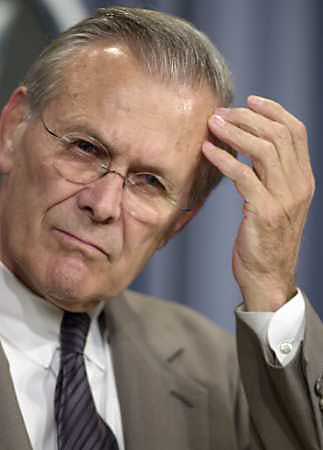 In 2001, the explicit warnings of Colin Powell that we were being fed a line about invading Iraq were ignored, and the President put his faith in Donald Rumsfeld's assurances that Iraq could be converted into a steadfast ally formed the basis of the central feature of George W. Bush's presidency -- overshadowing even 9/11.
Then, a graphic demonstration that Ahmed Chalabi's honeyed predictions about a glorious post-war Iraq, poured into the Administration's ear via Donald Rumsfeld, was not true, was not enough to shatter the President's steadfast faith in his Secretary of Defense.
After that, widespread criticism that not enough boots were on the ground to complete the mission of pacifying Iraq was not nearly enough to break Bush's loyalty to Rumsfeld.
The President has never once deviated from the cognitive dissonance of the Secretary of State's insistence that great resources are being placed into the hunt for Osama bin Laden, while also insisting that finding him is really not all that important. It obviously can't be both -- either it's worth it to invest a lot of resources in finding and killing the guy, or it's not.
Subsequently, the apparent impotence of the United States to respond to military challenges from North Korea and the proxies of Syria and Iran were not a demonstration to the man in charge that something was amiss in the Pentagon.
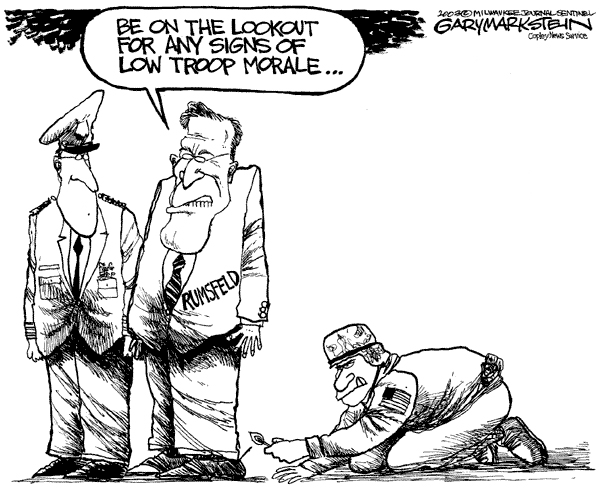 Neither was the call by an assortment of Congressional leaders from both parties and recently-retired generals, and the apparent behind-the-scenes critiques of serving general officers, for the resignation of the civilian leader of the military. Instead, we heard a drumbeat of praise and support from the White House, the equivalent of "You're doing a great job, Rummy."
The unprecedented editorial of the military newspapers calling for Rumsfeld's removal from power also failed to convince the President that one of his principal advisers was letting him down. As recently as Sunday night, George Bush insisted that Donald Rumsfeld was going to serve as Secretary of Defense until Bush's successor took office.
But let it not be said that George W. Bush is completely dense. The American public throwing the GOP's majority in Congress out on its ear was a sufficiently clear message to the President for it to dawn on him that, indeed, something has gone terribly wrong. And so this morning, Rumsfeld was resigned from the Administration, to be replaced by another old Bush friend from Texas, a man with an intelligence and administrative background who seems qualified for the job.
What I wonder now is whether Bush thinks that sacrificing Rumsfeld will be enough to placate the public. Obviously, it won't; the American people want to see something different being done and made that desire well-understood. Voting out Lincoln Chafee, a Republican who voted against the war, in favor of Sheldon Whitehouse, a Democrat who voted for it, is as clear a sign as I can think of that the American people are resentful of being misled about the WMD's, displeased with the continuing violence in Iraq, and nervous about the overextension of our military caused by the ongoing misadventure in the cradle of civilization. What alternative it is the people want to see is unclear -- but what is clear is that we want something different with regards to the war, because what Rumsfeld has been having the military do for the past six years is simply not working.
Here's hoping that the incoming Secretary of Defense, Robert Gates, is able to put together a better plan, one with a credible exit strategy and an endgame that is at least marginally acceptable to our economic, diplomatic, and security interests.
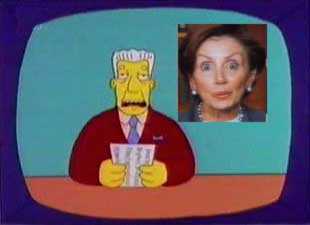
November 7, 2006
I Think It's My Fault
 Karl Rove and his incredible Republican Turnout Machine have some big-time egg on their faces. And I'm to blame. Well, sort of. And only partially.
I think that the better-than-I-expected Democratic results -- they've taken the House and, as I write, are leading in the three remaining contested Senate races, which would give them a one-seat majority in the Senate -- have two causes:
1. A lot of people, myself included, have grown disgusted with the lack of any kind of discernable progress in the war. Every time the news comes on, it seems that something new and awful has happened in Iraq; Afghanistan is slipping; there appears to be no way out and no solution that is even marginally to our advantage. This has taken away the Republicans' credibility on the issue of national security and terrorism -- whatever mandate they might have had to lead on that issue has evaporated. This does not translate into a Democratic mandate -- just a rejection of the path that we are on right now and a demand for change.
2. A lot of Republicans, myself included, have grown disgusted with the lack of any kind of fiscal restraint on the part of a don't-tax-but-spend-anyway Congress. It's astonishing that Democrats have gained greater credibility with the issue of the economy and the role of the government in the economy. But that's what's happened, because the Republicans as a group have simply abdicated the role of guardians of the Federal budget.
I cannot help but think that if Republicans had found room for a more libertarian-oriented agenda, or even one that was simply more more budget-conscious, they could have avoided this. Libertarians would have counseled more caution in starting a ludicrously expensive war; and objected strenuously to increasing spending without increased taxes to offset them (while preferring to do neither).
We'll never know for sure, of course. But you want proof? Look at Montana -- if the Republicans had kept the libertarian vote, would that have made the difference? In Missouri, if you add half the votes for the libertarian candidate to Jim Talent's vote total, and the Senate would have stayed in Republican hands.
But no. "Libertarian budget hawks aren't part of the "base," so screw them and the things they want. Besides, who are they going to vote for anyway, the Democrats? Gimme a break." Does that little mantra sound familiar to anyone?
Think about that for the next couple of years, Karl.
Labels:
2006 Election,
Domestic Politics
November 6, 2006
Election Liveblogging?
Not here. I'll make one or two posts, maybe, but I'm going to save most of my thoughts on the election until after returns are in. If you want minute-by-minute returns, watch the networks, or any of a number of websites. No one is really going to care about my momentary thoughts about the returns -- so better to provide thoughts on the real results.
I've already made my prediction (Republicans will keep the House by 5 seats, and the Senate will split, 50-50) , and given the near hysteria the media is feeding everyone over the expected Democratic landslide, it's a pretty bold prediction.
Besides, I suspect that most of the liveblogging is being outsourced anyway. I'll leave that sort of thing to the cheaper labor available in India.
I've already made my prediction (Republicans will keep the House by 5 seats, and the Senate will split, 50-50) , and given the near hysteria the media is feeding everyone over the expected Democratic landslide, it's a pretty bold prediction.
Besides, I suspect that most of the liveblogging is being outsourced anyway. I'll leave that sort of thing to the cheaper labor available in India.
Labels:
2006 Election,
Blog

November 3, 2006
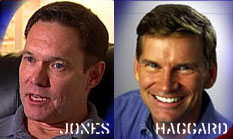
Meeee-eeee-eeee and Mr. -- Mr. Jones
 Me and Mr. Jones, we got a thing going on,
We both know that it's wrong
But it's much too strong to let it cool down now.
Oh, when I have money I call him up.
I leave a message on his machine.
Just two bills out from the church's donations,
And he gonna massage me all over the place.
Mee-eee-eee and Mr., Mr. Jones, Mr. Jones, Mr. Jones,
Mr. Jones gonna sell me meth to look at but not snort,
Oh, I know that it's wrong,
But it's much too long for me to cool down now.
I gotta be extra careful
that I don't get found out, now
Cause 14,000 people and the President look to me for moral guidance and quasi-political leadership, oh yeah.
Me, me and Mr., Mr. Jones, Mr. Jones, Mr. Jones,
Oh, we got a thing, a thing going on,
Drugs and gay sex are so much fun,
The temptation's too strong for me to let go of it now.
Well, it's time for me to go home to my wife,
I'll take the drugs with me and smile inside,
Now he'll go his way and I'll go campaign against gay rights,
And tomorrow we'll meet the same place, the same time.
Me and Mr. Jones, Mr. Jones, Mr. Jones.
Labels:
2006 Election,
Scandal
November 2, 2006
Hot Gay Evangelical Sex (Updated 2x)
It's interesting to note that the very arrogant preacher whom I saw in the Richard Dawkins video rightly call Prof. Dawkins on the carpet for arrogance is now caught up in allegations of having paid for gay sex. Apparently his accuser, the alleged prostitute, got mad when he saw his regular john taking a position advocating in favor of Colorado's Amendment 43, which would enshrine Colorado's Defense of Marriage Act in Colorado's state constitution.
Reverend Haggard denies the allegations completely and he is entitled to the presumption of innocence. The timing of the revelation, coming so close as it does to election day, makes its veracity somewhat suspect. But it's interesting that so many news sources are carrying it -- I suppose the idea that someone so prominent as a minister who regularly preaches to the President being involved in salacious gay sex is just too juicy a story to pass up if it turns out to be true. The story of the giant being toppled is one we see again and again.
For myself, I could believe this sort of thing being true. But I'll need more than an accusation to get behind it. For the time being, I'm going to assume the good Reverend is innocent and the victim of a very cruel accusation motivated by politics. His only mistake has been to take such a prominent and strident public position so as to attract this sort of attention.
UPDATE: Rev. Haggard has admitted "some guilt" but not the entire battery of accusations. That's the additional evidence I needed to shift away from the presumption of innocence. This morning's admission of "some guilt" when confronted with the allegation of a three-year affair with a call boy, seems fundamentally incompatible with Haggard's statement last night of "I've never had a gay relationship with anybody. I'm steady with my wife. I'm faithful to my wife." Look, when you make a mistake and get caught, the only thing to do is to buy it, all, immediately, in this case that being something like: "I've made mistakes in my life, and this was been one of them. I'm a sinner and I've asked for God's forgiveness. I'm asking for my wife's forgiveness, and for my congregation's forgiveness. I know I'll spend the rest of my life trying to make amends for what I've done." But that wasn't the reaction -- first there was outright denial and now there's "some" (but not "complete") guilt. If even some of this is true, does it matter all that much what part isn't? No, after this, I'm siding with Salsola's earlier comment and I must admit feeling a certain degree of satisfaction in seeing a hypocrite exposed for what he really is. Stay tuned for more developments. (7:15 a.m. Friday, November 3, 2006)
(UPDATED UPDATE): "Some guilt" apparently means "I bought meth from the guy, but I didn't use it; I paid for massages from the guy but didn't have sex with him." Yeah, right. Bill Clinton never inhaled, and he never had sexual relations with that woman. (1:33 p.m. Friday November 3, 2006)
Reverend Haggard denies the allegations completely and he is entitled to the presumption of innocence. The timing of the revelation, coming so close as it does to election day, makes its veracity somewhat suspect. But it's interesting that so many news sources are carrying it -- I suppose the idea that someone so prominent as a minister who regularly preaches to the President being involved in salacious gay sex is just too juicy a story to pass up if it turns out to be true. The story of the giant being toppled is one we see again and again.
For myself, I could believe this sort of thing being true. But I'll need more than an accusation to get behind it. For the time being, I'm going to assume the good Reverend is innocent and the victim of a very cruel accusation motivated by politics. His only mistake has been to take such a prominent and strident public position so as to attract this sort of attention.
UPDATE: Rev. Haggard has admitted "some guilt" but not the entire battery of accusations. That's the additional evidence I needed to shift away from the presumption of innocence. This morning's admission of "some guilt" when confronted with the allegation of a three-year affair with a call boy, seems fundamentally incompatible with Haggard's statement last night of "I've never had a gay relationship with anybody. I'm steady with my wife. I'm faithful to my wife." Look, when you make a mistake and get caught, the only thing to do is to buy it, all, immediately, in this case that being something like: "I've made mistakes in my life, and this was been one of them. I'm a sinner and I've asked for God's forgiveness. I'm asking for my wife's forgiveness, and for my congregation's forgiveness. I know I'll spend the rest of my life trying to make amends for what I've done." But that wasn't the reaction -- first there was outright denial and now there's "some" (but not "complete") guilt. If even some of this is true, does it matter all that much what part isn't? No, after this, I'm siding with Salsola's earlier comment and I must admit feeling a certain degree of satisfaction in seeing a hypocrite exposed for what he really is. Stay tuned for more developments. (7:15 a.m. Friday, November 3, 2006)
(UPDATED UPDATE): "Some guilt" apparently means "I bought meth from the guy, but I didn't use it; I paid for massages from the guy but didn't have sex with him." Yeah, right. Bill Clinton never inhaled, and he never had sexual relations with that woman. (1:33 p.m. Friday November 3, 2006)
Labels:
2006 Election,
Religion,
Same-Sex Marriage,
Scandal
Absolute Chaos
This morning, Iraqi Prime Minister Nuri Kamal al-Maliki (who earlier warned America that he was "not your man in Iraq") bowed to pressure from the warlord Moktada al-Sadr, and ordered American troops to lift their checkpointed seige of Sadr City, a Shiite slum to the northeast of Baghdad. The seige had been imposed after an American solider of Iraqi descent, who had been visiting his Iraqi civilian wife, was kidnapped and a group known to be affiliated with al-Sadr announced that they were holding the soldier hostage.
Read all about it in the Washington Post and the New York Times. Niether Faux News nor CNN have not made the connection between the kidnapping of the soldier and the easing of the crackdown on Sadr City -- come to think of it, didn't that part of Iraq used to be called "Saddam City?" Andrew Sullivan thinks there are nuances here, but frankly, I can't see them. Yes, there is a need to defer to the civilian government of Iraq, but whatever happened to "no man left behind"?
Oh, and before I forget, we've uncovered substantial evidence that Hezbollah, backed by its sponsors Syria and Iran, is now trying to stage a coup to overthrow the moderate government of Lebanon. Thus we see the wages of a war interrupted by unthinking bureaucrats incapable of distinguishing right from wrong exercising their power to cluck disapprovingly -- which is what they will do when the coup happens. I used to think the United Nations was mostly harmless but this makes me wonder -- there's no massive conspiracy to subjugate the world to a unified government there, to be sure, but there's also no ability to discern reality, and that can be dangerous, too.
And what are we doing about all of this here in the states? Chuckling over John Kerry's gaffe, because it seems to have helped the Republicans' chances of maintaining control over Congress.
Read all about it in the Washington Post and the New York Times. Niether Faux News nor CNN have not made the connection between the kidnapping of the soldier and the easing of the crackdown on Sadr City -- come to think of it, didn't that part of Iraq used to be called "Saddam City?" Andrew Sullivan thinks there are nuances here, but frankly, I can't see them. Yes, there is a need to defer to the civilian government of Iraq, but whatever happened to "no man left behind"?
Oh, and before I forget, we've uncovered substantial evidence that Hezbollah, backed by its sponsors Syria and Iran, is now trying to stage a coup to overthrow the moderate government of Lebanon. Thus we see the wages of a war interrupted by unthinking bureaucrats incapable of distinguishing right from wrong exercising their power to cluck disapprovingly -- which is what they will do when the coup happens. I used to think the United Nations was mostly harmless but this makes me wonder -- there's no massive conspiracy to subjugate the world to a unified government there, to be sure, but there's also no ability to discern reality, and that can be dangerous, too.
And what are we doing about all of this here in the states? Chuckling over John Kerry's gaffe, because it seems to have helped the Republicans' chances of maintaining control over Congress.
November 1, 2006
Time To Go On Record
 So here's my prediction: contrary to the popular media's predictions, I say that the Republicans will retain control of the House. It will be close -- very close. 220-215. The Republicans will select a new Speaker, who will be either the existing majority leader, John Boehner, or David Drier.
Neither party will have control of the Senate. It will split, 50 seats Republican, 50 seats Democrat. In the four disputed seats, Democrats Menendez (New Jersey) and McCaskill (Missouri) will win; Republicans Corker (Tennessee) and Allen (Virginia) will win. The Tennessee race will be within one percentage point and will not be declared until about a week after the election. There will be numerous allegations of fraud and illegal election conduct. There will also be a big problem with Tennessee's paperless electronic voting machines, which the losing candidate, through proxies, will complain bitterly about being manipulated against him and throwing the race to the winner.
We'll see how well I do in a week!
Labels:
2006 Election
October 31, 2006
Jerry Brown's Qualifications
 The chairmen of five county Republican committees have filed a lawsuit against five (generally heavily-Democratic) county registrars to prevent them from counting votes for Jerry Brown in his campaign for Attorney General. The theory is that Government Code § 12503 requires the Attorney General to have been able to practice before the California Supreme Court for at least five years prior to taking office:
No person shall be eligible to the office of Attorney General unless he shall have been admitted to practice before the Supreme Court of the state for a period of at least five years immediately preceding his election or appointment to such office.
A search of the State Bar's records for Jerry Brown shows that, indeed, he allowed his license to practice law to fall into inactive status from 1992 to 1996, and then again from 1997 to 2003. So he was rather clearly not an "active" member of the bar. Brown claims he let his membership lapse while he was Mayor of Oakland, but that doesn't hold water -- he was elected mayor in 1998, and had allowed his membership to lapse before that.
So the question is whether the phrase "admitted to practice before the Supreme Court" (from the statute) is the same thing as "able to practice before the Supreme Court" (which an inactive member cannot do). If these are the same thing, Brown is not qualified to be Attorney General. Allegedly, there is a 1980 opinion of then-Attorney General George Deukmejian, which included in dicta the statement that "inactive members are members of the bar." If so, that would be strong authority that these two phrases are not the same thing, and that Brown's admission to the Bar was always valid. I haven't found that opinion in a quick search, but that doesn't mean it doesn't exist.
Regardless, the point seems fairly persuasive to me. Brown never stopped being a lawyer even if his license was inactive; he has over 40 years of experience as a lawyer, even if much of those 40 years was spent in politics rather than the practice. That doesn't mean that I particularly want Moonbeam to be the state's top lawyer, but he is legally qualified for the job.
Labels:
2006 Election,
California,
Domestic Politics,
Law
October 30, 2006
Bad Move, Rush
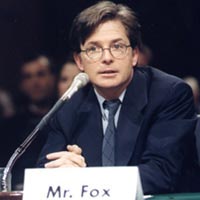 I realize that people who make their living selling political pornography (both on the right and on the left) have to be outrageous sometimes, and unafraid to take on the conventional wisdom, in the hopes of scoring a big hit. But Rush Limbaugh challenging Michael J. Fox was a serious gaffe, and an unkind cut at that. While Limbaugh accused Fox of "under-medicating" himself for his campaign commercial to help Democratic Senate candidate Claire McCaskill, it turns out that Fox was actually over-medicated at the time -- so that he could at least deliver his message while his body engaged in open, painful rebellion against his consciousness.
While the whole affair may not help Claire McCaskill's campaign for Senate in the critical toss-up race in Missouri, it certainly isn't going to help the Republican. Indeed, it does nothing but make Limbaugh look bad, even to people who might otherwise have liked him. I'm reasonably confident that Missouri voters can distinguish between the statements of Jim Talent and those of Claire McCaskill and that this whole sorry episode will likely not impact the election in any significant way (other than the impact of Fox's commercial).
But the whole thing has done at least two good things:
1. It has publicized, in a way that ordinary politics could not, the horror of neurological diseases like Parkinson's, and the role that stem cell research could play in combatting these terrible medical conditions. Seriously, if you've ever interacted with anyone who suffered from a degenerative neurological disease, you wouldn't wish it on your worst enemy. The worry that stem-cell research is going to incentivize abortions is asinine and another example of the kind of anti-science that gets me really upset.
2. It has left a big, slimy egg on Rush Limbaugh's face. Even his half-hearted retraction of his earlier statements is effectively drowned in an avalanche of blustery revisionism and attempts to prove that he was right after all. I take as much relish in seeing Limbaugh exposed for the mean-spirited, intellectually bankrupt diminisher of the popular debate that he is as I do in seeing Air America go financially bankrupt as a result of its failure to be funny, commercially viable, or to present any kind of effective counterpoint to the right which so outraged its unfunny, unoriginal talent.
Labels:
2006 Election,
Antiscience,
Scandal
October 29, 2006
Tracking the Polls
 This is shaping up to be one of the most exciting, unpredictable elections in memory. It's hard to get into the House races in any meaningful way, because they are going to be local rather than national in their focus. That makes the whole thing hard to predict. The best compilations I've found so far that look at the data on a district-by-district basis are Pollster.com and the New York Times.
Pollster has the Democrats pegged to have a one-vote majority of seats in the House, with 24 additional seats as "toss-ups." The New York Times, on the other hand, lists its polls at 205 for the GOP, 214 for the Democrats and 16 races as "toss-ups." But I have to think both of these are somewhat exaggerated in favor of the opposition party; incumbency has a great deal of power and influence, and people have fewer beefs with their own Congressman than they do with Congress in general.
In the Senate, there are now three "toss-up" races according to Pollster, namely Missouri, Tennessee, and Virginia. According to the Times, New Jersey is also a toss-up, but Pollster is anticipating that the Democrats retain that seat. If the Times is right, the results will be 48-48, with the remaining four seats determining the balance; if Pollster is right, the Democrats will need two out of the three toss-ups to get a majority in the Senate. Both present reasonably plausible scenarios for an exact 50-50 split in the Senate (assuming one counts Joe Liberman as a Democrat, which I know some do not). Senate races tending to be more about national issues, I'm a bit more confident in the reported poll results being more reliable.
This is shaping up to be one of the most exciting, down-to-the-wire elections in memory. It's hard to get into the House races in any meaningful way, because they are local. That makes the whole thing hard to predict. Which, of course, makes it tremendous fun to watch -- as long as you don't have a vested interest in one side or the other winning. I would not be surprised to see either party with control of the House in single-digit margins, and I would not be surprised to see the Senate split within one vote, for one of the most closely-divided Congresses in history. The race will be quite exciting, and will right down to the wire. We may not know the final results for a few weeks after November 7.
Labels:
2006 Election
October 28, 2006
Gays in New Jersey
 The New Jersey Supreme Court last week came to the conclusion that under that state's constitution, the rights of marriage cannot be lawfully withheld from same-sex couples.
If you read the opinion (linked again here) you will see a 4-3 split. The decision was not a one-vote majority in favor of extending the rights of marriage to same-sex couples. On that point, the New Jersey court was unanimous. Rather, the 4-3 split was on the issue of the use of the word "marriage." The minority would have mandated that "marriage," using that word, be offered to same-sex couples. But the majority of the New Jersey Supreme Court voted to give the Legislature six months to decide whether to call this arrangement "marriage," "civil union," or something else, or else the court will take action on its own and likely extend marraige to same-sex couples. It is very likely, given this ultimatum and the politics of the issue, that New Jersey will adopt "civil unions," much like the Legislature in Vermont did back in 2000.
Interestingly, there's one guy a lot of political jukies might remember who would marry his lover if he could.
And predictably, the Republicans are using the decision as a tonic to revitalize their hopes of retaining control of the government, a goal which had been starting to look all but conceded to the Democrats. Socially conservative activists are thrilled to have a bogeyman to rally against and to "energize the base." Sadly, though, the GOP needs to overcome a problem, in that the party's national leader has already endorsed the idea of "civil unions" for gay couples:
That Bush and his cronies today rail against the "judicial activism" of a decision that Bush himself invited is hypocrisy on a high level, which of course is no barrier to political activity.
I have been saying for a long time that there is no logical reason not to extend the rights of marriage to same-sex couples. Like the majority of the New Jersey Supreme Court, I am concerned more with substance than labels and I do not care if the legal institution to be created is called "marriage" or something else; a rose by any other name and all that. But I have consistently insisted that gay Americans be treated like Americans and be given the same ability to plan their lives with the people they have fallen in love with that heterosexuals enjoy. It should be as easy for them as it was for The Wife and I.
Dale Carpenter writes about the issue on Volokh, praising the "rights-forcing" but not democracy-reliant nor "status-forcing" middle way on the issue found by the New Jersey Supreme Court:
Of course no court can mandate social acceptance; but that is not what gay-marriage litigants asked for. What a court can do is remove any role the law might play in reinforcing social inequality. Denying the status of marriage to gay couples lends some continued legitimacy to the idea that they should not be accepted socially as the equal of married couples. For many people, that may be the correct message to send. But we cannot deny that it is sent and that law has played a role in sending it. Erasing that final status distinction at least ensures that, if social inequality between gay and straight couples remains, it will be no fault of the law.
The New Jersey Supreme Court has given that state's political leaders the option to avoid using touchy terminology while preserving and promoting substantive equality for all Americans. Social acceptance of these relationships can come later, and if it does, it will do so as a result of observing that homosexual relationships are created and dissolve in much the same manner as heterosexual ones, and seeing that indeed, the recognition of such relationships causes no harm to anyone else.
Prof. Carpenter also makes an interesting observation -- there are now five states (California, Connecticut, Massachusetts, New Jersey, and Vermont) that have some form of recognition for gay couples. One in six Americans lives in a state that has adopted such recognition through democratic processes; one in five has had substantial democratic input into the process of recognizing this clash of the demands of equality with the shibboleth of "tradition" and observed not a single ill social effect.
So I applaud -- stand up and cheer, really -- this opinion. And Republicans who would use this issue as a wedge should remember that in so doing, they are running afoul of the President's inartful attempt to dodge the issue.
Labels:
2006 Election,
Domestic Politics,
Same-Sex Marriage
October 26, 2006
Tennessee Senate Race
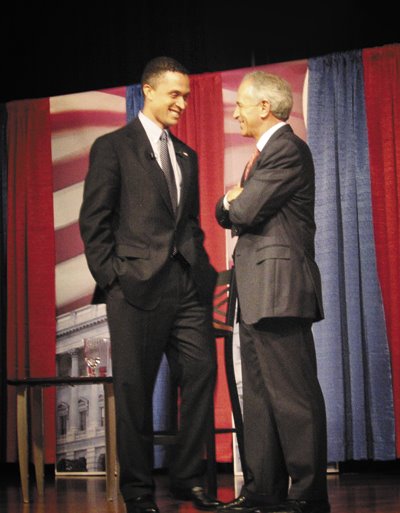 There is one thing that I miss about being in Tennessee right now -- the Senate race between Bob Corker and Harold Ford, Jr. They are neck and neck and the balance of power in the Senate may well turn on the outcome of this single race.
And it looks like there's some great advertisements going on. This one is easily the best -- an attack ad against Ford by the RNC. Ford and his supporters claim the ad is racist, and the accusations have stuck enough that the RNC pulled the ad from broadcast, but frankly I just don't see it. It's really funny.
Now, if Ford really wants to play with the big boys, he needs to learn how to respond to something like this with a punch in the mouth. Wonkette apparently did that on his behalf, this time.
Damn, this is good stuff.
Labels:
2006 Election,
Tennessee
October 23, 2006
Role of Parties
 For better or for worse, America has a two-party system. As one commentator pointed out recently, this is not likely to change for the foreseeable future. Assuming that the Democrats re-take control of Congress, about all we're promised is a bunch of TV fluff and a hike in the minimum wage.
But what the New York Times wrote about today is really kind of old news. Particularly in the West, but really kind of everywhere, people are more and more saying that they "vote for the person, not the party." One wonders whether this is really a good voting strategy, or even any kind of strategy at all -- and it certainly doesn't do anything to send a message to the recently-elected leaders about what it is that the voters want out of their government other than appealing personalities.
We can whine all we like about how things would be better if there were five or six parties -- a moral-values party, a labor party, a libertarian party, an environmental party, and so on. But from there it's a short step to ethnic and religious parties, and all of a sudden we start being Israel. And that's not the vision of political stability that our Founders had in mind for us -- an Italian-style government paralyzed by having to continually remake itself with ever-shifting coalitions is even less efficient than we would otherwise tolerate.
But the big problem with a two-party system is polarization and oversimplification. Too often we have to distinguish between "libertarian Republicans" and "religious Republicans" and "establishment Republicans" and "tax hawks" on the one hand and any of about twenty flavors of Democrat on the other hand (although the "Dixiecrat" of yesteryear is definitely a dying breed).
I'm also mindful of my experiences living in two states. In Tennessee, party identification is a combination of a person's heredity, views on abortion, and zealousness about guns. In California, economics, race, and a vision of the proper role of government are bigger issues. Where Democrats in Tennessee were reasonably palatable to me, there are very few Democrats in California who I would even flirt with the idea of lending even a vote to. For instance, Phil Bredesen seemed to be doing a reasonable job as Governor and the collapse of TennCare cannot be laid at his feet (although his failure to rescue it can). I've no idea if I would have considered voting for Harold Ford or not; Bob Corker doesn't seem to be a particularly attractive figure to me.
Moreover, the relative parity between the parties seems to keep the balance of power such that the will of the voters gets enacted most of the time. The result is actually one of the more libertarian states in the East despite significant power-holders from both parties anxious to impose their vision of the world, through government power, on the rest of the state. (Query, however, whether the state's libertarian skew in government policy is the result of actual voter preference or the necessity of a government starved for money by the absence of an income tax.)
Here, though, I find my feelings are different -- in no small part because I know very well what happens up in Sacramento when you elect Democrats into power. Taxes go up, quality and quantity of public services decrease through the mechanism of corruption and bureaucratic inefficiency, and individual freedoms decrease through increased regulations and enhanced gerrymandering. California confronts some significant problems and there is a role for the government; no one else is going to protect the environment, for instance. But the fact of the matter is that Californians are not under-taxed, they are not under-regulated, and they are not able to cast meaningful votes because there are almost no competitive districts at any level in the state.
So as I recently contemplated when looking at my absentee ballot, it doesn't matter much that I've grown disenchanted with the Republicans. Here in California, there just isn't any real alternative for me. The Democrat running for Assembly here, for instance, has said a lot of things in the local media that appeal to me. But it doesn't matter and I know it. This is a safe, secure Republican district because it was drawn that way. The Democrat just doesn't have a chance -- and even if he did, he and his apparently moderate points of view would be absolutely swallowed by the far-left wingnuts and any pretense of reasonability will vanish -- unless there is a Republican governor to exercise meaningful veto power.
If you are in the United States this November, you've got two realistic choices. (Even in Connecticut, where your choices are Joe Lieberman and Ned Lamont; the Republican in that race is a nonentity who might as well be a Libertarian or a Green.) Certainly you should pay attention to the personality of the person in question. Obviously you should consider the issues that matter most to you. But don't ignore the "D" or "R" after the person's name. It matters.
Labels:
2006 Election,
2008 Election,
California,
Domestic Politics,
Israel,
Italy,
Tennessee
Subscribe to:
Posts (Atom)

 Posts
Posts