Here were my predictions for 2010, and here's how they did:
Jon Huntsman will resign as ambassador to China and begin to lay the groundwork for a Presidential bid in 2012. Has not happened. In retrospect, I failed to credit the idea that Ambassador Huntsman might actually like being the Ambassador to the PRC and that he might not really want to be President.
Foolishly, Democrats will campaign in 2010 against George W. Bush. This will fail and result in gains by Republicans, but more in the House than the Senate. Congressional Republicans will realize a net gain of only two or three seats in the Senate, leaving the Democrats still firmly in control of that body and reviving talks of abolishing the filibuster. But, net gains in the House of Representatives will be such that the Democrats' majority in the lower chamber will be roughly ten seats and Republicans will optimistically talk of re-taking the House in 2012. Democrats abandoned their strategy of running against George W. Bush in favor of atomizing local races, which was only partially effective; Republicans took the House but not the Senate, although their Senate gains were larger than I had predicted.
A reconciled health care "reform" bill will not be passed out of Congress until March or maybe even early April. Its effect will be to very moderately increase taxes on middle-class Americans, only negligibly affect their actual health care options, and substantially inflate both the governmental deficit and the profits of enterprise-level health care providers. I'm taking credit for calling this one pretty much correctly.
The net inflation rate of the United States for CY 2010 will be in excess of 4%. Gratefully, this has not happened, but only because the Fed has kept the prime rate at a rock-bottom level.
President Obama will again increase the number of American troops deployed to Afghanistan. This happened. That doesn't mean I'm happy about it because I'm not, especially because we're now talking about bringing them home with no apparent political objectives accomplished despite hard work and bloodshed by our military.
Canada's government will collapse, for real this time, and new elections will result in a badly-fragmented Federal Parliament with the BQ playing the role of powerbroker. However, the BQ will not be able to leverage this into actual autonomy. Didn't happen; PM Harper took a hard hit, but survived.
An El Niño condition will manifest in the Pacific Ocean, relieving California's drought. In fact, it was a La Niña, but we had a wet winter at the start of 2010 and a wet winter at the end of 2010, and have been out of drought conditions all year.
Despite the economic help of favorable (that is, "wet") weather, California will increase sales taxes to 10.5% or higher, resulting in the highest sales tax in the nation. Despite this, functionally all incumbents in the Legislature eligible for re-election will be re-elected in November and the Democrat nominee (who right now looks like Jerry Brown) will win the Governorship. Mostly happened. The only thing I got wrong was the sales tax hike.
A national newspaper of significant stature, I'm thinking the Boston Globe, will be liquidated. The Seattle Post-Intelligencer went all-online and has functionally diedas a result.
2010 will be a good year for the stock market. The S and P 500 will realize a net gain of over 20% in CY 2010. As of today, the S and P 500 is 1,124.57, so that means that to win this prediction, the S&P will need to be at least 1,349.48 on December 31, 2010. The year-end close was it was 1,257.64.
Iron Man 2 will be the biggest box office hit of the summer. But another much-anticipated sequel in the same general genre, Tron 2, will disappoint and lose money. Wall Street 2 and Sex And The City 2 will both prove to be so unwatchably bad that we all would have been better off had they not been made at all. Remakes of Clash of the Titans and Red Dawn will both prove to be convincingly entertaining. Mostly happened. Clash of the Titans disappointed; the release of Red Dawn has been delayed; Tron was fun to watch but looks on track to not make much of a profit compared to its production expenses.
In First Amendment news, the Supreme Court will decide for the government, 5-4, in the case of Salazar v. Buono, ruling that a large cross, originally built privately as a war memorial, later transferred to Federal land, then the subject of an Establishment Clause lawsuit, and then the subject of a law transferring the cross to the VFW. The Court's decision will consider the longevity of the monument as a significant factor mitigating against the finding of an Establishment. (I consider this a pessimistic prediction, for the record). Justice Sonia Sotomayor will prove to be the decisive vote in favor of the government. I nailed it right up to the Sotomayor prediction, which turned out to be wrong. The decisive vote was Anthony Kennedy.
In Second Amendment news, the Supreme Court will decide, by at least 7 votes, that the individual right to own weapons articulated in District of Columbia v. Heller will be "incorporated" into the Fourteenth Amendment and thus apply to the several states as well as to the national government. However, the Court will unanimously decline the opportunity to expand the "privileges and immunities" clause embodied in the arguments. Watch for the decision in McDonald v. City of Chicago to be one of the last decisions announced in June. I hit this one right on the head.
Brett Favre will play his final year for the Minnesota Vikings, and then retire. For real this time because he'll be 41 years old and in at least moderate pain almost all of the time. He hasn't announced his retirement yet and there will be lots of jokes in August, but after the Vikings' disastrous season, it's clearly time for Brett to say goodbye.
Iran will successfully detonate a nuclear device. This will cause much wringing of hands and gnashing of teeth and many Americans and a significant number of Europeans will consider this to be an existential threat. While all of this is going on, the Russians will hem and haw and whistle tunelessly while staring at the ceiling while trying to blend into the background and go unnoticed. However, the Iranians will not use their newly-developed nuclear weapon against anyone, including Israel. Gratefully, this did not happen.
On December 31, 2010, the U.S. national unemployment rate will be somewhere between 7.5% and 8.5%. I was too optimistic here; the unemployment rate hovered just under 10% all year.
10. U.S. Vice President Joe Biden: "More people are going to be put to work this summer." June 17, 2010. Embarrassingly for me, Vice President Biden's prediction looks a lot like one of my own.
9. U.S. private citizen Meghan McCain: Sharron Angle, Charlie Crist, Christine O'Donnell, and Carly Fiorina will win their Senate races. November 2, 2010. All those candidates lost, three by decisive margins, congruent with polling data that had been available for weeks prior to Ms. McCain's prediction.
8. U.S. President Barack Obama: Guantanamo Bay's prison facilities will close within one year. January 22, 2009. Still over 150 prisoners there and only three trials have been held, all resulting in convictions.
7. U.S. Gen. Stanley McChrystal: "We're not at the end of the military phase, but we're clearly approaching that." March 2, 2010. Gen. McChrystal was referring to Afghanistan, not Iraq, although in each theater we present have over 50,000 combat troops actively engaged in the vital job of killing bad guys.
5. (Tie) Greek Prime Minister George Papandreou and Irish Prime Minister Brian Cowen: "Our countries don't need to be bailed out" (paraphrase), February 21, 2010 and November 15, 2010. Within weeks of each prediction, both countries were bailed out of imminent financial collapse by special funds created by the EU and the IMF.
4. Newsweek Magazine: Venezuelan President Hugo Chavez will be ousted in a military coup, December 2009. While Chavez remains in power, Newsweek was sold for one U.S. dollar earlier this year.
3. Former Cuban dictator Fidel Castro: The U.S.A. will soon launch an overt attack on Iran, shortly followed by another overt attack on North Korea, June 25, 2010. That, um, didn't happen, El Commandante. Better luck next time.
2. Former U.S. Ambassador to the United Nations John Bolton: If Israel fails to launch an overt military strike on Iran within eight days, the Iranians will achieve a nuclear weapon, August 17, 2010. The Israelis (presumably) used a computer virus instead.
1. Russian Foreign Ministry Diplomatic Academy Dean Igor Panarin: "There is a high probability that the collapse of the United States will occur by 2010," March 3, 2009. Sharp political differences over seemingly vapid causes should not be mistaken for the imminent collapse of a common national identity.
...Stay tuned for my fearless predictions for 2011, some of which will be based on sober analysis and some of which I'm pulling straight out of um, parts of my body.
Citizens Against Government Waste has put this advertisement out on the eve of the mid-term elections. It is called "Chinese Professor."
I am uncomfortable with the advertisement for a few reasons, and I like the ad for a few other reasons.
It is uncomfortable first because it plays on fear. I don't think it's specifically a reincarnation of the Yellow Plague fears of a century ago, but there is an echo of it. Rather, it's a fear that the Chinese are malicious simply because they are our new economic and military rivals. The advertisement's fear of being overtaken and even in some sense of the word mastered by the Chinese is not particularly racial -- rather, the ad simply assumes that the Chinese are as smart and as opportunistic as we are, and that they would not hesitate to use our own mistakes and misfortunes to their advantage. That's not thinking of them as racially evil or even particularly evil at all; it's just thinking of them as motivated and capable competitors.
It's a fear that the Chinese are consciously attempting to step in to the shoes of the United States, which is not something that I think is accurate. China is trying to do its own thing -- which does involve being rich and powerful, yes, but I've yet to see evidence that it involves trying to be a projector of its military power. China faces inherent geographical problems with the projection of its military power, particularly westward overland.
The Chinese do not own all of our debt. They own roughly one-twentieth of it. They're also not particularly happy about it because they don't think the acquisition of U.S. government debt is a good idea because they would prefer to have more Euro-debt than Dollar-debt, and would prefer debt more readily convertible to Renminbi, or gold, even more than that.
Three-quarters of the debt of the United States is owned by U.S. citizens and U.S.-based corporations and banks. If our economy and government catastrophically break under the weight of our debt and we default, the primary bearers of the harm done by that default will be ourselves.
The ad portrays an ultra-modern, ultra-clean, and technologically-advanced lecture hall in a Chinese university. There is no guarantee that the Chinese will not one day surpass us in technology, although I suspect that with globalization the level of technology will be much more uniformly spread than this -- if a Chinese university's lecture hall looks like that in 2030, it's a good bet that lecture halls will also look more or less like that in pretty much every industrialized nation, including the US.
The Chinese have economic and technological problems of their own, and urban-rural and age-driven cultural divides of their own, which will surely come in to play in the next twenty years over there. The professor in the advertisement looks to be pretty young -- in his early forties, perhaps. I don't think the Old Guard in China is ready to let go so easily, I don't think it would be comfortable with the free flow of information that a lecture hall laced with sophisticated computers and wireless internet would represent, and a young, good-looking, and charismatic professor like this would be viewed as a figure to watch closely by a sure-to-be still-authoritarian government, no matter how closely he held to the nationalistic line.
And if the United States economy collapsed utterly, the Chinese would suffer for it. We are, after all, their biggest customer.
All of which is not to say that CAGW is wrong. It is to say that the advertisement presents an unrealistic nightmare future as a scare tactic. Like all nightmare fictions, it is unlikely to come literally true, but rather should be viewed as a graphic and compelling symbol of what could come true. We are spending ourselves into impotency. While I think that the idea that we would all wind up working for the Chinese is a stretch, the idea that we could wind up enslaved to a huge public debt socialization is not.
If you are conservative, what you should fear about this is that recipients of governmental aid -- social security, welfare, medical care entitlements -- will wind up receiving the bulk of governmental redistributions and leave little for national defense, infrastructure, or law and order, reducing the government to the kleptocratic nightmare scenario of Directive 10-289.
If you are liberal, what you should fear about this is that the bulk of the debt will not be held by the government of the PRC, but rather that it will be held by large American or semi-American corporations and banks, who will then leverage the power over the government brought by that debt into increased receipt of governmental largesse and overt delegation of governmental power, the gradual institution of corporate feudalism in place of functional democracy.
I hope we can all find some common ground here. Sadly, fighting the descent of the nation into one or the other (or both, for that matter) of these nightmare scenarios means spending less money we don't have on stuff we can't afford. It means demanding that our government live within its means and not burden future generations with the finance charges on our present-day spending.
China is the world's most populous nation. It is an industrialized, nuclear-armed power. Unlike the former Soviet Union, it is a major trading partner of nearly every other industrialized and semi-industrialized nation on the planet. And it is run by a brutal dictatorship that is much more skillful than the former Soviets were at keeping its iron fist invisible to the outside world.
But not today. Not on the twentieth anniversary of the day when the government of the People's Republic of China unveiled its true nature and sent its tanks and infantrymen into the only significant gathering place in its capital city and killed an as-yet unknown number of college students peacefully expressing themselves. The "Gate of Heavenly Peace" became the site of a massacre. That happened June 4, 1989.
On June 4, 2009, Tiananmen Square in Beijing is flooded with police officers, who outnumber tourists. No one can enter the square without being thoroughly searched. No one can take a photograph there without official permission, which today is being granted only reluctantly and to few, if any, people who have serious camera and film equipment. No ne can take a banner or blank paper and art supplies into the square at all. Nor can anyone linger there.
Clever Chinese computer users will do what they can to dodge the government's typically ham-fisted attempts to control the circulation of information. Some will be caught and punished. The leaders of the student movement that caused so much fear in the halls of the People's Assembly and the Central Committee of the Chinese Communist Party twenty years ago have gone their separate ways -- some disillusioned and cynical, some pursuing their idealistic impulses in other ways -- and some of them have been taken into official custody by now, to prevent them from doing anything that might challenge the status quo.
The government has hoped to raise the next generation of Chinese in complete ignorance of what happened, but it is doomed to fail because too many people were there, and personal memories are not so easy to erase as the contents of censored schoolbooks. The result is a generation of young people who are deeply cynical about their own government, which may actually be acceptable to the government so long as they are overtly obedient. Certainly the disinterest in governmental and political affairs, which they share with their generational counterparts in the West, is welcomed by the leadership.
China's promises of reform and freedom are lies. If you are unmoved by the fate of college students who wanted democracy, consider in the alternative what China's government does to Christians and Buddhists who want the right to practice their religions in peace. The same people who sent tanks to kill college students twenty years ago are still running the show there.
Americans and Europeans, be grateful for your freedoms. Not everyone in the world has them. Honor and celebrate your liberty by using it.
It was only a couple of weeks ago that Utah's Governor, Jon Huntsman, came up on the national radar as a potential rival to Barack Obama's eventual re-election bid in 2012. Huntsman is young, competent, articulate, and appears to be able to position himself as acceptable to both social conservatives and fiscal conservatives. Sort of.
Obama, in turn, might be looking around to wonder whether he can hold on to his office under these crushing economic circumstances. If he can't turn the economy around, he'll have to absorb the blame. So he would want to make sure that the Republicans don't send someone against him who can take away the perception that he brings more competence and good economic policy to the White House than the Republicans can offer. So he might feel good reason to fear Huntsman. And he found a solution to that problem. Sort of.
President Obama appointed Gov. Huntsman to be his ambassador to China, and Huntsman has accepted. Now, this will give him familiarity with working with Democrats, and the ambassadorship to China would give him huge experience dealing with the most significant set of challenges facing America in the long term. So in terms of making him a good choice to be President, it only helps Huntsman. But of course Republicans will need to be given a very good reason to trust Huntsman ever again after this. He has taken himself out of the running for the 2012 nomination and possibly out of Presidential politics forever.
A clever move by the President, if Huntsman's prowess as a candidate was what the early hype was suggesting. And if that's really the case, I have to wonder why Huntsman would have accepted the appointment. If I were in politics, I'd rather finish out my resume by being President than by being Ambassador to China. Maybe he's counting on the political landscape looking very different in 2016 than it does today -- very different as in a radical restructuring or outright collapse of the Republican Party.
Stumbling around the net tonight, I came across this bit of propaganda from Newt Gingrich -- he is objecting to the domestic release of Guantanamo Bay prisoners, ethnic Uighurs who would otherwise be returned to the People's Republic of China. His concern is that these guys -- fanatical Muslims, trained as terrorists, and dudes prone to throw televisions across jail cells when they see images of women with bared arms -- are going to be put in suburban homes in Fairfax, Virginia, where they will apparently be expected to get jobs at Kinko's Copies.
Methinks Newt may be exaggerating just a tad here. But he does nevertheless touch on the problem of what to do with the Guantanamo Guys. Because these are by definition, Very Bad Dudes. We wouldn't have taken them to Guantanamo if they were mild-mannered semiotics professors.
So what do we do with them?
In the case of the Uighurs, we can't send them back to the PRC. That's because we know perfectly well that the PRC will collect these guys from us, sign the prisoner transfer papers, assure us with a straight face that no harm will become of them, immediately turn around and harvest their vital organs for spare parts and hard cash, and then tell the U.N. human rights investigators later that records of their incarceration have been "lost." Since we know that, we can't give them up to die, that would be the same thing as executing them ourselves, which we're not going to do because they haven't ever committed any violations of our criminal laws -- they just had atrocious taste in friends.
No one else is going to take them.
And we can't let them simply go free, as Gingrich correctly points out.
It's a bit like having a booger on the finger in public. It's not supposed to be there in the first place. But given that somehow you got a booger on your finger, what do you do with it? There's no kleenex handy. You can't wipe it on your clothes, because then you've got a booger smeared all over your clothes. You can't wipe it on the wall or the chair in front of you, that's just rude and gross. And it's going to take time and trouble, which you may not have, to get rid of the disgusting thing.
So I'm thinking, "Alaska." There are surely lots of places up there where they can hunt and fish and find what they need to survive, well out of the way of the civilian population, well out of the ability of their old buddies to come and get them without us knowing what's up, well out of the way of anyplace where they might have to endure the blasphemous sight of women with bare arms. We can set up a Quonset hut for them, fly in or paradrop supplies and survival equipment for them every six months or so, paint an arrow on the ground that points towards Mecca so they can pray, and otherwise leave them to their own devices. Lots of wilderness. Lots of islands. People live up there all year round and survive -- they can, too. Really, what could go wrong in Alaska?
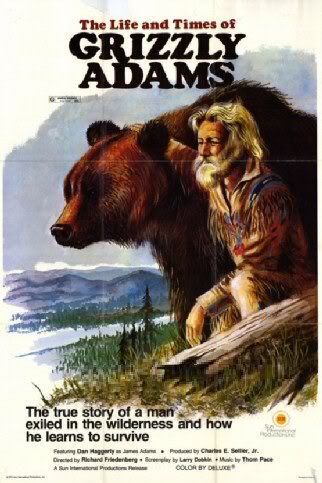
Now, if this were something we were doing as punishment for a crime, I'd say standing them out in the wilderness in Alaska may very well be cruel and unusual punishment. But we're releasing them because they're not criminals, in the technical sense of the word. Just really dangerous dudes that we can reasonably predict will become criminals if given a chance. So the Eighth Amendment doesn't apply; and if they decide they'd rather be latter-day Grizzly Adamses than residents at the Hotel Guantanamo, well, I might make the same deal if I were in their shoes.
Although brutally repressive of critics, the People's Republic of China has not managed to squelch internal criticism of its rule. One critic of the government's response to the devastaing earthquake in 2007 is a man named Huang Qi. Huang was rewarded for shining a spotlight on the PRC's inept response to the disaster by being charged with possession of state secrets (for knowing, among other things, that the government chose to let people die inside collapsed buildings rather than sending rescue teams to pull them out). Which sounds like espionage to me, meaning that Huang is facing a visit from a distinctive police van from which he will not emerge.
You can read some of Huang's work at his group's website. Not everything is translated into English, but you can get a sense of what he's doing and how he's doing it. The title of the website, 64taianwang.com, translates to "June 4 Celestial Web," in rememberance of the attacks on peaceful protestors in Tianamen Square of June 4, 1999. (I wrote about that event here, although I'm far from the only person to attempt chronicling it.)
Authorities arrested Huang, and detained him for a while. He wasn't working alone, and his friends arranged for a team of lawyers to gather evidence and mount a defense in the forlorn hopes that the trial might result in his acquittal. The lead attorney is a man named Mo Shaoping. This morning (about eight hours ago as I write) Mo was given notice that Huang's trial would start in twenty-four hours.
As any lawyer who has prepared a case for trial knows, gathering evidence and people together is a significant effort. Putting together questions and lines of attack are time-consuming activities, ones which require fairly intense thought. A man is on trial for his life and his attorney gets twenty-four hours to prepare a defense and gather witnesses. This is a farce. Huang might as well be denied a trial and the right to counsel altogether, if his attorney is going to be rendered unable to mount a meaningful defense by the arbitrary and capricious actions of the government.
Of all the things I have mused about over the past two and a half weeks concerning the truly awful things the People's Republic of China has done, I saved this one for the last. China exports a lot of products. It's not clear whether it "dumps" products or it really has a great competitive advantage over western industrial countries.
China exports its people, largely illicitly, and is a major transshipment point in the international slave trade. China is also a producer and transshiper of drugs. Both of these exports -- slaves and drugs -- represent a significant fraction of the global market in these dangerous, destructive, and contraband products. We ought not to condemn the government of the PRC, because it does not turn a blind eye to slavers or drug dealers -- it actively polices for these things and when it catches bad guys, the PRC just plain kills them.
But here's the focus -- one of China's biggest exports is weapons, and the weapons trade in China is directly with the government of the PRC, not with autonomous corporations within the country.
No western industrial nation can really criticize China for entering the world arms market -- everyone sells weapons, and nearly everyone sells weapons to other nations that probably ought not be trusted with anything more dangerous than a pointy stick. The United States is not immune from criticism with regards to the nations that we allow our arms manufacturers to do business with, although I think we're better than a lot of other nations in that regard.
I say that because compared to the PRC, we're a bunch of prissy angels with regards to our choice of trading partners. China's most controversial export is not weapons, but rather the support for genocide and other human rights abuses it extends to other nations.
Similarly, China has been untroubled by the uses to which its weapons are put in Zimbabwe, where minority and political opposition groups proposing an end to the rule of 28-year dictator Robert Mugabe have been on the receiving end of secret police squads Chinese-manufactured small arms as well as mortar shells and hand-held rocket launchers.
China's relationship with North Korea is complex, but it is not an oversimplification to say that the nations are allies. They have been allied in the past, however, and there is still a degree of geopolitical affinity between the PRC and the DPRK, two of the last remaining overtly socialist governments on Earth. Although North Korea imposes a regime of even greater brutality and cruelty than the PRC does on its own people, the styles and techniques of the two nations are similar and truly differ only as a matter of degree in terms of their focus on monopolizing political control of the nation through the deployment of force and terror upon the civilian population. China has until recently tolerated the presence of a large underclass of North Korean workers; China and North Korea share a trading relationship analogous to that of the U.S. and Mexico. China is a significant donor of unconditional food grants to North Korea; it is likely that without this food support, North Korea's extraordinarily poor and inefficient economy would be unable to feed millions of people and there would be mass starvation -- at the same time, because the food supports are there, the DPRK can concentrate its economic efforts (such as they are) to maintaining a large military. China also sells North Korea about 90% of its oil at vastly under-market prices. China does appear to be working in good faith to encourage North Korea to abandon its nuclear program, although it is an open question if China's economic support for its neighbor is not the most significant enabling factor allowing Lil' Kim to chase nukes.
I should also add that although we are technically allied with Pakistan in the Global War On Terror, China's biggest trading partner, co-developer of military equipment, and strategic ally has a significant history of internal human rights abuses and nuclear brinksmanship with rival India. Pakistan would not be so dangerous or obnoxious a regional power were it not for substantial support from China. If so, this represents at minimum a significant bending, if not outright violation, of the Nuclear Non-Proliferation Treaty.
I feel compelled to repeat myself with two important caveats. First of all, selling weapons is not necessarily a bad thing for a nation to do. The sale of weapons to other nations can be a good way to spread stability by putting military power in the hands of nations that will use it responsibly and that will become strong, reliable, and reasonably moral members of the international community. And second, the USA has in the past sold weapons to nations who have not lived up to their promises of responsible use of those weapons. What distinguishes us from China in this respect is that when it has become clear that our trading partners are not behaving responsibly with the weapons we have sold them -- El Salvador, Chile, the contras -- we have passed laws to prevent the further sale of weapons to these nations. Similar statements can be made of most European nations (although I have some doubts about the French).
China cannot credibly offer a similar defense of its weapons trade. China sells weapons knowing full well that they will be used to effect genocide, nuclear brinksmanship, and terrorism. The People's Republic is at best unconcerned with what happens in other nations, and why should it be? Like Spartans deathly afraid of their Helots, the Chinese government treats its own people as so much livestock, worrisome mouths to feed and minds to control so that there is no revolution. So the product of its highly profitable weapons sales program does not cause a moment's moral concern in Beijing -- the worst that could happen is that other nations will treat their citizens the way China treats its own.
I'm growing weary of this series of posts, to be honest with you, Loyal Readers. Losing my Tibet post into the aether of the Intertubes was a bit demoralizing, to be honest, and I think you get the point by now.
This post was intended to discuss how pervasive the Communist Party is in China. Topics of discussion were to include 1) the party's monopoly on all positions of any governmental power, 2) the party's censorship of all media to eliminate counter-cultural or disestablishmentarian messages, and 3) the network of secret police and informers that send friends and family members off to labor and re-education camps. But if you've been reading the rest of the Evil Olympics series, you've heard about all of that already. And if you haven't been reading about the Evil Olympics, then by now you aren't going to start and nothing I write will make you care.
I have, however saved one more subject for my grand finale. Read all about it tomorrow.
There are a lot of people in China. The government has been concerned for a long time about overpopulation. And it's taken action. Not as draconian as you might have initially feared, but yeah, it's still pretty bad. It wouldn't affect me personally were I Chinese, but the point about caring about people's rights is you have to care about everyone's rights, not just your own, or they're not really meaningful at all.
A Chinese couple is allowed to have only one baby. If a couple has more than one baby, it must pay a "social maintenance fee" which we would call a "baby tax." The fines are adjusted annually and at the provincial level, and adjust upward depending on the number of siblings that a new baby has. The "fee" is quite steep, usually amounting to the entire amount of disposable income of an average two-income couple in an urban area or the entire cash product of a rural couple's annual labor.
As with all laws and policies that are implemented and enforced at a local level, there is variance from place to place in how things happen. Some areas are lax in enforcement -- these tend to be rural, agricultural parts of China, where the new children are seen as providing agricultural labor for the future and are therefore welcomed. But in urban areas, this policy is more rigorously enforced, and that's probably where the policy is "needed" most -- urban dwellers consume food, rather than produce it. Different provinces have different policies about children from families that have split up due to divorce or widowed parents who remarry.
It does not seem to be the case that second and third children are denied social services, education, health care, or the other kinds of benefits provided to other children in China. Many rumors to that effect float around the internet but I have not found any substantiation of them.
Although the "one child" policy was implemented nationally in 1979, there had been efforts by the government to discourage fertility from the latter days of the Cultural Revolution in the 1950's. A common slogan many older Chinese can repeat to you is "One is good, two is okay, three is too many." (Apparently it rhymes or otherwise sounds cool when you say it in Mandarin.) The slogan was bombarded on people all over, from radio and TV to newspapers and posters around town. I get the impression that this family planning slogan is the Chinese equivalent of "Tastes great! Less filling!"
Along with the fees, the government also overtly encourages the use of various kinds of contraceptives, including birth control pills (which are available at a dramatically subsidized rate), condoms, IUDs, and contraceptive abortions. This pastiche of population-control policies has been more or less successful, as negative population growth is noted in many areas of China. Overall, the population of China continues to rise, but much less slowly than in many other industrialized areas of the world. 10% population growth will take China twenty years to realize; other nations can expect a rate of growth two to three times faster than that.
Adoption is one way out of the problem for some parents. All over the world, people who cannot afford to raise children offer them for adoption, and all over the world, other people who for one reason or another step in and adopt them. The Chinese government encourages this to a significant degree, both within China and to make Chinese babies available for adoption to foreign nationals. However, no tax breaks are given to the parents of children who offer their babies for adoption; that birth still counts for later potential liability for the baby tax.
If you are the sort of person who thinks abortion is bad, then this policy is something you will rush to condemn. (If you are the sort of person who thinks contraception is bad, then you will be beside yourself with rage.) I am not the sort of person who thinks abortion is bad (most of the time) but nevertheless, I also think that as a basic human right, you should be able to have children if you want to have them. A lot of people find that reproduction is an urge, a need, and they feel compelled to go out and make babies. This is a good thing in that it helps provide for the future, of course -- and I say, you get to decide when and how many babies you make, not the government. It's hard to imagine a much more personal sort of choice to make, and it's obnoxious that the government of China arrogates to itself the role of making such decisions for its people. Encouragement to a desired policy? Sure, that would be okay in my book. But the use of direct and powerful economic incentives is something else entirely.
I think that everyone, whether pro-choice or pro-life, can agree that forcing a woman to have an abortion is very, very morally offensive. This has not been unheard-of and happens to a small but appreciable extent even today. One suspects that the women forced to undergo abortions (a few of which have taken place during labor or even after birth has been given, which should probably be labeled "infanticide" at that point) at the hands of oppressive and intrusive police (and Party minders) are the ones who are otherwise branded "troublemakers" for political dissent or non-standard lifestyle choices. Artists, for instance.
There is also a phenomenon that China is only now starting to understand -- it has been called the "4-2-1 problem" by some and the "little emperor" syndrome by others. "4-2-1" is easy to understand -- a family now means four grandparents, two parents, one child. Children grow up without brothers and sisters to compete for family resources, so when they are young and the parents and grandparents are all working and earning income and other state support, a tremendous amount of resources can be put into a child by the family. But as the grandparents retire or die, and the parents age and need care from their children, there are fewer people to spread the burden around to. And if negative population growth is realized and sustained, China will confront a generational issue familiar to Americans today -- what happens when the larger, older generation starts to retire and the economic burdens of sustaining the country fall on smaller numbers of people? We don't know how to maintain our old age pension system (Social Security) in the face of baby boomers retiring and baby busters now being the focus of the workforce. China will face a similar problem in the future; indeed, its baby bust problem will likely be more dramatic than ours.
Parents are also subject to various kinds of genetic screening; those who are considered likely to pass along problems to their children -- from schizophrenia to serious genetic diseases like Huntington's, are given much heavier "fees" to pay if they have any children at all. The list of "imperfections" rendering parents susceptible to the enhanced baby tax is expanding and now includes dyslexia -- nearsightedness and crooked teeth surely cannot be far behind.
And finally, China's social structure is such that males are valued more highly than females. The pride of a traditional Chinese family is its eldest son. This is not so different from traditional societies around the world. But it can create something of a disappointment if the one "free" child a couple gets turns out to be a girl. And statistically speaking, about half of them are girls. More than three-quarters of all babies adopted by foreign parents out of China are girls. The result is that the next generation of Chinese is going to be overwhelmingly male. There are many stories of gender-selection abortions and exposure of girl-children to the elements so they die; it's hard to say to what extent that sort of thing actually happens. Lots of girl-children go missing in China; many fewer boy-children do.
"Overwhelming" doesn't sound like much at first glance -- in 2000, the sex ratio for live-born babies was 117 boys for every 100 girls. The trend preceding that benchmark in 2000 was increasing dramatically and it is currently thought that the ratio is about 125:100, which reduces down to 5:4. Again, 5:4 doesn't sound so awful, until you realize that we're talking about a nation of 1.2 billion people. One-ninth of 1.2 billion is more than 133 million "surplus" men. And what does a society do with its surplus men? It makes them into soldiers.
If you don’t remember the Tank Man, watch the video below. If you’re too young to remember the Tiananmen Square protests of 1989, then you must watch the video. If you have managed to stumble on this blog from China, please watch the video. Remember what he did. I write to help you remember why he did it -- I say he is the greatest hero in China's five-thousand year history.
At the end of his hundred and fifty seconds of distilled and pure bravery, a number of other people came out and grabbed him and pulled him out of the way of the tanks. He seemed to go willingly and these people do not appear to have been police. They seem to have been people who became convinced that this guy was about to get shot and tried to save his life. They may have been his friends; they may have been strangers to him. Here's the background.
On April 15, 1989, young people, particularly including college students, began gathering in public places around China. The protests were precipitated by the death of the former Secretary General of the Chinese Communist Party, Hu Yaobang. Hu had, in his years after stepping down from party leadership, condemned the harsh and authoritarian practices of the government under the stewardship of Deng Xiaoping. Hu openly admired the policy of glasnost pursued by Mikhail Gorbachev in the Soviety Union and called for implementation of “rapid reform” of the Chinese government. Because his policies were seen as critical of Deng and his clique of pro-authoritarian leaders, Hu had been forced to resign and to publish a humiliating “self-criticism,” which was circulated as another example of the evils of the repressive regime within the universities of China. So his death marked an opportunity for pro-democracy students to stage public memorial services in his honor.
Starting early on April 15, the day he died, and gaining force over the next several days, students began to congregate in Tiananmen Square, and by April 18, 10,000 of them demanded that the government revise the official obituary of Hu. For a day or so, they were dispersed, but after Hu’s funeral, more than a hundred thousand protestors gathered to march back on Beijing’s only major open space near the centers of government.
This was thought by the government to be too many people to disperse using the city’s available police force. So the government tried to use its favorite weapon – propaganda. Official state newspapers distributed an op-ed piece written by Deng, who wrote:
This only added fuel to the first and half again as many people came to Tiananmen Square to raise their voices in favor of reform and against repression. Some leaders emerged out of the crowds, and they issued a written demand to the government for freedom of the press, an end to corruption within the state, the resignation of Deng Xiaopang, and abolition of the Chinese Communist Party.
When propaganda did not work, the Party tried persuasion (and, we may assume, some level of intimidation as well). Protestors were identified as much as possible and overt representatives of the Party were sent to go speak with their families. Although the official line is that the Party tried to explain what kinds of benefits would be available to the protestors if they gave up the ghost and returned to their daily, ordinary lives, it seems safe to assume that along with the many carrots dangled there were also a few sticks raised. Implied in promises to provide medical care for ailing family members and opportunities for further educational and career advancement are the threats that such benefits can be withheld.
But this national network of party activity was so extensive that it actually strained the resources of the party and its network of informants and secret police (many of whom could not be contacted and activated for fear of revealing their identities to the friends and family they were supposed to be spying on. So party apparatchiks who were tapped to do the work were diverted from their main jobs of censoring the media. Although it took the Chinese media a few days to realize that suddenly, their minders had left them unattended, they figured it out soon enough and began broadcasting live coverage of the protests in Tiananmen Square across the country. This would prove decisive in making the protests a truly national symbol and a truly national crisis.
The protestors were, by contrast to what we might expect to have seen in Europe or the United States, orderly and law-abiding. There was peace, and the majority of the crowd demonstrated great respect to the government by seizing and handing over to police on the fringes of the square a man who, in an excess of contempt, had thrown ink on a poster of Mao Zedong. On the day that Mikhail Gorbachev came for a previously-scheduled state visit, the protestors sang socialist songs.
The hunger strike began at some point in mid-May. The leaders of the protest began to not eat and display their starvation to show solidarity with the lower classes of the cities, who they claimed had been neglected by a corrupt and elitist government. When Gorbachev came, the world media came with him and extensive coverage of the protests was broadcast around the world. Gorbachev had his meetings and left, but the global media stayed on to cover this most dramatic of events -- China appeared poised on the precipice of a popular revolution.
Immediately after Gorbachev departed, a significant dispute about how to handle the protests arose within the ranks of the governmental leadership. One faction, led by a Hu’s successor Zhao Ziyang, urged a soft response, while another group, led by Li Peng, urged a forceful crackdown. Zhao went so far as to wade into the protests with a megaphone, urging the students to end their hunger strike and not give up their lives so cheaply. The point at which he probably cut his own throat politically was when he told the protestors to look to their own futures, saying of his generation (the ones holding the reins of power), "We are already old, it doesn't matter to us any more." It mattered to Li and his group, and they eventually persuaded Deng to go along with their preferred response to the situation.
Li had martial law declared on May 20, 1989. Zhao protested that this was not necessary, and Li called for a vote of no confidence. Zhao lost and was unceremoniously ousted from power. However, the heavy-handed consolidation of power in the hands of the hard-liners threatened to cause rifts in the army itself; the regular army detachments stationed near Beijing were thought to be sympathetic to Zhao and unreliable against the civilian protesters now blocking entrance into the city as part of their demands for democratic reform. So the 27th and 28th People's Liberation Armies, which then combined infantry and armor divisions based in a more westerly province, were mobilized and given orders to enter Beijing and restore order.
On May 29, a statue, called the “Goddess of Democracy,” was brought into the square, to the amazement of the international media. She was more than thirty feet tall and constructed of papier-mache over a light metal skeleton by art students at Beijing Central Academy of Fine Arts. The government threatened to take the license away from any truck driver who hauled the Goddess to Tiananmen Square, so the art students hired six rickshaws instead. For six days, the Goddess held court in Tiananmen Square, and something like three hundred thousand people gathered in the square to see her unveiling. The sculptors of the statute proclaimed at the unveiling:
At this grim moment, what we need most is to remain calm and united in a single purpose. We need a powerful cementing force to strengthen our resolve: That is the Goddess of Democracy. Democracy…You are the symbol of every student in the Square, of the hearts of millions of people. …Today, here in the People’s Square, the people’s Goddess stands tall and announces to the whole world: A consciousness of democracy has awakened among the Chinese people! The new era has begun! …The statue of the Goddess of Democracy is made of plaster, and of course cannot stand here forever. But as the symbol of the people’s hearts, she is divine and inviolate. Let those who would sully her beware: the people will not permit this! …On the day when real democracy and freedom come to China, we must erect another Goddess of Democracy here in the Square, monumental, towering, and permanent. We have strong faith that that day will come at last. We have still another hope: Chinese people, arise! Erect the statue of the Goddess of Democracy in your millions of hearts! Long live the people! Long live freedom! Long live democracy!
The 27th People's Liberation Army arrived on the scene on June 2. Its entry to the city was actively resisted by civilians, who overturned buses and other cars and set them on fire to prevent the entry of the military vehicles. The 27th responded by shooting tear gas and live ammunition into crowds of civilians, and firing tank shells at oncoming vehicles and the makeshift barricades. Awaiting arrival of the lighter infantry from the 28th PLA, the armored columns positioned themselves strategically throughout the city, encircling Tiananmen Square and the universities. There were some civilian victories caused by the massive number of protests -- one armored personnel carrier was actually overturned by a mob and set on fire; the soldiers inside were killed by the mob.
In the square itself, black armbands began circulating amongst the protesters, and some slipped away in fear of what might happen next. They were prescient. The first wave came in the form of a light infantry maneuver on the morning of June 3, from three armored personnel carriers deployed at the primary entry and exit points for the square. The soldiers were given orders to fire on the crowd, and they executed them. When they ran out of ammunition, they conducted bayonet charges. Some print reporters described seeing soldiers with AK-47s hosing down the crowd with live fire. Some sought refuge from the hail of bullets and blades in the makeshift bus barricades; when the soldiers approached and removed these people, they were savagely beaten with truncheons, and much of this violence was captured on video. (You can find it on the internet if you care to look for it; I'll not embed it here.) Some of the protesters fought back with Molotov cocktails, but there were few, if any, firearms.
Once the firing began, the streets surrounding Tiananmen Square cleared in a hurry. That's when the tanks moved in. An American reporter on the scene described seeing tanks actually crushing protesters to death under their treads. By the early morning hours of June 4, Tiananmen Square was cleared. Hundreds had died in the square, and thousands more -- their parents, who came hours later to try and find their missing children -- were fired upon indiscriminately, in multiple waves, by the infantry occupying the square. The soldiers killed the driver of an ambulance that came to tend to the wounded. The China Red Cross initially published a figure of 2,600 dead on June 4, but that figure was retracted after the government threatened to arrest the leaders of the China Red Cross. The official figure is about 200 dead and about 500 wounded on June 4 in Beijing. It is thought the true number of casualties is between 7,000 to 10,000.
Scenes of slaughter like this were replicated in every city in China on June 4. No one knows how many people died, how many were shot and wounded.
More tanks and infantry continues to pour into the city as the remaining portions of the 27th and 28th PLA arrived on the morning of June 5. That's when Tank Man stood in front of the advancing column and, armed only with what looks like a shopping bag or a briefcase, briefly caused an advancing column of armor to stop on its deadly mission.
Newsweek photojournalist Charlie Cole is morally convinced, but lacks hard evidence to prove, that Tank Man was taken away from the scene by secret police, and executed within a few days of his unbelievable showdown. Other journalists who were on the scene point out that the people who took Tank Man away from the advancing column did not use physical force but instead guided him by the arm, a degree of gentleness unlike the more violent means employed by police when apprehending someone. A government official could not identify him when challenged by Time Magazine to do so, offering only the comment "I think never killed." Cole's leads have suggested Tank Man's name was Wang Wei Lin, but he cannot confirm that. Another author researching the incident came up with the name Wang Ai-Min, but again, this relies on some dubious sources. Regardless of his name, if those were secret police who spirited the man away, it's hard to imagine that he was not executed. China was put under intense diplomatic pressure to prove that the man was still alive and all right after things calmed down, and it has never done so.
But it's hard to say. We should not forget that the protests in Beijing were being duplicated in nearly every major city in China at the time. This was a very serious crisis -- not just several hundred college students smoking dope and engaged in hippie talk. Literally millions of people were demanding the immediate deposition of the government and its leaders. Cries of "down with the government" and "fascists stop killing" were frequently heard in protests around the nation. Deng and Li were right about one thing -- China was on the brink of a revolution. Tens, if not hundreds, of police and soldiers were killed by pro-democracy protesters.
Had a charismatic leader with sufficient ambition stepped forward to lead it, it seems likely that portions of the PLA would have defected to the rebel side and there could very well have been civil war. A possibility exists, we will never be able to know how probable, that this revolution could have actually succeeded. The PRC may well have found itself deposed and replaced with a new form of government -- one that would have had to have been more democratic than its predecessor, based on the strength and pervasiveness of the protests.
But that did not happen. The bad guys won. The Goddess of Liberty was rolled underneath the treads of a Chinese tank.
They won through the direct and brutal application of military force on innocent civilians. More people were killed trying to find loved ones in Tiananmen Square than had been killed in the square itself, even when soldiers were hosing down the crowd with automatic weapons. Parents paid a higher price in blood for daring to approach the square to learn their children were still alive or slain at the hands of their government than did the students who had been at the receiving end of the AK-47s and bayonets earlier that day.
They won by arresting a significant number of the intelligentsia that had formed the original core of the democracy movement. Thousands of college professors and student leaders around the country were rounded up and arrested, never to be heard from again. Many were able to plead for exile instead, and all have been refused re-entry into China to this day, even for short visits with their families.
They won by executing tens of thousands of arrested protesters from around the country after trials in kangaroo courts lacking even the most rudimentary forms of due process.
They won by purging any hint of sympathy for the protesters from within their own ranks. Zhao was not only stripped of his position within the Communist Party, he remained under house arrest until his death in 1991. Other reform-sympathetic leaders within the Party were arrested as well until they wrote public "self-criticisms" and other statements describing how they had "changed their minds" about the events of June 1989, and assigned to mid-level jobs in the western provinces. Journalists who expressed emotions of sadness or regret for the executions were fired from their jobs in state-run media.
They won by purging the event from their nation's history. No one will talk about the Tiananmen Square massacre. Discussion of the summer of 1989 is not permitted in schools or universities. Simply put, the PRC has marshaled all of its available resources into attempting to erase the memory of those days from its history in an eerie replication of Winston Smith's job editing history books for Oceania in George Orwell's dystopian novel 1984. Journalists touring Beijing University have shown pictures of the Tank Man facing down the armored column to students in 2006, to be met with blank stares and uncomprehending comments. They'd never heard anything about Tiananmen Square as the site of a protest against the government. They have heard of the chaos and violence of the Cultural Revolution, but the Revolution of 1989 is, for them, a purely European even; what happened then is dismissed as an insignificant counterrevolutionary demonstration of a small group of malcontents. An anniversary protest in Hong Kong just ten weeks ago was reported in mainland China as a rally in support of the earthquake victims in Sichuan. If you grew up in China in the 1990's, you might never know it happened at all.
The bad guys won. They killed so many innocent people, people who wanted the freedom to think and write as they chose, people who wanted the right to vote for their own leaders, people who wanted a government more or less free from corruption and one-party control. Things that most Americans take for granted.
I haven't cried much when writing this blog, ever. I can't help but cry putting these words down, re-learning better now what was learned twenty years ago through shadows and fog and clouds of gunpowder. China's leaders may try to edit Tiananmen Square from their country's official memory. But let the rest of the world never forget it. If I haven't made you cry about this, this episode of Nightline will.
Tank Man is a profound symbol of protest to repression. He demanded something from the tank – he is visibly shouting at the tank, asking a question or telling the tank to go away. I have always fancied that he said something like “Get out of my city! You’re not going to drive into the Square and attack all those kids!” And despite everything that had happened already, the tank driver hesitated, at least three times. For a few unbelievably pregnant seconds, the overwhelming military force of a brutally repressive government was stopped, by common decency, and nearly toppled a government.
Tank Man stands for all those kids, all those young people, all those Chinese citizens who stood up to their evil, repressive government, built a Goddess of Democracy and for seven glorious weeks made the Revolutions of 1989 a global, not just a European, world event. His identity has been lost to history forever, but if there was anyone, anywhere, who deserves the Big Brass Ones Award periodically dispensed from this blog, the Tank Man is him.
Hailed by some as a miracle of engineering, the Three Gorges Dam is the world's largest hydro-electric power generator, which when it is fully operational will produce 22,500 megawatts of electricity -- this is more than would be generated by twenty nuclear plants. If it had been done right, I'd be ready to hand huge kudos to the PRC for creating a source of power that massive, causing that much relief on fossil fuel burning plants, and being able to build it in the first place. I don't think the government of China was "evil" in the same sense that it is evil in its mind control practices and its zest for inflicting violence on its own citizens. Something on this scale cannot be anything but morally ambiguous and to be fair, we should not lose sight of the fact that the dam will generate a lot of power without leaving radioactive waste or pumping pollutants into the atmosphere; we should appreciate the engineering and innovations that led to its creation. But like nearly everything this authoritarian regime has attempted, the unthinking adherence to the commands of Mao, who originally ordered construction of the dam in 1949, has not been rationally considered in light of what is known today and were the project to be proposed now, it would have been dismissed as carrying too heavy a price tag. But because the dam was a dream of Mao's, the government has been all too willing to pay heavy prices in other arenas to achieve a single goal, and the most heavy price paid is human. Much electricity will be generated and commerce to the fabled city of Chongqing will be facilitated, but the government has dismissed an incredible amount of damage done by the many, many unintended consequences of the flood.
At a small town formerly known as Sandouping, the dam rises across a narrow portion of the Yangtze River Valley just downstream of a point where two large tributaries enter the river. The water began to accumulate in 2003 and as of this year, the lake created by the dam extends nearly four hundred miles upriver and the lake's deepest point is now more than 600 feet. Trillions of gallons of muddy water now make up this incredible flood. 1,400,000 people have been dislocated by the project, which has flooded prime farmland in the Yangtze River Valley. Thirteen cities, 140 towns, and over 1,000 villages were all moved because they were in the flood zone. For some of the displaced people, new housing above the flood zone was created, which involved displacing even more people. Others migrated to larger coastal cities to seek their fortunes there. No one was given all that much choice in the decision to move; it is not clear who was permitted their preference between remaining in the area or participating in the urban migration. And if you got migrated, you got screwed -- quoting from one human rights report:
Compensation offered to resettlers has fallen short of the replacement cost for their property. Instead, they are forced to buy housing at a cost that far exceeds the compensation they have been offered.
The land and jobs that have been promised to resettlers from rural and urban areas are no longer available. Where land has been offered, it has often turned out to be of inferior quality.
While approximately 500,000 people have been resettled to other areas in the Three Gorges region, more than 100,000 people have been forced to leave the Three Gorges area altogether.
Local authorities appear to have diverted a large part of the resettlement budget into unrelated infrastructure projects, using funds intended for household compensation on projects like hotels and roads.
According to the report, there is a “widespread belief that local officials have used the project as an opportunity to fill their own pockets.” Many cases of embezzlement of resettlement funds have been documented.
No independent grievance mechanism exists, and the resettlement process is conducted “in an atmosphere of officially orchestrated secrecy and intimidation.”
The police have used “excessive force” to quell the numerous protests against the resettlement problems, and the Three Gorges Project has become “an instrument of repression with widespread human rights abuses.”
Many of the people who wound up going to an urban area wound up in Chongquing, which has suffered a significant infrastructure strain and housing shortage as a result of the hundreds of thousands of people who have moved there. We will never, ever know how many people were rendered homeless by the flood.
In those cities and outlying areas were quite a large number of medium to heavy industries, including steel foundries, soap plants, and paint factories. Also in the more rural areas that have been flooded were some of the best farmland on the planet. All of this has been submerged. The loss of the farmland is regrettable because it increases the strain on China to produce enough food to feed all of its people. But this is nothing compared to the problem of the old industrial sites -- they are filled with a wide variety of toxic chemicals, heavy metals, and petroleum products. Some of this was cleared away before the flood. A great deal of it was not. A great deal more was trapped in the soil, which now will become silt and sediment at the bottom of the lake, agitated by shifting and changing currents and by the boats which now ply the river overhead. Consequently, materials like mercury, arsenic, phosphates, palladium, and benzene are all mixed with the lakewater and being discharged into the lower Yangtze river, there to wash out to sea. About a third of the water entering the reservoir is discharged from sewage treatment plants that inadequately filter... contaminants, shall we say. The million-plus residents of the cities of Wuhan, Nanjing, and Shanghai (each city has populations of over nine million; Shanghai's greater municipal area is estimated at nearly twenty million) all use the lower Yangtze as a primary source of drinking water; it is not clear how much of this stuff can be filtered out or whether it is even being filtered at all since no one is quite sure what is in the water anymore. And it's not just people who drink the water; some ecologists estimate that as many as a million pounds of fish and other sea harvest will die every year for the next twenty years, killed off and no longer breeding new fry, and putting further pressure to feed the 1.1 billion Chinese citizens who rely, in no small part, on the bounty of the sea. It remains to be seen how many people will be killed, either of toxic shock or starvation, by the poisons unleashed in the flood.
Some of the world's most amazing scenery -- the famous green-covered rounded mountain pillars of the Yangtze -- have been submerged in the name of industrial progress. These picturesque scenes have been replaced by 100 to 200 meters of water. This, by itself, might not be so awful, but along with the loss of the view, wetland areas used by a wide variety of birds have also been destroyed, raising substantial concerns about their ability to survive their annual migrations. Already lost are a species of river dolphin; the only surviving specimens are in aquaria and can no longer survive in the river because of habitat loss, temperature changes in river water and the disruption in their food supply. That food supply includes the fit-for-human consumption Yangtze Sturgeon, which will no longer be able to migrate from winter feeding grounds near the ocean to summertime molting grounds upstream to breed. It is not clear how the sturgeon will survive in the Three Gorges Reservoir without their food supply that in the past has included food found in abundance only towards the mouth of the river. The next candidate for extinction is the already-threatened Siberian crane, whose migratory patterns (for the eastern flock) included several days of layover in the wetlands that have now been lost to the flood.
Culturally, the Chinese drowned a huge amount of their heritage. The river valleys were the places were civilization first arose in China and there are countless burial sites and archeologically important areas. All of the raw information that could have been gained about early civilization in the area is now lost forever. Of particular interest were the hanging coffins of the Bah people, who inhabited the valley about 3,000 years ago. It was their custom to bury their dead in hollowed-out logs attached to the cliffs of the gorges; some coffins have been preserved for museum display but thousands have been lost to the flood.
Did it all need to be done? Perhaps. The dam will account for about 3% of China's overall electric use when it reaches full capacity; total hydroelectric power in China is projected to make up something like 10% of China's total supply by 2020 and this is a third of it. If that number seems small, bear in mind that China will have to provide electricity for 1.3 billion people and their employers by that time. It's a huge amount of power being generated, and in theory, the power does not generate pollution. But, because inadequate cleanup of the valley floors, the river and the South China Sea will have to deal with elevated levels of all sorts of heavy metals and toxins for years to come, all washed downstream by the waters of the flood.
And the earth will have her revenge on the water, sooner or later. The effectiveness of the dam will ultimately have to face its greatest test in the form of silt. Downstream of the dam, flooding will be controlled well by the new structure, but upstream there continue to be periodic rainstorms and the flooding they cause. This kicks up large amounts of silt, and now that the flood waters are higher, there is new much dirt for nature to erode and to deposit in the lakebed. Like everything else in the lake, the silt will gradually make its way downstream towards the dam. No one knows exactly how much or how fast it will move, but it is certain that the silt will diminish water pressure behind the power intakes for the electric generators. Particularly worrisome are large rocks displaced from the steep cliffs, which will eventually roll downstream with the currents; these cannot be moved or displaced with the same kind of tools as particulate mud. The more silt, the less electricity. Silt also is an impediment to navigation, of course. And the lack of silt resupplying river banks downstream raises the risk of soil subsidence, landslides, and destructive erosion downstream as well, putting something like a hundred million people living downstream of the dam at risk. as the silt moves downstream with the rest of the flood.
Why did all of this happen? Could the government have prepared for these things better? Obviously, it could have done so in retrospect. But the project had earned criticism for ten years from the outside world, and all of these issues had been raised in international forae then. Internally, though, critics of the Three Gorges Dam found themselves silenced and steered away from positions of influence over the project. Now, even the government has been forced to acknowledge that they have a tiger by the tail and a wide variety of problems could result if anything goes wrong with the dam. It is a shame that the authoritarian form of government that prevails in China did not allow for free public debate about so momentous, complex, and expensive an undertaking. Let us all hope, for the millions downstream, that the dam never breaks, because not since the Black Sea was created in an earthquake will any human being have seen such a flood.
Traditionally, Chinese society takes a dim but not completely negative view of homosexuality. The begetting of children, particularly sons, is a duty of a good Chinese man; this is reinforced by Confucian and Taoist teachings. So traditional morality in China takes a generally dim view of homosexuality; even cross-dressing can be considered morally unacceptable because it disrupts and challenges traditional gender roles in society at large. However, it should also be noted that homosexual acts are not "sins" in Confucianism or Taoism they way they are in the western monotheistic traditions; they are rather considered diversions from more productive or dutiful sorts of tasks. A man engaged in sex with another man could be having sex with his wife to father children, and therefore his neglect of his duty is the same as if he had been gambling or drinking too much.
I should also note that there is a substantial tradition of same-sex love in ancient Chinese literature and some scholars have suggested that homosexual acts for recreational sex were condoned in the Imperial court during the Han, Song, Quin and Ming dynasties. To that extent, homosexual affairs were sometimes seen as fashionable and elite sorts of activities, and one can imagine that as with all people, everywhere and at all times in history, when elites engage in a particular kind of behavior, some of the people below the the elites in social status will emulate them as a form of aspirational behavior.
In modern China, these traditional attitudes sharpened to a significant degree after the Cultural Revolution in 1949. For thirty years, homosexuality was outlawed and people who were openly homosexual were rounded up and sent to psychiatric treatment clinics where they were supposed to be "cured" but instead subjected to a variety of extraordinarily cruel and sometimes violent forms of aversion therapy.*
In recent years, the situation has materially improved and this is an area in which some genuine credit must be given to the PRC's government. Sodomy was decriminalized in 1999 and the reprogramming clinics were all shut down in 2001 when the government removed homosexuality from its list of recognized mental disorders. Gay pride parades have been permitted and gay-bashing is rare. It seems that younger generations of Chinese are tolerant of homosexuality, at least in the abstract.
However, state-run media outlets routinely censor any kind of entertainment or film coverage depicting homosexuals, whether in a good or bad light. Popular movies, like Brokeback Mountain, are not shown (openly) in China, although it seems possible for a consumer there to get a DVD of such things illegally. (There was great interest in Brokeback Mountain because the director, Ang Lee, is a world-renowned filmmaker of Chinese ancestry who also directed the immensely popular Crouching Tiger, Hidden Dragon). A popular story of two men struggling against official and social condemnation of their love, Lan Yu, was filmed in Taiwan but possession of a copy of the movie will earn the owner a substantial fine and, of course, confiscation of the contraband film.
There is still generational tension and attitudes about homosexuality are far from uniform. In that sense, China seems to be not unlike the rest of the industrialized world -- speaking very generally, the older generations take a dimmer view of it and individuals' tolerance varies widely. At first blush, it seems that gays in China face similar sorts of social pressures to remain closeted or to come out as they do in America or Europe. However, some activists complain that the social pressures in China are much stronger than in other industrialized countries, and therefore a large number of people remain closeted, even to the point of having heterosexual marriages to conceal their true preferences. It is hard to say to what degree that is true, since closeting of this degree inherently involves people who do not want to be identified.
The judicial system in China appears to be lagging behind evolving social attitudes about homosexuality. Some local law enforcement officers continue to harass homosexuals and in parts of China, particularly in rural areas, gay people continue to risk arrest for associating with one another or failing to conceal their identities. Gay rights activists claim that gay people convicted of crimes receive harsher sentences than straight people convicted of similar crimes. In October 1999, a court in Beijing issued an opinion condemning homosexuality as "abnormal and unacceptable to the Chinese public," and this opinion was allowed to stand on appeal to the People's Supreme Court.
AIDS and HIV have only very recently been recognized as significant health problems in China, and the government has been quick to identify "men having sex with men" as both at heightened risk for the disease and as vectors for its transmission. Although initially slow to react to the arrival and spread of the disease, the government is now taking action to provide education, distribute condoms, and treat those afflicted with the virus.
Gays certainly aren't going to get married any time soon; gay marriage legislation has been introduced and roundly thrown out of the National People's Congress twice, in 2001 and 2003, and the National People's Congress has shown no interest in revisiting the issue since. Being openly homosexual is also still grounds to deny a Chinese person the ability to adopt a child.
Hong Kong and Macau are a little bit different. Homosexuality seems to be well-tolerated in Macau and there have not been official laws against it since the Portuguese yielded administration of the "Las Vegas of China" to the PRC. Hong Kong had anti-sodomy laws until 1991, with punishments ranging up to life imprisonment, but the laws were almost never enforced and were taken off the books in 2005 by a prominent court case.
I started researching this subject thinking that I would wind up with another roundhouse condemnation of the PRC government, but I cannot justify such a thing. The government of China seems to be much more ambivalent than that and to some extent, the official policies of nondiscrimination and equal treatment appear to be both facially similar to those that prevail in some portions of the United States, and they appear to be treated with similar gravity by some -- not all -- government officials. Others seem to hold on to traditional prejudices against homosexuality, but again, I can't sit here in modern America and say the Chinese are necessarily any worse or even on balance very different from my own society in that regard.
So in answer to the question, what's it like to be gay in China? The answer seems to be that it sucks to be gay in China. But it sucks to be gay in the US, too. China has relatively escalated social pressure to remain closeted and discreet as compared to the US, so the difference in suckage is one of degree rather than kind.
* Some similar techniques are used in "gay deprogramming therapy" in the U.S. today.
Intellectual property is important because it is how a culture is created in a capitalist society. It is how technology is encouraged to advance. It is responsible for the countless innovations and richness of our lives. Respecting and enforcing the intellectual property of others -- copyrights, patents, trade secrets -- is fundamental to the value of our civilizations.
In that sense, China is a different civilization than ours. In theory, the PRC is a member of the World Intellectual Property Organization and therefore it is charged with enforcing internationally-registered copyrights, trademarks, and patents consistent with the Berne Convention for the Protection of Literary and Artistic Works. And in 1998, special intellectual property courts were created in China to attempt enforcement. The problem is that limiting control of particular works to the artists who created them (so that they can be exploited for profit for a time) seems to be a concept foreign to the PRC. I cannot determine whether there is simply a lack of education about it, or some kind of a a cultural incompatibility with the concept.
But foreign businesspeople seem to repeat, again and again, that when they discuss the idea of copying the intellectual work of someone else as a moral wrong, their Chinese counterparts return blank, uncomprehending stares -- they simply don't get it. These are ideas, not property, they seem to think; how can anyone own an idea like "beauty" or "efficiency"?
It seems that while the leadership of the country wants to make a show of trying to enforce intellectual property laws, but there is no real desire to do so, no real understanding of why it is important other than that all of China's Western trade partners seem to think it is terribly important.
So China remains high, and maybe even still atop, the list of nations where intellectual piracy is an industrial-scale problem. Pirated movies, albums, books, software, handheld electronic devices, and counterfeited designer merchandise of all sorts are openly manufactured and sold both within China and exported for sale on street corners as far away as Kansas City and Pisa. Chinese-hosted websites remain the primary nexus for file-sharing, and the masters of these websites possess sufficient technical skill to hide themselves from the simple sorts of traces that all but the most sophisticated enforcers might use. There is no will on the part of the Chinese government to expend the resources necessary to rigorously police its own corners of the internet for this; they are too busy clamping down on criticism of themselves to bother with what, in their hearts, they consider to be legitimate businessmen.
The outsourcing of much legitimate reproduction work to the tens of thousands of companies in China -- reprinting authorized DVDs of videos, for instance -- has led to the creation of an industrial infrastructure that lends itself to the quick, inexpensive, large-scale, and anonymous piracy of newly-released artistic works, to the substantial financial detriment of the artists who created them. New music CDs and new movie DVDs (the latter of which are frequently of movies still in theaters in the U.S.) can be had for as little as one U.S. dollar on a Beijing street corner -- although I'm willing to bet that most of those "merchants" have been shuttled away from sporting, media and housing venues by authorities acting at the direction of the image-conscious Communist Party authorities during the Olympics.
Don't believe me? Ask the U.S. Government, who characterizes the problem in China as "improving" but still "serious" and a "priority" for future enforcement efforts.
What, after all, can one say about a country whose tradition of counterfeiting the intellectual and cultural achievements of others is so rich that it enjoys its own epithet? The phrase "Chinese copy" means to crudely reverse-engineer a device without gaining any understanding of the science or concern for precision that may have gone into an original. The People's Republic of China has been doing this for well over a hundred years, particularly with military technology from the west -- one remarkable example includes the startling resemblance of the PRC Tu-4 bomber to an American B-29. A government may lead by example as well as by enforcement of laws.
To some extent, we have to allow for China, as a sovereign nation, to set its own agenda for priority in law enforcement and to choose for itself the way it will govern these issues. But particularly if China is going to sign off on international treaties promising the rest of the world that intellectual property rights will be enforced and valued within its borders, and we do business with them concerning these valuable commodities in reliance on those assurances, we have a right and a reasonable expectation that the Chinese will do what they promise. And we are entitled to maintain our beliefs and priorities, too -- if China is a land with a high incidence of intellectual property theft, chalking up that theft to a "cultural mismatch" is only worth so much.
One wife, two dogs, two cats. Childless by choice.
Attorney (licensed in California and formerly in Tennessee). Aspirations to the bench.
Likes: professional football, cooking, good wine, bad science fiction movies, long walks on the beach.
Dislikes: People who struggle to accomplish tasks of ordinary difficulty, most country music, willful ignorance, magical thinking, and weak-ass barley pop beer.
Q: Why do you write under a pseudonym? And why did you pick “Burt Likko” as that pseudonym? A: If I were writing under my real name, I might have to be more circumspect in offering provocative opinions. “Burt Likko” is an inside joke left over from an old friend of mine’s name being mangled by a careless person over the phone. If you don't get the joke, you aren't intended to. Move along, please.
Q: Where have you been transplanted from? A: I started out in California. Then I went to Tennessee. Then I came back to California.
Q: What’s the “Potted Plant” thing all about? A: The phrase “not a potted plant” comes from a famous quip made by a prominent lawyer named Brendan Sullivan while representing Oliver North, before a Congressional hearing in the late 1980's. It stuck with me.
Q: Why do you write such long posts? A: Not all my posts are long. But when I start exploring an idea, I want to do it completely.
Q: How much time do you spend writing all this stuff? A: It varies, of course. But probably less time than you think; I’m both a glib writer and a fast typist.
Q: Why do you write so many posts? A: I like it.
Q: I like to read your new stuff every day. But some days you don’t write anything at all! A: That’s not a question.
Q: Jeez, you really are a lawyer. Why don’t you write every day? A: Some days I don’t feel like it. Some days I don’t have time. Other days, I do, and on those days, I write.
Q: I don’t find the [insert subject here] posts interesting. A: So don’t read them. By the way, this is a list of “Frequently Asked Questions,” and that wasn’t a question. Q: Why didn't you write about [insert subject here]? A: There might by any of a number of reasons for that. Likely candidates include: 1) I haven't gathered enough information about [subject] to feel I have anything intelligent to say about it, 2) [subject] does not interest me at the moment, 3) I haven't found the time to write about [subject], or 4) pretty much everything that's needed to be said about [subject] can be found easily elsewhere. The internet is a big place and you should be able to easily find some discussion or coverage of [subject] if you can't find it here. I reject any moral judgments, whether explicit or implicit, concerning any failure, whether real or imagined, whole or partial, to comment on [subject]. If you think [subject] requires commentary that you do not believe is forthcoming here, well, Blogger and other similar services are 100% free and there is nothing to stop you from commenting on it yourself in your own forum.
Q: You’re not really an atheist, are you? A: I swear to God I am.
Q: Are you a member of the ACLU? A: No.
Q: Are you a member of Americans United for Separation of Church and State? A: No.
Q: Why don’t you refer to your wife by name? A: For the same reason I don’t refer to myself by name.
Q: What do you mean by “childless by choice?” A: I thought that was pretty obvious. I do not want to have or raise children.
Q: Oh, come on. Everybody wants kids. A: Incorrect. Also, that wasn’t a question.
Q: How much of this stuff about yourself is true? A: I don’t see how that matters. To the vast majority of you, I’m a pseudonymous blog author whom you will never meet or interact with. To those Readers, my personal life just isn’t all that big an issue.
Q: So why do you write about personal stuff at all? A: Because some of my friends and family do read the blog and for them, it’s a good way to stay in touch with me. If you don’t know me personally, then I would expect that my day-to-day personal affairs are uninteresting to you.
Q: Do you make money off this blog? A: Not a penny. Nor am I interested in doing so. The blog is a labor of love, not a commercial venture.
Q: Can I post on your blog? A: Maybe. We should talk (or e-mail) first, but it’s not out of the question.
Q: If I don’t want to comment but I have something to say about what you wrote, what can I do? A: Send me an e-mail. I won’t reprint our conversation without your permission and if I do reference what we’ve discussed, it will be in such a way that no one could possibly figure out who you are.
Q: Why do you delete comments? A: For the most part, I don’t. I do not delete comments for the reason that they reflect a point of view with which I disagree. But I do delete comments that 1) contain advertising or spam, 2) are overtly abusive, or 3) are apparently so unrelated to the topic of the post as to be non-sequiturs. And I reserve the right to delete any other comment for any reason that I, in my sole and complete discretion, choose to. If you believe a comment has been deleted wrongfully, I encourage you to rephrase your comment with the above in mind and try again.
Q: I hate you and think you’re an awful person because [insert reason, usually based on a political disagreement, here]. So why won’t you let me say so? A: It’s your right to disagree with me and even to hate me – but that doesn't make you special. The manner in which you express yourself is different than the viewpoint which you express. Respectful, intelligent disagreement is welcome. Trolling is not.
Q: Jesus Christ is my lord and personal savior. Can I give you my testimony? A: No.
Q: What would convince you that God was real? A: I strongly doubt that you can. Please don't try; I find such efforts tiresome.
Q: Why do you refer to God as Jehovah? A: It's the proper name of the diety most people are referring to when they talk about "God." I use the name despite the Biblical injunction against doing so because I do not believe in or fear magic spells or incantations in any form.
Q: You sometimes capitalize “God” and “Jesus.” That’s proof that you think they’re real and that they’re divine, isn’t it? A: No, it’s not.
Q: So you were a Catholic, is that why you don’t believe in God anymore? A: What exactly does that question imply? As far as I can tell, Catholics are every bit as likely as Protestants to be morally good people. If you can understand why I would reject the Roman Catholic Church’s particular flavor of mumbo-jumbo, then it shouldn’t be that big a leap for you to understand why I disbelieve in your church’s mumbo-jumbo, too.
Q: Evolution is just another kind of religion. Believe in it if you want, but it isn’t real. A: You’re entitled to your opinion, of course. But you’re profoundly incorrect. A “religion” by definition involves the relationship of a person with at least one supernatural entity. Evolution, by its very terms, eschews reference to supernatural causal factors with respect to the question of the manner in which biological organisms speciate over time. Evolution enjoys overwhelming support in the forms of the fossil record, species diversity, and the ongoing, observable phenomenon of speciation.
Q: Speciation has never happened. A: Yes it has.
Q: Where do you get your pictures? A: Generally from Wikimedia Commons, XKCD or FARK.
Q: Don’t you think that Feedjit thing is creepy? A: No. I think it’s cool.
Q: Didn’t your recent post on [subject] overlook [important fact]? A: Maybe it did. That’s what the “comments” section is for.
Q: Do you ever admit that you’re wrong? A: Yes.
Q: Why the Green Bay Packers? A: Because my family’s roots are in Wisconsin. I’ve rooted for the Packers since I was a little boy.
Q: I think you’re really a [something]. A: Oh.
Q: Why do you post recipes? A: Life is lived best with good food and good wine enjoyed amongst good friends. When I cook, and it turns out well, I like to share the joy that brings. If food, cooking, and recipes do not interest you, skip the posts about them.
Q: You really hate Sarah Palin, don’t you? A: No, I don’t. I admire that she achieved high political office at a relatively young age. She has charisma above and beyond her good looks and seems to be a basically likeable and appealing person and would probably be a great dinner guest. I respect that she is protective of her family. But she’s a) too socially conservative for my taste, and b) not been able to demonstrate a thorough enough grasp of public policy issues I care about to be the kind of President I would like.
Q: Do you think this blog got you dooced out of your job in Tennessee? A: It certainly didn’t help. But I've no regrets about that.
Q: Why do you hate Tennessee so much? A: I don’t hate Tennessee at all! Tennessee had some really good things going for it. Its politicians have figured out how to provide for an adequate state government without any income tax -- California should take a lesson from them. It’s beautiful and green. Housing was affordable. We made and still have some very good friends. I think it's something of a disadvantage there to not be (or at least claim to be) a Baptist, though. And I got a great offer to return to California.
Q: If you could be any kind of a tree, what would it be, and why? A: Anything in a national park. That would minimize my chances of being turned into furniture.
Q: For someone who claims to not have a television, you sure seem to know a lot about what’s happening on TV. A: The internet is a remarkable thing.
You may freely quote portions of the writing here in any non-commercial context, provided that attribution to this blog is given. By commenting on this blog, you agree that your comments are also published under a similar license. Full text of the limited copyright license may be reviewed here. No portion of this blog is commercial in nature in any fashion, nor operated for profit. Absolutely no advertising or other commercial activity is permitted or authorized herein. Any commercial advertisements placed in comments will be promptly deleted by the administrator. This blog uses tracking cookies. Side effects of repeated readings of this blog may include disagreement with your existing world view and a frustrating inabilty to pigeonhole the author as "liberal" or "conservative." All copyrighted material reproduced herein appears under a claim of fair use. Nothing herein constitutes legal advice, in any state; those seeking legal advice should consult with an attorney licensed to practice law in the appropriate jurisdiction. All opinions expressed in the primary text of this blog are solely those of the author and not of any other person or entity. No guarantee made of updates at any rate of frequency or periodicity. All statements of fact in this blog are derived from sources reasonably and in good faith believed to be true and accurate. Author not responsible for any harm arising from following anything construed as advice herein. No anonymous comments are permitted. Author reserves the right to delete any and all comments at his sole and complete discretion. Some posts are written in advance of posting and some posts are edited after publication for readability and correction of grammatical mistakes. An erection lasting more than four hours is a serious medical condition which requires immediate medical attention. Thank you for your cooperation and always remember that the Computer is your friend.


 Posts
Posts