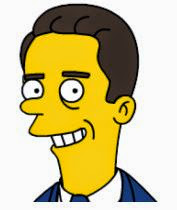
Dr. Arturo Carvajal ate an artichoke at Houston's. An entire artichoke. Stem, spiky leaves, and all. That turned out to have what I'm sure were decidedly uncomfortable gastrointestinal consequences and consequently he sued Houston's for not warning him that there were portions of the artichoke that are not edible and you scrape the meaty, edible plant flesh off the leaves and then discard them.
Ken at Popehat more than adequately describes the massive forehead-slap lawyers around the country will go through upon hearing of this utter nonsense. We can be relatively confident that the suit will not result in a favorable verdict and very likely will be thrown out of court at an early stage of proceedings.
But shit like this doesn't make the job of opposing tort reform any easier. Seriously, Marc R. Ginsberg of Mandina & Ginsberg LLP in Miami Lakes, Florida (with a satellite office in Key West), what do you have to say for yourself when you've just fed choice ammunition to people who want to use the political process to take away your ability to make a living? And mine? Wasn't I just writing about having to exercise some discretion in case selection? You've been an attorney much longer than me -- what on Earth made you think you'd be able to get anything out of this case?
Good thing I've given up on teaching law classes. This is yet another one I might not be able to credibly apologize for.
Showing posts with label Really Bad Ideas. Show all posts
Showing posts with label Really Bad Ideas. Show all posts
November 19, 2010
November 17, 2010
Irish Coffee Banned In White House
I don't need the White House to tell me whether or not I am legally permitted to drink a Four Loko. Or a Red Bull and vodka.* Or a rum and Coke. Yes, it sucks if some kids binge drink the stuff. The problem was the binge, not the drink.
The mixing of caffeine and alcohol is just fine and an adult should be able to decide whether to have one of these things or not. I put a little Bailey's Irish Cream, or its South African counterpart Amarula, in my coffee on weekend mornings. Is that going to be on the "banned" list too, Mr. President?
Get your damn government hands out of my liquor cabinet.
* I've tried Red Bull and vodka, and concluded that it tastes nasty. YMMV.
The mixing of caffeine and alcohol is just fine and an adult should be able to decide whether to have one of these things or not. I put a little Bailey's Irish Cream, or its South African counterpart Amarula, in my coffee on weekend mornings. Is that going to be on the "banned" list too, Mr. President?
Get your damn government hands out of my liquor cabinet.
* I've tried Red Bull and vodka, and concluded that it tastes nasty. YMMV.

 Labels:
Government,
Really Bad Ideas
Labels:
Government,
Really Bad Ideas
April 1, 2010
I Really Think He Was Sincere
In this exchange concerning the deployment of additional forces to Guam, I challenge anyone, whether Democrat or Republican, to not cringe at the 1:15-1:20 mark of questioning from Hank Johnson, Democrat representing Georgia's Fourth District (just east of Atlanta) concerning the environmental impact of an additional Marine brigade being sent to Guam...
...which would pretty much nominate Congressman Johnson for consideration as a mid-grade moron.
You can see that the Admiral responding to Johnson's questions paused for just a moment, anticipating laughter or getting ready to "make a funny" as well, and he stopped himself for just long enough to realize Oh shit, he really meant that and this guy holds a vote on my funding so he instead decided to take the question at face value and that turned out to be the safer road for him to go down.
Okay, on reflection maybe I was a bit harsh on Johnson above, when I said he was a "mid-grade moron." He did manage to get himself elected to Congress, after all, suggesting that he is probably actually pretty smart. He might have just been having a bad morning and didn't think through to the point that he would realize that islands are part of the surface of the Earth and therefore are incapable of capsizing. This isn't a matter of being uneducated, it's a matter of not using his native intelligence and education, of letting a desire to assume a particular posture get in the way of constructing reasons to support that posture. Results-driven reasoning can lead you to do that, which is why I think Johnson's remarks are, in all seriousness, better classified as "antiscience" rather than simple idiocy.
Hat Tip to Doug Mataconis. UPDATE: I considered the possibility that this might be an April Fools' joke. But Johnson's exchange was made more than a week ago.
...which would pretty much nominate Congressman Johnson for consideration as a mid-grade moron.
You can see that the Admiral responding to Johnson's questions paused for just a moment, anticipating laughter or getting ready to "make a funny" as well, and he stopped himself for just long enough to realize Oh shit, he really meant that and this guy holds a vote on my funding so he instead decided to take the question at face value and that turned out to be the safer road for him to go down.
Okay, on reflection maybe I was a bit harsh on Johnson above, when I said he was a "mid-grade moron." He did manage to get himself elected to Congress, after all, suggesting that he is probably actually pretty smart. He might have just been having a bad morning and didn't think through to the point that he would realize that islands are part of the surface of the Earth and therefore are incapable of capsizing. This isn't a matter of being uneducated, it's a matter of not using his native intelligence and education, of letting a desire to assume a particular posture get in the way of constructing reasons to support that posture. Results-driven reasoning can lead you to do that, which is why I think Johnson's remarks are, in all seriousness, better classified as "antiscience" rather than simple idiocy.
Hat Tip to Doug Mataconis. UPDATE: I considered the possibility that this might be an April Fools' joke. But Johnson's exchange was made more than a week ago.
Labels:
Antiscience,
Domestic Politics,
Really Bad Ideas
March 30, 2010
Talk About Diminishing Personal Freedom!
Oh, what's the world coming to when a young Republican can't even take out some friends to an afterparty at a lesbian bondage themed strip club anymore? It was only two thousand dollars they dropped at Voyeur! Creeping totalitarianism, that's what I say.
Labels:
Really Bad Ideas,
Scandal,
Sex
December 8, 2009
News Flash
Hey, New York Times! I don't think you got the memo from back in, what was it, 1997. Here it is again: Video games are not just toys for small children any more. Video games are like any other kind of entertainment media -- they are created for and marketed to varying and particular demographics and not all of them are little kids.
Just as there are "G" rated movies for kids and "R" rated movies for grownups, Grand Theft Auto: The Ballad Of Gay Tony is not going to be an appropriate stocking-stuffer for an eight-year-old girl.
Any questions?
Just as there are "G" rated movies for kids and "R" rated movies for grownups, Grand Theft Auto: The Ballad Of Gay Tony is not going to be an appropriate stocking-stuffer for an eight-year-old girl.
Any questions?
Labels:
'Tis The Season,
News,
Really Bad Ideas
November 19, 2009
Six Options
I'm as committed as ever to the idea of due process. I have plenty of intellectual companionship in saying that a trial is the right thing to do because indefinite detention is not a good option, and that we should have no fear of doing the right thing, as long as we do it the right way, but I'm also completely at a loss for what to do or thing when our government claims to be trying to do the right thing, but at the same time admits that it's all just for show. Having a show trial is worse than having no trial at all. More thoughts from around the blogosphere more or less echoing this sentiment here, here, and here.
So now that I've argued passionately in favor of the rule of law even in a tough case like this one, I need to react to the fact that what I had been led to believe was a very legal, moral, and correct thing to do is revealed to be nothing but a sham.
One thing I'd point out -- in this exchange, Senator Grassley gets something wrong. He says that our criminal law is "our law is clear that the moment custodial interrogation occurs the defendant, the criminal defendant, is entitled to a lawyer and to be informed of their right to remain silent." I agree that our criminal law ought to be that clear. But it's not -- a generation's worth of futzing around with the concept of "exigent circumstances" has transformed Miranda into a Swiss Cheese of a legal rule. Now, if we tortured KSM, then yes, any evidence obtained thereafter is "fruit of the poisoned tree" and is properly excluded from the trial. And while I labored mightily to not believe it was true, available evidence says that I was wrong before -- we did torture this particular prisoner. But with the many "exigent circumstances" rules to Miranda, I have difficulty seeing a court excluding evidence of the confession he (purportedly) gave before the torturing started. At this point, though, I'm not certain Miranda matters at all because the Constitution is evidently of little importance to the people in charge of solving the problem of what to do with these prisoners.
What I can do is say that it appears to me that as a nation, we have six viable options for how to proceed with this situation. Here they are, in my order of preference.
So right now, it seems to me that the right thing to do is to have a military tribunal conduct the trial. I absolutely agree that the trial must be venued in either New York City or Washington, D.C., because that's where the attacks took place. (Having it in Pittsburgh, in recognition of the United Airlines Flight 11 flight in which passengers overpowered the hijackers, is silly because it appears that the target of that strike was going to be either the Capitol or the White House.) And the trial should not be public, if we're going to be discussing classified evidence. But the trial should be meaningful -- it should be before an unbiased panel (which I frankly think is more likely with a military court than a civilian one) and it should have a consequence one way or the other. If there is an acquittal, then those charges are dismissed and the defendant goes free -- so long as he is not awaiting trial on some other crime. Given that Eric Holder repeatedly and forcefully stepped on his own dick during yesterday's Senate hearings, this will now require that the Administration say publicly, loudly, and repeatedly that the Attorney General is being overruled by the President himself -- that if the trial results in acquittal, the result will be actual liberty for Khalid Sheikh Mohammed. Such a statement will carry a heavy political price for the President to pay, but that's the consequence he must face for the singular error made by his hand-picked subordinate. As a second-best alternative within this broad choice, hold the trial in a civilian court, but it appears that a military tribunal is a superior forum for this particular case, with the evidence at issue. But either way, hold a real trial.
The next-best thing to do is to say that we have reviewed the available legal authority and find that the al-Qaeda prisoners in our custody right now are prisoners of war. The necessary ingredient of being a prisoner of war is that the captive must have been engaged in the service of a foreign state and wearing a uniform of some kind; I do not think it an extraordinary or facile gloss on the situation to say that al-Qaeda was trying to create a new nation-state (to wit, the proposed Caliphate of Osama bin Laden) and that this nascent political entity had simply not issued uniforms to its warriors yet. We could call the al-Qaeda detainees "prisoners of war" if we wanted to. That would mean that ultimately, they will be charged with no crimes at all, and when al-Qaeda is no longer engaged in hostilities against the United States, they'll be let go. That commits us to not torture these prisoners, which we shouldn't be doing anyway, and it gives them other rights while they're in custody under the Geneva Conventions. And it bargains away our claim that these guys are nothing more fearsome than common criminals. But it does make absolutely certain that there will be no trial and we will keep custody of them until the threat is gone.
The third-best thing to do would be to hold a Nuremburg-style trial for commission of "crimes against humanity." For that, we'd need to enlist jurists and lawyers from other nations and have a public proceeding. One of the useful precedents set by Nuremburg is that at those trials, the defense of tu quoque was not permitted -- so evidence of wrongdoing by the United States (i.e., torture of prisoners, use of military weapons causing civilian collateral damage) would be irrelevant and excluded. The downside is that at Nuremburg, the lawyers and judges were making it up as they went along and the whole proceedings left the taste of a show trial to implement victor's justice. But personally, I don't think they were actually show trials -- many of the Nuremburg defendants were acquitted and set free.
After that, we're out of options for dealing with these prisoners within the confines of the law. So the fourth-best thing we could do, at this point, would be to just kill our prisoners. Frankly, by the time we run out of good legal options, simple murder becomes the best political expedient. I hope that no one is comfortable with that statement, by the way -- despite the fact that we are talking about people we're quite certain have a lot of blood on their hands and at least at one time were quite anxious to get more. The reason for your discomfort with that statement is that it's quite evident that even if we did capture these bad guys "on the battlefield" and they aren't entitled to any Constitutional rights at all, they're our prisoners now and we have power over them. My point about just killing them is that if we're going to dispense with actually complying with the law, and say that the only rule that applies to these guys is Rule .303, then we should do it right. And then we must accept the moral and possibly legal consequences of doing so. But this does have the two conveniences of intellectual consistency and and expedient result. Again, I hope no one is comfortable with this.
Moving further down the list, the fifth option is to do nothing -- that is, to do what we have been doing, holding these guys indefinitely without charges, without presenting evidence, and in a legal limbo that we refuse to resolve. That has many, many disadvantages in that it leaves open and unresolved this festering problem. I found the status quo unacceptable under Bush, why should it be any more acceptable under Obama?
But the worst thing we can do is pretend to comply with the law when we're actually not doing it. A show trial actually goes further than the status quo towards making a mockery of our legal system and offering evidence to the world that we are willing to disregard the rule of law when it is inconvenient for us to comply with it. This is worse than legal limbo because it turns our courts into vehicles of fraud. Not using our courts at all is bad enough -- but tainting them with the corruption of a show trial is worse because it deprives the courts of legitimacy as surely as the Executive branch has abdicated its own legitimacy already, twice now under two different Presidents of both major parties.
And this last choice is the option that the Administration has apparently chosen to pursue.
If nothing else, America ought to stand for the rule of law. Insisting upon the rule of law is why we had our Revolution in the 1770's. Insisting upon the rule of law has made this nation rich, powerful, and righteous. We disregard the rule of law at our peril. That would be the start of a historic cancer that will eat away at us from within as surely as the decision of the Roman citizenry to eschew and outsource military service led to the rot and sudden collapse of their empire, because like the Roman martial ethic, the American legal ethic is the taproot of our greatness. I fear that the highly-polarized political atmosphere of this country is an environment ripe for that cancer to metastasize.
I have not yet perceived an existential threat to the nation in the misguided policies of the Obama Administration. I have perceived serious long-term problems with our economic health, advocacy of policies doomed to be expensively ineffectual, and evidence of managerial incompetence. These are not good things, but they are the sorts of problems that our government can adapt to and against which the Constitutional system of government was built to withhstand. But this is the first time I've seen this Administration take a truly dangerous stance, to point a dagger directly at the still-beating heart of what makes the United States of America a nation of which I can be proud to be a citizen. It broke my heart when the last Administration did the same thing and it breaks my heart now that I see it happening again.
So now that I've argued passionately in favor of the rule of law even in a tough case like this one, I need to react to the fact that what I had been led to believe was a very legal, moral, and correct thing to do is revealed to be nothing but a sham.
One thing I'd point out -- in this exchange, Senator Grassley gets something wrong. He says that our criminal law is "our law is clear that the moment custodial interrogation occurs the defendant, the criminal defendant, is entitled to a lawyer and to be informed of their right to remain silent." I agree that our criminal law ought to be that clear. But it's not -- a generation's worth of futzing around with the concept of "exigent circumstances" has transformed Miranda into a Swiss Cheese of a legal rule. Now, if we tortured KSM, then yes, any evidence obtained thereafter is "fruit of the poisoned tree" and is properly excluded from the trial. And while I labored mightily to not believe it was true, available evidence says that I was wrong before -- we did torture this particular prisoner. But with the many "exigent circumstances" rules to Miranda, I have difficulty seeing a court excluding evidence of the confession he (purportedly) gave before the torturing started. At this point, though, I'm not certain Miranda matters at all because the Constitution is evidently of little importance to the people in charge of solving the problem of what to do with these prisoners.
What I can do is say that it appears to me that as a nation, we have six viable options for how to proceed with this situation. Here they are, in my order of preference.
So right now, it seems to me that the right thing to do is to have a military tribunal conduct the trial. I absolutely agree that the trial must be venued in either New York City or Washington, D.C., because that's where the attacks took place. (Having it in Pittsburgh, in recognition of the United Airlines Flight 11 flight in which passengers overpowered the hijackers, is silly because it appears that the target of that strike was going to be either the Capitol or the White House.) And the trial should not be public, if we're going to be discussing classified evidence. But the trial should be meaningful -- it should be before an unbiased panel (which I frankly think is more likely with a military court than a civilian one) and it should have a consequence one way or the other. If there is an acquittal, then those charges are dismissed and the defendant goes free -- so long as he is not awaiting trial on some other crime. Given that Eric Holder repeatedly and forcefully stepped on his own dick during yesterday's Senate hearings, this will now require that the Administration say publicly, loudly, and repeatedly that the Attorney General is being overruled by the President himself -- that if the trial results in acquittal, the result will be actual liberty for Khalid Sheikh Mohammed. Such a statement will carry a heavy political price for the President to pay, but that's the consequence he must face for the singular error made by his hand-picked subordinate. As a second-best alternative within this broad choice, hold the trial in a civilian court, but it appears that a military tribunal is a superior forum for this particular case, with the evidence at issue. But either way, hold a real trial.
The next-best thing to do is to say that we have reviewed the available legal authority and find that the al-Qaeda prisoners in our custody right now are prisoners of war. The necessary ingredient of being a prisoner of war is that the captive must have been engaged in the service of a foreign state and wearing a uniform of some kind; I do not think it an extraordinary or facile gloss on the situation to say that al-Qaeda was trying to create a new nation-state (to wit, the proposed Caliphate of Osama bin Laden) and that this nascent political entity had simply not issued uniforms to its warriors yet. We could call the al-Qaeda detainees "prisoners of war" if we wanted to. That would mean that ultimately, they will be charged with no crimes at all, and when al-Qaeda is no longer engaged in hostilities against the United States, they'll be let go. That commits us to not torture these prisoners, which we shouldn't be doing anyway, and it gives them other rights while they're in custody under the Geneva Conventions. And it bargains away our claim that these guys are nothing more fearsome than common criminals. But it does make absolutely certain that there will be no trial and we will keep custody of them until the threat is gone.
The third-best thing to do would be to hold a Nuremburg-style trial for commission of "crimes against humanity." For that, we'd need to enlist jurists and lawyers from other nations and have a public proceeding. One of the useful precedents set by Nuremburg is that at those trials, the defense of tu quoque was not permitted -- so evidence of wrongdoing by the United States (i.e., torture of prisoners, use of military weapons causing civilian collateral damage) would be irrelevant and excluded. The downside is that at Nuremburg, the lawyers and judges were making it up as they went along and the whole proceedings left the taste of a show trial to implement victor's justice. But personally, I don't think they were actually show trials -- many of the Nuremburg defendants were acquitted and set free.
After that, we're out of options for dealing with these prisoners within the confines of the law. So the fourth-best thing we could do, at this point, would be to just kill our prisoners. Frankly, by the time we run out of good legal options, simple murder becomes the best political expedient. I hope that no one is comfortable with that statement, by the way -- despite the fact that we are talking about people we're quite certain have a lot of blood on their hands and at least at one time were quite anxious to get more. The reason for your discomfort with that statement is that it's quite evident that even if we did capture these bad guys "on the battlefield" and they aren't entitled to any Constitutional rights at all, they're our prisoners now and we have power over them. My point about just killing them is that if we're going to dispense with actually complying with the law, and say that the only rule that applies to these guys is Rule .303, then we should do it right. And then we must accept the moral and possibly legal consequences of doing so. But this does have the two conveniences of intellectual consistency and and expedient result. Again, I hope no one is comfortable with this.
Moving further down the list, the fifth option is to do nothing -- that is, to do what we have been doing, holding these guys indefinitely without charges, without presenting evidence, and in a legal limbo that we refuse to resolve. That has many, many disadvantages in that it leaves open and unresolved this festering problem. I found the status quo unacceptable under Bush, why should it be any more acceptable under Obama?
But the worst thing we can do is pretend to comply with the law when we're actually not doing it. A show trial actually goes further than the status quo towards making a mockery of our legal system and offering evidence to the world that we are willing to disregard the rule of law when it is inconvenient for us to comply with it. This is worse than legal limbo because it turns our courts into vehicles of fraud. Not using our courts at all is bad enough -- but tainting them with the corruption of a show trial is worse because it deprives the courts of legitimacy as surely as the Executive branch has abdicated its own legitimacy already, twice now under two different Presidents of both major parties.
And this last choice is the option that the Administration has apparently chosen to pursue.
If nothing else, America ought to stand for the rule of law. Insisting upon the rule of law is why we had our Revolution in the 1770's. Insisting upon the rule of law has made this nation rich, powerful, and righteous. We disregard the rule of law at our peril. That would be the start of a historic cancer that will eat away at us from within as surely as the decision of the Roman citizenry to eschew and outsource military service led to the rot and sudden collapse of their empire, because like the Roman martial ethic, the American legal ethic is the taproot of our greatness. I fear that the highly-polarized political atmosphere of this country is an environment ripe for that cancer to metastasize.
I have not yet perceived an existential threat to the nation in the misguided policies of the Obama Administration. I have perceived serious long-term problems with our economic health, advocacy of policies doomed to be expensively ineffectual, and evidence of managerial incompetence. These are not good things, but they are the sorts of problems that our government can adapt to and against which the Constitutional system of government was built to withhstand. But this is the first time I've seen this Administration take a truly dangerous stance, to point a dagger directly at the still-beating heart of what makes the United States of America a nation of which I can be proud to be a citizen. It broke my heart when the last Administration did the same thing and it breaks my heart now that I see it happening again.
October 30, 2009
Another White House War On Its Media Critics
First, it was Fox News. But now, it's Edmunds.com. Edmunds dared to suggest that "Cash for Clunkers" was a gigantic waste -- for every vehicle sold under the program, taxpayers paid $24,000 (more than the retail value of a lot of those vehicles). The White House blog responded that Edmunds must have been examining car sales on Mars and contrasted Edmunds' article to "mainstream analyses." (Edmunds replies to that claim here.)
Oh, and the Associated Press got a taste of White House rebuke, too. But the President and his minions taking on the mainstream press is nothing new. Taking on a used-car website, however, is really pushing the boundaries of thin-skinned message control. And silliness.
What this proves is that literally anyone who criticizes the White House and finds any kind of an audience for it will earn the personal attention of President Obama's political staff, at minimum in the form of a sting from the White House blog. I'm expecting my blast of Presidential rebuke any day now.
Bring it on.
Oh, and the Associated Press got a taste of White House rebuke, too. But the President and his minions taking on the mainstream press is nothing new. Taking on a used-car website, however, is really pushing the boundaries of thin-skinned message control. And silliness.
What this proves is that literally anyone who criticizes the White House and finds any kind of an audience for it will earn the personal attention of President Obama's political staff, at minimum in the form of a sting from the White House blog. I'm expecting my blast of Presidential rebuke any day now.
Bring it on.
October 27, 2009
The Opposite Of Capitalism
Here's the lead paragraph from the Associated Press:
Since when does Ford have to pay for the failures of General Motors? Well, actually, that would be since the UAW was given a functionally controlling interest in GM while still locking its employees into Ford's labor force. So, bad example. Ahem... Since when does Google have to pay for the mistakes of Microsoft? It doesn't. In any kind of a sane world, should Microsoft make a significant mistake, Google gets to capitalize on it. Why is the financial services sector any different than that?
Look, I can see the argument that more stringent regulation of financial services providers might be necessary given recent events. Certainly I can understand, if not necessarily agree with, the political will to use the government's power to get financial services companies to behave in a more conservative fashion. But this bill does not do that. This bill means that if Bank of America makes a series of risky loans and fails, Wells Fargo and MBNA get to pick up the tab and pay for it -- not B of A's stockholders, which is who properly should bear that risk.
Note, of course, that we're not just talking about banks here. When I use the term "financial services company" that can mean a bank but it can be any entity that offers financial products of any nature -- home mortgages, mutual funds, annuities, universal life insurance policies, derivative funds, and so on. So yes, I'm looking at the brokerage houses, and the insurance companies, and the hedge funds here.
But the problem is that the regulations are going to be written by a "council" of the biggest of these financial product providers, under the leadership of the Federal Reserve -- and its activities in seizing and addressing failed financial product providers will be funded by the members of the council itself, not by the government. Leaving aside the whole fox-guarding-the-henhouse nature of the manner in which the regulations would be drafted (this would be, quite frankly, par for the course) the problem is that when it comes time to put bite in it, we're talking about massive amounts of money and it has to come from somewhere.
When even Barney Frank admits that this creates a "perverse incentive," it's a bad idea. No, this is not just a "bad idea." It is an abyssmally bad idea. We could send space probes out to search this vast galaxy of ours for worse ideas and it would take centuries before they returned any likely candidates.
The President says he likes the idea because it shifts the burden of rescuing a failed banking institution from the taxpayers to a "council" of other banks. Whose conduct would be heavily-regulated by the government, which would force the other "council" members to pay for the rescue and rehab of their failed competitor, all under the guidance and supervision of the Federal Reserve. Which I thought existed for the purpose of controlling the money supply and the interest rates at which the government lends and borrows money.
Bool-shit. If Bank of America fails, then there are three good ways under existing law to handle that:
These ways of handling failed banks work fine. There is plenty of room for governmental involvement and supervision in all of them so that the public can make sure that conservative, smart, and ultimately beneficial decisions get made about how all of these things happen. Now, if the proposal were only to expand the scope of the FDIC or to create another government entity analagous to the FDIC for other kinds of financial services company, I would probably not be saying much of anything. But that's not what's on the table here.
So we've no need of a fourth way of dealing with this, in particular not a fourth way that involves the seizure of the assets of a company that avoided the mistakes of the failed competitor. To further quote the AP:
Now, this terrifyingly bad idea isn't the end of America as we know it, so let's not panic just yet. Here's why I say that. If I were forced to pay a tax, that would be one thing. This isn't a tax. It's a taking. That makes it a Fifth Amendment issue. If I owned stock in, say, SunTrust Bank, and SunTrust was required to participate in this "council" and then use its assets to rehabilitate MBNA which was teetering on the brink of failure, I'd sue the government. My property -- that is, the bank which I owned and its assets -- would be taken from me for some kind of a public benefit, and that means that the government has to compensate me for that. I think I'd win on that seizure claim.
But just because the courts are there to protect against this sort of an abuse does not mean the idea should be endorsed. It is a terrible idea and it should be resisted mightily. It is one thing to say that segments of the free market that impact the public benefit need to be regulated. Reasonable people can disagree about that. It is something else to say that the market as a whole must be directly controlled by the government to correct the mistakes of one of its members. That is what the President is talking about. That is not capitalism, in which a competitor either profits by dint of its cleverness or fails by dint of its risky behavior. This is the opposite of capitalism. Let's get our Congresscritters to stop this idea in its tracks so we don't have to bother a court with it, why don't we?
And egad, something else just occurred to me. If you thought it was expensive for the government to bail out failed banks using taxpayer money, just wait until it tries to do it for free. A poignant thought on the day our national debt topped twelve trillion dollars.
UPDATE: Banks within the FDIC system are required to pay money into the FDIC to help fund its depositor-protection activities, in what amounts to a mandated insurance policy. This is qualitatively and quantitatively different than FDIC member banks being required to pay in enough money to bail out their competitiors when they fail.
President Barack Obama on Tuesday embraced a House bill that would give the government unprecedented power to seize bank holding companies and other large financial firms teetering on the brink of collapse and stick their competitors with the cost.Whiskey. Tango. Foxtrot.
Since when does Ford have to pay for the failures of General Motors? Well, actually, that would be since the UAW was given a functionally controlling interest in GM while still locking its employees into Ford's labor force. So, bad example. Ahem... Since when does Google have to pay for the mistakes of Microsoft? It doesn't. In any kind of a sane world, should Microsoft make a significant mistake, Google gets to capitalize on it. Why is the financial services sector any different than that?
Look, I can see the argument that more stringent regulation of financial services providers might be necessary given recent events. Certainly I can understand, if not necessarily agree with, the political will to use the government's power to get financial services companies to behave in a more conservative fashion. But this bill does not do that. This bill means that if Bank of America makes a series of risky loans and fails, Wells Fargo and MBNA get to pick up the tab and pay for it -- not B of A's stockholders, which is who properly should bear that risk.
Note, of course, that we're not just talking about banks here. When I use the term "financial services company" that can mean a bank but it can be any entity that offers financial products of any nature -- home mortgages, mutual funds, annuities, universal life insurance policies, derivative funds, and so on. So yes, I'm looking at the brokerage houses, and the insurance companies, and the hedge funds here.
But the problem is that the regulations are going to be written by a "council" of the biggest of these financial product providers, under the leadership of the Federal Reserve -- and its activities in seizing and addressing failed financial product providers will be funded by the members of the council itself, not by the government. Leaving aside the whole fox-guarding-the-henhouse nature of the manner in which the regulations would be drafted (this would be, quite frankly, par for the course) the problem is that when it comes time to put bite in it, we're talking about massive amounts of money and it has to come from somewhere.
When even Barney Frank admits that this creates a "perverse incentive," it's a bad idea. No, this is not just a "bad idea." It is an abyssmally bad idea. We could send space probes out to search this vast galaxy of ours for worse ideas and it would take centuries before they returned any likely candidates.
The President says he likes the idea because it shifts the burden of rescuing a failed banking institution from the taxpayers to a "council" of other banks. Whose conduct would be heavily-regulated by the government, which would force the other "council" members to pay for the rescue and rehab of their failed competitor, all under the guidance and supervision of the Federal Reserve. Which I thought existed for the purpose of controlling the money supply and the interest rates at which the government lends and borrows money.
Bool-shit. If Bank of America fails, then there are three good ways under existing law to handle that:
- The failed bank can be acquired by one of its competitors, at a fire-sale price. The particulars of the merger must be approved by the Securities and Exchange Commission and more recently, by the Secretary of the Treasury.
- The failed bank can declare bankruptcy, and either seek a reorganization or a liquidation under the supervision of the Bankruptcy Court and a Bankruptcy Trustee. This will result in the assets of the bank being liquidated and sold off to competitors, or being reorganized and rehabilitated. The United States of America has automatic standing to intervene in the public interest in such a proceeding.
- The failed bank can be seized by the Federal Deposit Insurance Commission, which will result in it being placed in receivership, there to either be merged, liquidated, or rehabilitated -- sort of an involuntary bankruptcy. Here and only here do taxpayer dollars come in to play, and that is done only to guarantee the safety of deposits. (The receiver is paid out of the remaining assets of the failed bank.)
These ways of handling failed banks work fine. There is plenty of room for governmental involvement and supervision in all of them so that the public can make sure that conservative, smart, and ultimately beneficial decisions get made about how all of these things happen. Now, if the proposal were only to expand the scope of the FDIC or to create another government entity analagous to the FDIC for other kinds of financial services company, I would probably not be saying much of anything. But that's not what's on the table here.
So we've no need of a fourth way of dealing with this, in particular not a fourth way that involves the seizure of the assets of a company that avoided the mistakes of the failed competitor. To further quote the AP:
Federal regulators already can dismantle banks. But the government was powerless last year at the height of the financial crisis when large bank holding companies and other non-bank institutions, such as insurance giant American International Group, started failing."It is unfair to force them to invest their capital in advance to pay for the mistakes of othes." You don't say.
Who should pay to dismantle these firms had been considered among the toughest questions that Congress had to answer after last year's near-collapse of several firms that prompted hefty government bailouts.
Lawmakers know that voters are still angry from the bailouts and don't want to see taxpayer money on the line. At the same time, businesses say it is unfair to force them to invest their capital in advance to pay for the mistakes of others.
Now, this terrifyingly bad idea isn't the end of America as we know it, so let's not panic just yet. Here's why I say that. If I were forced to pay a tax, that would be one thing. This isn't a tax. It's a taking. That makes it a Fifth Amendment issue. If I owned stock in, say, SunTrust Bank, and SunTrust was required to participate in this "council" and then use its assets to rehabilitate MBNA which was teetering on the brink of failure, I'd sue the government. My property -- that is, the bank which I owned and its assets -- would be taken from me for some kind of a public benefit, and that means that the government has to compensate me for that. I think I'd win on that seizure claim.
But just because the courts are there to protect against this sort of an abuse does not mean the idea should be endorsed. It is a terrible idea and it should be resisted mightily. It is one thing to say that segments of the free market that impact the public benefit need to be regulated. Reasonable people can disagree about that. It is something else to say that the market as a whole must be directly controlled by the government to correct the mistakes of one of its members. That is what the President is talking about. That is not capitalism, in which a competitor either profits by dint of its cleverness or fails by dint of its risky behavior. This is the opposite of capitalism. Let's get our Congresscritters to stop this idea in its tracks so we don't have to bother a court with it, why don't we?
And egad, something else just occurred to me. If you thought it was expensive for the government to bail out failed banks using taxpayer money, just wait until it tries to do it for free. A poignant thought on the day our national debt topped twelve trillion dollars.
UPDATE: Banks within the FDIC system are required to pay money into the FDIC to help fund its depositor-protection activities, in what amounts to a mandated insurance policy. This is qualitatively and quantitatively different than FDIC member banks being required to pay in enough money to bail out their competitiors when they fail.
October 24, 2009
Weekend Weirdness, Volume II
I quite enjoyed last week's Saturday compliation of the weirdest things I've come across on the Intertubes. So here's this week's installment.
Let's start with some big critters. I don't know why but the cow is somehow more impressive than the pigs. And if that doesn't freak you out, I bet this will.
Here's a large sample platter of assorted cheesiness. Much of it remarkably well-preserved from my youth.
Then, God prefers atheists. Here's why: unlike some folks, atheists tend to not be inconsistently paranoid about bar codes.
Carving a pumpkin this weekend? I thought my idea of a Roswell alien on an oval gourd was creative but it turns out there's a few levels above that.
Danii Minogue attacks a man while swimming in the Great Barrier Reef. I think this was supposed to be a humor column but if so it falls short of the mark.
Eat your heart out, Jerry Bruckheimer.
A profoundly bad idea, mass-produced in plastic.
Let's start with some big critters. I don't know why but the cow is somehow more impressive than the pigs. And if that doesn't freak you out, I bet this will.
Here's a large sample platter of assorted cheesiness. Much of it remarkably well-preserved from my youth.
Then, God prefers atheists. Here's why: unlike some folks, atheists tend to not be inconsistently paranoid about bar codes.
Carving a pumpkin this weekend? I thought my idea of a Roswell alien on an oval gourd was creative but it turns out there's a few levels above that.
Danii Minogue attacks a man while swimming in the Great Barrier Reef. I think this was supposed to be a humor column but if so it falls short of the mark.
Eat your heart out, Jerry Bruckheimer.
A profoundly bad idea, mass-produced in plastic.
Labels:
Atheism,
Critters,
Ethics and Morality,
Music,
Really Bad Ideas,
Science,
Weirdness
September 22, 2009
Quick, Close The Barn Door! The Horse Escaped!
It ought to be rather simple and obvious. Don't use public money to fund political messages. The White House is finally getting it and at least they're not trying to tap-dance around admitting that someone didn't screw up. A little bit too late, but at least now the issue's been raised.
Labels:
Domestic Politics,
Government,
Really Bad Ideas
"Certainly This Was A Case Of Bad Judgment"
...So says the chief of police. Which is kind of an understatement.
Dateline: Lakeland, Florida. Cops execute a search warrant, and bust in to a (suspected) drug-dealer's house to seize evidence. While some of them search through the house, tag and bag evidence, help haul the heavy stuff out to the evidence van, and otherwise engage in what you'd normally think of as "police work," other officers are otherwise engaged.
Dateline: Lakeland, Florida. Cops execute a search warrant, and bust in to a (suspected) drug-dealer's house to seize evidence. While some of them search through the house, tag and bag evidence, help haul the heavy stuff out to the evidence van, and otherwise engage in what you'd normally think of as "police work," other officers are otherwise engaged.
Labels:
Crime and Punishment,
News,
Really Bad Ideas
August 25, 2009
Cash For Clunkers: What Happens Next
I'd like for us to upgrade my wife's car, which we just finished paying off. But we're not going to do that -- we're going to hold on to the car that we don't need to make any payments on, and probably not replace it until we're done paying off my car, so we only have one car payment at a time. Until then, we'll make do with a not-so-spectacular vehicle and continue to live within our means. That is more important, and worth more money in tough times, than gaining an additional five to ten miles to the gallon. That's a decision that makes sense for individual consumers.
But apparently, that sort of decision doesn't make sense to the economic nincompoops in the Obama Administration, who think that we're so collectively rich as a nation we can just destroy perfectly good cars to buy new ones on credit.We're not doing it to decrease overall oil consumption or protect the environment. As a society, we're not about to run out of oil. We've already demonstrated that even dramatic increases in passenger car mileage is of only minimal benefit to the environment as compared to unspectacular, incremental increases in very-low mileage vehicles.
We're apparently not doing it to benefit American auto manufacturers, because it turns out that 59% of the vehicles purchased in the cash-for-clunkers program are foreign, and eight out of the top ten purchased cars were Japanese or Korean. So what we've done is to temporarily subsidize sales of foreign cars.
That's, um, not what I recall as being the stated policy goal of this program.
Well, what happens next? Let's say you traded in your old "gas-guzzling" car for a newer Japanese one. Got somewhere between $3,000 and $4,500 for it. What does the dealer do with that old thing? Does he turn around and re-sell it, injecting badly-needed cash flow into the automotive market, reducing the overall market price of cars so that more people can buy cars later, or even take it apart to part the thing out or sell it to a parts dealer?
No. Here's what seems to be a perfectly nice 2001 Corvette. The guys pour in some kind of cleargunk liquid into the engine, which eventually gels up and seizes, permanently disabling the motor (engine smokes at 3:00 and seizes at about 4:30):
As if that weren't sin enough, next they destroy the vehicle completely. Here's a perfectly operable Dodge Dakota 4X4 turned into a dense steel oblong in the name of temporarily subsidizing the sale of Hondas, Kias, Toyotas, and Hyundais:
We were sold this program as a way of revitalizing the American auto industry, meaning primarily the Big Three of GM, Ford, and Chrysler, and improving environmental conditions. The result, however, is a billion and a half dollars of national debt we didn't have before and a bunch of junked, formerly-operable cars.
I'm waiting for the part where someone explains to me why I'm better off for our government having done this. I'm not holding my breath. In the meantime, I'm adding a new tag to the blog: "Lighting Our Money On Fire."
But apparently, that sort of decision doesn't make sense to the economic nincompoops in the Obama Administration, who think that we're so collectively rich as a nation we can just destroy perfectly good cars to buy new ones on credit.We're not doing it to decrease overall oil consumption or protect the environment. As a society, we're not about to run out of oil. We've already demonstrated that even dramatic increases in passenger car mileage is of only minimal benefit to the environment as compared to unspectacular, incremental increases in very-low mileage vehicles.
We're apparently not doing it to benefit American auto manufacturers, because it turns out that 59% of the vehicles purchased in the cash-for-clunkers program are foreign, and eight out of the top ten purchased cars were Japanese or Korean. So what we've done is to temporarily subsidize sales of foreign cars.
That's, um, not what I recall as being the stated policy goal of this program.
Well, what happens next? Let's say you traded in your old "gas-guzzling" car for a newer Japanese one. Got somewhere between $3,000 and $4,500 for it. What does the dealer do with that old thing? Does he turn around and re-sell it, injecting badly-needed cash flow into the automotive market, reducing the overall market price of cars so that more people can buy cars later, or even take it apart to part the thing out or sell it to a parts dealer?
No. Here's what seems to be a perfectly nice 2001 Corvette. The guys pour in some kind of clear
As if that weren't sin enough, next they destroy the vehicle completely. Here's a perfectly operable Dodge Dakota 4X4 turned into a dense steel oblong in the name of temporarily subsidizing the sale of Hondas, Kias, Toyotas, and Hyundais:
We were sold this program as a way of revitalizing the American auto industry, meaning primarily the Big Three of GM, Ford, and Chrysler, and improving environmental conditions. The result, however, is a billion and a half dollars of national debt we didn't have before and a bunch of junked, formerly-operable cars.
I'm waiting for the part where someone explains to me why I'm better off for our government having done this. I'm not holding my breath. In the meantime, I'm adding a new tag to the blog: "Lighting Our Money On Fire."
Labels:
Cars,
Government,
Lighting Our Money On Fire,
Money,
Really Bad Ideas
August 20, 2009
The Punishment Should Fit The Crime
Now, I think there's no problem with a law that requires you to register your guns. And Plaxico Burress owned a gun that he had not registered. And it went off when he carried it into a club in New York City, discharging into his own foot. So he pretty clearly violated the gun registration law. I think that deserves punishment. And sports fans and gun owners all over the country couldn't understand how someone could possibly carry a weapon so incompetently that he literally shot his own foot. "Shooting yourself in the foot" is a turn of phrase for everyone but Plaxico Burress, who instead turned it into a way to get the attention of the bouncer at a New York nightclub.
What the hell was he thinking, trying to get a gun into a nightclub in the first place? Don't clubs in New York have metal detectors?
But the punishment for violating a gun registreation law, absent proof of some other crime being concurrently committed involving the illegal firearm, should be a fine. I had mistakenly thought Burress had a prior conviction but upon looking into it, it seems his criminal record was clean. (Sad that I simply presumed that an NFL player would have had a prior conviction on his record, isn't it?) Other than failing to register his weapon, then, Burress was not committing any crime.
And literally shooting yourself in the foot is undoubtedly quite painful; that pain seems sufficient punishment for stupidity and/or carelessness while handling a firearm. Not to mention that Burress, as a wide receiver in the NFL, needs to have healthy feet in order to make his living and earn his prodigious salary. Had he been fined on top of being hurt, endangering his career, and being publicly humiliated, I would have said that was sufficient. Two years in prison is a bit much in terms of sentencing for this particular crime, no matter what his attitude about the whole thing was.
The punishment should fit the crime. This punishment seems aimed more at making an example out of Burress precisely because he's a big-name celebrity, which I think is a bad reason to deprive someone of more liberty than would have been done to Joe Schmoe in the same situation.
What the hell was he thinking, trying to get a gun into a nightclub in the first place? Don't clubs in New York have metal detectors?
But the punishment for violating a gun registreation law, absent proof of some other crime being concurrently committed involving the illegal firearm, should be a fine. I had mistakenly thought Burress had a prior conviction but upon looking into it, it seems his criminal record was clean. (Sad that I simply presumed that an NFL player would have had a prior conviction on his record, isn't it?) Other than failing to register his weapon, then, Burress was not committing any crime.
And literally shooting yourself in the foot is undoubtedly quite painful; that pain seems sufficient punishment for stupidity and/or carelessness while handling a firearm. Not to mention that Burress, as a wide receiver in the NFL, needs to have healthy feet in order to make his living and earn his prodigious salary. Had he been fined on top of being hurt, endangering his career, and being publicly humiliated, I would have said that was sufficient. Two years in prison is a bit much in terms of sentencing for this particular crime, no matter what his attitude about the whole thing was.
The punishment should fit the crime. This punishment seems aimed more at making an example out of Burress precisely because he's a big-name celebrity, which I think is a bad reason to deprive someone of more liberty than would have been done to Joe Schmoe in the same situation.
Labels:
Crime and Punishment,
News,
Really Bad Ideas,
Sports
August 6, 2009
The National Debt Road Trip Video
Let's say that deficit spending is like speeding while driving. You shouldn't be doing it at all, but sometimes maybe you just can't help yourself.
George W. Bush was a leadfoot. So was Ronald Reagan and George Bush the Elder and Wiser. But in fact, if we're going to compare deficit spending to speeding, the we would be saying that George W. Bush blew through a stop sign at 63 miles an hour. That's bad. But not nearly as bad as Barack Obama, who is on pace to get at a supra-autobahn speed of 173:
So if deficit spending is like speeding, where's the cop who's going to pull this maniac off the road before he wipes out and really hurts somebody? That would be you, ladies and gentlemen, when you vote.
Hat tip to Doug Mataconis.
George W. Bush was a leadfoot. So was Ronald Reagan and George Bush the Elder and Wiser. But in fact, if we're going to compare deficit spending to speeding, the we would be saying that George W. Bush blew through a stop sign at 63 miles an hour. That's bad. But not nearly as bad as Barack Obama, who is on pace to get at a supra-autobahn speed of 173:
So if deficit spending is like speeding, where's the cop who's going to pull this maniac off the road before he wipes out and really hurts somebody? That would be you, ladies and gentlemen, when you vote.
Hat tip to Doug Mataconis.
June 24, 2009
Hope It Was Worth It
Man, that's one expensive trip Mark Sanford just took to Buenos Aires. I don't mean the airfare, hotel, and car rental. He'll be paying that price in the future.
June 12, 2009
The Best-Sounding Bad Idea To Come Along In A Long Time
 Reading at Left Coast Rebel about a month ago, I was dismayed to learn last month that the Cash for Clunkers program was gaining political purchase. I can see the logic behind the initiative -- subsidize the ability of people who are driving around old gas guzzlers for newer, more fuel-efficient vehicles -- and I can see that there would be some environmental good done by realizing the objective of updating our fleet of personal vehicles.
But this is definitely a thing to do when times are prosperous, when there is excess money to be spent on this sort of thing. Right now, we're only seeing subtle macroeconomic hints that the recession may be receding, but that doesn't mean times are getting better and it certainly doesn't mean times are good. We're deficit-spending ourselves into fiscal anemia and paying people between $3,000 and $4,000 for what Congressional sponsors hope will be 625,000 vehicles is $2.5 billion that we simply don't have right now.
But even under the best of theoretical circumstances, it is also not clear that the policy would work, or that its benefits would not be swamped by unintended adverse consequences. As I wrote at LCR, if we were in a budget surplus condition, I could call this policy proposal defensible, at least in the abstract; but still a luxury we can't presently afford.
Now, the bill that the House of Representatives just passed has been so compromised that it seems unlikely that it would effect so little advancement towards its policy goal that it seems like a waste of time. In its current form, "cash for clunkers" will benefit almost no one. There are simply not a lot of people who own crappy old cars and who are looking to buy brand-new cars to replace them. So who would be cashing in on this program? As Prof. Steven Levitt writes in today's Gray Lady:
If any vehicles are going to qualify under this program, I suspect it will be because enterprising people who already plan to buy new cars will go out and buy old junkers on the used-car market and then trade them in under the program. But those transactions won’t represent incremental new car sales; it will just be a way for people who were already going to buy a car to rip off the government.Prof. Levitt points out that, although about ten percent of the total fleet in the United States get low enough mileage to meet the initial threshold for subsidy eligibility status, the bulk of those vehicles are light-duty pickup trucks. Now, light-duty pickup truck owners tend to hang on to those vehicles longer than car owners do because light-duty pickup trucks have utility as cargo carriers in addition to their ability to move passengers around. They therefore become auxiliary rather than primary vehicles, part of the reason why there are more vehicles than drivers registered in nearly every state. The incentive to get rid of a high-utility auxiliary vehicle is much lower than the incentive to upgrade a personal-transportation-only primary vehicle.
Additionally, the person asking for a subsidy on the clunker trade-in will need to prove that the vehicle was registered and insured for the previous year. Well, here's a couple of facts for you coming from a guy who sometimes serves as a traffic judge -- between 20% to 25% of the vehicles on the road are not insured and about one in thirty don't have current registration. They aren't insured and they aren't registered because the people who own and drive them are poor and cannot afford to pay the money to insure and register their vehicles. The vehicles that are uninsured and unregistered tend to be old-model vehicles, the ones that this subsidy is aimed at, because those low-quality vehicles are the only ones that poor people can afford to buy in the first place to meet their transportation needs.
In other words, I would predict that the insurance and registration requirement would substantially narrow the number vehicles that will qualify for the subsidy in the first place. And of those vehicles, the true economic incentives to part with them may be lower than the cash price for such vehicles available on the open market and indeed may be lower than the subsidy offered by this program.
When it's the only car you've got, even if it's a clunker, and you probably can't scrape together enough money to buy a replacement, the utility value of that crappy old car is very high. Higher than the marginal value of $500 to $1,000 in cash that you could get on the open market for it, and probably higher than the $3,500 to $4,500 subsidy you could get for trading it in to be crushed into a small, heavy metal cube. And since you can't scrape together enough cash to replace your junker-with-a-market-value-of-$1,000, you're not in the market for a new car anyway, so the $3,500 to $4,500 subsidy is a non-issue.
In other words, the transactions Congress intends to incentivize are simply never going to happen. Let's consider what would really happen.
 If you had maybe $6,000 in available cash, you could buy up a dozen junkers at $500 each, and trade them all in at once, getting a $3,500 subsidy for each trade-in. You'd use that money to get new car worth $42,000. You could then re-sell the new car to a third party without ever putting the key in the ignition, realizing a profit of $36,000.
Given an infinite number of $500 cars eligibile for the subsidy available to purchase, your $36,000 in profit from the first turn-around would buy you 72 more junkers, which for your next cycle of purchases and trade-ins, would be worth $252,000 in new car purchase subsidies. Even after paying sales tax, re-registration fees, and rental on property large enough (and zone appropriately) to store 72 crappy old cars at a time, you could theoretically wind up with something like $200,000 in profit.
What makes this worth doing is the government subsidizing the junkers to seven times their open-market value -- paying $3,500 for a car that would sell for $500 on the open market. In real life, you'd be shelling out cash for more than eighty crappy old cars to make this work. Also in real life, the universe of people who are actually selling $500 vehicles that get mileage below eighteen miles per gallon and who have been able to keep their cars registered and insured for an entire year is not infinite; indeed, it is relatively small.
These owners would respond to your market activities by demanding higher prices for the suddenly-desirable subsidy-eligible cars they had to sell -- I'll go so far as to predict that the supply side portion of this market is small enough that even a single entrepreneur behaving this way would, in short order, move the demand curve of that market and drive up the market cost of these vehicles.
This assumes, moreover, that you're the only person in the area clever enough to have figured this out and exploit it -- which wouldn't be the case; this is a pretty easy business model for pretty much anyone to puzzle out. That would also create upward pressure on the demand curve. So it wouldn't take long before sellers began demanding $1,000 or more for the same cars they had previously willing to sell for $500; eventually, the market price would rise to something very close to the subsidy and now all of these middle-men would be out of business.
What's amazing is not that this happens, but rather how fast it happens. Frankly, I doubt that you'd be able to make it through the first cycle of purchases and re-sales before the market price rose to a point that made the business model unworthwhile. You'd never get to the point that you could pocket $200,000 in after-tax profits because you'd have run out of subsidy-eligible cars to buy at any price.
What's more, all of these owners of subsidy-eligible cars would be out of customers. So they would hang on to, and drive, their old junkers until they were in a position to buy new cars for themselves and exploit their own subsidies. That's what the new equilibrium would look like -- people holding on to old, crappy, inefficient cars for longer, creating an even older, less-efficient fleet of cars than we have now. I don't think this is what Congress intends.
Ah, the pernicious and perverse effects of government intervention in the economy!
The only people who would find practical value to this program, as Prof. Levitt suggests, are entrepreneurial sorts who would look to exploit both the government and the economically-disadvantaged owners of the junkers who are intended to be the beneficiaries of the program. I'll go a step further than him and predict that these entrepreneurial sorts will wind up being the auto dealers themselves. They'll "sell" the junkers to their customers who are buying new cars anyway. Then, their customers will "trade them in" and use the voucher to underwrite new car purchases. The dealers will keep a portion of the subsidy for themselves as an "administrative fee," or build that fee into the ultimate purchase price of the new car.
I don't think this is what Congress intends to happen with this program, either. But I could be wrong about that.
Finally, bear in mind that each and every transaction under this program would be a piece of the $2.5 billion line-item of deficit spending, which will also incur transaction costs, paying for clerks and administrators to make the subsidy happen, and of course the cost of creating a new branch of the Department of Transportation and training the people who will work there to do the job. All of that will also be paid for out of deficit spending.
Could the idea be made better? Yes. Remove the insurance and registration requirement for subsidy eligibility. Expand the scope of the subsidy to allow for the purchase of a previousy-owned vehicle with improved mileage instead of only to brand-new cars. Render vehicles sold to the subsidy claimant in the previous six months ineligible for the subsidy to deter exploitation by middlemen and the economic drag that would produce. These things would steer the subsidy back towards the intent of the bill, which is to help people upgrade crappy old cars to more fuel-efficient ones.
But even then, it's still spending billions of dollars that our government just plain doesn't have in the first place. Cash for clunkers -- a creative idea, to be sure, but not one that I can endorse.
Labels:
Cars,
Domestic Politics,
Government,
Industry and Commerce,
News,
Really Bad Ideas
June 5, 2009
In Which I Disabuse You Of A Variety Of Food Myths
It's difficult indeed to believe that an attorney would actually file a lawsuit in Federal Court alleging that a reasonable consumer would have been confused into thinking that "crunchberries" are an actual fruit that could be purchased in a box of Cap'n Crunch cereal. Now, I see and hear more ridiculous sorts of things in my practice quite often.
Nevertheless, there is only so much apologizing I can do for the legal profession, only so much denial I can of the criticisms of "frivolous lawsuits" because there are some damned silly lawsuits out there. And "Crunchberries" is one of them. Lawyers are supposed to be a safeguard against this sort of thing, not perpetrators of it.
It's advertising, people. You're supposed to be possessed of reasonable intelligence, which might be defined as the ability to understand when a claim is intended to be taken literally and when it's just "puffery." See Coca-Cola Co. v. Koke Co. (1920) 254 U.S. 143 (although there is no cocaine in Coca-Cola, the name is not deceptive even when conjoined in advertisements depicting a coca leaf). See also Hayna v. Arby's, Inc. (Ill.App.1981) 425 N.E.2d 1174 (addressing false advertising challenge to claim that Arby's sold actual "roast beef" as opposed to the salty meat-like film that they actually put in their sandwiches).
Continuing in the same vein:
Hat tip to Charles at Popehat.
* This is largely because there are no such things as angels or devils. If they did exist, I'm reasonably sure that they both would prefer rich, moist, chocolatey Devil's food cake to dry, tasteless, boring Angel's food cake.
Nevertheless, there is only so much apologizing I can do for the legal profession, only so much denial I can of the criticisms of "frivolous lawsuits" because there are some damned silly lawsuits out there. And "Crunchberries" is one of them. Lawyers are supposed to be a safeguard against this sort of thing, not perpetrators of it.
It's advertising, people. You're supposed to be possessed of reasonable intelligence, which might be defined as the ability to understand when a claim is intended to be taken literally and when it's just "puffery." See Coca-Cola Co. v. Koke Co. (1920) 254 U.S. 143 (although there is no cocaine in Coca-Cola, the name is not deceptive even when conjoined in advertisements depicting a coca leaf). See also Hayna v. Arby's, Inc. (Ill.App.1981) 425 N.E.2d 1174 (addressing false advertising challenge to claim that Arby's sold actual "roast beef" as opposed to the salty meat-like film that they actually put in their sandwiches).
Continuing in the same vein:
- "Grape Nuts" are not actually nuts harvested from grape vines.
- Nothing in Five Alive fruit juice is actually alive.
- Chicken of the Sea is made from fish, specifically tuna.
- There is no blood in a blood orange.
- Jimmy Dean Sausage is not named for James Dean.
- Girl Scout cookies are not made from real Girl Scouts.
- Similarly, shepherd's pie contains no shepherds (and no sheep, either).
- Mocha Mix contains no actual mocha and was not made in the city of Mocha.
- Angels do not actually eat angel food cake. Devils do not actually eat devil food cake.* You can buy or make quantities of pound cake which weigh more or less than one pound.
- Julius Caesar never ate what we today call "Caesar salad."
- The marshmallows in Lucky Charms possess no magical abilities.
- "Denver" omlettes can be made anywhere. See also "New York" strip steaks, "New England" clam chowder, and "Philadelphia" cream cheese. But cf. Tequila, Champagne, Parmesan, and Bordeaux, which actually signify geographic origin in their names.
- Hush puppies are made from cornmeal. And sometimes with little bits of onion, but I don't like them that way. But no dogs or shoes are harmed (typically) in the making of hush puppies.
- Buffaloes do not have wings. Those come from chickens.
- Baby carrots are not special miniature carrots, nor are they harvested early in the season before the carrot can become an "adult." There is no such thing as an "adult" carrot.
- Baby back ribs come from pigs, not human babies.
- Goldfish crackers do not contain any ingredients derived from goldfish. Similarly, Chick-O-Stick candy contain no products made from chickens, nor is it served on a stick.
- Bear claws are actually doughnuts.
- If you are in the United States, Canada, or pretty anywhere but France, the "French Bread" you are eating was not made in France and was unlikely to have been made by an actual French person. Same with "Italian Bread"; see also "German" potato salad, "German chocolate" cake, "Black Forest" cake, "Irish" stew, some "Swiss" cheese, "Spanish" rice, and "India" pale ale.
Hat tip to Charles at Popehat.
* This is largely because there are no such things as angels or devils. If they did exist, I'm reasonably sure that they both would prefer rich, moist, chocolatey Devil's food cake to dry, tasteless, boring Angel's food cake.
Labels:
Food,
Law,
Really Bad Ideas,
Unimportant but Mildly Amusing
May 16, 2009
Yglesias Loses All Credibility
Sorry, Matt -- Oprah Winfrey would not make a good Supreme Court Justice. Sure, she has compassion, and yes, she'd be a reliable pro-choice vote. Having a background in the entertainment industry, she may have some understanding of copyright and trademark law. But for all her business acumen, she is ill-prepared to handle the subtleties of admiralty disputes, exclusionary rule challenges, patent claims, and transational jurisdictional issues like forum selection and choice-of-law clauses?
My read of Ms. Winfrey's biography suggests that she has two years of college at Tennessee State University but does not mention any formal education past that. Which is not to say she's unintelligent; quite to the contrary, I'm convinced that she's quite intelligent and if she didn't complete her degree, well, 2.8 billion dollars and a huge media empire later has proven that maybe you don't need to do that in every case. Ms. Winfrey's intelligence is not the issue here. Mr. Yglesias' apparent decision to set his own intelligence aside, and offer this deeply silly suggestion, is the issue.
We're talking about a lifetime appointment to the highest court of the nation here. Let's at least get a lawyer.
Hat tip to David Schraub at Debate Link for the lead to this truly daffy idea.
My read of Ms. Winfrey's biography suggests that she has two years of college at Tennessee State University but does not mention any formal education past that. Which is not to say she's unintelligent; quite to the contrary, I'm convinced that she's quite intelligent and if she didn't complete her degree, well, 2.8 billion dollars and a huge media empire later has proven that maybe you don't need to do that in every case. Ms. Winfrey's intelligence is not the issue here. Mr. Yglesias' apparent decision to set his own intelligence aside, and offer this deeply silly suggestion, is the issue.
We're talking about a lifetime appointment to the highest court of the nation here. Let's at least get a lawyer.
Hat tip to David Schraub at Debate Link for the lead to this truly daffy idea.
May 14, 2009
Prison Sales, Welfare Scams, and Territorial Reversion
Apparently, the Governator will today propose selling San Quentin State Prison. And the Los Angeles Colosseum, and the Cow Palace, and a few other choice properties owned by the state. All in the hopes of generating up to a billion dollars of bonus revenue.
I wrote ten months ago that this is a bad idea. I still think it is. Seems to me that the state is simply not being creative enough with those properties to generate revenue from them. Granted, using property to incarcerate and kill criminals is about the worst kind of way to make money with it, so a repurposing of the famous prison might be in order.
But other sports arenas and concert venues and convention centers are run profitably. There is no reason the Cal Expo in Sacramento cannot be. There is no reason that the Agnews Developmental Center, 81 acres of prime space in San Jose, could not be converted into condominiums, for instance, and even preserving the historic look of the place, although if anyone had spent any time there, chances their memories of it are likely unpleasant. Or a shopping center and farmer's market (back in the 1920's there was a farmer's market run out of what was then called the Angews Insane Asylum).
These are properties that could -- and in private hands will -- generate a positive income stream if exploited correctly. In July, I thought that the amount of money that the state would get in exchange for parting with these unique and valuable pieces of real estate would be insufficient to solve our budget problems and represent a loss of unique opportunities to generate revenue. Given that a) the economic storm appears to be lightening a little bit, and b) the state's budget crisis is half again as bad as it was a year ago, I don't see any reason why I should change my mind.
We're twenty one and a half billion dollars short, folks. The state's credit rating is as low as it can get. The budget-reshuffling propositions next Tuesday are going to fail. And we've already raised state taxes beyond a comfortable or even justifiable level. That leaves us with two options.
One is to make painful budget cuts and have less government, which I suggested we do last year.
The other would be to forfeit statehood and allow California to revert to being Federal territory, to make the whole thing Washington's problem. Of course, we'd lose our delegation to Congress in the process and therefore be at the mercy of representatives of other states in solving these financial problems.
Lest Readers mistake what they read here for serious policy proposals: I'm not serious about giving up statehood; that was a facetious remark. I'm not sure that such a thing is even possible. If you wanted to talk about really bad ideas, that's a whopper. Makes selling the Del Mar Fairgrounds look like a wrong answer in a trivia game by comparison. No, my serious proposal is that we make budget cuts.
The only area where that can conceivably be done is in the sphere of social welfare programs. Our roads are already falling apart. Our prisons are already overcrowded.* Our schools are already stretched to their limit. So that means that, for instance, we need to take a very serious look at the "home health care workers" paid by the state to be caretakers for disabled people.
Now, if you don't know about this racket, chances are good you'll be outraged. Let's take a hypothetical state of the USA other than California and call it, I don't know, "Tennessee" for discussion purposes. If you live in Tennessee and your parents or grandparents become ill or disabled or just plain old and unable to move around and take care of themselves as well as they cold back when they were in their forties and healthy, you can do any of a number of things with them. For instance, you might find an assisted-living facility for them where they can have nursing care on call and professional staff to help them with things that they can't do. Or, if you can't afford that, or can't find such a facility that is acceptable, you could take them into your own home and care for them yourself. It's a strain and a sacrifice, but it's also giving back to a parent you love who raised you, and you probably would consider that sort of thing to be your responsibility as part of a family.
In California, if you couldn't afford to pay for assisted living for your invalid relative, you'd do the same thing -- take them into your own home and care for them yourself. Only here, it's not something you'd do gratuitously, as part of your sense of responsibility to your family. No, here, you'd become a state employee first. California will pay you at least two and a half times the minimum wage as a full-time employee to do something that you already had a responsibility to do on your own. And the state will make you join the Service Employees International Union to do it, too, withholding part of the money from your state paycheck for your union dues. Which the SEIU will turn around and use to make political contributions to the Obama for President campaign.
So when it comes time to talk about budget cuts in California, SEIU will pull its strings in the White House and make damn sure that you, a protected, unionized employee of the State of California being paid to do something that you'd do for free in Tennessee because it's your responsibility to do it, will not have to give up a "job" that costs the taxpayers more than forty thousand dollars a year for people who do it, or even endure the indignity of a pay cut.
Now, this isn't "welfare" in the classic sense of general relief payments or unemployment insurance benefits. This is state employment. I shared a client with another lawyer many years ago, and our guy was in this system. "His job is getting paid to wiping his mama's butt," is how my colleague described it. I'm pretty sure that the dude supplemented this income with, shall we say, unlicensed but highly entrepreneurial retail activities, but that's another story.
If you're not outraged by this, you haven't been paying attention. Go back and read the previous four paragraphs of this post again. Read the linked article from the Fish Wrapper. Then you'll have a sense of why it is that Governator Schwarzenegger would rather sell off the Orange County Fairgrounds than make a budget cut -- this is how entrenched the special interests have become in Sacramento.
It's the same thing with a whole bunch of other places, too -- compare how much a prison guard makes in California to Tennessee. Even adjusting for the cost of living differential, you'll be shocked. And then you'll be despondent to realize just how impotent Sacramento has made itself to do anything about it.
The teacher's union has huge power, too. The Fish Wrapper did a series of stories recently about how difficult it is to fire a teacher at a public school. It's become cheaper to pay bad teachers to sit in empty rooms doing crossword puzzles until they get 100% benefits on retirement than it is to try and fire them.
That's why I'm talking about budget cuts as "painful." But it has to be done because we are out of other options. When we've reached the point that we'd rather sell off a billion dollars' worth of unique and potentially income-generating assets to make up 4% of our budget shortfall than make these kinds of cuts, it's gone too far. I'm on the verge of saying "burn it all down and start over from scratch."
* We could relieve some of that pressure by decriminalizing drugs. But I wrote about that earlier this morning already.
I wrote ten months ago that this is a bad idea. I still think it is. Seems to me that the state is simply not being creative enough with those properties to generate revenue from them. Granted, using property to incarcerate and kill criminals is about the worst kind of way to make money with it, so a repurposing of the famous prison might be in order.
But other sports arenas and concert venues and convention centers are run profitably. There is no reason the Cal Expo in Sacramento cannot be. There is no reason that the Agnews Developmental Center, 81 acres of prime space in San Jose, could not be converted into condominiums, for instance, and even preserving the historic look of the place, although if anyone had spent any time there, chances their memories of it are likely unpleasant. Or a shopping center and farmer's market (back in the 1920's there was a farmer's market run out of what was then called the Angews Insane Asylum).
These are properties that could -- and in private hands will -- generate a positive income stream if exploited correctly. In July, I thought that the amount of money that the state would get in exchange for parting with these unique and valuable pieces of real estate would be insufficient to solve our budget problems and represent a loss of unique opportunities to generate revenue. Given that a) the economic storm appears to be lightening a little bit, and b) the state's budget crisis is half again as bad as it was a year ago, I don't see any reason why I should change my mind.
We're twenty one and a half billion dollars short, folks. The state's credit rating is as low as it can get. The budget-reshuffling propositions next Tuesday are going to fail. And we've already raised state taxes beyond a comfortable or even justifiable level. That leaves us with two options.
One is to make painful budget cuts and have less government, which I suggested we do last year.
The other would be to forfeit statehood and allow California to revert to being Federal territory, to make the whole thing Washington's problem. Of course, we'd lose our delegation to Congress in the process and therefore be at the mercy of representatives of other states in solving these financial problems.
Lest Readers mistake what they read here for serious policy proposals: I'm not serious about giving up statehood; that was a facetious remark. I'm not sure that such a thing is even possible. If you wanted to talk about really bad ideas, that's a whopper. Makes selling the Del Mar Fairgrounds look like a wrong answer in a trivia game by comparison. No, my serious proposal is that we make budget cuts.
The only area where that can conceivably be done is in the sphere of social welfare programs. Our roads are already falling apart. Our prisons are already overcrowded.* Our schools are already stretched to their limit. So that means that, for instance, we need to take a very serious look at the "home health care workers" paid by the state to be caretakers for disabled people.
Now, if you don't know about this racket, chances are good you'll be outraged. Let's take a hypothetical state of the USA other than California and call it, I don't know, "Tennessee" for discussion purposes. If you live in Tennessee and your parents or grandparents become ill or disabled or just plain old and unable to move around and take care of themselves as well as they cold back when they were in their forties and healthy, you can do any of a number of things with them. For instance, you might find an assisted-living facility for them where they can have nursing care on call and professional staff to help them with things that they can't do. Or, if you can't afford that, or can't find such a facility that is acceptable, you could take them into your own home and care for them yourself. It's a strain and a sacrifice, but it's also giving back to a parent you love who raised you, and you probably would consider that sort of thing to be your responsibility as part of a family.
In California, if you couldn't afford to pay for assisted living for your invalid relative, you'd do the same thing -- take them into your own home and care for them yourself. Only here, it's not something you'd do gratuitously, as part of your sense of responsibility to your family. No, here, you'd become a state employee first. California will pay you at least two and a half times the minimum wage as a full-time employee to do something that you already had a responsibility to do on your own. And the state will make you join the Service Employees International Union to do it, too, withholding part of the money from your state paycheck for your union dues. Which the SEIU will turn around and use to make political contributions to the Obama for President campaign.
So when it comes time to talk about budget cuts in California, SEIU will pull its strings in the White House and make damn sure that you, a protected, unionized employee of the State of California being paid to do something that you'd do for free in Tennessee because it's your responsibility to do it, will not have to give up a "job" that costs the taxpayers more than forty thousand dollars a year for people who do it, or even endure the indignity of a pay cut.
Now, this isn't "welfare" in the classic sense of general relief payments or unemployment insurance benefits. This is state employment. I shared a client with another lawyer many years ago, and our guy was in this system. "His job is getting paid to wiping his mama's butt," is how my colleague described it. I'm pretty sure that the dude supplemented this income with, shall we say, unlicensed but highly entrepreneurial retail activities, but that's another story.
If you're not outraged by this, you haven't been paying attention. Go back and read the previous four paragraphs of this post again. Read the linked article from the Fish Wrapper. Then you'll have a sense of why it is that Governator Schwarzenegger would rather sell off the Orange County Fairgrounds than make a budget cut -- this is how entrenched the special interests have become in Sacramento.
It's the same thing with a whole bunch of other places, too -- compare how much a prison guard makes in California to Tennessee. Even adjusting for the cost of living differential, you'll be shocked. And then you'll be despondent to realize just how impotent Sacramento has made itself to do anything about it.
The teacher's union has huge power, too. The Fish Wrapper did a series of stories recently about how difficult it is to fire a teacher at a public school. It's become cheaper to pay bad teachers to sit in empty rooms doing crossword puzzles until they get 100% benefits on retirement than it is to try and fire them.
That's why I'm talking about budget cuts as "painful." But it has to be done because we are out of other options. When we've reached the point that we'd rather sell off a billion dollars' worth of unique and potentially income-generating assets to make up 4% of our budget shortfall than make these kinds of cuts, it's gone too far. I'm on the verge of saying "burn it all down and start over from scratch."
* We could relieve some of that pressure by decriminalizing drugs. But I wrote about that earlier this morning already.
May 9, 2009
Everybody Involved Insists On Proving Themselves To Be Jackholes, Part XIV
Working in the legal industry often exposes me to situations where I am listening to a client convey a tale of woe and suffering, one in which everybody involved (except my interlocutor) has gone out of their way to be a gigantic, inconsiderate, and arrogant jerk. And almost inevitably, as soon as I've finished gathering information and possibly a settlement offer from this aggrieved victim, I have to turn around and talk to a different person involved in the dispute, who tells me that no, they are the innocent victim who always acted in good faith and with good moral intent, and the person I was just speaking to is in fact the architect of both the specific misfortune at issue in the lawsuit as well as a fairly substantial amount of the generalized suffering of the civilized world.
My response to this situation is generally to tell everyone involved that if we're going to settle the dispute, we need to adopt a "no bad guys" attitude, one in which we set aside the moral or dignitary slights of the other parties and just try and go forward without assigning ethical worth to whatever it is that they are complaining about. But in fact, nearly every time I say this, what I'm really thinking is that it's a "no good guys" situation, one in which everyone's an asshole.
So then I'm enjoying a mild morning in my back yard, drinking some coffee, eating a nice ripe pear, watching my dogs spar, and catching up on my blogging. And I come across a lead to this press release from a right-wing public interest law firm, the Pacific Justice Institute. Here's the story.
Castro Valley is a suburban city, located on the southeaster part of the Bay Area. The Castro Valley Unified School District runs the public schools there. The District invited a lesbian minister to come and speak to its math and science classes. She gave a talk to the classes entitled "Out for Good."
Some parents got bugs up their butts about this and apparently wanted to sue the District for having a lesbian in the same room as their precious little snowflakes. I have to infer that the issue here is homosexuality from a line in the press release which indicates that "According to students, the minister spoke about her lesbian wedding and similar events under the heading 'Out for Good.'" The author of the press release went out of his or her way to indicate that the speaker was a lesbian, that she had a "lesbian" wedding, and also spoke of "similar events." Presumably, had a heterosexual minister spoken to these math and science classes, these complainants would not have objected.
Of course, even a cursory look at the law would reveal that they get zero (meaning zilch, nada, zippo, donut-hole, goose-egg, aught, scratch, no-love-here) say in what kinds of activities the District gets to pursue under the rubric of providing education to its students. I can only presume that their lawyers possessed a modicum of responsibility and have told them this. So they had to content themselves with presenting a Public Records Act request to find all correspondence, contracts, and other documents relating to the minister's activities at the District.
And the District has complied with this spoiling-for-a-fight attitude by refusing to cough up the records.
So here's my "jerks all around" take on things.
First, the minister. I'll assume for purposes of this post that her presentation was appropriate for the ages of the children to whom it was delivered, and if that is the case, she is the least culpable of all of the parties involved here. I also don't know (because the District won't produce documents) whether she demanded, was offered, or accepted a speaking fee. It seems fair to assume that yes, she was paid for her time. Which is okay, but still she should understand that being a religious minister, going in to a public school, and making a presentation about homosexuality, is pulling a pin on a live grenade and rolling it into a crowd. She's instigating this sort of a fight. I have little love for instigators as a general rule.
Second, the parents. Okay, so a speaker came and spoke to your kids and you have some moral qualms about the subject matter of her speech. Fine. The solution is to teach your kids the things you want them to learn. Teach your kids how to question what this authority figure told them, how to draw their own conclusions, and what principles they should use to guide their thoughts. The solution is not to run to court, the solution is not to hire lawyers, the solution is not to get a bug up your butt about the whole thing and thereby draw attention to it in front of your kids. She isn't going to make your daughters into lesbians, and the fact that she is a lesbian does not make her inherently evil. Relax.
Third, the District. What are they thinking? They hired a religious minister to speak to public school kids. What's more, they hired this minister to speak to science and math classes about a social issue. This isn't science, it isn't math. And then, when they got a public records act demand, they stonewalled. Dumb, dumb, dumb. Further, they did it to bring forth a speaker about a highly controversial political subject, same-sex marriages, and apparently expected that this would be hunky-dory with everyone. Just because they can use their power this way does not mean that it is wise for them to do so. A little discretion and thought should have gone into this decision. A public agency is going to lose that sort of a battle, every time. Cough up the documents, and don't draw a lawsuit you're certain to lose. I can only assume that the District either ignored its attorneys' advice or instructed its attorneys to search for any reason to not comply with the law that they could think of, which would be at least on the edge of bad faith legal conduct.
And finally, the Pacific Justice Institute itself. This is not a pot that needs stirring. This needs to settle down and die, it needs to become a non-controversy and go away. No one will benefit from this legal fight, the public will not be served or benefitted in any fashion either from the controversy or from any of the possible outcomes of this dispute. The only thing that will result from this is a consumption of scarce judicial resources, the expenditure of attorney time that could have been spent solving real problems, and debatably, increased demands on an already-overburdened public purse. And they seem to be really pushing on this whole lesbian angle which strongly suggests to me that lesbians and gays are being demonized for the political and financial gain of the PJI. Having been involved in this game early in my career, I know that the point of the lawsuit is the ability to issue press releases whenever they do anything and the ability of the PJI to brag to its supporters about the work they're doing in fundraising letters. By using the legal system to go after anything that can be slapped with the label "gay," they'll get increased fundraising, or at least they think they will. And it's doubtful that anyone at PJI has bothered to think through just how awful that state of affairs really is.
So I'd like to thank the Castro Valley Unified School District, the Pacific Justice Institute, a short-sighted and politically-motivated minister, and some bigoted parents in the East Bay for completely ruining my otherwise-enjoyable morning.
My response to this situation is generally to tell everyone involved that if we're going to settle the dispute, we need to adopt a "no bad guys" attitude, one in which we set aside the moral or dignitary slights of the other parties and just try and go forward without assigning ethical worth to whatever it is that they are complaining about. But in fact, nearly every time I say this, what I'm really thinking is that it's a "no good guys" situation, one in which everyone's an asshole.
So then I'm enjoying a mild morning in my back yard, drinking some coffee, eating a nice ripe pear, watching my dogs spar, and catching up on my blogging. And I come across a lead to this press release from a right-wing public interest law firm, the Pacific Justice Institute. Here's the story.
Castro Valley is a suburban city, located on the southeaster part of the Bay Area. The Castro Valley Unified School District runs the public schools there. The District invited a lesbian minister to come and speak to its math and science classes. She gave a talk to the classes entitled "Out for Good."
Some parents got bugs up their butts about this and apparently wanted to sue the District for having a lesbian in the same room as their precious little snowflakes. I have to infer that the issue here is homosexuality from a line in the press release which indicates that "According to students, the minister spoke about her lesbian wedding and similar events under the heading 'Out for Good.'" The author of the press release went out of his or her way to indicate that the speaker was a lesbian, that she had a "lesbian" wedding, and also spoke of "similar events." Presumably, had a heterosexual minister spoken to these math and science classes, these complainants would not have objected.
Of course, even a cursory look at the law would reveal that they get zero (meaning zilch, nada, zippo, donut-hole, goose-egg, aught, scratch, no-love-here) say in what kinds of activities the District gets to pursue under the rubric of providing education to its students. I can only presume that their lawyers possessed a modicum of responsibility and have told them this. So they had to content themselves with presenting a Public Records Act request to find all correspondence, contracts, and other documents relating to the minister's activities at the District.
And the District has complied with this spoiling-for-a-fight attitude by refusing to cough up the records.
So here's my "jerks all around" take on things.
First, the minister. I'll assume for purposes of this post that her presentation was appropriate for the ages of the children to whom it was delivered, and if that is the case, she is the least culpable of all of the parties involved here. I also don't know (because the District won't produce documents) whether she demanded, was offered, or accepted a speaking fee. It seems fair to assume that yes, she was paid for her time. Which is okay, but still she should understand that being a religious minister, going in to a public school, and making a presentation about homosexuality, is pulling a pin on a live grenade and rolling it into a crowd. She's instigating this sort of a fight. I have little love for instigators as a general rule.
Second, the parents. Okay, so a speaker came and spoke to your kids and you have some moral qualms about the subject matter of her speech. Fine. The solution is to teach your kids the things you want them to learn. Teach your kids how to question what this authority figure told them, how to draw their own conclusions, and what principles they should use to guide their thoughts. The solution is not to run to court, the solution is not to hire lawyers, the solution is not to get a bug up your butt about the whole thing and thereby draw attention to it in front of your kids. She isn't going to make your daughters into lesbians, and the fact that she is a lesbian does not make her inherently evil. Relax.
Third, the District. What are they thinking? They hired a religious minister to speak to public school kids. What's more, they hired this minister to speak to science and math classes about a social issue. This isn't science, it isn't math. And then, when they got a public records act demand, they stonewalled. Dumb, dumb, dumb. Further, they did it to bring forth a speaker about a highly controversial political subject, same-sex marriages, and apparently expected that this would be hunky-dory with everyone. Just because they can use their power this way does not mean that it is wise for them to do so. A little discretion and thought should have gone into this decision. A public agency is going to lose that sort of a battle, every time. Cough up the documents, and don't draw a lawsuit you're certain to lose. I can only assume that the District either ignored its attorneys' advice or instructed its attorneys to search for any reason to not comply with the law that they could think of, which would be at least on the edge of bad faith legal conduct.
And finally, the Pacific Justice Institute itself. This is not a pot that needs stirring. This needs to settle down and die, it needs to become a non-controversy and go away. No one will benefit from this legal fight, the public will not be served or benefitted in any fashion either from the controversy or from any of the possible outcomes of this dispute. The only thing that will result from this is a consumption of scarce judicial resources, the expenditure of attorney time that could have been spent solving real problems, and debatably, increased demands on an already-overburdened public purse. And they seem to be really pushing on this whole lesbian angle which strongly suggests to me that lesbians and gays are being demonized for the political and financial gain of the PJI. Having been involved in this game early in my career, I know that the point of the lawsuit is the ability to issue press releases whenever they do anything and the ability of the PJI to brag to its supporters about the work they're doing in fundraising letters. By using the legal system to go after anything that can be slapped with the label "gay," they'll get increased fundraising, or at least they think they will. And it's doubtful that anyone at PJI has bothered to think through just how awful that state of affairs really is.
So I'd like to thank the Castro Valley Unified School District, the Pacific Justice Institute, a short-sighted and politically-motivated minister, and some bigoted parents in the East Bay for completely ruining my otherwise-enjoyable morning.
Subscribe to:
Posts (Atom)

 Posts
Posts