May 30, 2006

Mustache Maintenance

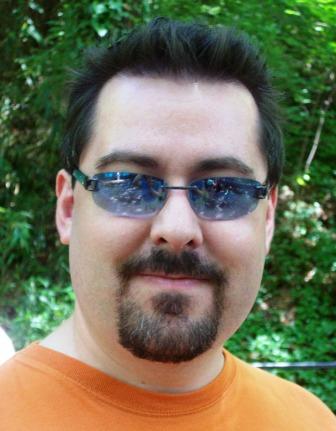
For the past five weeks, I've experimented with controlled growth of a mustache and a trimmed beard, commonly called a "goatee." It's not a classic goatee in the sense that I'm not letting the beard hair grow long and hang down like a goat's beard. As you can see, I'm keeping it relatively neat and trim. It's not quite growing in as thick as I would like on the right side of my mouth, and my lower lip is not filling in at all, it seems.

Yesterday night, I picked out most of the gray whiskers from the beard with a tweezer. Ow. I haven't bled that much out of my face since I first learned to shave. At least I didn't cry like a little girl when I did it. Much.

Grooming the beard turns out to be a bit more complex than I had anticipated. Every day, I shave off my cheeks and neck. This cuts down on the itching quite a bit. Then, I have a little comb which I use to straighten out the whiskers and get them all going in the same direction. Then, I trim off the excess length on the mustache to keep it from protruding on my lower lip, using a small scissors. Every couple of days, I use a small battery-powered clipper to keep the rest of the hair the length I want. I've been trying the longer setting but the mustache is getting to the point that it bugs me, so I'm working with the shorter setting up there for now.

One of my friends says it makes me look more Italian. The Wife says she likes it except for how scratchy it is when she kisses me. My friends in DC didn't comment on it at all. I'm wondering now if I should keep it after I resume formal law practice in a professional office environment. I've heard it said (by people who say such things) that men with beards inspire less trust than clean-shaven men. Apparently the beard is a subconscious indicator that the man wearing it has something to hide. I want to inspire trust in my clients and respect in my peers; if the beard gets in the way of doing that, of course, it goes. If The Wife says she doesn't like it, it goes. But I'm kind of enjoying having it in spite of the more-elaborate-than-expected grooming that goes with it. With a recent short haircut, I think the effect is maximized.

A Few Words of Comparison

After spending a weekend in a very urban area (northern Virginia/Washington D.C.) and returning to Knoxville, Tennessee, I have a few comparisons between the places. Some are, believe it or not, favorable to Knoxville.

Driving: Drivers in D.C. are significantly more aggressive than they are in Knoxville. As a result, it is somewhat safer to drive here. However, the roads in Tennessee are falling apart literally before our eyes. In several places around Knoxville and other cities we passed through, we felt like we were four-wheeling in the outback instead of driving on paved roads. We didn't have that feeling anywhere in the D.C. area. Also, the heavy reliance on the Metro by the locals reduces the burden of longer-distance driving on the roads, and there is nothing like that in Knoxville.

Parking: Yes, parking in a big city can be a challenge. But after having gone downtown this afternoon to meet up with The Wife for lunch and wasting fifteen minutes of her lunch hour trying to get to where we wanted to go and parking the car, I have to give the nod to D.C. on this. That goes for the District as well as the northern Virginia suburbs; in residential neighborhoods and shopping centers there, parking was a snap. We didn't have any unreasonable trouble parking anywhere we went in D.C., other than when we wen to the National Zoo.

Commerce: Shopping and other commercial activities are significantly easier in D.C. There are many, many more options of things to buy, and the quality of goods available, from fresh produce to wine to fresh flowers to electronics and books, is much greater there than here. It does cost more, but not that much more, and consequently day-to-day consumer activities result in better values in D.C. than here. The Wife went looking for a shirt and failed to find anything she liked, so perhaps she'll disagree with me on this one.

Livability: D.C. (the district itself) seems remarkably livable. There are sidewalks everywhere; people are out with their dogs all the time playing and having fun on the weekends; there is the open-air market and beautiful parkgrounds for them to enjoy. People seem to live more active lifestyles than in Knoxville; there are more joggers and walkers and other people engaged in recreational athletics than I see here. Perhaps the absence of sidewalks virtually anywhere in Knoxville is responsible for this. D.C. is more dog-friendly, and that's a big plus for me.

Environment: Here, we are relatively blessed all around. D.C. has some glorious scenery. The row houses are beautiful, the embassy houses are beautiful, the suburban houses are beautiful. The whole area is overrun with green -- parks, manicured lawns, trees. Rivers and smaller runs everywhere are pleasing to the eye. And of course in the District, there are monuments and spectacular symbols of America like the Capitol, the Washington Monument, and so on. But Knoxville is beautiful in its own way -- it is even more lush and green than northern Virginia and it has wonderful mountains and hills to break up the landscape. Only downtown and industrial zones mar an otherwise-attractive environment here. There were comparable levels of allergens and air pollution.

Diversity: No comparison here, either. Knoxville is like TV in the fifties -- pretty much all black and white. Both colors are pure, corn-fed Amurcin. D.C. is every bit as much a melting pot as Los Angeles; perhaps it skews a bit more towards those of European descent than for Latinos, but there's all kinds there. We had great Mexican food at a taqueria and drove through ethnic neighborhoods with Ethipoians, Koreans, Chinese, and Latinos who had both Mexican and Guatemalan flags; I overhead people speaking in Spanish, Arabic, and Russian and with a variety of accents during our adventures. In neither place do I get a sense of profound or overt racial tension. While here in Knox there is substantial Balkanization of racial groups, when members of different groups interact at work or in commerce, there seem to be very few problems. In D.C., with so many people from so many different backgrounds, people interact with one another all over the board -- although it does not escape me that there is still some ethnic Balkanization and the bulk (not all, but most) of our friends there are Europeans, like us. So

Weather: The stifling summer heat has begun in both places. Both feel hot and humid; today it is oppressively so here in Tennessee. I'm tempted to turn the air conditioner on but for now I'm toughing it out with the windows and a very slight breeze. But D.C. got pretty hot, too. Fearing a cold wind or rain, I wore a denim shirt and cargo pants to the ballgame and wound up sweating profusely. If you don't have formal places to be, shorts and light T-shirts are mandatory this time of year.

Cost of Living: Nowhere I have ever been, except perhaps the pre-EU Czech Republic, compares with East Tennessee for low cost of living. Housing and gas are relatively affordable here; we live in a house somewhat smaller than that of dceditor and her husband, on a similarly-sized lot; the purchase price of the undeveloped lot that our friends live in could buy two, maybe even three, single-family homes in our neighborhood.

While we were there, The Wife asked me if I would prefer to live in the D.C. area than Tennessee. My answer was, "If we had the income to support our existing lifestyle here, yes, I would." She didn't ask for a comparison with California.

So is it good to be home? I suppose, but this will only be our home for another week. We're getting packed up and ready for the move soon, and then this won't be our home any more. In two weeks, we'll be Californians again.

May 28, 2006

Adventures in Washington

We got here Friday afternoon and met up with our friends. After only a few moments, we got re-acquainted with their precocious and adorable young daughter and their two cats, including the playful Spencer and Kinsey, the Cat of Ultimate Evil. Actually, Kinsey is a sweet cat, but she looks at me like she hates me. Clare, our friends' almost four-year-old daughter, has of course dominated the weekend.


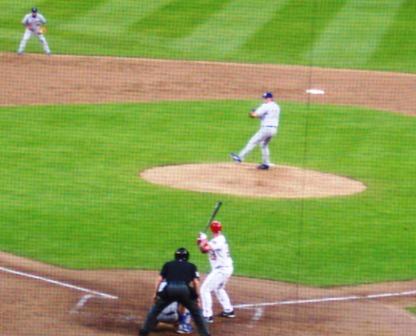
So when the sitter showed up, we left to go to RFK Memorial Stadium to see the Nationals take on the Dodgers. RFK is an older stadium, and still one of the multi-use stadia. Football and soccer are played there in addition to baseball, but aside from some blocked-off seating, they do a very good job of dressing it up for baseball. Our friends got some fantastic seats -- the picture to the left is taken from our seats.

To the right is Dodgers pitcher Jeff Tomko, throwing one of six RBI doubles resulting in the Dodgers' loss. I complained a while a go that the Dodgers have good pitching but no sticks. I was proven half wrong by the game last night. There wasn't any good pitching going on, either. On the plus side, though, The Wife had a fantastic time. She even admitted it. Maybe I can get her to go to some games once we get out to California.

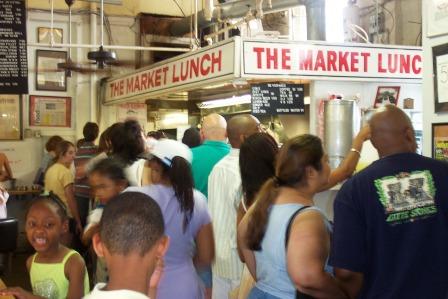
Yesterday we got up early and went out to the Eastern Market, where we were told we would have some extraordinary pancakes. They were quite good, although standing in line for an hour to get them was not a good prelude to eating them. The Eastern Market was really a cool place; fresh, good produce and lots of fresh flowers. We bought our contribution for tomorrow's barbeque at one of the butcher's counters, and The Wife was good enough to realize that the other ingredients for my steak.

After that was a crowded visit to the National Zoo. It was a very full day and we had to park on Connecticut Avenue and walk up and down the hill to go see everything. The Amazonia exhibit was most interesting, but I got the biggest chargeout of seeing big cats. Clare was the most amusing when we asked her what sound a giraffe makes and she was stumped. We let her off the hook early, though.

Our friends had a wedding to go to last night so they cut us loose and we went to downtown Arlington for dinner. Arlington was very crowded, and we ran out of cash at the parking garage -- very embarrassing. D.C. is a fun, generally good-looking city (even the less-than-good neighborhoods) but it can get expensive.

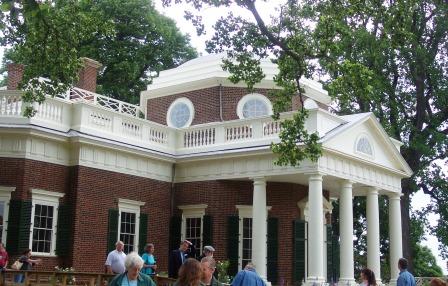
We had been looking forward to walking The Mall and a relaxing barbeque with friends tomorrow. But there is a "Rolling Thunder" rally today and over thirty thousand bikers are predicted to show up and watch Nancy Sinatra perform by The Wall. We're actually quite tired; I'd forgotten from my last visit just how much walking around is involved in a trip to D.C. It's nice to have a walkable city, and the collection of monunments and symbols of nationalism adds to the enjoyment of being here. After Thursday, when The Wife and I went to Monticello and marvelled at the ingenuity of one of our finest Founders, I had hoped to find it inspiring again to see all of these symbols of the greatness of America. But for the sake of our ears and our sanity, we will avoid the crowd and defer a visit to the mall and the Second World War Memorial (which I have never seen) until some other time.

May 25, 2006

Looks Like A Bad Call To Me

Today, the President ordered the documents seized from Rep. Jefferson's office to be sealed for 45 days. Why? Apparently at the request of Speaker Hastert, who is trying to deflect long-standing linkage of him to corrupt lobbyist Jack Abramoff which recently re-surfaced, much to his chagrin.

As I wrote last night, there is absolutely no reason for Bush to defer to Hastert on this one. The FBI did everything right. Although Bush seems to want to aggrandize his power in virtually every other sphere of influence imaginable, he's backing down here. I just can't figure out why he would do such a thing. He's holding all the cards. The guy who's going down is from the opposition party and obviously a crook. The action is to his political advantage -- and his party's political advantage. The White House seems to have nothing to lose if Jefferson goes down.

So what's the deal? What's the game -- or is this a seriously badly blown call? At this point, I can't see any advantage here. Why is Hastert making such a fuss, and why is Bush backing down?

Charlottesville

So this morning, I got my house in order in Palmdale; fortunately, another attorney was physically going to my appearance scheduled for this morning. I haven't yet logged in to check on what happened. Then we cleaned up the house and left a couple big bowls of food for the cats.

Then, we drove and drove all day -- well, about eight hours, including stops for food and gas and such, all the way up the Shenandoah Valley. It's quite pretty, and and enjoyable drive for the most part. One of the stops along the way was a Wal-Mart where The Wife bought us a trivia game and that was worth some entertainment on the way up.

Tomorrow we're going to see Monticello, and maybe the grounds of UVA, and maybe even the Michie Tavern, which we are actually quite close to right now. But for now, I'm content to just rest for a little while.

May 24, 2006

Corruption and Abuse of Power

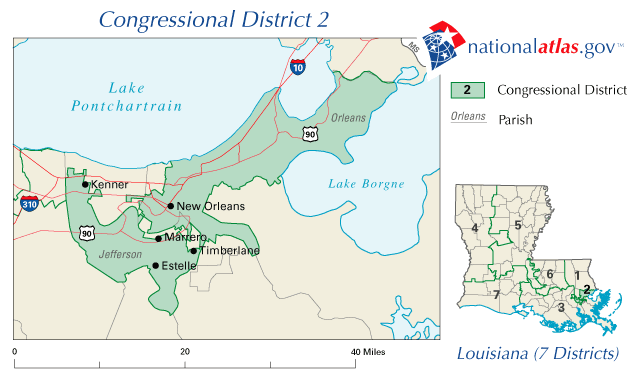
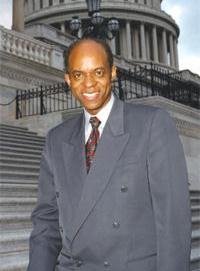
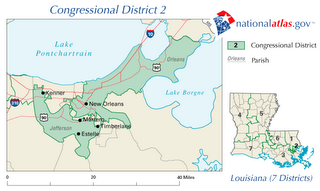
The man to the right is U.S. Congressman William Jefferson, a Democrat who represents the Second Congressional District of Louisiana (map to the lower right -- that looks just little bit gerrymandered to me, but what do I know) and who is the focus of the most recent political outrage.
It seems that Rep. Jefferson may have been (gasp) tainted by corruption. Corruption of the really sleazy, obvious kind, the kind grown from too much certainty in one's own power. A fourteen-month investigation recently culminated in a Virginia businessman giving Jefferson $100,000 in hundred-dollar bills. Alas for Rep. Jefferson, the businessman was wearing a wire, and $90,000 was found in Jefferson's freezer later that night. These events took place in early August of 2005.

Thing is, when he's not taking bribes, Rep. Jefferson has also been an outspoken critic of the administration. And Saturday night, evidence of the apparent bribe and a bunch more evidence of Jefferson's corruption was used by the FBI in an 83-page affidavit supporting an application for a search warrant which was executed Saturday night on Jefferson's congressional office on Capitol Hill. FBI agents were in Jefferson's office for nearly six hours, presumably searching through everything.

The hue and cry against this has been carefully parsed -- on both sides of the aisle -- to not defend Jefferson personally. Which is good, and a smart move for everyone; the guy is obviously on the take. While Jefferson has publicly maintained his innocence, that sort of cry tends to ring hollow when some of the people who bribed him plead guilty to bribing him. (At least he's not for sale cheap; $100,000 is a reasonably hefty bribe.)

But the thing is, no one can remember a time that the FBI has ever before raided a Congressional office. And Democrats have been preparing to organize their 2006 elections around attacking the Republicans' "culture of corruption." This obviously takes a lot of the wind out of those sails. So from the left, part of the outrage is caused by having a good weapon taken from them. But that the Democrats must now apologize for corruption within their own ranks even as they accused the Republicans of greater corruption causes me to shed no tears whatsoever -- corruption is bad and there is little doubt that it exists in both parties.

But interestingly, from the Republican leaders of Congress have also come objections; Speaker Dennis Hastert has called the raid "unconstitutional," and Majority Leader John Boehner has indicated that he believes the issue will undoubtedly be resolved by the Supreme Court. Even the excerable Bill Frist has joined the challenge to the Administration based on this activity.

What's the Constitutional issue here? Jefferson was corrupt, he had been served with a subpoena a month before to which he had not complied, there is substantial reason to believe he is implicated in a crime, and the FBI had been investigating him since early 2005. Certainly we want the FBI to investigate corruption and prosecute it where it is found -- while it is odd that the political winds blew exactly this way, the wheels had been set in motion well before this.

The argument that I have heard is that the raid implicates Jefferson's ability to freely discharge his deliberative duties as a member of Congress under the "speech and debate clause." I can't agree with that. First of all, Jefferson does not enjoy immunity from criminal prosecution, whether he is actively engaged in discharging his Congressional duties or not. The "immunity clause" applies only to civil claims directly related to a Member of Congress discharging his duties -- he can and should be subject to criminal liability during his time in office and cannot freely commit crimes, even petty ones, and even while giving a speech on the floor of the Congress itself. Williamson v. United States, 207 U.S. 425, 446 (1908). Investigating and prosecuting the motive for a particular legislative action is fair game for law enforcement; prosecuting the action itself is not. United States v. Brewster, 408 U.S. 501, 526 (1972), aff'd, United States v. Helstoski, 442 U.S. 477 (1979).

And I'm the one who has been screaming for months now that the Executive Branch needs to work within the Constitutional scheme of separation of powers and checks and balances to gather information in the discharge of its duties, both related to military power and in law enforcement. This is clearly law enforcment -- and the FBI got a warrant. So the FBI sought judicial approval for its actions, and got it. The demands of separation of powers are met; two branches of government acted in concert to police against corruption in the third.

And I am not impressed with the argument that there is a "tradition" of deference to Congressional offices by the FBI. Traditions can be wrong sometimes; traditions can be changed; traditions are not written down in our laws or Constitution. That does not mean that traditions are without value or importance. It means that hiding behind a "tradition" is not the same thing as invoking the Constitution. That the raid on the Congressional office took place at all is extraordinary in that it goes beyond the tradition of the President letting Congress do its own thing.

Yes, it is odd that a critic of the administration, from an area with a lot of things to criticize the administration for, should get this kind of ground-breaking treatment. And it is almost certain that high-level officials, most likely including Attorney General Gonzales himself, were knowledgeable of the progress of this investigation and likely involved in directing it at some level. But, other Members of Congress are similarly under some form of investigation for corruption. As one commentator points out, serious corruption issues have been in play for ten Members recently: William Jefferson (D-LA), Tom Delay (R-TX), Bob Ney (R-OH), Jerry Lewis (R-CA), Duncan Hunter (R-CA), Virgil Goode (R-VA), Richard Pombo (R-CA), John Doolittle (R-CA), Dave Weldon (R-FL), and Randy Cunningham (R-CA; resigned after pleading guilty to corruption). He forgot Katherine Harris (R-FL), who is mixed up in the Cunningham-Goode corruption issue. Still, Jefferson is notable for his being alone on that list as part of the minority party rather than the President's party. However, as the prosecution of Duke Cunningham shows, law enforcement is going after Republicans on the take, too. That Jefferson is a Democrat caused Atty. Gen. Gonzales to lose absolutely no sleep, I'm sure. But Jefferson was going to go down anyway. Hopefully, anyone else on that list who really did break the law will suffer similar fates -- corruption in Congress hurts the country as a whole and I'm pleased to see that law enforcement is doing something about it.

Come to think of it, there's a lot of Republicans from California on that list of suspicious politicans. Hmm....

Anyway, I just don't see a Constitutional problem here -- because the FBI got a warrant. If they had simply unilaterally raided Jefferson's office, I'd be crying bloody murder, too. But they didn't. This time, the Administration respected the system of divided powers set up by the Constitution. It wasn't too much to ask that they take the time to do it right, and that's what they did.

And to me, that makes all the difference in the world. I cannot join the chorus of those who criticize this recent development. Jefferson is obviously a crook. I'm glad he's in legal trouble for taking bribes. His Congressional office is not entitled to any special immunity for him to take bribes within. Neither he nor his colleagues should feel any chilling effect in their ability to debate the issues of the day because law enforcement is looking out for corruption within their ranks. It is Rep. Jefferson who abused his power in this case, not the FBI or the White House.

May 17, 2006

Still Life With Cheese and Pears


Bachelor Life

The Wife is in California, looking for a place for us to live. She flew out early this morning and she won't be back until Monday. This will be the longest period of time we have spent apart since about our fourth date.

So how am I spending my five days as a quasi-bachelor? Have I called over the girls from Chi Delta to help me dust? Did I order an extra-large cheesesteak pizza and demolish a twelve-pack of beer? Has the house been accidentally lit on fire yet? Just how messy can the house get in fourteen hours? (Actually, I hesitate to ask the last rhetorical question, because The Wife has the uncanny ability to look at the house and see dirty where I see nothing.)

I spent close to all of the day teaching and surfing the net. I found out that I have another online class that started yesterday, about which I had completely forgotten. So I got that set up as quickly as I could and once again I have to contend with a multiplicity of student concerns, which are compounded by the fact that I showed up a day late and have suffered a loss of credibility with my students as a result. I've been talking about quitting the online teaching because it isn't much fun anymore; I've been talking about doing it but not caring too much about doing a good job But I find now that I just don't have it in me to stop teaching, or to stop doing it right.

When I wasn't online teaching or becoming alarmed at unhappy news from Mesopotamia, I cleaned out the fridge, changed the cat litter, did some laundry, played with the dogs and cats, threw out all the garbage, made tortellini and sausage, unloaded the dishwasher and washed more dishes. Who knows, maybe tomorrow I'll even cut the grass while I'm being really dull and boring on my own.

This Had Better Not Be True

Don't tell me to keep this in perspective and that only one-twentieth of the people were killed in Haditha than were killed in My Lai. Don't tell me that I can't possibly know what it's like to be out there in the field under the kind of pressure that our troops are feeling in Iraq. American soldiers should be better than this.

Two years ago, it took eight idiots, a camera, and a black hood for us to lose whatever claim for nobility we might have had in liberating Iraq, and our efforts to secure the area and gain the hearts and minds of the Iraqi people was irrevocably set back. Was it reasonable that it turned out that way? Of course not. But we're dealing with emotions here, not logic. There is no calculus of equality -- we are held to the moral standard of angels; our enemies, to that of demons. And that's the way it is.

But if the stories from Hadditha are accurate, what we'll be seen as can only be imagined. Our world image has already taken a huge beating. Any American in uniform will be seen as a cold-blooded murderer and any civilian American as underwriting murder. This will be inaccurate -- obviously, the vast majority of our troops aren't doing things like this -- but our enemies and our critics seem better able to manipulate the media than our government. And we will wind up needing to execute some of our own soldiers to collectively redeem ourselves in the eyes of the world.

John Murtha had better be wrong.

May 16, 2006

More On Metadata

Last week, I promised some additional thought on the metadata monitoring issue; as you’ve read, I’ve been busy with family obligations and haven’t had a chance to do a lot of thinking or research about the issue. After a long, boring drive through Indiana, I've had some time to collect my thoughts on the issue. As is often the case, my own legal experiences provided the guide to my thoughts.

Now, I see a substantial qualitative difference between getting a list of phone numbers, call times, and durations on the one hand, and recording and listening to the content of conversations on the other hand. Yes, this sort of information can be misused. And yes, this information, once gathered, could be used to support more intrusive sorts of monitoring, such as actual wiretapping, either with or without a warrant. But still, actually listening to what people say is clearly more intrusive and invasive of a privacy interest than what we are talking about, and the privacy interest at stake is much more well-defined and easy to understand. The “what” and “why” of a conversation contains the essence of the conversation’s value and therefore reaches the very heart of why conversations are protected by privacy interests.

But I’ve thought about my experiences as a lawyer in getting telephone records. Typically, phone companies resist responding to subpoenas for telephone records even in the face of compliance with all legal requirements that would normally compel their production. For instance, in California, document subpoenas typically require what is called a “consumer notice” to issue to the person whose records are being requested. And by operation of law, a plaintiff waives any privacy right pertaining to any issue remotely related to a case by filing the lawsuit in the first place and putting those facts at issue. California is not a state that treats individual privacy rights casually. Yet despite this, phone companies in California are very reluctant to give up telephone records of their subscribers and instead usually require an explicit consent to give them up.

Clearly, something is being protected here. You can tell a lot about a telephone call and about the person who placed the call with only “who,” “when,” and “where.” And telephone records only give the same kind of information that this “newer” program would reveal – the number called, the time of the call, the duration of the call, and possibly the exchanges used to route the calls, which could reveal the location of the calls. These records do not reveal the “what” and the “why” of a conversation; they only reveal the “who,” “when,” and “where.” If the phone companies protect these records so zealously from subpoenas – which are, after all, court orders – then they apparently believe that these records contain privacy-protected information. So do their subscribers, and rightly so.

What’s most bothersome about all of this is that the phone companies involved apparently cooperated voluntarily with the NSA’s request for this information. When the NSA showed up and says, "Hey, can we have every phone record of every call anyone has made for the past five years," Verizon gave it up faster and easier than a drunken sorority girl at homecoming. When a lawyer shows up with a valid court order compelling production of particular phone records, the phone companies get religion and insist they're protecting their customers' privacy rights. As I understand it, some of them are getting sued for this. Good. The dichotomy is irreconcilable.

One of the phone companies, Qwest, refused to cooperate – and that was the end of the story. Good for Qwest; if I ever again get a land line, I’m going to use them. I’ve heard a number of people shrug off the program as if to say that the government could have got the records by subpoena or executive order if it had chosen to and they think (incorrectly) that the USA PATRIOT Act permits this sort of search. Still others seem to think that because the phone companies voluntarily turned over the records, nothing wrong happened. Nearly two-thirds of respondents to a poll referred to on NPR stated that they were unconcerned with the government’s collection of this data. All of this misses the point, which is that there is a reasonable expectation of privacy in the “when,” “who,” and “how long” dimensions of a phone call. You have an individual right – against everyone in the world – to have that information kept private absent a showing by the government of its need for that information.

I have to conclude that, once again, the Constitution has been violated in the name of the fight against terrorism. This is an overreaching diminishment of Americans' privacy rights. Is it as bad as it could have been? No, but that shouldn't stop you from being upset, especially because this represents another step down the slippery slope to a nightmarish scenario. Your rights have been violated, Loyal Reader. What do you intend to do about it? Are you going to be part of that two-thirds majority who shrugs off the violation of your civil rights by your own elected government after offering you a false bargain of liberty in exchange for security? Or will you, like me, insist that we are yet rich enough and powerful enough to have a country that is both secure and free?

Appalachian Surreality

At some point in every road trip, you've got to stop and get some food. We delayed this for some time yesterday thanks to my grandmother's considerating in packing sandwiches to eat on the road. While this helped our travel time substantially, and the prosciutto was top-quality, there does need to be a break along the way and hot food has some inherent appeal over packed sandwiches. While the Appalachian Mountains were quite beautiful, we just had to stop somewhere. The Wife spelled me from northern Indiana to just south of Indianapolis, but I drove the bulk of the 1,450 miles we put on the car this weekend.

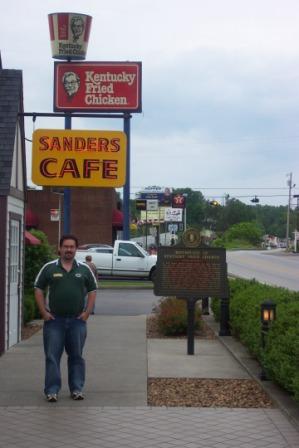
Our rest stop on our return trip was in Corbin, Kentucky. Corbin is the point where the old U.S. highway routes 25-East and 25-West converged. At this spot, an entrepreneurial former Army private opened a filling station, which became successful and to which a motel and a restaurant were added. Harlan D. Sanders' restaurant really took off when he perfected a method of pressure-frying his chickens and in the 1950's, he personally franchised the concept (and the recipie) all over the country. His nickel-a-chicken payoffs quickly grew into the fast-food giant that today is Kentucky Fried Chicken, and it all started in Corbin. Harlan Sanders was never an actual Colonel in the military; "Colonel" was an honorary title given to him by the governor of Kentucky (who was also one of his investors) and Sanders used the title relentlessly in promoting himself.

The original restaurant is gone and much of "The Colonel's" property was condemned to build Interstate 75. A re-creation now stands near where the original used to be. That's me standing out in front of it. Inside is a somewhat-nicer re-creation of a 1940's roadside diner, with a display of a re-created 1940's-era kitchen with some of Sanders' original equipment and some other appropriate displays. The restaurant today, however, is a modern KFC with a contemporary menu, complete with the potato-flake mashed potatoes and the gravy that Harlan Sanders himself called "sludge" and "wallpaper paste."

Just outside the faux-original Sanders Cafe there were some interesting advertisements. Apparently it's election time in Kentucky, and the race for Jailer in Laurel County is hot. (Query as to why there is a special elected office of Jailer.) Lonnie Owens wants to be the Republican nominee for Jailer -- which apparently is different from the office of Sherrif. And you've got to imagine that, pretty much anywhere in the country, getting the Republican party nomination for Jailer is pretty much a guarantee of winning the general election. A particularly classy touch is putting the billboard next to the tattoo shop advertisement.

Also interesting are the many anti-abortion billboards around Corbin, and one set of billboards advising Christians not to worship on Sundays and to not celebrate Easter because those traditions have their roots in pagan practices. This is a level of religiosity which utterly baffles me. Caring what day of the week or what time of year a particular religious ceremony is observed seems to ignore the point of the ceremony in the first place, and it reduces the religion to little more than a set of magical rituals and arguments about how to perform them.

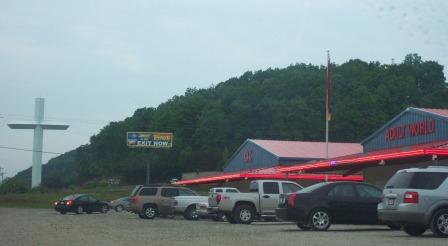
But all of that weirdness belongs to Kentucky, not Tennessee. The Wife and I are not going to be travelling along I-75 again for a long time, and we'd noted a bit of Tennessee surreality needed to be documented, too. One of the largest adult bookstores I've ever seen is located just off I-75 in Caryville, Tennessee. Next to it is an RV park and repair facility owned by someone who apparently does not like his neighbor and has erected a gigantic cross next to it, apparently in an effort to either deter the religious from going to Adult World, or to inspire thoughts of church and religion next to this den of sin and debauchery. I doubt if it works, but the juxtaposition of the sex-toy superstore and the gigantic cross is quite disarming -- and something likely only to be found in the middle of the Bible Belt where religion reaches hysterical levels of intensity.

The Appalachian Mountains are heartbreakingly beautiful this time of year, with all the trees finally filled in and wisps of fog and cloud floating about. We'll miss all the green when we live in the California desert. And there's weirdness in California, too. But there is a great deal of weirdness here in the south. Our sojourn through Kentucky confirmed for us that the weirdness is not confined to Tennessee but seems to be well-distributed throughout all of Appalachia.

Noble Soldier

To celebrate the second anniversary of our wedding, my grandmother asked that my uncle, who used to be in the wine sales business, pull out a treasure -- a bottle of Chateau Lafite-Rosthchild 1969. Now, this could be a wine review here – but seriously, what value would that have? Would you seriously expect me to say that I didn’t like it? It was easily the best glass of wine I’ve ever had. Complex and mild, there were delicate hints of tobacco under the fruit, with a wonderful tannic taste and balanced layers of cherry and flowers.

We’ll never have anything like that again – how much would a bottle of such wine cost, I wonder? We’re leaving behind virtually all of the bottles of wine we’ve drunk in Tennessee; only taking a few very noble soldiers back to California with us to start our display. This one is going to become one of the centerpieces of the collection. Naturally, we owe a huge debt of thanks to my aunt and uncle for letting this noble soldier go to his duty.

My grandmother kept about half a glass in a carafe to make vinegar. Seriously, she did. This is in keeping with what seems to be a tradition of using very expensive, high-quality wine for prosaic purposes; my mother once used half a bottle of one of the princes of my father's collection to make spaghetti sauce and my grandmother's sister used an entire kilogram of Parmaseano Reggiano (not just the heel in the sauce, but the entire wedge) for one of her pasta dishes.

Dateline: Milwaukee

Good news, I suppose: America has not been completely homogenized. This turned into something of an inconvenience while we were in Milwaukee. I had to teach my class online, and to no one’s surprise, there is no wireless internet in my grandmother’s house. So after some discussion, we wound up getting a hint from my aunt and uncle to go to a Starbuck’s on Highway 100 and Greenfield Avenue.

The Wife and I drove there, and did not see any Starbuck’s. A few more blocks down Greenfield, and we determined that there were no coffee houses anywhere. Every block had at least three taverns, though. West Allis – and indeed most of Milwaukee – appeared nearly devoid of coffee houses. So we tried driving by Marquette University and then UW Milwaukee.

Near UWM, we found two places with wireless internet – and both were closing when we walked in because it was 7:00 p.m. on a Sunday night when we showed up. What kind of coffee house closes at 7:00 p.m. on a Sunday night? So back we drove to West Allis – and this time, we found the Starbuck’s. Then I had to buy an internet account at Starbuck’s. It didn’t work properly for a while until I could reconfigure my computer and made it work. Fortunately, it did eventually work, and my students did not need much trouble.

So it was back to my grandmother’s house where I wrote one of two final exams that I need to write this week, and The Wife and I sat with my grandmother watching a broadcast of Woody Allen’s farcical Shadows and Fog.

May 13, 2006

Dateline: Watertown

The worst thing so far about this trip has been a sudden snap of Arctic cold air. It’s not even 40 degrees outside; our entire trip was through cloudy skies and most of it was rainy. There was a terrible wreck between two tractor-trailer rigs in Lexington, Kentucky; it took us nearly an hour to get through a small college town. That, in turn, caused us to hit Chicago at 5:00 Central time. It took us as long to get from Gary, Indiana to Addison Drive as it did to get from Indianapolis to Gary. Most of the time, we were in rain. The Wife drove from Covington, Kentucky to a point about twenty miles south of Indianapolis. She also drove from the Illinois Tollway travel oasis (home of the gyro that ate Sheboygan) to New Berlin, Wisconsin. 700 miles later, we’re at my in-laws’ house.

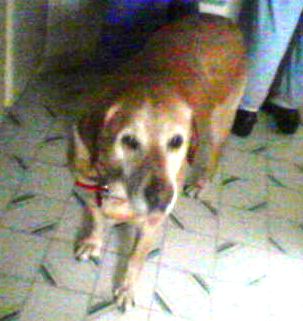
I like my in-laws; they’re nice folks. The only trepidation I felt about coming here was that the house has no heat in the upstairs guest bedroom and the shower lacks substantial water pressure. But they’ve done something since we were here last; there is some more pressure than I remember and the water got hotter than I remembered, so that was a big plus. Sleeping upstairs still involves using about six comforters on the bed. Today the agenda is to drop off my in-laws’ dog Bosco (the big old guy to the right) to be doggie-sat while my in-laws travel to Seattle to meet up with family (including my brother-in-law, who will fly up to meet them from Long Beach), watching The Da Vinci Code, and dinner at a nice restaurant in the nearby city of Johnson’s Creek.

When we got here, my in-laws did not think that there would be any “high tech” stuff like wireless internet anywhere near here, and that we’d have to all the way into Madison to find something like that. Of course, things are a little bit more widespread than that; there is a coffee shop right here in Watertown. They were blown away that such a thing would be right here in little old Watertown. I'm not a big fan of the "world music" being played here, but that's as it is.

May 12, 2006

Road Trip

Today begins our first of several upcoming road trips. The Wife and I are going to Wisconsin this time, to visit family for Mother's Day. We did Mother's Day early with my mother; now it's time for The Wife's mother and my grandmother. We'll be much farther away from them in a month than we are today. (And it gets us out of Tennessee.) It's supposed to be a twelve-hour drive, which makes for a long day. So of course, The Wife is vacuuming the house before we leave. I'm sure there's a good reason for that.

May 11, 2006

Quincentennial

This is my 500th post on this blog. A five hundredth anniversary is called a "quincentennial." Easy to remember because you can think of the exotic fruit quince.

It's now been 333 days since I started blogging on June 13, 2005. That's an average of 1.5 posts a day. Site usage information tells me that there is a loose corps of about 100 readers who check in periodically; I don't know who most of you are. And that's cool.

Speaking of anniversaries, The Wife and I will be spending ours next week driving from Wisconsin to Tennessee after visiting our families there. Any ideas on what I should get her, aside from a full tank of unleaded? (Gasoline: the gift that says, "Yes, honey, we are still in Indiana.") Seriously, though, I should get her something other than finally agreeing to return to California. She's been singularly responsible for getting me through our time out here and I'm very grateful to her.

Some Things Never Change...

...and other things do. Contemplating my return to Los Angeles, I read the sports pages today to get caught up, while eating lunch. Local sports here is pretty much a wasteland right now; die-hard fans are watching UT baseball but aside from that, there is no sports in East Tennessee in spring. So, I have recently learned :

1. The Clippers are in the NBA playoffs. The Lakers are not. Phil Jackson and Kobe Bryant got along just fine this year, and maybe that was the problem. Oh, and maybe not having O'Neal on the team kind of hurts, too. I suppose I'll have to root for the Clippers against the Suns, but it looks like the Mavericks-Spurs series is a whole lot more interesting.

2. The Dodgers are near the basement of the National League West, because while there is decent pitching, the bats just aren't there. The media are, once again, watching Barry Bonds despite the fact that the Giants are in the basement. Who's leading the laughably weak NL West? Colorado. The San Diego Padres can't bring it against anyone but Los Angeles.

3. The "Los Angeles Angels of Anaheim" are being sued for giving away handbags to women but not men on Mother's Day. I'm all for gender equality and I generally like California's pro-active antidiscrimination law, but there is a point at which it becomes ridiculous.

4. In the Stanley Cup playoffs, all four top-seeded teams in the West were upset. In the East, all four top-seeded teams made it to the quarterfinals. The apparent best team in the NHL this year, the Ottawa Senators, are looking hard at being swept by the Buffalo Sabres in a series of one-point games. From L.A., the Mighty Ducks still represent; the Kings didn't make the cut this year.

5. There is still no professional football being played in Los Angeles, which remains a satellite market of the San Diego Chargers. That's fine with me; it makes it more likely I will be able to see Green Bay games broadcast on regular TV come the early autumn.

High Tech Cocktails

Although it's a little early in the morning for this sort of thing, it's worth a mention. One bizarre idea: mojitos in spray cans. One very intriguing idea: scotch cooled with liquid nitrogen. Cold as if it were on the rocks, but powerful as though it were straight up.

Spaniards who at El Bulli in Barcelona (which recently was rated the "best restaurant in the world" by European food snobs displacing The French Laundry in Napa Valley) don't have a monopoly on good ideas for serving cocktails, either. While perhaps less inventive with the drinks, these Hungarians seem to have identified a successful business model.

(Link by reference to Jonathan Adler (nee Juan Non-Volokh) at Volokh.)

May 10, 2006

Monitoring Metadata

It appears that the NSA wiretapping is somewhat broader in scope than even I had been led to believe. A database is being compiled of every single phone call -- and I can only assume every single e-mail -- that is either originated in or received in the United States. Eavesdropping is apparently not part of this program, so the contents of your calls (and, presumably, e-mails) are not part of the inquiry. But the fact of the phone call is.

So, here's the question of the day. Let's say that TL, who is a citizen of the US, has a friend -- let's call him "Xavier" -- who is also a citizen. TL lives in Knoxville; Xavier lives in, say, Dallas. Neither TL nor Xavier are suspected of any criminal or terrorist activity (although TL has been known to make subversive posts on the net from time to time, critical of the Administration, which in the minds of some people makes his loyalty to the country suspect).

If TL wishes to communicate with Xavier, he has several options. He can write Xavier a letter and send it by a variety of postal services. FedEx, UPS, the ever-disappointing DHL, and even the U.S. Postal Service can deliver the letter to Xavier in one day for a few dollars. Or, the U.S. Postal Service can send it via first-class mail within several days. If this is the chosen mode of communication, there is little doubt that the fact that a letter has been sent from TL to Xavier will not be recorded by the government; the existence of the communication is private.

TL might call Xavier on the telephone. According to the latest information, the contents of the communication are not examined or recorded by the NSA or any of its computers. But the presumed identity of the callers, the time of the call, the call's duration, and the physical mechanisms used to make the call are recorded. By "physical mechanisms" I mean whether the call was made from a land line or a cell phone. Either way, it is possible for the data thus gathered to reveal where TL was located physically when he made the call, and where Xavier was located physically when he took it. That information is being stored.

TL might also send Xavier an e-mail. Again, the metadata about the e-mail is at least as interesting as the content of the e-mail. Excluding the content of the e-mail from the NSA's analysis, the NSA still likely records the time of the e-mail, various information about the format and any attachments, what internet nodes was used (indicating where the author and recipient were) -- all the same information about the communication that delicately skirts around what is actually being communicated.

Does TL have a privacy right in the "who," "where," "when," "how," and "for how long" of his communications to Xavier, so long as the government keeps its eyes and ears out of the "what" and "why" parts of the communication?

Privacy falls within two general categories: the right to autonomously make personal decisions affecting one's life, and the right to control access to information about oneself. Both are part of the "right to be left alone." Both facets are at least implicated by governmental intrusion on privacy -- the monitoring program might chill otherwise free communication simply from the knowledge that the recordation program exists.

The most objectionable part of the domestic wiretap program was that somebody was listening in on the conversations of American citizens under circumstances in which they had a reasonable expectation of privacy, and for which no judicial authorization was given. But this is substantively different -- the content of the communications has been removed, with nearly surgical precision, from the government's data-gathering information.

As the hour is late, and the question very ambiguous in my mind, I shall need to reflect further on this point. But I may have to conclude that, particularly with cell phone calls and other communication that utilizes public resources, the "when," "how," and "how long" information -- and maybe even the "who" and "where" information, is not subject to reasonable expectations of privacy nor does the recordation of the use of those public media indicate any likelihood of chilling communication itself.

I don't even know right now how I want the issue to be resolved. It makes me uncomfortable, but not nearly as uncomfortable as the programs that include eavesdropping. I want the government to have the information it needs to protect me, and I want the government to protect and respect my privacy. I believe that both objectives can be realized. What I just haven't thought through yet, since this information is still new to me and I'm not thinking at a 100% level right now, is whether this program will achieve either, or both, of these objectives.

More thought on this in the next few days.

How To Buy A House In California

The median home price in California is over half a million dollars for a single-family home. In the high desert, where The Wife and I are going, prices are still below the median, but not by much. How I could ever afford to buy a home under such circumstances has long baffled me. Clearly, The Wife has to work, too, and we won't be able to afford luxuries like food or gasoline.

Or, maybe we could get a fifty-year mortgage. Also known as "a surefire way to never accumulate equity," this product would offer substantially lower payments. Presumably, we could refinance once our earnings power increased or when the rate shifts to variability, and at that point perhaps we could get iunto a situation in which more than a miniscule portion of the payment actually went to principal rather than interest. The good news, though, is that the high percentage of interest woud look very favorable on taxes, and hopefully some equity would accumulate because of market pressures.