June 7, 2009

Read The Article

One of my big gripes about journalism is when headlines are deceptive and do not accurately summarize what is described in the article. Today brings a good example: judging from the headline in this article from the Associated Press ("Alternative Medicine Goes Mainstream"), one might think that "alternative medicine" is gaining significant acceptance by the mainstream medical establishment.

It is not -- at least, not in the sense that any real doctors think it actually does anything. Read the article and you'll see why. Nearly every paragraph in the article contains facts which indicate why you should not use alternative medicines, why big hospitals are irresponsible for offering woo and calling it "treatment," and why the public and insurance premium payers are being bilked by the providers of this woo:
Government actions and powerful interest groups have left consumers vulnerable to flawed products and misleading marketing.

Dietary supplements do not have to be proved safe or effective before they can be sold.

Some interfere with other things you may be taking, such as birth control pills.

...many of these products are made by big businesses.

Ingredients and their countries of origin are a mystery to consumers.

hey are marketed in ways that manipulate emotions, just like ads for hot cars and cool clothes. Some make claims that average people can't parse as proof of effectiveness or blather, like "restores cell-to-cell communication."

Even therapies that may help certain conditions, such as acupuncture, are being touted for uses beyond their evidence.

...more than $2.5 billion of tax-financed research has not found any cures or major treatment advances, aside from certain uses for acupuncture and ginger for chemotherapy-related nausea. If anything, evidence has mounted that many of these pills and therapies lack value.

...some offer treatments with little or no scientific basis, to patients who are emotionally vulnerable and gravely ill. The Baltimore hospital, for example, is not charging for Reiki but wants to if it can be shown to help. Other hospitals earn fees from treatments such as acupuncture, which insurance does not always cover if the purpose is not sufficiently proven.

Health insurers are cutting deals to let alternative medicine providers market supplements and services directly to members. At least one insurer promotes these to members with a discount, perhaps leaving an incorrect impression they are covered services and medically sound. Some insurers steer patients to Internet sellers of supplements, even though patients must pay for these out of pocket.

A few herbal supplements can directly threaten health. A surprising number do not supply what their labels claim, contain potentially harmful substances like lead, or are laced with hidden versions of prescription drugs. [¶] "In testing, one out of four supplements has a problem," said Dr. Tod Cooperman, president of ConsumerLab.com, an independent company that rates such products.

...spending money for a product with no proven benefit is no small harm when the economy is bad and people can't afford health insurance or healthy food.

Cancer patients can lose their only chance of beating the disease by gambling on unproven treatments. People with clogged arteries can suffer a heart attack. Children can be harmed by unproven therapies forced on them by parents who distrust conventional medicine.

at least there are regulatory systems, guideline-setting groups and watchdog agencies helping to keep traditional medicine in line. [¶] The safety net for alternative medicine is far flimsier. ... Some states license certain types, like acupuncturists; others do not.

Some studies suggest that vitamin deficiencies can raise the risk of disease. But it is not clear that taking supplements will fix that, and research has found hints of harm, said Dr. Jeffrey White, complementary and alternative medicine chief at the National Cancer Institute.

The Dietary Supplement and Health Education Act of 1994 exempted such products from needing FDA approval or proof of safety or effectiveness before they go on sale. [¶] "That has resulted in consumers wasting billions of dollars on products of either no or dubious benefit," said [Bruce Silverglade of the consumer group Center for Science in the Public Interest.]

People need to keep a healthy skepticism about that magical marketing term "natural," said Kathy Allen, a dietitian at Moffitt Cancer Center in Tampa, Fla. [¶] The truth is, supplements lack proof of safety or benefit. Asked to take a drug under those terms, "most of us would say 'no,'" Allen said. "When it says 'natural,' the perception is there is no harm. And that is just not true."

I didn't write any of that, it's all from the article. I've quoted 616 out of 1818 words in the article -- more than a third of it. My point is to demonstrate that the headline does not accurately explain the contents of the article, which any reasonable person would read and think to not use alternative medicine.

Now, what would be interesting to learn is just how much money is spent on woo, how much of it is paid by insurers, and how much of it is being paid by the government.

Pseudonymity (UPDATED)

Some bloggers use their full, real names when the blog. I say, good for them that they can do so freely and without fear of overt consequence.

Most of the bloggers who do that are well-established in their careers or are in careers which lack substantial review processes in which one's peers or one's superiors (or worse, one's would-be superiors) have real effects on their real lives. Examples include editorial journalists, self-employed writers, and tenured professors.

I also read a number of blogs that are not political. Culinary-focused blogs, for instance, are a secondary form of advertising for chefs looking to not only share ideas but also to demonstrate their abilities. They are most instructive to the amateur when they discuss experiments that did not go so well as well as their triumphs, but either way they're a good source of ideas. And since these chefs work in a creative industry, unless they air out personal disputes rather than talking about the theory, process and results of their craft, there is no particular consequence to their disclosure of their identities.

Others in the world of blogging, though, do not have these sorts of luxuries. In a lot of professions, forthright expression of oneself on the Intertubes can carry real-life consequences. Case in point, "publius" at Obsidian Wings. Publius is generally a left-leaning blogger; he has undertaken a defense of the Sotomayor nomination recently and of conservatives inveigling against "judicial activism" generally. Having launched a series of critiques of counter-critiques at one such right-leaning blogger, Ed Whelan, he managed to score some points, of varying degrees of penetration. Either individually, or cumulatively, Whelan eventually had enough and undertook the necessary detective work to track down the true identity of his critic, which he then publicized on his own blog.

For all of the above, with very few exceptions, blogging is a hobby and not a profession, job, or even avocation. Despite its "hobby" status, blogging is something done a public forum, indeed, the Internet is probably the most public forum yet created at any time in human history. And people who evaluate others use it to learn things about their evaluees. Publius turns out to be a non-tenured professor at an educational institution. He is rightly concerned that his blogging will be taken into account when he makes his bid for tenure.

I do not include the real name of publius here or links to the real posts -- it should be child's play for anyone interested to find these things with simple Google searches. If you do that, you'll also know that publius used an e-mail account registered to "Edward Winkelman," which is not publius' real name, again for the purpose of corresponding without directly identifying himself.

I do exactly the same thing. I understand publius perfectly.

He wants to get tenure, he wants to have the ability to advance in his profession. Once his blogging identity is known, the blog becomes part of his lexicon. The blog is just a hobby for him; he does not want to offer it as part of his "official" body of work, which in his case is largely academic. Academic work can be quite politicized, as well -- or not, depending on the subject matter.

For instance, an extensive body of academic writing on Article 9 of the Uniform Commercial Code does not necessarily lend itself to "liberal" or "conservative" labels -- at least not easily, and particularly not in the present economic situation in which both liberal and conservative politicians have taken a variety of stances on a variety of issues dealing with the subject matter of Article 9 and the bitter political truth is that no one has a clue about what to do. (If you aren't following why I picked Article 9 for this example, that just goes to show why this area of academic inquiry is not necessarily political in the left-versus-right sense of that phrase.)

Unlike publius, I've not made any person -- particularly any other blogger -- the subject of a crusade. In going after Whelan so hard, publius risked making an enemy out of an object of criticism. Which is not to give Whelan a pass for "outing" publius; that elevated the dispute between the two from a battle of ideas to a personal attack. Perhaps Whelan thinks publius crossed that line first; publius agreed with a characterization of Whelan as:
...the guy Republicans look to when they need to discredit a Democratic legal or judicial nominee. He pores over their record, finds some trivial fact that, when distorted and taken totally out of context, makes that person look like some sort of extremist. Whelan knows this is what he's doing. It's willful. He's essentially a legal hitman, someone who provides the "expert" opinion that the right wing echo chamber then uses as the basis of its attack campaign.
Note, though that publius was not the author of those words; he agreed with and reposted them. He also agreed with and reposted a critique of Whelan by Eugene Volokh, and Whelan seems to have no beef against Volokh. Query, though, as to whether even if this constitutes a personal attack by publius on Whelan, whether "outing" publius' identity was the appropriate response. I think not -- "outing" publius demonstrates to me that Whelan had run out of ammunition with which to defend his previous writings.

Personally, I'm much more sympathetic to publius' situation than to Whelan's. Most of my own friends and family know of this blog and know of my reasons for writing under a pseudonym. I've shared my true identity with a few people who have earned my trust online -- who have proven worthy of that trust. No regular Reader here, despite whatever running disagreements we might have, has undertaken a Whelan-like search to "out" me.

Now, I suspect that a regular follower of this blog could probably do exactly that. There are more than enough clues in these pages for an intelligent, motivated person to track down exactly who I am to a high degree of certainty. If they do, and I'm confronted the way publius was, I'll certainly own my writings; I'm not ashamed of what I've written here. What I'm hoping is that no one ever bothers to do that.

The reason for that is not that I'm ashamed of my writings or that I need to be anonymous to attack anyone. My reasons for writing psedonymously are manifold:
  • I might want to be a judge one day. As a judge, I would need to refrain from personal participation in political issues or from pre-opining on issues which might come before me. While I don't think I've pre-judged any particular issue that I might in theory have to handle as a judge on these pages, some might think I have because I've expressed an opinion.* While I think that I can pretty easily set aside my own preferences and look at the law as it applies to a given situation† some might think otherwise. So it's better and more prudent to establish a separation between my professional work and this blog, which is a hobby.
  • Even if I'm never elevated to the bench -- and right now, with mandatory judicial furloughs caused by the budget crisis and the prospect of judicial salary reductions being imposed as judges are re-elected, that career move appears to have a downside -- I am still a lawyer, charged with representing my clients, and some of them might disagree with my opinions here, and take their business elsewhere because of that. Again, there's no particular reason why my own personal opinions should interfere with my ability to represent my clients,‡ but it's simply more prudent to avoid the issue by, again, establishing a separation between my personal musings and my professional activities.
  • The world is full of creepy, unbalanced people who do weird things. The opinions I address here might cause someone to deem me their enemy or a threat. I don't mind being criticized for my opinions, but I do mind it if someone slashes the tires on my car or threatens me with a gun. I have enough personal risk of reprisals from the hundreds of people I evict in my landlord-tenant practice and regular litigation practice from the people with interests adverse to my clients who demonize me. I don't need any more of that from the blog, which is supposed to be fun.
  • If I'm going to write about ideas and concepts and thoughts, writing under a pseudonym, in my opinion, depersonalizes those ideas. The ideas have to stand and fall on their own merits. If I'm Arnold Schwarzenegger, and I articulate an idea, then that idea comes from Arnold Schwarzenegger. But if I'm Transplanted Lawyer, someone who lacks a face and a real-world identity, then my ideas must either be valid, or not. Pseudonymity forces me to articulate and nuance my idea such that it can stand on its own, free from my own personality, reputation, or identity (whether that would help or hurt the idea's credibility is debatable). So too must critiques of what I write be focused on the content rather than the source.
Now, if you write under your own full, real-life name, good for you. But I do not think that's the right way for me to write. And if you correspond with me, which you're welcome to do, you're likely to get a response that is also a pseudonym. I hope that you'll not be Whelan-like in seeking to "out" my real identity, even if you have the ability to do so -- if for no other reason to avoid making yourself the kind of asshole Whelan demonstrated himself to be.

UPDATE (June 9): Whelan apologized to publius. It was a good apology. Publius accepted his apology, and quite gracefully. Given that, this particular controversy ought to be over. Hopefully the debate continues but the tone between the two simmers down. And I can see a difference between disagreeing with but tolerating another blogger's pseudonymity and "outing" that blogger.


* News flash: every judge on the bench, at every level of the judiciary from Chief Justice Roberts right on down to your local juvenile traffic referee, is a human being, and every one of those human beings have political opinions and preferences. One hundred percent of them. One is not disqualified for judicial office simply by virtue of having, or even expressing, political opinions.

† Example: I favor same-sex marriage as a policy. Nevertheless, I have opined that the recent California Supreme Court decision upholding Proposition 8 was a correct application of law to a particular case, despite the fact that I would have preferred, on a policy basis, to see same-sex marriage reinstituted in California.

‡ Example: I am an atheist. Nevertheless, I have and have had churches and other religious institutions as clients -- for instance, with regards to disputes between the church and insurance companies or contractors. Why not? My lack religious faith has nothing to do with my appreciation of the transaction at issue and the church has as much right as anyone else to have its contracts enforced.

June 5, 2009

Another Literal Video: Total Eclipse Of The Heart

In Which I Disabuse You Of A Variety Of Food Myths

It's difficult indeed to believe that an attorney would actually file a lawsuit in Federal Court alleging that a reasonable consumer would have been confused into thinking that "crunchberries" are an actual fruit that could be purchased in a box of Cap'n Crunch cereal. Now, I see and hear more ridiculous sorts of things in my practice quite often.

Nevertheless, there is only so much apologizing I can do for the legal profession, only so much denial I can of the criticisms of "frivolous lawsuits" because there are some damned silly lawsuits out there. And "Crunchberries" is one of them. Lawyers are supposed to be a safeguard against this sort of thing, not perpetrators of it.

It's advertising, people. You're supposed to be possessed of reasonable intelligence, which might be defined as the ability to understand when a claim is intended to be taken literally and when it's just "puffery." See Coca-Cola Co. v. Koke Co. (1920) 254 U.S. 143 (although there is no cocaine in Coca-Cola, the name is not deceptive even when conjoined in advertisements depicting a coca leaf). See also Hayna v. Arby's, Inc. (Ill.App.1981) 425 N.E.2d 1174 (addressing false advertising challenge to claim that Arby's sold actual "roast beef" as opposed to the salty meat-like film that they actually put in their sandwiches).

Continuing in the same vein:

  • "Grape Nuts" are not actually nuts harvested from grape vines.
  • Nothing in Five Alive fruit juice is actually alive.
  • Chicken of the Sea is made from fish, specifically tuna.
  • There is no blood in a blood orange.
  • Jimmy Dean Sausage is not named for James Dean.
  • Girl Scout cookies are not made from real Girl Scouts.
  • Similarly, shepherd's pie contains no shepherds (and no sheep, either).
  • Mocha Mix contains no actual mocha and was not made in the city of Mocha.
  • Angels do not actually eat angel food cake. Devils do not actually eat devil food cake.* You can buy or make quantities of pound cake which weigh more or less than one pound.
  • Julius Caesar never ate what we today call "Caesar salad."
  • The marshmallows in Lucky Charms possess no magical abilities.
  • "Denver" omlettes can be made anywhere. See also "New York" strip steaks, "New England" clam chowder, and "Philadelphia" cream cheese. But cf. Tequila, Champagne, Parmesan, and Bordeaux, which actually signify geographic origin in their names.
  • Hush puppies are made from cornmeal. And sometimes with little bits of onion, but I don't like them that way. But no dogs or shoes are harmed (typically) in the making of hush puppies.
  • Buffaloes do not have wings. Those come from chickens.
  • Baby carrots are not special miniature carrots, nor are they harvested early in the season before the carrot can become an "adult." There is no such thing as an "adult" carrot.
  • Baby back ribs come from pigs, not human babies.
  • Goldfish crackers do not contain any ingredients derived from goldfish. Similarly, Chick-O-Stick candy contain no products made from chickens, nor is it served on a stick.
  • Bear claws are actually doughnuts.
  • If you are in the United States, Canada, or pretty anywhere but France, the "French Bread" you are eating was not made in France and was unlikely to have been made by an actual French person. Same with "Italian Bread"; see also "German" potato salad, "German chocolate" cake, "Black Forest" cake, "Irish" stew, some "Swiss" cheese, "Spanish" rice, and "India" pale ale.
Let's leave skip the jokes about Alfredo sauce.

Hat tip to Charles at Popehat.

* This is largely because there are no such things as angels or devils. If they did exist, I'm reasonably sure that they both would prefer rich, moist, chocolatey Devil's food cake to dry, tasteless, boring Angel's food cake.

Mandatory Vacation

While some of the commenters to this article act like this was common knowledge, I did not know this fact and I consider myself fairly sophisticated about employment matters. There are lots of reasons for "use it or lose it" policies regarding vacation or PTO, but this was not one that I had ever considered. It makes sense once explained, of course, it's just not intuitively obvious.

Gifting For A Finicky Couple

Gifts are an interesting kind of social contract. When you give a gift to someone else, you make an elaborate show of saying that it is given with no expectation of anything in return, that it is done for a generous motive and as a gesture of friendship and affection. But this is a polite social lie. If the gift is not reciprocated at some point in the future, this is seen as impolite, almost insulting. There must be a return gift. When the return gift is delivered, the social contract is completed, and bonds of friendship and affection are strengthened. If it is not, resentment and tensions grow instead.

Depending on a variety of circumstances which vary from culture to culture, the gift may be of lesser, approximately equal, or even greater value than the first gift. But in functionally every culture and throughout all of human social history, gifts come with the unspoken (even denied) expectation that there will be a return gift.

Enough theory. Here's the practical issue: some friends have invited us to see a play with them tomorrow evening. We enjoy this couple's company but gift protocol is a problem with them because their personal tastes and habits are much more particular than ours.

In characteristic fashion, they have already bought the tickets for the event, at thirty dollars a head. They will not take money from us to repay them for the cost of the tickets. We offered to meet them for dinner, with the idea that we'd pick up the tab for dinner, but they declined that offer.

"Dude, get them a good bottle of wine, already," you might say. "We know you're able to pick out a prince at the BevMo." Indeed, wine is a perfect gift for things like this -- it is easily portable, you can spend any amount of money based on the quality/prestige of the label, and it carried a degree of high-falutin' elegance that makes it a classy gift.

Except this couple doesn't drink at all -- they're complete teetotalers. They're also vegetarians (not vegans), which may be why they're not really in to going out to dinner with us (we will drink and eat meat freely).

So what object might we get them, in the neighborhood of fifty to seventy-five dollars, that would suffice as a return gift for the tickets to the play? They have small, yappy dogs, if that's any help.

Congratuations New Hampshire

After some legislative showboating, New Hampshire adopted same-sex marriages earlier this week. This, again, was done through the democratic process, and substantial exceptions to non-discrimination laws were made concurrent with adoption of same-sex marriage, ostensibly so as to ensure that no religious or fraternal organizations are required to solemnize marriages contrary to their beliefs. The law takes effect January 1 of next year.

Timothy Kincaid at Box Turtle Bulletin points out that as of this week, more than a third of all Americans now live in jurisdictions that provide some level of official recognition to same-sex relationships:
In Kincaid's chart, dark blue indicates full marriage rights, light blue indicates strong civil unions (called "domestic partnerships" in California and Nevada) with only trivial differences to marriage, yellow indicating weaker civil unions offering some, but not all, of the rights of marriage, and gray indicating recognition of same-sex marriages or civil unions performed elsewhere.

Note, though, that the bulk of the other states have statutory or state-constitutional prohibitions against same-sex marriage. Nineteen states, representing a nearly-identical percentage of the population, have constitutional amendments prohibiting not only same-sex marriage but also prohibiting any kind of same-sex civil union.

Rhode Island also recently enacted a very limited recognition of other civil unions, which should shift it into the "yellow" category on Kincaid's chart. To add to the chart, then:


These laws can all be changed, but there's still a lot of work to be done, and it will have to be done changing hearts and minds.

June 4, 2009

The Speed Of Evolution

Guppies transplanted from a predator-free environment to one in which they were potentially food for other animals were able to alter their reproductive output by significant margins within about twenty generations. For guppies, that's only about eight years.

If you find the idiocy of Ray Comfort persuasive, you'll dismiss this remarkable demonstration of evolution in action as a "mere adaptation." But if you take the time to understand that adaptation is evolution, this is all the proof you'll need.

China's Cautionary Example

China is the world's most populous nation. It is an industrialized, nuclear-armed power. Unlike the former Soviet Union, it is a major trading partner of nearly every other industrialized and semi-industrialized nation on the planet. And it is run by a brutal dictatorship that is much more skillful than the former Soviets were at keeping its iron fist invisible to the outside world.

But not today. Not on the twentieth anniversary of the day when the government of the People's Republic of China unveiled its true nature and sent its tanks and infantrymen into the only significant gathering place in its capital city and killed an as-yet unknown number of college students peacefully expressing themselves. The "Gate of Heavenly Peace" became the site of a massacre. That happened June 4, 1989.

On June 4, 2009, Tiananmen Square in Beijing is flooded with police officers, who outnumber tourists. No one can enter the square without being thoroughly searched. No one can take a photograph there without official permission, which today is being granted only reluctantly and to few, if any, people who have serious camera and film equipment. No ne can take a banner or blank paper and art supplies into the square at all. Nor can anyone linger there.

On June 4, 2009, as you read this post from the comfort of your home, likely with the only restrictions on your internet access being those which you have self-selected to shield yourself from the evils of images of people having sex or using foul language, consider how 350 million internet users in the PRC do not enjoy that luxury. Twitter, Flickr, YouTube, Hotmail, Facebook, and a wide variety of other internet search engines, social networking, and other ways to gather information and share ideas have been shut down. There are no town squares, physical or virtual, open in China at all today.

Clever Chinese computer users will do what they can to dodge the government's typically ham-fisted attempts to control the circulation of information. Some will be caught and punished. The leaders of the student movement that caused so much fear in the halls of the People's Assembly and the Central Committee of the Chinese Communist Party twenty years ago have gone their separate ways -- some disillusioned and cynical, some pursuing their idealistic impulses in other ways -- and some of them have been taken into official custody by now, to prevent them from doing anything that might challenge the status quo.

The government has hoped to raise the next generation of Chinese in complete ignorance of what happened, but it is doomed to fail because too many people were there, and personal memories are not so easy to erase as the contents of censored schoolbooks. The result is a generation of young people who are deeply cynical about their own government, which may actually be acceptable to the government so long as they are overtly obedient. Certainly the disinterest in governmental and political affairs, which they share with their generational counterparts in the West, is welcomed by the leadership.

China's promises of reform and freedom are lies. If you are unmoved by the fate of college students who wanted democracy, consider in the alternative what China's government does to Christians and Buddhists who want the right to practice their religions in peace. The same people who sent tanks to kill college students twenty years ago are still running the show there.

Americans and Europeans, be grateful for your freedoms. Not everyone in the world has them. Honor and celebrate your liberty by using it.

June 3, 2009

An Example Of How THE ISSUE Trumps Everything Else When It Comes To The Supreme Court

Rush Limbaugh called Sonia Sotomayor a "reverse racist." But he may support her nomination to the Supreme Court anyway. Why? She's Catholic and has an unclear record on THE ISSUE. That is why my guide to language surrounding Supreme Court nominations refers so heavily to that particular matter. Meet the new boss, same as the old boss.

By the way, it's not insignificant that she's Catholic. Consider:

Justice
ReligionVoting Pattern on
Abortion Rights Cases
John Roberts
Roman Catholic
Restrict Roe/Casey
John Paul Stevens
Protestant
Affirm Roe/Casey
Antonin Scalia
Roman Catholic
Overturn Roe/Casey
Anthony Kennedy
Roman Catholic
Varies
David Souter
Protestant
Affirm Roe/Casey
Clarence Thomas
Roman Catholic
Overturn Roe/Casey
Ruth Bader Ginsburg
Jewish
Affirm Roe/Casey
Stephen Breyer
Jewish
Affirm Roe/Casey
Samuel Alito
Roman Catholic
Restrict on Roe/Casey

What this adds up to is that all non-Catholic Justices would sustain existing abortion law; only Kennedy would keep Planned Parenthood v. Casey (which altered and moderately restricted Roe v. Wade, based on an "undue restriction" and "viability" standard) in place. Note that in the case of Roberts and Alito, I'm reading tea leaves a little bit from their Federalism opinions and votes in Gonzales v. Carhart.

So Kennedy right now is the deciding vote; he's generally voted to affirm Casey, but in Carhart, he sustained the ban on partial-birth abortions, thus restricting abortion rights somewhat. Since Sotomayor is going to replace Souter, and the religion-based voting pattern holds with her, that turns a reliable "affirm" vote into a wobbly vote to at least further restrict abortion rights.

Religious Blocs

President Obama is traveling to Egypt to deliver an "Address to the Muslim World." (He's in Saudi Arabia today.) Now, the President excels when he delivers "challenging" speeches, like his campaign addresses on religion and race. He can encourage people to be thoughtful and introspective, pointing out that they are capable of self-improvement. He works well with shades of gray rather than black-and-white; when he's working in one of the gray zones, his rhetoric can be powerful indeed. And the word is that Obama will "challenge" Muslims in a fashion like this.

My fear is that his target audience is not ready for this. As I first read at Glittering Eye, he runs the risk of being seen as conceding, in advance, the somewhat radical proposition that the world can be divided up into religious blocs, leading up to the formation of a trans-national Muslim caliphate. Now, at Glittering Eye, Dave Schuler actually disagrees with this conclusion and does not think Obama is impliedly splitting the world up into four to six religious blocs, which is a correctly-nuanced view of Obama's intent. I think, though, that Obama runs a risk of being perceived as falling into this trap, or at least a greater one than Schuler seems willing to concede.

One of the reasons that I think President Obama is at risk of doing is is his laughably incorrect statement that the United States also could be considered as “one of the largest Muslim countries in the world.” No, Mr. President, by no rational, reality-based method can that statement be justified. To be sure, we have Muslims here and they are free to practice as guided by their consciences and traditions. The most generous estimate I have seen pegs total Muslim population here as about five million. In fact, it's likely to be something like less than half of that in reality. In a nation of more than three hundred million, we're talking about a population that is hovering somewhere between half a percent to two percent of the overall population.

It ought to be patently obvious to the entire world -- and it is -- that Americans overwhelmingly self-identify as Christian. Socially, this is a nation made up of more Christians than non-Christians. If there is any particular faith that can be said to guide Americans' decisions, that faith is not Islam.

And, as I continually underline on these pages, the government of this country is secular. We are not governed by Sharia law, we are not governed by Biblical law, we are not governed by religious tenets or theology of any faith. We are governed by secular laws, created through a republican process of divided government which has as its foundation the principle of representative democracy. Our most fundamental law prohibits the Establishment of any religion.

Finally, if one looks at total Muslim population within a nation as an index of how "Muslim" it is, the United States still falls very short. We have fewer Muslims within our citizenry than nations like Burkina Faso, Thailand, or Germany. So claiming that the United States could be considered "one of the largest Muslim countries in the world" is simply incorrect.

Which is not to say that the President is wrong about a variety of other things. America as a nation and Americans as individuals harbor no ill will towards Islam or towards Muslims as people. We do harbor ill will towards those who would do violence against us. But that is not all Muslims, it is a very small number of them; it certainly is not Islam itself.

Nor can we afford to convey the message that the United States is somehow a polar opposite to the "Muslim world." This encourages the formation of a caliphate. Not a lot, perhaps, but it's an issue. Muslims in Indonesia and Nigeria can only find common ground if they perceive that they hvae a common enemy, and international politics being what they are, the only available enemy to accomplish that is the United States.

The best way to prevent the United States from being made into a polarizing bogeyman is not to give pretty speeches. It is to treat Muslim nations as equals and trading partners, it is to tie their social stability and economic fortunes to our own. It is to treat their citizens as human beings worthy of rights on par with those we recongize in our own citizens; it is to serve as a force for peace, stability, and prosperity in the world at large. For the most part, we do this already. Where we have failed, we can acknowledge our mistakes and try to do better. And our actions will speak much louder than the undoubtedly pretty words our President will speak in Cairo tomorrow.

Speaking of Abortion....

Sidreal has conceived of a rather elegant and clever way of depicting one's stance on the issue. Still too complex for sound-bite, energize-the-base politics, but very useful for quickly understanding the nuances (and there are many) to an individual's position. For the record, my own personal curve is concave (or positively parabolic, if you prefer) where sidreal's is convex (negatively parabolic), but its beginning and ending points are pretty much the same.

June 2, 2009

Living The Dream

I ran into a buddy today at the courthouse. I asked him how he was doing, and he said, "Living the dream!" That was encouraging and uplifting. It made me feel happy for my friend and reminded me that he and I became lawyers to do what we're doing and it's a lot of fun to do. And, as I learned this weekend, it beats the hell out of chainsawing trees for a living.

Then today I had dinner with a very old friend, a guy I'd not really seen for nearly ten years. He asked how I was doing and I said "Things are pretty good." (I was more positive about the more specific "How's married life?" since I happen to enjoy my marriage a lot.) Upon driving home afterwards, I contemplated that my response to essentially the same question I'd asked my courthouse buddy was a good deal less enthusiastic.

I guess I'm not really living my dream, or I'd have had the same enthusiastic response my courthouse buddy gave me. I thought I was living the dream back when I first passed the bar and did Constitutional litigation. That dream turned out to have a big dark side. Then I thought I was living the dream when I had my own law firm. That dream turned out to have huge burdens associated with it. I might have been living the dream out in Tennessee, if there had only been enough steady income to keep us supported.

And for now, maintaining our current standard of living seems like enough of a challenge. Certainly, things are pleasant enough as it is -- a good job, challenging cases, a nice home, enough money to stay afloat. Don't get me wrong, Readers, I'm not complaining, not by the remotest stretch. But I can't really say if I'm living the dream or not; I don't know what that dream might be right now anyway. But I'm pretty sure this isn't really it.

To make it worse, I did a Google image search for "living the dream" and found out it's a Jonas Brothers song and a European soccer movie. Soccer, huh? Makes me think of David Beckham. He's living the dream.

No Resolution

When I was in high school and college, lo these many years ago, the big flashpoint political issues that I can recall talking about were:
  • Abortion
  • Affirmative action
  • The Cold War
  • Balancing environmental protection with economic growth
  • Illegal immigration
  • Gay rights
  • Responding to unstable conditions in the middle east
  • Patriotism (mandatory recitation of the Pledge of Allegiance; flag-burning)
  • Runaway Federal deficit spending
  • Extramarital affairs of politicians
  • Crime
Things haven't changed a whole lot in twenty-five years, have they? The Cold War has gone away but we're looking at "containment" and appropriate responses to nuclear-armed Iran and North Korea. Russia is also still, in some senses, a strategic rival kept in check by superior military power. So our "Cold War" concerns have transformed from a bipolar world to a multipolar one.

We're still worried about the extramarital affairs of politicians (John Edwards), and gay rights (marriage, these days), and demonstrations of patriotism (remember all the hand-wringing about Obama not wearing a flag pin on his lapel?). And unstable conditions in the Middle East?

In fact, about the only thing that seems to no longer be an issue, or at least not a huge one, is crime.

So my question is, what's happened? Why have we done nothing to move towards resolution or consensus on these issues? Have our leaders let us down? Have we let ourselves down, shouting at one another instead of listening?

Let us try to at least listen to one another in the future and understand the legitimate, good-intentioned concerns of those with whom we disagree.

I am pro-choice. But I recognize that pro-lifers have a legitimate concern about when human life begins and that our laws ought not to sanction killing innocent human beings. That does not mean I agree with them that an embryo that has only been fertilized for six weeks is a human being worthy of that protection -- but it does mean I can see how a fetus six weeks away from a scheduled childbirth could easily be considered one. In return, I ask that a pro-lifer understands that my concerns about personal bodily autonomy and control of one's decision to have sex and reproduce (or not), the government not interfering in private medical decisions between a patient and her doctor, and caution about allowing religious doctrine to control public policy are also not frivolous.

I am generally against affirmative action. But I recognize that historically, various groups of people who do not look like me have had the doors of opportunity slammed in their faces, and that history leaves a legacy which makes it difficult for those same sorts of people today to get the same kinds of opportunities that I may take for granted. And I understand that their social and historical experiences are different than my own and present valid and valuable perspectives on things. So I can see how "diversity" is important even if I do not believe that affirmative action is the right way to get it. In return, I ask that affirmative action proponents understand that fair processes involve opportunities and not results, and that the results of legitimate processes may not always conform to demographics.

I am in favor of same-sex marriage. But I recognize that people have great caution about changing a long-established social tradition. In return, I ask opponents of same-sex marriage to recognize that gay people want to have the same access to social normalcy as straight people do, and to set aside their personal dislike for gays at least enough to recognize their fundamental equality with us straight folks.

I think we should have opened immigration, with easy access to guest worker programs and a standardized and relaistic path to naturalization. But I understand that those who would restrict access to the legal right to be present in and work in the United States do not do so for evil motives like racism (well, not all of them), but rather from a concern about the economic health of our country. In return, I ask that they understand that economic immigrants are a fact of life who deserve to be dealt with in intelligent, humane ways.

See, this is not so very hard. Why does the ability to at least understand the concerns of a different point of view seem to have escaped so many people? Why do we have to keep on arguing about the same stuff, over and over again for more than half of my life?

From My Spam Filter -- A Reason To Drink Pepsi!

This charming message found its way into my e-mail today. Fortunately, the spam filter caught it but as it turned out today was a day I checked the spam filter to make sure nothing I actually want to read is getting thrown away. So I saw that somehow, Donald E. Wildmon is aware that Out magazine contains "page after page of nude and semi-nude photographs of men in suggestive positions."

He must have made a detailed review of the magazine to find out.

Now, he and his "American Family Association" are very upset that Pepsi has advanced the homosexual agenda by having:

  • Taken out an advertisement in Out magazine, apparently looking to exchange their fizzy sugar water for gay people's money.
  • Refused to withdraw their membership in the National Gay and Lesbian Chamber of Commerce when the AFA asked them nicely to stop associating with those awful homosexual gay people.
  • Required its employees to attend diversity training classes explaing why anti-homosexual bigotry is a bad thing (in part so as to avoid being sued by gay people).
  • Sponsored gay pride parades in a further effort to encourage people to exchange their money for Pepsi's fizzy sugar water.
  • Gave a total of $1,000,000 to the Human Rights Campaign (HRC) and Parents, Families and Friends of Lesbians and Gays (PFLAG).
  • Gave hundreds of thousands of dollars to the "No on 8" campaign in California and other pro-same-sex-marriage political causes.
  • Advertised on TV commercials in an effort "to promote the homosexual lifestyle." (I call bullshit on this one -- I can't think of any Pepsi commercial I've ever seen that has ever illustrated homosexual behavior.)
Well, for the most part, I approve of all the things Pepsi is accused of doing here, and while this is not a commercial (since this is a non-commercial site) I will say that when I am in the market for sugary fizzy water, this e-mail makes me more likely to select a Pepsi product than a non-Pepsi product.

Also, I'll say that as a general rule, whatever the American Family Association asks me to do, my presumption from now on will be to do the opposite.

June 1, 2009

Unmeritorious Decision

Prof. Shaun Martin writes of the Supreme Court affirming the death penalty for Richard Davis, who is Polly Klaas' murderer:

It doesn't take much to figure out what the California Supreme Court's going to do in this one once the resulting death sentence comes up on automatic review. This is an extremely high profile case. The possibility of being recalled -- or defeated for reelection -- is a distinct possibility if you vote to reverse. So I hope it comes as no surprise to anyone that the California Supreme Court unanimously affirms the conviction and death sentence.
Not to express any love for Davis, who deserves none, but this isn't deciding the case on its merits. Judicial action of all sorts, and criminal prosecutions in particular, should be decided on their merits and not subject to popular vote. Adjudication is not democracy. Unpopular people have rights, too, and our legal system should protect and vindicate everyone's rights, not just those of the well-regarded.

Guys like Davis are pretty nearly the worst sorts of criminals our society has to deal with and I have no real problem with the death penalty being on the table for stuff like this. When we as a society collectively decide to put a criminal to death, though, we need to be really sure we're wearing the white hats.

And there is some reason to doubt that here -- Prof. Martin correctly, and sarcastically, points out that in his case there may indeed be good cause to believe that the police did act improperly while gathering evidence, and there has to be some kind of a remedy for that. Ignoring a violation of the Constitution when we're putting someone to death strikes me as, at best, incautious. Doing so because of political pressure is downright dangerous, which is another reason why elected judges are a dubious idea. Judges need to have the insulation from the pressures of politics to make the kinds of decisions that may actually be called for in this case.

Which calls to mind how I think the bench should be staffed:
  • Judges should be appointed by the Governor of their state, or by the President in the case of Federal judges, and after a background investigation to ensure their good moral character and intellectual qualifications to serve, be subject to review and confirmation at the election of one (or maybe both) houses of the applicable legislature.
  • If the legislature fails to take action to exercise its power to advise and consent on judicial appointments within a specific and short period of time (30 days), the legislature's consent will be deemed to have been given to that appointment, and the judge will be sworn in and seated.
  • The term of service resulting from the appointment should be for a single, lengthy term of service, say, eighteen or twenty years.
  • During that time, the judge's compensation cannot be reduced, and from which the judge could only be removed through impeachment, conviction of a crime of moral turpitude, or loss of a license to practice law.
  • Pensions should fully vest prior to completion of the term of service (maybe at three-quarters of the length of the term), with the judge able to resign prior to completion consistent with the canons of judicial ethics but otherwise at will.
  • Upon completion of the term, the judge should not be eligible for re-appointment to the bench at the same level for another five years -- but both during the term and in the five-year "hammock" period, the judge would be eligible for appointment to a court at a different level (i.e., trial judge to appellate judge) and to serve a complete term at that level as well, with pensions not to cumulate.
The idea here is to insulate judges from the direct ebb and flow of the political process, and in particular to keep their job security out of the hands of the fickle public as a whole so that the judges have the ability to render a legally meritorious decision without fear of public backlash. Executives and legislatures must have input into who serves on the bench, and they will serve as the peoples' representatives in the process of staffing the courts, and that check needs to be exercised ab initio, not post facto.

The limited, non-renewable terms are there to keep turnover high so that if a judge does fall out of step with the profession, they cannot do too much harm during that time. Don't cry for a judge who is "forced" to retire with a full pension after eighteen years of service -- that pension will be supplemented by very healthy fees from lawyers hiring that retired judge to perform ADR for them.

I think this makes a whole lot more sense than either the lifetime appointments system of the Federal Courts or the elected judges who sit in most states for short or medium-length terms.

Here's A Test Of Your Mood

Let's say you were just at a restaurant and a little kid ran away from her parent and into the kitchen -- an environment with flames, hot grease, knives, slippery floors, and all manner of other dangers. And the parent did nothing to stop it, thinking it was a cute game of hide-and-seek. Or let's say you witnessed someone with a kid in their car make a sudden and unsafe maneuver. Or let's say you were at a store and saw a child climbing the shelves, handling knives or other dangerous implements, and the parent did nothing. Or any sort of scenario you might imagine in which a parent of a small child appeared to do something dumb, either overtly or by omission.

You'd have a little part of you that thought "some people are too stupid to have kids," wouldn't you? You'd be thinking, "it's always the really dumb people who breed too much." You'd fear that society was devolving to Idiocracy. And a little tiny part of you would be glad that there are governmental agencies that will take children away from unfit parents. At least, I suspect you would, because in those situations, I sure would think those things.

The duration of time between your most recent unpleasant interaction with a parent who struck you as unintelligent (and the undoubtedly annoying behavior of the child that resulted from it), and the time you read these remarks, will undoubtedly influence the strength and eagerness of your response to these thoughts. If you're like me, and you already have a low tolerance for unpleasant child behavior and a hair-trigger impulse to blame neglectful parents for it, then that will also be a factor.

But actually making and implementing policy based on such hair-trigger responses is not always a good idea.

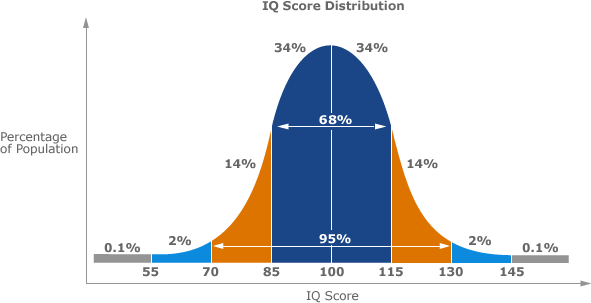
Now, read this story from the UK. There, a woman is having her three-year-old daughter taken from her. The girl has some tough medical challenges, and the mother was tested as having an IQ of 71. To help put this in context, I've found an IQ bell curve and posted it to the left -- every fifteen points of IQ represents about a one-sixth deviation from the "average" score of 100, such that a little bit more than two-thirds of the population falls in between 85 and 115. A score of 71 is very close to two full standard deviations from average; put another way, approximately 95% of adults in the UK score higher than her.

Some people believe in IQ tests as a true measure of intelligence; I am skeptical, but I do think the test measures something related to intellectual ability. So at least according to the test, this is not a particularly clever lady.

But even if true, is that really a good reason to take her kid away from her? Let's just assume for a moment that she is indeed that dim. (Her court-appointed attorney protests that she tests at 86, or at the low end of the first standard deviation, for a variety of measurements of mental facility.) She has had her custodial rights restricted already, but now the court overseeing the case has ordered that the kid be put up for adoption, taking the kid away from the mother permanently, with only very brief visitation rights.

Indeed, the court in the UK ruled that this woman is not intelligent enough to competently give direction and assistance to her own lawyer, and empowered the lawyer to act unilaterally on her behalf -- which consisted of rolling over and agreeing to the government's decision to put the kid up for adoption. The Times article makes it seem like once the kid is put in a foster family, the natural mother is, for all practical purposes, never getting her back.

There is no suggestion that the mother irresponsibly neglected any of the daughter's medical or other needs. She may have found keeping up with the schedule of getting the kid to a variety of doctors and specialists challenging -- anyone would, given a busy enough schedule, but let's assume that this is indeed mentally taxing for her, and not just frustrating as it would be for someone in that middle two-thirds of the IQ bell curve.

Would you want to live in a society where the government really does things like break up families because the parents are literally too dumb to raise kids? My presumption is no, dumb people have rights too. But the answer is not nearly so obvious, on either side of the fence, as it might seem at first blush. The libertarian position, that the government has no business doing this, is the one I favor on balance.

But, a parent who truly lacks the intellectual ability to raise a child can easily put the child in danger through neglect, and never realize it -- maybe never even have the ability to realize what's going on. The need to protect children, who lack the experience and mental ability to look out for themselves, is not trivial. This is why there are laws against sexual relations with minors -- they lack the experience and mental ability to have that kind of relationship; this is why there are laws against letting kids drive, because they lack the experience and mental ability to do so without endangering themselves and others; this is why there are laws against child labor because kids lack the experience and mental ability to protect themselves from being exploited (hell, adults do not do such a good job of protecting themselves from harm while doing those things).

So I guess where I come down is I need to see a really compelling case that a child is endangered before I'd side with the interventionists. What disturbs me about this case is that I cannot glean from the Times article what facts are there that make this a really compelling case. Indeed, if the mom here was able to get the kid to see her doctors, as the article indicates she was, then I think that argues in favor of letting her keep her parental rights. Just because she may not be the sharpest tool in the shed does not, by itself, seem to be a good reason to take her daughter away from her.

Yes It Does Work Both Ways

A big story in right-leaning media over the weekend, apparently, the harassment by San Diego County code enforcement officials of a pastor and his wife having Bible study in their house on Good Friday. I read about it today on tinyfrog (hat tip), who is skeptical of the portrayal of the pastor as lily-white and totally without blame in the situation (referencing additional facts found on snopes):
So, it’s not “a few friends” which sounds like two or three people, but 15 people – which lead to parking problems and a neighbor calling the police. So, here are the things not mentioned in the FOX news story: the actual number of visitors, parking problems, and a neighbor calling the police to file a complaint.
Okay, fifteen people isn't “a few friends” but it is a medium-sized party for a suburban residential area, the sort of thing that if your neighbors do every once in a while you put up with. There was apparently an issue with a neighbor's car door being dinged, and the pastor paid to have it fixed. It's not an unreasonable-sized gathering.

But here's the thing. The pastor can have Bible study if he wants to. Like a lot of volunteer groups, not every church group is wealthy enough to afford standard church accommodations or renting meeting halls for every activity. And it's their Constitutional right to congregate and engage in religious activity. If I get to have a Constitutional right to not worship, they get to have a Constitutional right to worship. It's the same right, and it's as important for them as it is for me. So I say, leave them alone, San Diego County.

Another Endorsement For Same-Sex Marriage

Who's in favor of same-sex marriage now? Dick Cheney.


Actually this is not so surprising as you might think; like the man says, his daughter is gay and has been in a long-term relationship with her partner for a long time and thanks to that relationship, he has a granddaughter on whom the former Vice-President apparently dotes (as any grandfather should). Of course, he loves not only his granddaughter but his daughter, too, and by extension, her partner. Which goes to show a point I made half a year ago, which is that actually knowing a gay person makes someone more likely to accept gay marriage. I don't claim that point is original to me.

The point is that a guy who has made himself one of the post-Bush Administration exemplars of what it means to be a conservative thinks that the Federal Defense of Marriage Act should be repealed, states allowed to make their own decisions, and appears to favor same-sex marriage rights.

Chainsaw

Only someone who hasn't had to use a chainsaw would suggest that it's an easy job. Chainsawing is hard, tiring work.

See, most of last weekend was spent outdoors or in the garage. We're working on a dry bar to install in our dining room, to provide extra storage space and enhance the value of the house. So The Wife motivated me to go and get some of the work done, including trimming the four-by-six studs we are using to support the whole assembly. Well, it turns out that one of the studs we'd bought had become really warped, so I had to get a replacement.

Between that and some of the other supplies I determined we'd need to move the project forward, I was at the Do-It-Yourself Home Improvement Mecca Store for a little bit over an hour. When I got back, I noticed a number of trees in the front yard were now devoid of some of their lower branches. So I unloaded the stuff, and went around back, and sure enough The Wife was taking a saw to every tree in the back yard.

Could she have done this earlier, when we had the guys with the mulcher right there? Of course not. So instead, we got it all picked up and hauled off to the front yard, where it didn't fit into the trash cans becuase it was about a dumpster's worth of tree limbs. Therefore, I borrowed our neighbor's chain saw and set to work cutting the things down to size. Eventually, it all fit (sort of) into four of the trash containers we have for our regular service and I'm hoping that it will be cleared away as green waste. If not, I'll have to arrange for a special pickup next week (which I'm going to anyway, to get rid of some old furniture we no longer want or have room for).

I took some time out in the middle of my chainsawing to eat lunch (because I was frankly feeling faint between a reduced diet and an unfamiliar amount of manual labor). The chainsaw had run out of gas anyway. As he told me later, my neighbor didn't hear the chainsaw running for several minutes, and took the time to come out and see if there was any blood on the chain. Seeing none, he went on about his business. That's a good neighbor.

So between hauling around and chainsawing up a dumpster's worth of tree limbs, and moving construction studs and cabinets around the house, I spent much of the weekend sweaty and tired. And The Wife was doing her share of the work, too; she cut the limbs down in the first place, weeded our front planter, and painted the components of the bar. We're both sore in places we didn't remember having.

The result is a much cleaner-looking yard and a half-assembled bar with built-in cabinets, but still sans the adjustable interior shelf, kick plate, and top. So this week we hope to install the adjustable shelf facings and mount a top-piece for the bar, to be followed by the pièce de résistance -- the beaten-copper jacket for the bar-top.