May 9, 2007

TL, Sincerely

Lawyers write lots of letters. Some days it feels like that’s all I do. A lawyer friend of mine asked the other day how to close his letters, and another lawyer friend pointed out that the closings on lawyer letters struck him as odd when he read them literally; “very truly yours” was a phrase that struck him as nearly meaningless and he got my curiosity up about where that phrase came from.

There are lots of rules for closing out general business letters as well as lawyer letters, like the rule that says use “Yours faithfully” when you don’t know the recipient and “Yours sincerely” when you do. I’m not at all certain that these rules are hard and fast or that grammar authorities have any consensus on the question of the best way to close a professional letter. But “Very Truly Yours” is a valediction that is used almost exclusively by attorneys. Why is that? The etymology of the phrase (and other phrases using the word “yours”) traces back through the custom in Merry Olde England of signing off letters identifying the author as the “servant” of the addressee, even in cases where the letter was intended as an insult.

This seems to go back to medieval England when pretty much the only things written down at all were either legal or ecclesiastical in nature, and so all writings ended either with an “Amen” or some other invocation of God, an affirmation that the writing was authorized by the King, or with some supplication to the correspondent because the contents of the letter were a petition or some other kind of request for a favor.

So, the custom of medieval correspondents explaining why they ought to be given the favor that they requested traced back to the relationship of a vassal to a lord, which was ostensibly a relationship of a contractual exchange of services. The vassal should be given a favor because he is the vassal; the lord is supposed to render services of protection to the vassal, and thus both are servants of one another and that is why each should do what the other says. (In reality, of course, the vassal begs the lord for something which was either given or not, and the vassal took what he got and liked it.)

This evolved into lawyers petitioning judges and royalty for favors, and they kept the custom of reminding their correspondent that they (the lawyers) were the humble servants of the king and the court, and so it worked its way into polite written exchanges. One might imagine a note reading something like this resulting from this tradition:

Dear Mr. Burr,

Your Grave Insults to my Honour have not gone unnoticed and this brand of Knavery most Foul shall not go without ƒuitable response. I today demand an Immediate and most forthright Apologie in retraction of ye remarks, as ƒhould befit a proper gent. of true name, that which ye have disproven yourƒelf extant in the estimation of the better folk of New Yorke.

Failing to have recd. from you by Tuesday next your Apologie, I shall await ye arrival upon the Jersey banks of the ƒhore of the Hudson River at daybrk. on ye Friday, to resolve this Affair of Honour with the implement duello of your choice, as the Gentleman’s Right ƒhall then be yours.

I remain your most obedient and humble servant,

Alexander Hamilton.


(Obviously, the letter is fictional; Hamilton’s challenge to Burr was delivered orally, and through proxies, as was the custom of the day.) But you get the idea; no gentleman worthy of the name would have closed a letter to another without begging to be the “Most True Servant” of his correspondent. The servile phrasing of the valediction here would have seemed entirely customary despite the aggressive tone of the preceding portions of the letter. But from a closing like “I beg to remain your true and humble servant” the phrase would have been shortened to something like “I remain your true and loyal servant” to “Your true servant,” to “Yours truly.”

Even today, subjects of the British Royal Family are requested, for sake of politesse and etiquette, to address most members of the Royal Family in writing with the now-obviously similar phrase “Yours Very Truly,” with the exception of the Queen, of whom you must “remain” Her Majesty’s “faithful and obedient servant.”

In modern professional writing, a letter requires a closing of some kind to indicate to the reader that the content of the letter is complete. By custom and tradition, this comes before the signature of the author, which is given to verify the origin of the letter. Certainly, a closing must be complimentary rather than insulting or sarcastic in professional use; you can’t end the letter with something that leaves a bad taste in the reader’s mouth. And a professional valediction is of necessity cool in tone, as the letter is not being written in general to express friendship or warm feelings, but rather to accomplish some kind of professional purpose.

Now, for some reason, “Sincerely” seems to not be used (at least by attorneys) as its literal meaning is thought unnecessary – if you weren’t sincere about what you just wrote, why did you go to the trouble of writing it? But that logic doesn’t hold up when considering what “Very Truly Yours” really means. So I like “Sincerely.” When I am writing a lawyer from the law firm of Condescending, Stubborn, Foolhardy & Arrogant, LLP, to tell him that I’ve had it with his hide-the-ball negotiation tactics and filed suit against his obstinate client instead, I am in no way making myself that attorney’s “servant” – I am taking what I want from his client through the compulsory process of the courts, which is pretty close to the opposite of what you would expect from a “faithful and obedient servant.” I suppose “Very Truly Yours” is perfectly fine, but I’ve come to use “Sincerely” more often than “Very Truly Yours.” I’d prefer to be thought of as redundant rather than obsequious.

The Godfather: Libertarian Treatise

Ilya Somin makes an interesting case for Mario Puzo’s novel (and, by extension, the movies which faithfully adapted it) as a libertarian treatise.  Certainly, Professor Somin recognizes that the real focus of the story is personal – the corruption of Michael Corleone – and that the story’s exploration of similarities between the Mafia, big business, and the government reaches a point of demonstrating their general moral equivalence, which sounds more liberal than libertarian to me.  But the backdrop is based on a (perhaps unconsciously) libertarian world view about protective associations in the style of Robert Nozick, the dangers of political corruption and inefficacy within the state, and the dangers of violence and social degradation that result from criminalizing substances, both narcotic and alcoholic.

Race and Cheating

I know that most of my Loyal Readers are not particularly sports fans, and I've not made many remarks about sports for a while. But it's likely that this year, Barry Bonds of the San Francisco Giants will surpass Hank Aaron for having the most career home runs in the history of Major League Baseball. This prospect is generating decidedly mixed reactions on the part of baseball fans.

The problem, according to some, is race. Apparently, no one wants to give Bonds the benefit of the doubt because he's a big black man, so they "presume" he's used steroids and therefore doesn't "deserve" the record. Never mind the evidence against him on that point, we're talking about the emotions generated by racial differences here. So you can disregard, if you like, the photograph to the right of Bonds when he started playing for the Pittsburgh Pirates in 1986. But I look at that photograph and I see a good-looking 22-year old in that photo, exactly what I'd expect to see in a young athlete. Bonds looks like he's in pretty good shape, and has the slender, fast build and the serious, earnest attitude of a young baseball player.

Now, to the left is a photograph of Bonds today. Still in good shape -- hell, he's in phenomenal shape. He looks more like a prize fighter than a baseball player. Twenty years later, what happened to that man's neck? Good nutrition?

Yes, top-tier professional athletes have become better, faster, and stronger than their counterparts from yesteryear, and there are a lot of reasons for that. But there is no way you can tell me that this change in the body of a man in his forties is solely the result of good nutrition and exercise. There's been some other kinds of science helping him out, too.

So there are two questions -- first, does race have anything to do with the baseball-loving public's distaste for the prospect of Bonds getting one of the most prestigious and prominent records in the rich history of the sport? I think not. I'm not saying that America is colorblind. I'm saying that sports fans -- even ones who may have some obnoxious racial attitudes in other parts of their lives -- are more than willing to accept and admire black athletes. Non-sports fans don't care about Bonds one way or the other, but sports fans as a group tend to care about performance and achievement.

No, I think people don't like the idea of Bonds having that record not because Bonds is black, but because Bonds is a jerk. You don't have to be white to be an asshole. Besides, the current record-holder, Hank Aaron, is also black. And Bonds' godfather; the two men are personally very close, which most sports fans think is pretty cool even if they aren't particularly big Bonds fans themselves.

Second, do we care if Bonds is using human growth hormone, steroids, or various kinds of supplements that are not part of a "normal" diet and exercise regimen? These are not "normal" people who are just playing baseball for fun. The market rewards athletes who push themselves as hard as possible, and do whatever is within their power to excel. We sports fans love it when we see records being broken and demonstrations of feats of remarkable strength, agility, speed, and physical abilities. So why shouldn't Bonds use (legal) drugs and other products to make himself better? Didn't athletes of the bygone years of "fair play" engage in unusual training and dietary regimens, too? Granted, their ideas of what to eat and how to conduct their lives to be better at their craft were different than ours today (lots of red meat, sitz baths, and things like that) but we don't put asterisks next to their names anymore.

Ultimately, it doesn't make much difference in the world if Bonds is a steroid user, HGH user, or if he's simply an honest baseball player with an image problem. He'll very likely break the home run record this year, and good for him. He is what the sports market has demanded that he be, and he should reap the rewards that go with it. If the achievement seems corrupted (and it does) that is not just Bonds' fault. It is also the fault of the governing authorities of the sport who mollycoddle and turn a blind eye to what they call "cheating" and it is also the fault of the fans and consumers of the sport who demonstrate, time and again, that "cheating" isn't nearly as important as winning. That is a problem that goes well beyond Barry Bonds.

And the fact that Bonds is black is really a minute issue compared with the fact that society rewards cheaters.

Coasting A Little

Not many posts recently because The Folks are in town and staying with us. They've no desire to intrude on our lifestyle but we don't get to visit with them much. So I'm devoting more of my time to being with them while they're here. For instance last night my dad made some really good steaks and grilled vegetables, and we had a relaxed, enjoyable dinner together. It's a great pleasure to have them here and everyone's getting along very well indeed.

Yes, I'm normally a more prolific writer than this but a week of coasting is probably no skin off anyone's nose. After all, this is a completely noncommercial blog so you're still getting your money's worth.

One thing to note is a debate between the Rational Response Squad, a group of young atheists, and the Way of the Master guys (Kirk Cameron and an English preacher), both of whom have brash, in-your-face styles of presenting their world views. The Way of the Master guys claim to be able to "prove" the existence of God without reference to faith or the Bible, and there will be a debate on that subject on ABC News Now today (May 9) at 2:00 and later tonight on Nightline at 11:35 p.m. (No, I don't have a clue as to why ABC insists on broadcasting Nightline at 11:35 instead of 11:30.) I do not anticipate anything new being said by anyone, but it might make for an interesting confrontation.

I also anticipate that the side you agree with before watching the debate will be the side you will think won the debate afterwards. I will try to keep an open mind, but I've seen the internet video of the Way of the Master dudes before and I think they've got pretty weak ketchup, from an intellectual point of view, although they do have a pretty slick website. I've also seen a preview from the debate, and it looks like the Way of the Master guys -- while perhaps making a decent case to the already-converted -- fail in their objective to prove the existence of God without reference to faith or the Bible.

Meanwhile, the RRS guys have been proceeding on other fronts, too -- including a most interesting copyright suit against Uri Geller (the widely-debunked, spoon-bending "psychic").

UPDATE: On second thought, I think I've written plenty today.

May 6, 2007

The Vegas Run

Yesterday The Wife and I rode with some friends in their RV out to Las Vegas, so The Wife could compete in the speech contest and tell her tall tale. She did very well in the competition, but it was a home-town crowd and with one exception, all Vegas people won. Not much you can do about being home-towned; it was a big weekend and it is very inconvenient for people from California to get to Las Vegas, especially on short notice for a holiday weekend and particularly when there is a big event going on.

The RV was a good way to go -- in part because I didn't have to drive it. The Wife and one of our friends sat in back and chatted the whole way out, while us menfolk sat up in the cab and spoke.

One thing we noticed was that the Joshua trees seem to come in two varieties out in Nevada; there are the relatively narrow-branched kind we're familiar with in the Antelope Valley, and another kind with shorter trunks and wider leaf-spikes crowning their tops. I found an example of the two varieties next to each other.

I can't speak too highly of the Crestwood Suites on the South Strip. About the best adjective I can think of would be "adequate." But there isn't a lot you can do on short notice. The days of plentiful, quality rooms in casino hotels available for cheap are gone forever, I think; most of the big hotels are going to give you a runaround and tell you that they're sold out for the weekend you want to be there.

Now, there is a whole lot of nothing out on I-15 between Barstow and Las Vegas. Empty road, bleak, Martian-looking mountains, and dry lakebeds. It's particularly not fun to drive in heavy traffic on the way back on Sunday, which is one of the reasons why I was very happy to not be doing the driving myself. Right about the time we got to world-famous trivia answer Zzyzx Road, we hit twenty miles of heavy traffic, caused by a bad accident in which a BMW flipped over into the median. I saw two civilian-looking guys walking around the wreck, who I took to be the driver and passenger, so it looks like they walked away, but the car was a twisted hunk of metal barely recognizable as a Bimmer. It reminded me of why I liked my old BMW so much -- besides being a fun car to drive, I could have confidence that it would be safe if the worst happened.

We dropped a lot more money in the outlet mall than I did in the casino. At least we have something to show for that. I would have liked to have seen a show -- Penn & Teller, maybe, or one of the Cirque du Soleil shows that are up and down the Strip -- but The Wife didn't want to go out at all, and she did have to get up really early to make it to her competition.

So, I didn't do very much gambling -- I lost eighty dollars in a few short rolls of craps while waiting for The Wife's event to start this morning. I need to remember to never play on Sunday, even if I hadn't played previously on Saturday. I wouldn't have played at all if it weren't for the fact that Toastmasters events always start late. When I tried to get in the room to talk to The Wife rather than just hang out and sit on the couch with nothing to do for the two hours it took these people to get their shit together, some guy blocked me from entering the room and told me, "You have to leave." So I did, and sat around with no coffee next to a bored osteopath from the meeting next door, feeling unwelcome.

That's not to say the weekend was a total loss. I got a few new shirts and some cooking toys from our excursion to the Vegas outlet mall. I got to see The Wife give her speech and it's important to me to go support her for a big event like this. We got to hang out with some friends and I didn't have to drive. I suppose had I won this morning I would have enjoyed the gambling more.

Stealth Cat


...being an example of why considering things only from your own perspective can leave your ass exposed.

May 5, 2007

RV Picnic to Vegas

Our friends are driving their RV out to Las Vegas and taking us along with them. We're bringing the food -- cold cuts, cheese, and fruit. They eat pretty healthy so that should be pretty good all around. The trip ought to be fun.

Vegas itself is a prospect I look forward to with a mixed attitude -- I usually enjoy Las Vegas, but it's a bother leaving the critters behind and having to trust others to care for them. Gambling is fun but I probably won't do any of that at all -- it's Cinco de Mayo and fight night tonight, so it's going to be an absolute madhouse up and down the Strip. We found a room near the outlet malls and The Wife seems pretty excited about that for some reason that makes me wonder if we'll come home with as little money as if we did go gambling.

May 4, 2007

Death House

When we buy a house, we ought to look for a house where someone has died recently.

No, I'm serious.

People, for some reason, seem to think that a death taking place in a house is a bad thing, something that would make the house less desirable to live in. I suppose if no one cleaned up after the death and all the gooey nastiness that happens when someone dies, that could leave a stain and a bad smell. Maybe if the person died from some sort of communicable disease I might consider that relevant. But aside from that, it's not like death is particularly contagious.

But the fact is that the market price of such a house drops dramatically. This seems to me to be completely irrational; what are these people afraid of, ghosts? Turns out, yes, that is part of the fear, although the stigma of being the situs of a deaht seems to be somewhat more complex than that. There is money to be made as a result of this sort of irrationality.

California Civil Code § 1710.2 states that a seller need not disclose a death in the house that took place more than three years prior to the intended date of sale. But does that imply that a death in the house within three years is material? It would seem so -- any fact that, if known, would lead to a change in the market price of the property, is material. Since a recent death is such a fact, it should be disclosed.

So, you buy a house where there has been a death within three years. As a result of that fact, you pay a sub-market price for the house. Hold on to the house for three years and, if no one else dies in the intervening time, you can then sell the house for its market price. The downside is that you will absorb a capital gain tax liability, but you can avoid that if you are lucky enough to buy a new, better death house that you buy for a sub-market price, and structure the sale as a 1031 exchange.

Alas, The Wife wants to buy a new house, it seems. There's another model home with a floor plan she really likes. So I guess that's what I want to buy, too, even though this bit of useful knowledge could get us in to a lot more house than we otherwise could afford.

Pick Up Stix

A few days ago, instead of having lunch with the partners at the firm, I worked through lunch and figured I'd get some faster food for lunch. So I went to the new Pick Up Stix down the street, thinking I'd try something new.

The food turned out to be pretty good, for counter-service fast food, and the price was quite reasonable for what I got. It was delivered to my table as I read the newspaper by a friendly, if somewhat harried, expediter.

I say "harried" because the place was absolutely jam-packed at 2:00 in the afternoon, and it took more than half an hour between the time I ordered my food and the time it was presented to me. I don't know if that was because the crew didn't have their act together yet or if that is the intended speed for the service. But it wasn't as fast as I had been led to believe it would be -- my "fast" solo lunch turned out to take more than an hour.

EZ Move? I Think Not

Earlier this week, I called the Verizon "EZ Move" number because I was sick unto death of getting wrong numbers from Knoxville.

See, nearly three years after we got a land line there that used to belong to a contractor, we're still getting his wrong numbers for business and personal calls. Since contractors tend to show up at job sites pretty early in the morning, and Knoxville is three time zones ahead of us in California, I found the calls at five in the morning intensely bothersome. Slightly less irritating were the people who called back to the same number again, right after I took the time to explain to them that I was not a contractor in Maryville, Tennessee but a lawyer in Southern California and if they wanted to sue someone in Los Angeles, I could help them.

I'd held off on doing this for some time because someone from Verizon explained that it would be easier to do once I got a new phone. Turns out no, that isn't the case at all and I could have done this months ago.

So I did it shortly after getting my new phone (which I like a lot). This caused massive confusion in the office, because people thought that the new phone came with a new number. So when someone needed to get a hold of me one morning to learn a piece of information, all the paralegals in the office panicked because they all thought they had no way to reach me. It never occurred to any of them to call the number they had to see if maybe I had left a forwarding message -- had they done so rather than fretting for half an hour until I got into the office, they would have found that they could have reached me handily.

But that's not even the half of it. I couldn't change my number without also changing The Wife's. I tried to do it one night, but she was out and about, and the phone needs to be reprogrammed, so doing that would have caused her to be without service and she might have needed it. So I waited a few days until another time that was convenient for me to change to a local number. My number change went through pretty quickly and without many problems.

Not so for The Wife. The instructions I got to pass along to The Wife to reprogram her phone were not particularly clear about how to leave the forwarding message, which apparently Verizon can't do on its own. So we have to leave our old accounts open for a month and change the voice mail greeting to let the callers know that the number is not good anymore and to call the new number. For some reason, The Wife's phone kept having service problems with the voice mail and it was very confusing to figure out which voice mail she was calling. Tonight we finally (I hope) solved all the problems because it also turns out that only I was on the account at all, so her voice mail was locked up and no one could change it.

At the same time, a bunch of high-strung Toastmasters have been trying to get hold of The Wife for days. I didn't realize this was going to be happening, or that she was going to give out the old number to all these people on the very day that I had the phone numbers changed. So that, too, was a big inconvenience to her.

I guess it just never occurred to anyone at Verizon that people moving from one area code to another might want their voice mail to be portable, too. That seems like it ought to be something that is within their technical ability to accomplish, but I guess not. Every time we've dealt with this over the past three days, The Wife has been astonishingly upset, to the point that I become afraid of her. It's made me unpleasant and angry at times, too. Hopefully, we've solved all the problems now, but we'll only know for sure tomorrow.

Intrade's Reaction to the Debate

Mitt Romney:  Up 2.2 points.

Fred Thompson:  Up 1.2 points

Ron Paul:  Up .2 points (doubling in value)

Elizabeth Dole:  Up .1 points (doubling in value)


Rudy Giuliani:  Down 1.4 points.


No other change (including McCain)

GOP Debate

At Oval Office 2008, I offer an objective assessment of the candidate forum last night at the Ronald Reagan Library. As you might expect, I was rooting for my candidate, but even so I have to assess that there was no clear standout. I thought it might be interesting to take a survey of some major media outlets covering the event, and how they headlined it:

ABC: Republican Field Running to Reagan and Away From Bush
Atlanta Journal-Constitution: Giuliani alone on Roe v. Wade at GOP debate
Associated Press: GOP Contenders Embrace Reagan Legacy (AP feed led to a newspaper in Joplin, Missouri)
Boston Globe: Republican candidates show their differences
CBS: GOP Hopefuls Evoke Reagan At Debate
Chicago Sun-Times: Issues Divide, Reagan Unites (note: debate coverage was difficult to locate; political news in Chicago was on a purported slumlord who contributes lavishly to Barack Obama)
CNN: Debating in Reagan's Shadow, Giuliani Bucks GOP Field
Dallas Morning News: GOP hopefuls focus on their credentials (note: debate coverage was difficult to locate and was reprint of AP coverage)
Faux News: Abortion Divisive Issue at Debate
Knoxville News-Sentinel: No coverage apparent
Los Angeles Fish Wrapper: Differences emerge as Republicans debate
Miami Herald: GOP debate focuses on Iraq war, abortion
MSNBC: Giuliani's Gamble: Former NYC calculating libertarian stance may not be a liability
New York Daily News: GOP Hopefuls Duke It Out: Rudy gets wobbly on abortion views
New York Times: "...a debate that highlighted a party in flux..."
NPR: Republicans Debate In Reagan Country
Philadelphia Inquirer: No coverage apparent
Reuters: 2008 Republicans back war
San Francisco Chronicle: GOP hopefuls gather under Reagan mantle
Washington Post: GOP Field United On War, Divided On Social Issues

If you're a junkie, you'll have watched the debate already and can discuss it at Oval Office 2008.
Here, I think it's interesting to note that about all the media found of interest to report on were the frequent references to Ronald Reagan, and Rudy Giuliani's attempts to articulate a nuanced stance on abortion.

The Dry Po

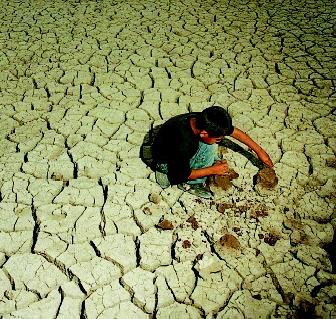
Imagine if the Ohio River ran dry. Or some other major river like the Arkansas, Missouri, or the upper Mississippi. In fact, the Colorado River does run dry, or very close to it, by the end of its course at the head of the Gulf of California. But that's because it is so heavily-exploited by agriculture, from Utah to Mexico.

Well, in Italy, the Po River is the largest river in the country, and it's dry today. You could walk across the riverbed in your good shoes. (Well, maybe not, they'd get dusty.) Apparently there are heavy storms this week, which is good, but a drought like this is a big deal for our friends in Italy.

It does seem like there's been a lot of extreme weather conditions in the past several years. Environmentalists would say it's the result of global warming, or some kind of global climate change. That's likely true, although there seems to be less scientific consensus than some would have us believe about the impact of industrialism on that phenomenon.

One of the things I study in legal history is the effect of global climate change in the thirteenth century -- what is now called the "Little Ice Age" cause large agricultural failures in northern Europe, and combined with the decimating effect of Bubonic Plague, this resulted in a change in social and economic structures that urbanized places like England and France, and placed more bargaining power in the hands of suddenly-scarce laborers as against the agricultural landowners who had formerly enslaved them.

But really, all that proves is that 1) there are winners as well as losers when things change, and 2) global environmental change is caused by things other than industrialization. That doesn't mean much when considering what's happening now; scientists are sounding alarm bells all over the place and a few other scientists are suggesting restraint. More study is necessary, and protecting the environment is necessary, no matter what.

May 3, 2007

Yawns

Round about 2:00 this afternoon, the heater kicked on in the office.  Perhaps not coincidentally, ever since then I have been yawning absolutely uncontrollably, to the point where my jaw is cracking and tears are flowing freely from my eyes.  Sure, a lot of people get a little bit logy between two and three o’clock in the afternoon.  But a series of yawns like this is very odd indeed.

How To Use Powerpoint Effectively

May 2, 2007

New Phone Number

All you Loyal Readers who know my true identity may want to update your records.  You can call my old phone number and get my new phone number.  The old Tennessee number is no good anymore.  Same thing for The Wife.  (Maybe this will stop the five-in-the-morning calls from people looking for a contractor near Knoxville.)

Do Street Names Affect Property Values?

Take two houses – with identical floor plans, identical lot sizes, in the same neighborhood, and functionally identical landscaping and decoration.  One of them has the address of 123 Shady Oak Lane, and the other has the address of 44293 Solzhenitsyn Street.  Will these houses sell for different prices because “Shady Oak Lane” is easier for most people to say than “Solzhenitsyn Street”?  A realtor in Austin, Texas thinks so.  But, there is an upside to an unusual street name – buyers don’t seem afraid to buy a house with an unusual name, and will buy the less expensive house with the unusual street name faster than the more expensive house on the traditionally-named street.  Hat tip to Steven Levitt at Freakonomics blog.

In Pro Clarence Thomas

While I’ve little time to read or comment on the article in any depth, Stephen Presser of the Manhattan Institute offers a spirited defense of the much-maligned Clarence Thomas in the City Journal.  Conservative, yes; always right, no – but one thing to admire is clear, uncompromising intellectual consistency, which is a trait that Professor Presser claims Justice Thomas has demonstrated in abundance during his sixteen years (!) on the High Court.

May 1, 2007

Fracture

Something about the movie Fracture bothered me. The legal procedures didn’t seem like they were right. Unsurprisingly, Eugene Volokh does a better job than I could have explaining them. Two issues half-remembered from my criminal law class just didn’t sit right with me, and Prof. Volokh really hits it on the head.

Obviously, don’t follow the Volokh link if you don’t want the spoilers.

Oh, and I didn’t buy the romance in the “B” plot, either, but that’s a different complaint; I rarely buy movie romances. Aside from that, Anthony Hopkins is at his fiendish best; he’s not quite Hannibal Lechter but still definitely intelligent, manipulative, and evil, and therefore immensely entertaining. And the movie gets its Los Angeles geography pretty much right; the interiors of the D.A.’s office and the courthouse are not like reality but the locations are all in areas where I would have expected the kinds of activities going on to have taken place, right down to the location of the parking lots the characters use. Ryan Gosling makes a credible and good-looking cocky young attorney with an obliquely-referenced southern drawl, and we are treated to a too-brief glimpse of the radiant Embeth Davidtz.

So on the whole, I liked the movie, despite the narrative and legal flaws. It’s a good story, and a nice bit of suspense to get the summer movie season started.

The Sad Story of Reggie the Alligator

Two fools tried to raise an alligator in their back yard in San Pedro. When the gator grew too large to keep in their pool, they dumped him in a lake down in Harbor City.

After scaring the piss out of local residents for several weeks, the city hired a Katrina refugee and a team of alligator farmers from Florida to capture the beast and take him to the zoo. I guess Los Angeles County Animal Control is not equipped for dealing with alligators. The gator-hunters promptly had a falling-out of such epic proportions that the job didn’t get done.

Then, “Reggie the Alligator” disappeared, for more than a year. Now, it looks like he’s back. The two fools who tried to raise him in their back yard have been found and dealt with through the criminal justice system. Hopefully, the creature can be caught and put in a safer and more appropriate location than some nasty urban “lake” filled with who knows what kind of bizarre runoff from the city – and out of the way of little kids and household pets that might otherwise have become tasty gator snacks.