September 19, 2006

Bite Me, Ahmadinejad

It's easy for me to appreciate the daunting challenges faced by diplomats and world leaders. Trying to find some kind of common ground with guys like the President of Iran must be a huge challenge. He complained to the United Nations today that there was no outcry of human rights violations levied against Israel during its recent war with Hezbollah, claiming that there was "blanketed and unwarranted support" for Israel during that conflict.

Dude, I know good and well that you can get CNN in Tehran. I know that the BBC is available there, too. And I know good and damn well that you can watch Al-Jazeera all day long in Iran. And I know that there were lots of talking heads, lots of Palestinian, Syrian, and Iranian mouthpieces, proxies, PR flacks, and spinmeisters hitting the airwaves every damn day. I remember lots of images on TV of ruined Lebanese villages, piles of rubble where apartment buildings used to be and pictures of Lebanese people, rendered homeless, grieving over their lost loved ones. That there were also similar pictures coming from Israel only proves that 1) the Israelis took their lumps, too, and 2) Israel, unlike Hezbollah-controlled southern Lebanon, permits a free press.

So I don't want to hear about how the Western media and the people of the West uniformly gave blanket support to Israel. Because we didn't. A lot of us, myself included, had to go out of our way to remind others in the West that yes, there were good guys and bad guys in that war and that Hezbollah is not an organization of good guys.

To suggest that Westerners gave their uncritical and unflinching support to Israel is revisionism at its finest. To make that suggestion before the gathered heads of state of the entire world is revisionism writ upon the largest of all possible canvases. Would that we had actually done as Ahmadinejad suggests we did. Perhaps we would have been able to wipe those bastards off the planet entirely. And then we could credibly tell this dude that we mean it when we say we want his mullahs to stop enriching uranium.

Terrorist Detainment Bill

I haven't blogged at all about the controversy surrounding the President's bill to request authority to detain terrorism captives and try them before military tribunals, other than expressing my approval for the President's decision to work with Congress on the subject. I haven't blogged about the defection of between six to fifteen Republican Senators from the party line and their insistence that, among other things, the defendants have some ability to confront the evidence to be used against them. I haven't blogged about who I think is right and who I think is wrong; I haven't blogged about the Republicans who support the original White House bill, what I think of the new and revised White House proposal, what I think of the split in the GOP, what I think of the Democrats snickering up their sleeves about Republican disunity on the party's core issue, or the President's frustration with not getting exactly what he wanted out of Congress.

I haven't blogged about these things because there really isn't a lot for me to say. This is how the political process works. Congress is supposed to critically evaluate, deliberate about, and if necessary imposed modifications to, the proposals of the President. There is supposed to be a diversity of opinions about how we should do things. The people making these decisions are supposed to make them based, on political pressures, their own wisdom and intelligence, and their own visions of what is both patriotic and advantageous for the country. It's the reason that Congress was created as a deliberative body.

There doesn't seem to be much doubt that Congress is going to give the President some form of authority to detain and try these people. And there is no doubt that we are talking about people who cannot be trusted with pointy sticks, much less dangerous information and the liberty to take advantage of it. And, there is no doubt that this pivotal group of "moderate" Republicans is committed to seeing that the resulting scheme is both fair and effective. I would hardly call Lindsey Graham and John McCain "moderates" without noting that if that label really fits, the entire spectrum has moved very far to the right from when I first came to political awareness.

The process is messy, frustrating, overrun with competing egos, divisive, electoral cannon fodder, time-consuming, and the result is not guaranteed to favor one or the other side of the debate. That's why they call it "politics" and not "dictatorship." That's why the Supreme Court insisted that another branch of government be involved in making these decisions. That's the way it's supposed to work, and the system seems to be working the way it's supposed to work. That's what the Framers intended to happen and it's what ought to be happening. So I'm pretty much satisfied with the process, I don't have a super-clear picture of what the result is going to be (I don't think anyone does), and again, I'm pleased to see the three branches of government doing their respective jobs.

September 17, 2006

Chipotle Marmalade

A friend came over tonight, and we had to set up some nosh. One thing I really like is pepper jelly and cream cheese. But, we couldn't find any pepper jelly at Trader Joe's, so we had to do a substitute.

It turned out to be surprisingly simple. Four ounces of orange marmalade and one tablespoon of chipotle powder. For an extra taste and texture bonus, I sliced up some cucumbers on top of the cream cheese. It was really tasty and yummy -- the marmalade gave a tangy, citrus flavor and the chipotle powder was smoky and spicy.

We never got to the salad at all -- it has a lot of stuff including greens, alfalfa, pomegranate seeds, cranberries, bleu cheese, candied walnuts, and persian cucumbers. It ought to be good.

We'll use the other half of the marmalade at some point this week for crepes. We've done lemon crepes a lot; I'll look forward to the different taste of orange crepes.

A Part Of My Life

We haven't been to the Hollywood Bowl in some time; The Wife and I were supposed to go two years ago but we wound up moving to Tennessee instead. So it was with great pleasure that I accepted one of my best friends' invitations to join him and his family at the Bowl last night.

Later, I was reminded that The Wife really dislikes the Bowl. She gets frustrated with traveling there, she dislikes the crowds, she doesn't like that it gets quite cool in that canyon, she becomes infuriated with the parking and the post-show evacuation of the area, and I don't think the music really lights her fire all that much. I don't think she even likes the pre-show picnic all that much. So I think the next time I get an invitation to the Bowl, I may wind up accepting on my own behalf but not The Wife's.

This is something of a disappointment for me; I really enjoy the Bowl experience and with all the good things in my life, I want to share them with my dear wife. I'm willing to put up with the traffic difficulties in exchange for the great time in a beautiful location and the wonderful music. I like the Bowl so much that was where I chose to propose to The Wife; a fact which she is aware of and takes into consideration, but which still fails to change her opinion of the overall experience. I've also very much enjoyed the lead conductor of the Hollywood Bowl Orchestra, John Mauceri. He has a wonderfully rich, deep voice and makes me, a member of a 17,000 person audience, feel like I'm sitting in his living room while he hosts a dinner party and maybe shows off a little bit with a musical instrument. Last night was his farewell concert. It was longer than usual, had more than the usual number of Mauceri-staged encores, and fireworks. Given the special occasion, the crowd was willing to forgive Mauceri his indulgences in his love for muppets and encores. He started at the Bowl in 1990, the year before I first moved to Los Angeles and began enjoying shows at the Bowl. I don't know who will lead the orchestra next year but he will have some big shoes to fill.

The Bowl is new, also; as the low-res picture taken with my phone illustrates somewhat poorly, the acoustic orbs have been replaced with a circular overhead rack of lights and speakers; it looks something like a flying saucer over the orchestra. There are also permanently-mounted viewscreens at four locations along the side of the theater. This is very nice for those of us in the cheap seats to see detailed action of what is going on -- the bass players spinning their instruments on their spikes, or the dancers, or the singers, or the conductor doing his dance previewing the changes in the music.

So I will continue to want to go to the Bowl; it's one of the best nights out in California. It's a special place for me, it's one of the big attractions to life in Southern California, and I'm going to continue to enjoy it in the future. If The Wife wants to continue to accompany me, that would be great; but if she doesn't, I'm just going to have to go on my own.

September 16, 2006

More Visions of the Future

All of this week (and much of last) has been spent in reflection and rememberance of the attacks on America five years ago. It's preferable to think about the future, however; certainly we should not forget but we also should look ahead and make things better.

So with that in mind, and with a futuristic focus (variously optimistic and pessimistic depending on the subject) in the past several posts, here is a vision of downtown Manhattan in 2012, at what today we call Ground Zero:


I like it.

The tallest of the new buildings, the Freedom Tower (officially named World Trade Center Tower 1), will be 1776 feet tall and will shoot a beam of light up into space. Its next-tallest companion, World Trade Center Tower 2, has a very distinctive look to it, with its four diamond faces appear to be many buildings combining into one. World Trade Center Tower 3 will have a diamond-shaped lattice which reflects from WTC 2. The profile of World Trade Center Tower 4 is not as remarkable but it will still be taller than the New York Life Tower and nearly as tall as the Empire State Building, and its lower stories, more visible from the street level, promise to be elegant and graceful.

Hopefully the Lower Manhattan Development Corporation comes up with some better names for WTC 2-4. But now that I think about it, LMDC will probably sell the naming rights for those buildings, so they will become the T-Mobil Tower or the FedEx Building or the AIG Tower or things like that. Still not terribly interesting but better than "World Trade Center Tower 4."

The four towers will gather around a large memorial park with the footprints from the original towers kept intact, like so:


Whatever the buildings are called, the World Trade Center will once again rule New York's skyline. The old towers were, while overwhelmingly impressive feats of engineering, not terribly beautiful. These new towers add an artistic element befitting one of the world's great cities.

I would see tremendous significance in the new site being dedicated by President Rudolph Guiliani, but it's still a little early to make a prediction of that nature with any degree of plausibility.

Il Futuro Del Sud

The future of southern Italy may, or may not, start construction in the very near future. The Straits of Messina are, at their easternmost point, just over two miles wide. The Italian government decided some time ago to bridge the Straits, and a private consortium has been created to build the bridge. It would be, by far, the longest suspension bridge in the world.

To the left is a Google Earth image of the straits that I created this afternoon. The island of Sicily appears to the west and north, Calabria (the toe of Italy's boot) to the east and south. The image is from a simulated eight of just under eleven miles above the earth, and the line representing the approximate path of the bridge is 2.11 miles.

There are three main objections to the project. One is environmental, in that the bridge may distrupt the habitat of certain marine animals that live in the strait. This seems to be a relatively minimal problem (at least after construction is completed). The second is the expense; Romano Prodi's new center-left government of Italy is balking at the six-billion Euro cost of the bridge. The third is that the infrastructure on Siciliy is not up to par -- there is no highway linking the proposed landing point of the bridge and major Sicilian cities like Siracusa. There are also fears that the Mafia will take over construction (what, corruption in Italy? I'm shocked, shocked at the idea).

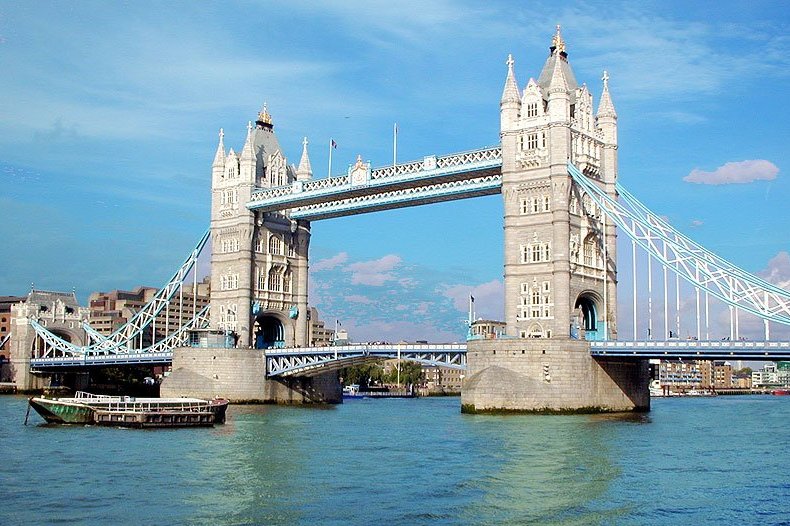
Still, it seems to me that the bridge project would be a very good thing for Italy and particularly for Sicily. The linkage of an Italian mainland autostrada with the Sicilian road network will facilitate commerce and business on the island, and provide growth opportunities for the area, and the rest of the infrastructure -- as well as other forms of economic growth -- will come as a result. The bridge will also become a tourist attraction in its own right, just as the Golden Gate, Brooklyn, and Tower Bridges have.

Governments and peoples have to continually invest in and upgrade their infrastructures. People also have to have great projects to believe in and work towards their collective greatness and rally towards. One of the finest hours of the United States was the Apollo Program. This bridge, and the preservation of Venice, are such big collective projects for Italy in particular, and Europe as a whole. So good luck to our friends in Italy in their projects for the future!

Hydrogen

In the past three days, I've seen or heard of hydrogen cars at least three times. It's a promising technology and its long-term implications are tremendous. The BMW model is pictured to the right; you can see a video from the BBC describing GM's prototype -- not only is it hydrogen-powered but has some other interesting features.

As I've read elsewhere, it takes a lot of energy to create energy, and this would be no different than the energy it takes to pump oil out of the ground, move it to a refinery, turn it into gasoline, and then distribute it to tens of thousands of local stations that sell it. Extracting hydrogen from seawater will be the same. There is also the problem that hydrogen can't be compressed, and there is as of yet very little infrastructure to distribute it.

But, hydrogen promises to be somewhat cheaper than gasoline, the environmental impact of widespread adoption of hydrogen engines would be tremendous, and most of all, it would significantly diminish the geopolitical significance of oil-rich regions of the world. Just like my previous hopes about the nearness of efficient oil-shale extraction technology, there is the danger that this is putting all my hopes in a gee-whiz technology basket instead of urging the adoption of more funadmental kinds of reforms and changes, but at least now there is some diversity of such baskets.

I still think it bears some thinking about what the world would look like in fifteen years or so if the energy axis of the world is tipped so far to one side. Petroleum power would not go away, either in the industrialized or the developing world. But with the U.S. as a net exporter of petroleum derived from Colorado's shale, OPEC broken, and the primary source of motive power for individual vehicles shifting from gasoline to hydrogen, the U.S. would regain a substantial amount of hegemony which we currently feel slipping away. At the same time, energy policy would diminish in importance, and geopolitical alliances currently formed because of petroleum rivalries would dissolve. Countries would start finding other reasons to jockey for position and alignment. Religion would be one such axis; so would access to the ocean (as a source of seawater for hydrogen-powered vehicles). Refinement and extraction plants would also become very important. Landlocked nations would become dependencies on their neighbors or would begin to deplete their own freshwater resources. Environmentally, it's likely that the world would become somewhat more humid with more water vapor and heat emitted into the atmosphere, and continued greenhouse effect from use of petroleum-driven engines and the massive amounts of coal used to power plants that power the electrolicization of hydrogen plants. Environmental changes would not stop; they would slow perhaps, but we would also see more examples of extreme weather like super-hurricanes.

Perhaps this world would best be explored, for the time being, through the vehicle of near-future science fiction. Ah, another writing project I've invented for myself.

September 14, 2006

Look Into The Future

Apparently,in the view of at least one judge, this man was not a dictator. He was just surrounded by people who made him look like one.

Oh, I see. Here, I thought a guy who held absolute power himself, maintained a chokehold on the military, suppressed all forms of political opposition, and brutally repressed his own people was a dictator. How could I have been so foolish all these years?

Having just done some study of English history, I recall that Englishmen celebrated the restoration of Charles II to the throne of England as a return to freedom and liberty. It seems strange to us to think of a king as a figure of liberty. But they did, because the Protectorate of Oliver Cromwell had sucked so badly and dissolved into such chaos that even submitting to the rule of a monarch seemed closer to liberty than what they had.

So I suppose it's possible that maybe in the mind of this judge, a "dictator" is something other than what we Westerners think of when we hear that word. Maybe something got lost in the translation. These are possibilities. Also on the list of possibilities: the judge is as incompetent and corrupt as pretty much every other Iraqi governmental official.

How this country would stay united and not dissolve into outright civil war should we ever withdraw our overwhelming military presence -- and continue to take casualties from the near-daily terrorism in place there -- is absolutely beyond me.

I'm losing my faith in the ability of even the well-intentioned, powerful, and capable men and women we've sent there to create something worthwhile in the cradle of civilization. You can't save the world unless it helps you along. And it seems to me that the Iraqi people would much rather dissolve into sectarian and ethnic subunits than create a nation in any meaningful sense of that word.

Thanks to this judge's rather non-judicial show of bias, we have a glimpse into the future. Come, peer into the crystal ball with me, and tell me if you like what you see: The United States will vie with Iran and the Saudis for influence in small countries with names like Anbar, Samarra, and Kabarra, which in turn will jockey with one another for oil extraction and water use rights, with the great game of trying to keep a mollified Turkey in NATO instead of allowing it to enter Iran's orbit aligned against an independent Kurdistan.

Tell me why I'm wrong.

September 12, 2006

No Hay Agua

Once again, plumbing problems confound the Rented Mansion In The Desert. This time, the rear yard's sprinklers had a PVC coupling bust in half. Water has shot out uncontrollably for several days. The landlord has not fixed the problem -- admittedly, information about the problem has been slow getting to him -- and now one of our meddling neighbors took it upon himself to turn off our water main so once again, we live in a house, in the desert, with no water at all. That this situation infuriates me should not be a significant surprise to anyone. So I'm going to Wal-Mart to find a cap and some super-glue and I'm going to cap off the pipe so we can have water again. I am sick and f****ng tired of the water not working around here.

September 11, 2006

All That's Changed Is The Debate

A lot of people have complained that the public has not been asked to make sacrifices for the "War on Terror" the way people made sacrifices in World War II and Vietnam. For instance, nylons were not available to women during the war, and many foods were reserved for the military. To this day, my father-in-law won't drink coffee because when he was growing up, a wheat product called "Postum" was used in its place so that the troops could have the "real" coffee that was available.

If we had, would our commitment to the struggle be greater or less than it is today? Probably about the same. There is a lot of debate about the particulars and the role of Iraq, but it seems to me that there is substantial resolve to see the struggle through across the spectrum. If we civilians had suffered more privation these past five years, would we have had greater success than we have enjoyed in our various battlefields or in the world political arena? Probably not. But the terms of the debate would be different -- there would be greater pressure to bring things to a conclusion, so that the sacrifices could come to an end.

One such commentator is Sideways Mencken. Reading his blog reveals an interesting take on the way that the terms of the political debate have changed since the 2000 election. In essence, he observes that the Republicans used to play to voters' anger, but have switched to playing to voters' fear. In response, the Democrats gave up playing to voters' guilt, and have picked up anger as their emotional touchstone.

If he is right, I would suggest that the Democrats find a different way to direct their message. The Republicans tried "anger" during the Clinton Presidency, and the public correctly saw that the anger was little more than sour grapes about losing the White House. The public has also correctly seen the same attitude within the Democrats' reflexive Bush-hating. Hate is not enough to set a political agenda in motion.

When the Republicans succeeded in the Nineties it was in 1994, with Newt Gingrich and his Contract With America. If you think about it, Gingrich & Co. did not really deliver a lot of the goods promised in the "Contract With America," but that was never the point. The point was to convince the public that Republicans were going to make things better in specific ways. The 2000 and 2004 elections were both very, very close, so it's difficult for either party to claim that their message resonated with the country as a whole.

I also think the Democrats need to reckon with the fact that when fear really resonates wwith people, anger doesn't matter, much less guilt, pride, greed, hope, love, nationalism, trust, or any of the other emotional appeals that have been used in the past.

The Republicans, for their part, need to think carefully about fear as a failsafe message. It's a high-stakes gamble, to manipulate voters' fears. If the voters agree that the enemy you identify should be feared, and the voters agree that your solution to the threat is the right one, you will be richly rewarded. If you miss either, you risk handing your opponent either the opportunity to offer a better solution, or exposing your cynical ploy.

Mencken also ignores another emotional message that the ideological extremes are selling to themselves -- contempt on the right and nostalgia on the left. The Ann Coulters of the world have been dispensing contempt for the left and even for moderates for quite some time now. On the left, Moveon.org and Ralph Nader and the like would like nothing better than to return the debate of the day to the terms of the 1960's, when the issues of the day were the evils of big corporations and when American troops would come home from an unwinnable foreign war. Instead of big auto companies and Vietnam, they see things as coming full circle with oil companies and Iraq cast in the "bad guy" roles.

These products are sold mainly to "energize the base," rather than to appeal to the middle. It does not appeal to the middle to be told, "We've been here before and it didn't work out so well," because that message does not offer any solution for making things better. Nor does it any good to appeal to political moderates by insulting them.

Mencken's picture is significantly incomplete, however, because the target audiences of contempt and nostalgia are probably more important than those of us in the middle. I might be scared, or outraged, into voting one way or the other. But so many of the messages are targeted at those with whom the leaders already agree that I rather doubt that the message of fear is intended to change anyone's mind -- it is a get-out-the-vote strategy.

What's particualrly interesting to think about is how much, or more likely how little, 9/11 did to change the terms of our political debate to this. The Republicans have seized on 9/11 and the fear it created as their lietmotif for the past five years, but if it had not been terrorists, the Republicans would probably have seized on immigration as the polarizing target of fear; even today this issue has substantial resonance with both core and many centrist voters. But the Democrats' message of outrage and rekindling the fires of the sixties would probably have been exactly what it is now no matter what had happened.

So what's really happening is just the continuing realignment of our own internal politics. Three thousand people died five years ago, and about all that seems to have happened as a result of that is that we finally realized that yes, the world is full of very dangerous people who want to kill most of us and convert the rest of us forcibly to their bizarre, extremist version of their religion. But we've all but forgotten Afghanistan -- after knocking that country back to the stone age, we left it alone and focused on obtaining control of an oil-rich area that had little to do with the provocation that started it all. For better or worse, we're stuck there and have tolerated the continuing existence of our national demons in the hills around Jallalabad, the halls of Parliament in Tehran, and the parade grounds of Pyongang. We would rather continue to argue amongst ourselves about how other people have sex, who should get to avoid paying their fair share of the costs of our government (turns out, all of us do) and to listen to mixed messages about an unacceptably ambiguous, chaotic, and bloody situation in our new military protectorate.

So do we need to start making sacrifices? Yes, but the sacrifices we need to make are not the ones that people have been talking about.

The solution to our problems is not to be found in a timetable for withdrawal, it is not to be found in calls to "stay the course," and it is not to be found in appeals to our religious prejudices. We need to address our continuing failure to update our energy infrastructure to have more nuclear power and more efficient personal transportation. We need to commit to balanced budgets. We need to stop rewarding politicians of both parties who distract the public debate from vapid emotional appeals at the expense of offering concrete ideas to improve our collective strength and wealth. If we're going to commit to a military adventure, we cannot allow military strategy to become a political football and must instead be willing to devote the long-term resources to achieve both military and political success.

These things are hard and must be done consistently over the long term. But for too long we have been doing what is easy and expedient in the short term. It is short-term expediency that we must sacrifice, not pantyhose and pork bellies.

September 10, 2006

Owned

Game One was not exactly a success for our 2006 Green Bay Packers. We got a big fat donut hole in our own house to start out the season, after giving up twenty-six points. Three turnovers (two of them interceptions), a failure on special teams leading to a touchdown, and three sacks. Not an auspicious beginning.

Recipe Substitutes

Good guacamole has fresh onion in it. When I tried to make guac yesterday, the only onion in the kitchen was starting to go bad, so I needed a substitute. Scallions lend a much, much stronger flavor to the guac than onions.

But it worked out well. We like the guacamole and it's got a nice pungent flavor. Scallions are more expensive than onions but when that's what you've got on hand, that's what you use.

A Pleasant Reunion

Last night, The Wife and I went to a party in Beverly Hills. It was thrown by an old friend of mine; she and I went to high school, college, and law school together. She and her husband now have a beautiful canyon bungalow home, apparently once owned by Howard Hughes. "Bungalow" is a relative term in Los Angeles; in this case that means a house in which a married couple and two young boys are just starting to feel the edges of the house.

The Wife had more to drink than I can ever remember. She is a silly drunk, which is a lot of fun at a party. In her defense, she was the victim of a very charming gay man from Palm Springs (big shock) who kept on plying her with kamakazies and making all sorts of racy jokes. "The last gym I was in moved to Paris!" (I can't even imagine how many times he's used that joke, but I bet it's one that gets funnier every time.) Random quasi-celebrity encounter at the party: Michael Jackson's ex-wife. Yes, the ex-wife of that Michael Jackson. She lives about five miles from us in Palmdale.

The house was recently re-done for a show on HGTV, a show which The Wife watches regularly. One of the designers was at the party also, but strangely, I spoke with her and her husband more than The Wife did. There were some lawyers, some designers, an editor from the Los Angeles Fish Wrapper, a guy who keeps a bomb dog, and one of my former law partners.

Although the bulk of the people at the party were quite well-off, there was remarkably little pretension there. Our friends who hosted the party were particularly down-to-earth. My only complaint about the party was that we had to drive an hour there and back, so we didn't make it home until 1:30 this morning.

We are hopeful that our friends, who frequently come to visit family up here in the Antelope Valley, will come to visit us in our house in the near future. It's been too long and it's such a great pleasure to have old friends around. So here's hoping that we'll be sharing wine and good times soon.

September 8, 2006

Bush and Lincoln

Newt Gingrich was, and remains, a polarizing figure. He's certainly opinionated. But he's also a bit different than he was back when he was a partisan leader. He's also really smart. His recent column, comparing the situations faced by President Bush with the Civil War faced by President Lincoln, is worth a read and worth very serious consideration.

September 7, 2006

More Student Feedback

It's nice to be praised for your work:

This was the most challenging and best class I've had at the University of Phoenix.

The Instructor was the best that I have had since starting UOP.

The instructor did a wonderful job teaching this class. I wish all instructors were as involved as he is.

I really liked this instructor. The course was very challenging.

This course exceeded my expectations. I have developed a genuine interest in law. Before taking this class I abhorred anything that had to do with law and anything legal. The instructor is fabulous. He makes the class very interesting and fun. I hope I have him for the next business law class. … As I mentioned before the instructor is absolutely fabulous. He makes learning the key concepts of the course very easy and he does it in a fun way; to keep his students interested in the class. He gives feedback quickly and gives you advice on how to improve where needed.

Thanks, students. I appreciate it.

Results of a Good Draft

Quarterbacks:
Peyton Manning (he wears #18, thus the reference to the 26th Amendment)
Ben Roethlisberger (appendicitis man)
Marc Bulger (fragile but good)
Charlie Frye
Gus Frerotte (for when Bulger becomes disabled)

Position Players:
Rudi Johnson (the #4 RB in the league; less press than LD, LT, and SA)
Cory Dillon
Clinton Portis (moderately injured at the moment)
Julius Jones
Warrick Dunn
Jeremey Shockey (a holdover from last year's team)
Tatum Bell
Chris Cooley
Joe Horn
Matt Jones
Keyshawn "Just Give Me The Damn Football" Johnson
Todd Heap

Kickers:
Shayne Graham (another holdover)
Jay Feeley

Defense:
Denver Broncos

As I see it, only two teams had drafts as good as us. We're well-positioned to make a run for the money, at least the way things look now, at the start of the season. Roethlisberger and Portis are temporarily injured but will come back by week 2 (Portis may play this week; officially he's "day-to-day" but we're not starting him) and we've got more elite and "A" list players than our share. We're also very heavy on running backs and in most weeks we can play all RB's and no WR's or TE's.

With Shayne Graham as our primary kicker and Rudi Johnson as our featured RB, we take a piece of the action from one of our primary competitors, who drafted Carson Palmer and Chad Johnson to try and double-dip on Cincinnati's explosive offense.

My big misgiving is Julius Jones -- I've had very bad luck with Dallas Cowboys in the past and all I can do now is cross my fingers and hope that he performs well. There's also a question about whether Mike Bell or Tatum Bell will get goal-line carries in Denver, but we had to take a player of that caliber at that time and Tatum has as good a chance as anyone of getting work that will result in points.

So, the FSM's are optimistic. We'll see on Sunday!

September 6, 2006

Avocados

A client keeps on bringing these in to the office. I like avocados and I make damn good guacamole. But how many of these things can we eat? An office of twenty people can't keep up with the constant flow of alligator pears that keep on finding their way into our break area. I don't want to sound like an ingrate, because it's a nice thing to have, and not everyone has access to fresh, good avocados all the time. At the same time, avocados are made of, like, pure fat. Yummy, but you can't make a steady diet of these things. So what do you do with this sort of thing?

What I've Been Asking For All Along

As promised, I have a few more thoughts on the President's announcements today.

First, I've never doubted that much of the covert activity, intelligence-gathering, confinement of prisoners, and other controversial parts of the "Global War On Terror" were aimed at real terrorists, at real bad people, people who need to be controlled and interrogated. Some of what the President said today confirmed that, and demonstrated what sorts of things are going on by publicly divulging some details of what's been happening and the kind of people who are being detained and questioned.

No one on the left side of the political spectrum should doubt that these are bad people who mean to do us harm. We as a nation have a right and our government has an obligation to do what is within its power to thwart their objectives. And some of that power is not nice or pretty in its application, but is necessary nonetheless.

Second, I've been saying, for a long time, that while I expect my government to protect me from the bad guys -- by finding them and shooting them if necessary -- I also expect it to do things the right way. My criticism of the Administration has not been that it has been targetting bad guys or based on any love of the people who are on the receiving end of this treatment. It has been based on concerns about the division of powers between our branches of government.

For the first time in quite some time today, Bush made statements that sounded like he understood his role in the government. He is the President, not the dictator. He recognized the role of the military, of covert intelligence agencies, his own office, the Supreme Court, and Congress. And to my tremendous relief, he acknowledged the role of both the Court and Congress in running and protecting our country. His is a powerful position within the government, and rightly so.

Third, I have a hard time deciding, at this point, whether his avowed committment to human rights and constitutional liberties is simply lip service that will be winked at or whether his chastisement in the Hamdan case changed his attitude about those things in any meaningful way. Hamdan has clearly changed his point of view about his relationship with Congress and his ability to unilaterailly exercise power. When a Court of this composition -- as a friend said tonight, "A group of judges so pro-defense that they quiver in their boots" -- nevertheless goes out of its way to lecture the President about exceeding his powers, the President listens carefully. But whether he got the whole message or not is difficult to tell.

Our enemies see us as less than human, that is clear. But this undeniable fact neither gives us the right to reciprocate nor does it mean that it is to our advantage to do so. Rather, I am as convinced now, as ever, that America is held to a different and higher moral standard than its enemies, and we should welcome those exacting expectations. We are not weakened by behaving well. We need not be shackled by our own laws and legal system. We are made of stronger stuff than our enemies have reckoned and we will prevail in the end because of our strength.

So, the President needs to get Congressional authority -- and likely will need to submit to some kind of Congressional oversight -- to have military tribunals provide meaningful and fair trials to our prisoners. This is as it should be.

First of all, we have no reason to believe that the military tribunals will pre-judge these people or give them unfair trials, and we also have little reason to believe that this judicial process will result in the release of dangerous people. Military tribunals, which can hear evidence that due to its sensitive nature cannot be divulged in a standard civilian court, are a reasonable way to deal with evidence as well as security; while I am still not convinced this is the only way trying these men can be handled, it is a reasonable one. The point here is that I believe due process can be afforded in this fashion if the bill that Congress eventually passes addresses that issue in a meaningful way. We have the best justice system in the world in this country and it is gratifying to see the President both submitting to it and finally showing some faith in that system's ability to participate in the governance and protection of the nation.

Secondly, there is no diminishment in the President's powers to have to request this sort of authority from Congress under these circumstances. The panicked five or six days after 9/11 are past us and it is high time that we soberly addressed our position in the world. It is a dangerous world, to be sure, full of enemies and fraught with peril. But it is also not a world where we can only react to what our enemies do; the truth of the matter is that we hold the initiative in this chess game in a variety of theaters of operation and in many respects we hold considerable if not overwhelming advantages. So there is no need for "emergency" action; the point of giving the President the power to act unilaterally in time of war is because there is no time for Congress to deliberate on an emergency issue. The situations we face today permit careful deliberation and thought by our representatives, as well as meaningful and influential participation in that process by the President.

Thirdly, from a results perspective, what we will see happening is going to be functionally the same as if the President had been permitted to exercise these powers unilaterally anyway. He's getting the results he wanted -- and now, he's going to get them in the right way. He's not going to be weidling power and making decisions on his own, or in a military fashion. We are not governed by the military; the military is governed by the political branches of our government, which in turn is controlled by the electorate. This fundamentally democratic system has worked very well in difficult geopolitical sitautions in the past -- the Cold War involved a substantial amount of military, paramilitary, and intelligence operations which were not made public but had tremendous effect, all of which were carried out by the executive branch under Congressional supervision (and occasional intervention) and thereby the goals of efficacy and democracy were both realized.

Fourth, this President has little to fear from submitting to a compliant Congress. I include in that analysis both the current Congress, which is nearly done with its meetings, and the next Congress. I forecast that the Republicans may drop a seat or two in both the House and the Senate, but Republicans will remain in control of both chambers. George Bush will be the first Republican President since (I think) Theodore Roosevelt to have had a Republican Congress for eight years. He's issued one veto in his entire Presidency, and pretty much carries around Congress in his pocket.

So the President has not really lost much on a practical level by going through these steps. But the nation gains immensely. It retains the protection we have enjoyed, and recaptures the forms of liberty and controlled government that distinguish us from virtually every other nation on the globe and in history. If we have a meaningful follow-through on what was presented to us today, this will mark one of the brightest days of the George W. Bush era.

#1 Pick

With some pleasure, I learned that our fantasy football team has the #1 pick this year. Tomorrow my buddy and I will get together with the other Real Men of Genius and we'll draft the players into the 2006 Flying Spaghetti Monsters.

It's a scoring-only league, so running backs, while important, are less important than quarterbacks. No one scores more points than elite QB's, of which I calculate there are eight. Two stand out above the others, so the only question anyone will have is which of the two we will pick. Here's a hint: the Twenty-Sixth Amendment.

More Later

With some excitement, I read about the President's news conference a few hours ago, in which he announced that he would seek Congressional authority for military tribunals for terror detainees. I'm very pleased -- this is exactly what I and many people like me have been demanding for a long time. I will read more, and write more, on this subject later tonight.