Last weekend, I saw 127 Hours at what I suppose must have been one of the only four screens in America showing it. It's in wider release this weekend. Apparently, the rumors going around are that the "arm scene" is so gruesome people are fainting. I didn't faint. It was tough going, but I made it through, so did The Wife, so did our friends. The "arm scene" was actually shorter than I feared it would be and its toughest part was not what I was expecting.
No full movie review here. Suffice to say that the movie was actually quite good. Short (it is a movie based on a single event, after all), bombastic (score by A.R. Rahman who rejoins Danny Boyle after their success in Slumdog Millionaire) and visually powerful (does not deter me from wanting to visit the Canyonlands). But the biggest winner has to be James Franco, who unflinchingly portrays a cocky young hiker, rendering him sympathetic while still illustrating the flaws that got him into his awful predicament. And it's all the more interesting because, of course, it's based on a real event.
I wonder if I would have done what the guy did. I can handle low levels of pain for a while and if the pain creeps up on me, gradually escalating, I can deal with it. But a sudden, sharp pain such as a dentist's tool coming near a tooth nerve makes me recoil quickly and profoundly; every trip I take to the dentist for anything more than a routine cleaning leaves me feeling like a pain wimp. To inflict such pain on myself would be a great challenge -- even if it came down to a choice between that and death. Hopefully I (and all of you) never have to find out and when the end does come, it will be swift, painless, and only arrive after a long and happy life.
November 14, 2010
November 12, 2010
Somehow I Don't See This In My Crystal Ball
President Lyndon Johnson famously responded to overwhelming public criticism of his handling of Vietnam by announcing that he would not serve as President for a second full term -- he channeled the long-dead General William Tecumseh Sherman, who said "If nominated, I will not accept; if drafted, I will not run; if elected, I will not serve."
This created chaos for the Democratic party in 1968, and paved the way for Richard Nixon to explore entirely new and different ways to get into political trouble concerning Vietnam.
Today, it is easy to see that President Barack Obama has run in to strong -- I'm not sure "overwhelming" is accurate, but "strong" certainly is -- public criticism of his handling of the economy. Is the solution a Polk-like "one and done" for Barack Obama?
Survey says: irrelevant, because it's not gonna happen. It's fundamentally contrary to the President's personality not to seek re-election, just as it was fundamentally contrary to his personality to decline a Nobel Peace Prize he demonstrably had not earned.
This created chaos for the Democratic party in 1968, and paved the way for Richard Nixon to explore entirely new and different ways to get into political trouble concerning Vietnam.
Today, it is easy to see that President Barack Obama has run in to strong -- I'm not sure "overwhelming" is accurate, but "strong" certainly is -- public criticism of his handling of the economy. Is the solution a Polk-like "one and done" for Barack Obama?
Survey says: irrelevant, because it's not gonna happen. It's fundamentally contrary to the President's personality not to seek re-election, just as it was fundamentally contrary to his personality to decline a Nobel Peace Prize he demonstrably had not earned.

 Labels:
2010 elections,
Barack Obama,
Domestic Politics,
News
Labels:
2010 elections,
Barack Obama,
Domestic Politics,
News
There Is No Part Of This Story That Is Not Surreal

Except he maybe ought to not be surfing because paddling out past the breakers apparently exhausts him so much that while surfing he falls asleep.
And wakes up out of sight of land.
Whereupon he is pushed back to shore by a pod of friendly porpoises.
The porpoises were unavailable for comment.
Now you know why I like to read the British newspaper websites. You can't get this sort of thing on CNN. Instead, you get it on the Scottish equivalent of David Letterman (porpoise story at the 9:00 mark). Hat tip to Rufus F.
Labels:
Weirdness
November 11, 2010
The Real Villains
Sometimes I wonder why exactly I can't find it in my heart to condemn Islam so starkly, clearly, and powerfully as Pat Condell:
Then I remember the answer: what Condell is describing here isn't congruent with my own personal experience with Muslims. I've had Muslim clients, I've had Muslim friends, I've had Muslim attorneys as adversaries in cases I've handled, I've hired Muslims as expert witnesses in cases I've handled. In all those experiences, some of them have been friendly and nice, some of them have been kind of jerks and seemed untrustworthy, and some of them have been basically unremarkable. Many of them are immigrants from other parts of the world to the United States and of these, some have adapted better to the culture here than others. Some of them are smart, others not so much.
Put another way: in my own firsthand experience, the Muslims I have dealt with have acted pretty much like any other group of people one might care to identify. Demonization of them is not congruent with my own experience.
Like any other group of people, some of them are going to be assholes. Some of these assholes are going to be assholish about their religion and if one focuses on the media (particularly a partisan press) one might get the impression that there are a lot of assholish fundamentalist Muslims out there. And indeed, there are fanatics and some of those fanatics are dangerous and willing to use violence to achieve their ends. The word that comes most readily to mind when describing people within a society who use violence to achieve their ends is "criminals." I believe criminals should be treated like criminals and their religion is not the primary reason why I condemn criminals -- their harmful, lawless behavior is.
Now, bear in mind that Condell's soliloquy here addresses an issue of what kind of behavior should and should not be criminalized. The root of what Condell is talking about in the video above is not criminal behavior by Muslims, nor should it be. It is assholish behavior by them. It is beyond rude and arrogant for a Muslim to think that he or she can live in and enjoy the benefits of a free society and still make use of the power of the government to prevent themselves from being offended by something someone else has to say. Freedom of speech and freedom of religion does not mean freedom from criticism. Freedom of speech means that the government tolerates the offensive things that people say.
Pat Condell is and ought to be free to condemn Islam without fear of governmental reprisal. That is what freedom of speech means. He also ought to be free from the fear of violent reprisal for his statements. That is what it means to be part of a peaceful, law-abiding society. If something in Condell's speech offends you, you have two primary options which are acceptable in a free society: you may either 1) ignore him, or 2) rebut him.
Same as the Muslims who don't like hearing their backwards religion criticized.
What I fear gets lost in a polemic like the one above is the proper focus of Condell's diatribe. The real villains in the situation he's describing in Austria are not the Muslims. They are the governmental officials who are punishing free speech, who invoke the judicial power of their nation to prosecute someone for the "crime" of criticizing someone else's religion. In a nation that purports to respect freedom and individual rights, there is no other option to the government but to tolerate someone criticizing Islam. The Muslims are availing themselves of a governmental remedy that ought not to exist. It ought to be very obvious that the remedy for speech they dislike is more speech.
I do not think all of the criticisms and condemnations of Islam are valid. I think critics of Islam paint with too broad a brush -- as though a critic of Christianity were to claim that every Christian is, wants to be, or at least admires and supports, people who assassinate abortion doctors. A Christian can condemn both abortion and the people who murder doctors who perform abortions; the vast majority of Christians condemn both.
Is this a logical and consistent position for them to take? I don't much care, because real human behavior with respect to religion is that people pick and choose what commands of their holy books and clerical leaders they will follow and which ones they will ignore. The overwhelming amount of the time, they opt for morally good behavior.
So are there violent, awful, morally indefensible passages in the Koran. Damn skippy there are. Are there Muslims who nevertheless believe in an act upon these morally indefensible passages? Sadly, yes. Those people are, as I mentioned above, "criminals." They should be treated like criminals. Their coreligionists, however, do not deserve to be treated like criminals until and unless they too commit criminal acts. And those in charge of the governmental powers need to be careful about the kinds of acts that they criminalize.
If I believed in God, I would thank Her that I am blessed to be a citizen of a country with a strong Constitutional guarantee of free speech. A prosecution against someone for speaking their mind about a social issue of the day here would quickly run up against a First Amendment challenge and the prosecuting authorities would be scrambling, hard, to justify their actions. If they pressed on, they would earn the rightful condemnation not only of those who agreed with the defendant's political point of view, but others who would see creeping totalitarianism. Witness how Ezra Levant is a hero -- not for criticizing Muslims, but for criticizing and standing up to his own government:
So. Why don't I take on the evils of the Muslim faith? Because it is the abuse of government power which most offends me. Frankly, I expect that a manual of social mores come out of the late Bronze Age Middle East is going to contain all manner of utterly morally indefensible things, and that people who insist on taking those obsolete visions of society literally are going to act in morally indefensible ways.
Those sorts of evildoers can best be kept on the fringes of society where they belong is not through making sure that "their side" always loses in a political fight. The best and most enduring way to keep them out of power, keep them out of positions where they can do real harm to our society, keep them from actually imposing their views on those who do not wish to subscribe them, is to consistently and with principle insist that the government honor as inviolable, and to safeguard as the highest objective of its existence, the civil liberties of the individual.
Those liberties, our best and most enduring protections against the evil theocracy that a small number of fanatic, literalist Muslims would impose on the rest of us, will not be toppled through military conquest. Those liberties can, however, erode. The forces that erode them will not be forces that are obviously and apparently trying to subvert and transform American society. Rather, they will and can only be those forces that claim to be protecting, defending, and conserving that society.
To claim that this is a "Christian nation" and therefore that Christianity is entitled to special, favorable treatment by the government takes away the bulwark of separation of church and state. What will the Christian nation advocates claim if and when Muslims outnumber them at the ballot box and suddenly America is proclaimed to be a "Muslim nation?" They will have already established that the government may favor the majority's religion -- and should they then find themselves in the minority, there will not be the Constitutional guarantee against Establishment of a religion to protect their rights.
The real villains in Pat Condell's diatribe are not the Muslims who complained loudly about being offended that someone in Austria publicly explains why they dislike Islam. The real villains in Ezra Levant's videotaped discovery are not the imams who filed complains with the Alberta Human Rights Commission. The real villains are those who would involve the government in those kinds of issues in the first place. We protect the rights of unpopular minorities not because we like what the minorities do, not because we would make them elites, not because we desire to see democracy subverted or overturned. We protect them because we must limit the power of the government, whether that power is used to an unpopular end or a popular one.
Why don't I condemn Muslims more stridently than I do? Because as awful as 9/11 was, our nation is much too resilient and powerful to collapse because a few buildings were destroyed and some innocent people were murdered. Only we have the power to really destroy ourselves, and such destruction will not be an overt attack but rather a metamorphosis. The real threat is in our own city halls and statehouses, in Congress and the White House, at our own ballot boxes -- a short-sightedness about the expediency of government action to address that which is unpleasant today, without regard for the future disasters that we invite by setting aside the safeguards to our liberties. An intelligent respect for everyone's Constitutional rights, and an independent judiciary to safeguard them, are the best defenses we have available.
Then I remember the answer: what Condell is describing here isn't congruent with my own personal experience with Muslims. I've had Muslim clients, I've had Muslim friends, I've had Muslim attorneys as adversaries in cases I've handled, I've hired Muslims as expert witnesses in cases I've handled. In all those experiences, some of them have been friendly and nice, some of them have been kind of jerks and seemed untrustworthy, and some of them have been basically unremarkable. Many of them are immigrants from other parts of the world to the United States and of these, some have adapted better to the culture here than others. Some of them are smart, others not so much.
Put another way: in my own firsthand experience, the Muslims I have dealt with have acted pretty much like any other group of people one might care to identify. Demonization of them is not congruent with my own experience.
Like any other group of people, some of them are going to be assholes. Some of these assholes are going to be assholish about their religion and if one focuses on the media (particularly a partisan press) one might get the impression that there are a lot of assholish fundamentalist Muslims out there. And indeed, there are fanatics and some of those fanatics are dangerous and willing to use violence to achieve their ends. The word that comes most readily to mind when describing people within a society who use violence to achieve their ends is "criminals." I believe criminals should be treated like criminals and their religion is not the primary reason why I condemn criminals -- their harmful, lawless behavior is.
Now, bear in mind that Condell's soliloquy here addresses an issue of what kind of behavior should and should not be criminalized. The root of what Condell is talking about in the video above is not criminal behavior by Muslims, nor should it be. It is assholish behavior by them. It is beyond rude and arrogant for a Muslim to think that he or she can live in and enjoy the benefits of a free society and still make use of the power of the government to prevent themselves from being offended by something someone else has to say. Freedom of speech and freedom of religion does not mean freedom from criticism. Freedom of speech means that the government tolerates the offensive things that people say.
Pat Condell is and ought to be free to condemn Islam without fear of governmental reprisal. That is what freedom of speech means. He also ought to be free from the fear of violent reprisal for his statements. That is what it means to be part of a peaceful, law-abiding society. If something in Condell's speech offends you, you have two primary options which are acceptable in a free society: you may either 1) ignore him, or 2) rebut him.
Same as the Muslims who don't like hearing their backwards religion criticized.
What I fear gets lost in a polemic like the one above is the proper focus of Condell's diatribe. The real villains in the situation he's describing in Austria are not the Muslims. They are the governmental officials who are punishing free speech, who invoke the judicial power of their nation to prosecute someone for the "crime" of criticizing someone else's religion. In a nation that purports to respect freedom and individual rights, there is no other option to the government but to tolerate someone criticizing Islam. The Muslims are availing themselves of a governmental remedy that ought not to exist. It ought to be very obvious that the remedy for speech they dislike is more speech.
I do not think all of the criticisms and condemnations of Islam are valid. I think critics of Islam paint with too broad a brush -- as though a critic of Christianity were to claim that every Christian is, wants to be, or at least admires and supports, people who assassinate abortion doctors. A Christian can condemn both abortion and the people who murder doctors who perform abortions; the vast majority of Christians condemn both.
Is this a logical and consistent position for them to take? I don't much care, because real human behavior with respect to religion is that people pick and choose what commands of their holy books and clerical leaders they will follow and which ones they will ignore. The overwhelming amount of the time, they opt for morally good behavior.
So are there violent, awful, morally indefensible passages in the Koran. Damn skippy there are. Are there Muslims who nevertheless believe in an act upon these morally indefensible passages? Sadly, yes. Those people are, as I mentioned above, "criminals." They should be treated like criminals. Their coreligionists, however, do not deserve to be treated like criminals until and unless they too commit criminal acts. And those in charge of the governmental powers need to be careful about the kinds of acts that they criminalize.
If I believed in God, I would thank Her that I am blessed to be a citizen of a country with a strong Constitutional guarantee of free speech. A prosecution against someone for speaking their mind about a social issue of the day here would quickly run up against a First Amendment challenge and the prosecuting authorities would be scrambling, hard, to justify their actions. If they pressed on, they would earn the rightful condemnation not only of those who agreed with the defendant's political point of view, but others who would see creeping totalitarianism. Witness how Ezra Levant is a hero -- not for criticizing Muslims, but for criticizing and standing up to his own government:
So. Why don't I take on the evils of the Muslim faith? Because it is the abuse of government power which most offends me. Frankly, I expect that a manual of social mores come out of the late Bronze Age Middle East is going to contain all manner of utterly morally indefensible things, and that people who insist on taking those obsolete visions of society literally are going to act in morally indefensible ways.
Those sorts of evildoers can best be kept on the fringes of society where they belong is not through making sure that "their side" always loses in a political fight. The best and most enduring way to keep them out of power, keep them out of positions where they can do real harm to our society, keep them from actually imposing their views on those who do not wish to subscribe them, is to consistently and with principle insist that the government honor as inviolable, and to safeguard as the highest objective of its existence, the civil liberties of the individual.
Those liberties, our best and most enduring protections against the evil theocracy that a small number of fanatic, literalist Muslims would impose on the rest of us, will not be toppled through military conquest. Those liberties can, however, erode. The forces that erode them will not be forces that are obviously and apparently trying to subvert and transform American society. Rather, they will and can only be those forces that claim to be protecting, defending, and conserving that society.
To claim that this is a "Christian nation" and therefore that Christianity is entitled to special, favorable treatment by the government takes away the bulwark of separation of church and state. What will the Christian nation advocates claim if and when Muslims outnumber them at the ballot box and suddenly America is proclaimed to be a "Muslim nation?" They will have already established that the government may favor the majority's religion -- and should they then find themselves in the minority, there will not be the Constitutional guarantee against Establishment of a religion to protect their rights.
The real villains in Pat Condell's diatribe are not the Muslims who complained loudly about being offended that someone in Austria publicly explains why they dislike Islam. The real villains in Ezra Levant's videotaped discovery are not the imams who filed complains with the Alberta Human Rights Commission. The real villains are those who would involve the government in those kinds of issues in the first place. We protect the rights of unpopular minorities not because we like what the minorities do, not because we would make them elites, not because we desire to see democracy subverted or overturned. We protect them because we must limit the power of the government, whether that power is used to an unpopular end or a popular one.
Why don't I condemn Muslims more stridently than I do? Because as awful as 9/11 was, our nation is much too resilient and powerful to collapse because a few buildings were destroyed and some innocent people were murdered. Only we have the power to really destroy ourselves, and such destruction will not be an overt attack but rather a metamorphosis. The real threat is in our own city halls and statehouses, in Congress and the White House, at our own ballot boxes -- a short-sightedness about the expediency of government action to address that which is unpleasant today, without regard for the future disasters that we invite by setting aside the safeguards to our liberties. An intelligent respect for everyone's Constitutional rights, and an independent judiciary to safeguard them, are the best defenses we have available.
Labels:
Constitutional Law,
Europe,
News
5 Questions From 2 Christians 4 Atheists
This one seems to be making the rounds on the Intertubes. It may not be particularly philosophically deep, but it is seemingly popular. I'm not about to make a video response as the authors solicit, although this guy's video response ends on a charming note. So I'll do a written response instead.
1. What kind of evidence would it take for you to believe in God? Not what would be a good start, but what evidence would actually convince you? And when we say "God," we're talking about a mind which is all-loving, all-powerful (meaning he can do everything but what is logically contradictory), all-knowing, and eternal.
Notice the rhetorical twist in the question: "We Christians can't seem to convince you atheists of the existence of God. So instead, please try to convince yourselves." Sorry; it doesn't work that way; this isn't Moot Court. As proponents of the claim that God exists, you bear the burden of proof. What that proof might be, I haven't a clue. Maybe such evidence exists; I haven't seen any after forty years of life but then again, I don't know what you've got to offer. So hit me with your best shot.
2. Is there anything I can do that would convince you that God exists? Like, could any argument we could make have the potential to sway you?
See my answer to question #1, above. One thing I'd suggest you do before trying is to see if your new, wonderful argument is really new and wonderful. And sorry, chances are that it isn't. In fact, chances are good that your argument is some variant of either the ontological argument or the cosmological argument, and I find neither to be convincing.
3. If you realized that an all-loving God existed, would you desire to have a relationship with Him? If you said "yes" to that question, would you want to have a relationship with Him just to get into heaven or for some other reason?
An all-loving God would be a nice friend to have for all sorts of reasons, the best reason being to enjoy and reciprocate the love and friendship offered. Now, note that according to your definition, God is all-powerful, all-knowing, and all-loving. As such, an all-loving, omnibenevolent God would put everyone into eternal paradise and bliss in the afterlife, regardless of whether they were sinners, apostates, or whatnot. So if an all-loving God existed (as you've defined Him), I wouldn't be worried about getting in to heaven at all; that God would put me in Heaven no matter what because He loves me the same way He loves you.
4. Have you ever met a Christian that lives their life in such a way that it is clear that they believe in an all-loving God? (Onscreen disclaimer: "I am not insinuating that only Christians can be moral") Meaning they live a life that is impressively kind, loving, and selfless.
Yes, I have met and known and in some cases formed warm friendships with many Christians whose kindness, capacity for love, and selflessness have impressed me and touched me deeply on an emotional level. Those friendships have deeply enriched my life. Similarly, I've met and been morally impressed by people who identify as Jewish, atheist, agnostic, Buddhist, Muslim, Hindu, or in the case of my favorite roommate from college, Zoroastrian. I do not think one's religiosity has any more relationship with one's moral worth than does one's shoe size.
5. Has the presence or lack of presence of such a person had any impact on your atheism?
None whatsoever. My love for my friends, and their love for me, does not change the fact that there is no evidence whatsoever to justify or even inspire belief in the supernatural, any more than such love (or the lack of such love) would change the speed of light or the force of gravity. The universe is utterly and absolutely indifferent to your feelings about it. God either exists or does not exist, regardless of whether Christians are good people or bad people.
1. What kind of evidence would it take for you to believe in God? Not what would be a good start, but what evidence would actually convince you? And when we say "God," we're talking about a mind which is all-loving, all-powerful (meaning he can do everything but what is logically contradictory), all-knowing, and eternal.
Notice the rhetorical twist in the question: "We Christians can't seem to convince you atheists of the existence of God. So instead, please try to convince yourselves." Sorry; it doesn't work that way; this isn't Moot Court. As proponents of the claim that God exists, you bear the burden of proof. What that proof might be, I haven't a clue. Maybe such evidence exists; I haven't seen any after forty years of life but then again, I don't know what you've got to offer. So hit me with your best shot.
2. Is there anything I can do that would convince you that God exists? Like, could any argument we could make have the potential to sway you?
See my answer to question #1, above. One thing I'd suggest you do before trying is to see if your new, wonderful argument is really new and wonderful. And sorry, chances are that it isn't. In fact, chances are good that your argument is some variant of either the ontological argument or the cosmological argument, and I find neither to be convincing.
3. If you realized that an all-loving God existed, would you desire to have a relationship with Him? If you said "yes" to that question, would you want to have a relationship with Him just to get into heaven or for some other reason?
An all-loving God would be a nice friend to have for all sorts of reasons, the best reason being to enjoy and reciprocate the love and friendship offered. Now, note that according to your definition, God is all-powerful, all-knowing, and all-loving. As such, an all-loving, omnibenevolent God would put everyone into eternal paradise and bliss in the afterlife, regardless of whether they were sinners, apostates, or whatnot. So if an all-loving God existed (as you've defined Him), I wouldn't be worried about getting in to heaven at all; that God would put me in Heaven no matter what because He loves me the same way He loves you.
4. Have you ever met a Christian that lives their life in such a way that it is clear that they believe in an all-loving God? (Onscreen disclaimer: "I am not insinuating that only Christians can be moral") Meaning they live a life that is impressively kind, loving, and selfless.
Yes, I have met and known and in some cases formed warm friendships with many Christians whose kindness, capacity for love, and selflessness have impressed me and touched me deeply on an emotional level. Those friendships have deeply enriched my life. Similarly, I've met and been morally impressed by people who identify as Jewish, atheist, agnostic, Buddhist, Muslim, Hindu, or in the case of my favorite roommate from college, Zoroastrian. I do not think one's religiosity has any more relationship with one's moral worth than does one's shoe size.
5. Has the presence or lack of presence of such a person had any impact on your atheism?
None whatsoever. My love for my friends, and their love for me, does not change the fact that there is no evidence whatsoever to justify or even inspire belief in the supernatural, any more than such love (or the lack of such love) would change the speed of light or the force of gravity. The universe is utterly and absolutely indifferent to your feelings about it. God either exists or does not exist, regardless of whether Christians are good people or bad people.
Labels:
Atheism,
Philosophy,
Religion,
Science
Serious Dialogue On The Big Issue
If we're ever going to take real steps towards reducing the debt, we are going to have to make cuts in sacred cows. And we're going to have to take steps that raise real revenue in a way that doesn't weigh down economic growth.
So despite the fact that it comes in the form of an obnoxiously long set of overly-complex and unbeautiful Powerpoint slides, I have to welcome the arrival of the President's Fiscal Commission report on reducing government expenditures. Because it's all well and good to talk about reducing the deficit, and ultimately the debt, but it's something else entirely to get down into nuts and bolts and wield a merciless scissors on the government. Because if Paul Krugman is horrified by it, there's pretty good odds that it's worth a second look. Let me offer my own take on the high points of the idea, perhaps in a more understandable format than the one presented by the commission itself.
There's a lot of stuff in here that I think is either too ill-defined or abstract to be counted on as deficit reduction and savings I don't believe will be real even if the policies are implemented. But there has clearly been a resolve to make painful choices for the sake of reaching sustainability, balanced against a need to not shock the system too badly or starve little old ladies along the way.
What I'm calling it is a good-faith and serious response to the Paul Ryan proposal, and a useful next step in the process of actually cutting spending instead of just kind of being mad about the debt.
So despite the fact that it comes in the form of an obnoxiously long set of overly-complex and unbeautiful Powerpoint slides, I have to welcome the arrival of the President's Fiscal Commission report on reducing government expenditures. Because it's all well and good to talk about reducing the deficit, and ultimately the debt, but it's something else entirely to get down into nuts and bolts and wield a merciless scissors on the government. Because if Paul Krugman is horrified by it, there's pretty good odds that it's worth a second look. Let me offer my own take on the high points of the idea, perhaps in a more understandable format than the one presented by the commission itself.
| Proposal | Projected Impact | TL's thoughts |
|---|---|---|
| Revenue cap at 21% of GDP. | No direct impact | This number seems arbitrary to me. While I hope we wouldn't, if we should need more revenue, we should be able to get it. |
| Reduce overall discretionary spending in FY 2012 to FY 2012 levels | Unspecified | There was too much discretionary spending in FY 2010. Roll it back to FY 2008. |
| Sequester discretionary spending above caps | Controls spending creep | Putting spending cuts on autopilot doesn't work, because it's too easy for Congress to override. |
| Apply overhead savings Secretary Gates has promised to deficit reduction | $28 B | Yes yes yes! All spending cuts must apply to deficit reduction. There are no "savings" or "dividends" to spend on pretty things elsewhere. |
| Freeze federal salaries, bonuses, and other compensation (including noncombat military personnel pay) for 3 years | $14.5 B | Well, that's painful, alright. No one wants to tell the soldiers "no raises," and civilian workers no less. |
| Reduce military procurement by 15 percent | $20 B | Less equipment, etc.; painful indeed. If we don't feel the pain, we aren't tightening the belts. |
| Modernize Tricare, Defense health | $6 B | Looks suspiciously like "eliminate waste, fraud, and graft." |
| Reduce spending on base maintenance and facilities maintenance | $3.4 B | My experiences out at Edwards AFB over the past several months reveal it to be not beautiful nor particularly modern-looking, but serviceable and well-maintained. If Edwards is a good exemplar, then chances are that yes, this is a place where we can probably afford to make some cuts for now -- but we can't defer maintenance forever. |
| Integrate children of military personnel into local schools in the United States | $1.1 B | This is a buck-pass, not a spending cut; education costs not paid by the Feds would have to be paid by the various states. Nor does it address children of soldiers stationed overseas, for whom there is no state structure to pass the buck to. |
| Reduce Congressional & White House budgets by 15% | $.8 B | This is more illustrative than meaningful; Congressional offices are generally pretty cramped and only a few staffers make real money anyway. But it's important to do for symbolic purposes. |
| Cut the federal workforce by 10% (2-for-3 replacement rate) | $13.2 B | Do more with less? If the private sector can do it, so can the government. I like that the plan is to do it through attrition rather than layoffs. |
| Freeze federal salaries, bonuses, and other compensation at non-Defense agencies for three years | $15.1 B | Same as with the military personnel; these are generally hard-working people with talent and skills in their fields. It sucks for them to have to do without raises but again, we have to think differently and more frugally about our government. |
| Eliminate 250,000 non-defense service and staff augmented contractors | $18.4 B | Again, this is probably going to suck in practice but is probably necessary if we're going to be serious about this job. |
| Create a Cut-and-Invest Committee charged with trimming waste and targeting investment | $11 B | Now, this is eliminating waste, fraud, and graft. Some other committee will come up with another eleven billion dollars in cuts these guys couldn't? |
| Eliminate all earmarks | $16 B | Hardly a new idea but one that Congress can't seem to steel itself to do. |
| Sell excess federal property | $1 B | I'm skeptical of government asset sales; it's a one-time fundraiser and if it's an asset worth having in the first place, the government will have to lease it back. |
| Reformed, simplified tax structure (one tier for corporate taxes, three tiers for personal income taxes) and substantially reduce deductions | $1,100 B | Reducing deductions is, effectively, a tax hike. The three-tiered progressive tax structure would be similar to the six-tiered structure in place now, so this isn't fundamental reform. As I've noted before, deductions today count more than marginal rates. |
| Raise gas tax gradually by 15¢ beginning in 2013 | Not stated | I can think of no more inflationary tax than the gas tax, unless we were to institute a VAT. Initially, I disapprove. |
| Pay doctors and other providers less, improve efficiency, and reward quality by speeding up payment reforms and increasing drug rebates | Unspecified | I hate seeing doctors take pay cuts; plenty of docs out there aren't making mid- to high-six figure salaries and they have huge educational loans and overhead to deal with. Still, everyone takes a hit here. The "improve efficiency" is still something like the magic of reducing fraud and waste, but it's hard to argue that there isn't inefficiency in large medical facilities. That doesn't mean that people are idle there; it means that no one can figure out how to run things any more efficiently than they are. So at least some of this may be an illusion. |
| Pay lawyers less and reduce the cost of defensive medicine by adopting comprehensive tort reform | $ 4 B in 2013, increasing thereafter | I guess this will be news to the Commission: there are already caps on malpractice verdicts in most states. Turns out they don't have any effect on malpractice insurance rates and have done nothing to stop escalating health care costs, almost as if malpractice lawsuits have no substantial effect on healthcare costs. So this $4 billion in savings is also magic. |
| Expand successful cost containment demonstrations | Unspecified | Once again, it's the magic of cutting waste and fraud. |
| Require Drug Rebate Payments for name-brand drugs on Medicare Part D | $5 B in 2013, increasing thereafter | How about abolishing Medicare Part D altogether? The market will price out the drugs just fine, thank you very much, President Bush. |
| Identify an additional $200 billion savings in federal health spending | $200 B | As best I can figure, this is cuts in payments to hospitals and other non-doctor providers |
| Strengthen the Independent Payment Advisory Board (IPAB) | Unless I miss my guess, this is the entity that looks at claims from doctors, hospitals, etc., and adjusts them downward. This may well be redundant with the other medicare cuts. I am pleased that they're looking at medicare and medicaid spending cuts seriously at all. | |
| Reduce farm subsidies by $3 billion per year | $ 3 B | A good idea anyway. |
| Ask federal workers to contribute ½ the cost (not 1/14th) of pension and retirement | Private employers are doing this and the government needs to follow suit. | |
| End payments to states and tribes for abandoned mines. | We're doing what now? | |
| Require Tennessee Valley Authority to impose transmission surcharge on electricity sales. | They're not doing this now? Southern California Edison does here. I've no complaints about my electric bill; TVA ratepayers can do this too. | |
| Index all fixed-dollar user fees to inflation. | Well, duh. | |
| Review, annually, whether the budget is on a sustainable path. | You would have thought that there would have been powerful political incentives to do this anyway, but no, that turns out not to be true. So I guess the government has to require itself to look in to this more than sporadically. | |
| Allow Congress and the President to waive the requirements during years with low economic growth, unanticipated military conflict, or major disaster. | I'd be okay with that if it requires a super-majority in Congress to do. | |
| Gradually move to a more progressive benefit formula by creating a new bendpointat the 50thpercentile and reducing upper replacement factors slowly over time, phased in by 2050 | That sounds right -- if you have substantial income other than Social Security, you shouldn't get Social Security. | |
| Increase retirement age by one month every two years after it reaches 67 under current law, meaning the normal retirement age would reach 68 in about 2050 and 69 in about 2075. | We might even go a little bit faster than that, especially later in the track. | |
| Gradually increase the taxable maximum to capture 90 percent of wages by 2050 | I've never understood why SSI taxes cap out at $106,000. If the basic idea behind progressive taxation is rich people pay more, why are we capping payments at all? |
There's a lot of stuff in here that I think is either too ill-defined or abstract to be counted on as deficit reduction and savings I don't believe will be real even if the policies are implemented. But there has clearly been a resolve to make painful choices for the sake of reaching sustainability, balanced against a need to not shock the system too badly or starve little old ladies along the way.
What I'm calling it is a good-faith and serious response to the Paul Ryan proposal, and a useful next step in the process of actually cutting spending instead of just kind of being mad about the debt.
November 10, 2010
A Little Black Book With Me Poems In't
Should I admit that I took the time to listen to Pink Floyd's The Wall tonight? That I did it sober? Well, I did. I hadn't listened to the whole album all the way through since law school at the latest, so that's at least fifteen years.
Now, you're absolutely right to roll your eyes: The Wall is narcissistic, self-absorbed, and periodically juvenile. But it's also a brilliant piece of music. Really good orchestration and arrangements, really good use of the dubs and audio-dissolves, Roger Waters giving his all on vocals and David Gilmour giving the best guitar work of his career. And linked together in what turns out to be a coherent and viable, if not always blindingly obvious, arc of a story that rushes forward with a relentless momentum, which is how I found myself sucked in to listening to the whole thing instead of only one or two songs as I'd originally intended.
Another Brick In The Wall Part 2 is the famous song with the "We don't need no education" lyric, but Another Brick In The Wall Parts 1 and 3 are much more scary and musically interesting. You'll remember the other big hits, like Young Lust and Comfortably Numb. But the less famous songs -- Goodbye Blue Sky, Waiting For The Worms, Mother, and Empty Spaces -- are really, really good, especially in the context of the album's overall story arc. As to that narrative, I won't believe that life as a rock star sucks so badly that it drove Roger Waters insane, although the drugs may have played a part in that. And all the drugs may have unleashed some serious creativity, because the story arc holds together nicely from beginning to end.
By the way, did you know that Toni Tennille -- yes, of Captain & Tennille -- did backup vocals on The Wall?
Now, you're absolutely right to roll your eyes: The Wall is narcissistic, self-absorbed, and periodically juvenile. But it's also a brilliant piece of music. Really good orchestration and arrangements, really good use of the dubs and audio-dissolves, Roger Waters giving his all on vocals and David Gilmour giving the best guitar work of his career. And linked together in what turns out to be a coherent and viable, if not always blindingly obvious, arc of a story that rushes forward with a relentless momentum, which is how I found myself sucked in to listening to the whole thing instead of only one or two songs as I'd originally intended.
Another Brick In The Wall Part 2 is the famous song with the "We don't need no education" lyric, but Another Brick In The Wall Parts 1 and 3 are much more scary and musically interesting. You'll remember the other big hits, like Young Lust and Comfortably Numb. But the less famous songs -- Goodbye Blue Sky, Waiting For The Worms, Mother, and Empty Spaces -- are really, really good, especially in the context of the album's overall story arc. As to that narrative, I won't believe that life as a rock star sucks so badly that it drove Roger Waters insane, although the drugs may have played a part in that. And all the drugs may have unleashed some serious creativity, because the story arc holds together nicely from beginning to end.
By the way, did you know that Toni Tennille -- yes, of Captain & Tennille -- did backup vocals on The Wall?
Anti Sharia Amendment Enjoined
A Federal court in Oklahoma has enjoined certification of the passage of Measure 755, about which I and several others wrote a while back. If you haven't been keeping up with past episodes, Measure 755 would forbid an Oklahoma court from "considering or using" either Sharia law or international law, including treaties.
The District Court's opinion can be read here. Judge Vicki Miles-LaGrange first finds a likelihood that the plaintiff has standing, and then finds a likelihood that Measure 755 fails all three prongs of the Lemon test. Bear in mind that this is a preliminary and prudential finding; the matter will be more fully briefed at a hearing set for November 22 when the State of Oklahoma will have an opportunity to brief and defend Measure 755 on its merits after some time to prepare more thorough arguments and briefs. Hopefully, this briefing will include declarations from the legislators who authored and sponsored the ballot initiative, but we'll see what it finally looks like.
I have also seen a lot of grousing that the challenge to Measure 755 was brought by a distasteful and weird group called the Council on Islamic-American Relations. For the record, CAIR is not an object of my praise or any sort of moral defense; I've no particular love for them. To the extent that CAIR's members are American citizens or people lawfully within the United States, they have the same rights I do to advocate whatever changes to the law they think are desirable and they need offer no further justification than their desire to speak. No one else is under any obligation to listen to them or to agree with them, and CAIR is so marginal and impotent an advocacy group that it may be effectively disregarded as a political force of any import whatsoever.
But CAIR is also not the named plaintiff in this lawsuit; the plaintiff is an individual American citizen named Muneer Awad, who is a Muslim living in Oklahoma. He does not like that the state is officially demeaning his religion and fears injury in that his will makes reference to Sharia requirements that a portion of his estate be distributed to charity, and therefore that Measure 755 would prevent an Oklahoma probate court from following those instructions. Whether Mr. Awad is a member of CAIR, or if CAIR is bankrolling the legal challenge, or if CAIR is just another one of the shouters from the sidelines, is unclear -- but also irrelevant. A legal argument is valid, or not, regardless of who makes it.
The standing issue is more interesting than the Establishment Clause issue. Because I think the Lemon test has been superseded by and subsumed into the endorsement test ("The proper inquiry under the purpose prong of Lemon, I submit, is whether the government intends to convey a message of endorsement or disapproval of religion," Lynch v. Donnelly (1984) 465 U.S. 668, O'Connor, J., concurring) the issue of whether Measure 755 violates the Establishment Clause is a slam dunk. It could not be more clear that Measure 755 singles out a single religion for especial disapproval.
The more interesting question is who gets to make that argument, and when, and how the Court can respond to it.
I think Mr. Awad likely has standing. A will is of no tangible benefit to the testator, whether the will is entirely secular or makes reference to religion in some way. But the will is of an intangible, emotional benefit to the testator, who acquires with the will the knowledge and assurance that his family, loved ones, and other people he cares about will be provided for after his death as he would want them to be. Like an insurance policy, what one buys with a will is peace of mind. Losing that peace of mind seems to me to be a tangible enough injury to convey Article III standing. So the disputant has standing, the dispute is ripe, and there is a substantial federal issue in the violation of the Establishment Clause.
But then I get to this issue. Mr. Awad's will makes reference to Sharia. So under Measure 755, an Oklahoma probate court would have to disregard those sections of the will referring to Sharia. But couldn't the will -- and thus the probate court -- order disposition of the estate to charity anyway? He doesn't have to write in a reason into the will at all, and it would be a simple thing for the court to say, "For whatever reason, the testator wanted 10% of his estate to go to charity, so 10% goes to charity." To the extent that he enumerates his reasons for wanting his estate disposed of this way, the Court could treat that text as a superfluity and simply ignore it.
Then there's the question of the way the Court approached the remedy. In the TRO ruling (again, which is only in effect for about two weeks) the Court enjoined the state from certifying the election return. I'm not at all sure this is the right remedy. Either the voters passed Measure 755 in accordance with Oklahoma state law, or they did not. That's the only thing the certification tells us. Whether Measure 755 is Constitutionally valid or not is a different question.
There is clearly no problem with the Court enjoining enforcement or enactment of Measure 755. It could remain on the books as a dead letter.
Personally, I see no problem with the Court striking Measure 755 from the Oklahoma constitution, because the Supremacy Clause provides that no state law may contradict the U.S. Constitution -- and Measure 755 violates the Establishment Clause of the First Amendment by virtue of its dis-endorsement of Islam. But it has to get in the Oklahoma constitution in the first place before it can be stricken. And the presence of even a dead letter on the books creates at least an insult to those who would have been condemned by the law. It was widely believed in Tennessee that the provision of the state's law forbidding atheists from serving in public office or on juries was unconstitutional and unenforceable -- but I still felt insulted by the state when I lived there; the presence of that law was an official reminder from the state that I was not quite a first-class citizen, even if there would be no tangible effect of that classification. So striking the law from the state's constitution seems appropriate to me.
I'm not entirely comfortable with the way this is going down. Procedure is as important just like substance, so while I've no quibble with the finding that there is an Establishment Clause violation, I wonder if the remedy here is correct. Because the nature of the injury here has not been shown to be concrete, and because the remedy is one which does not seem tailored to address the remedy, this comes close to being an advisory opinion.
The District Court's opinion can be read here. Judge Vicki Miles-LaGrange first finds a likelihood that the plaintiff has standing, and then finds a likelihood that Measure 755 fails all three prongs of the Lemon test. Bear in mind that this is a preliminary and prudential finding; the matter will be more fully briefed at a hearing set for November 22 when the State of Oklahoma will have an opportunity to brief and defend Measure 755 on its merits after some time to prepare more thorough arguments and briefs. Hopefully, this briefing will include declarations from the legislators who authored and sponsored the ballot initiative, but we'll see what it finally looks like.
I have also seen a lot of grousing that the challenge to Measure 755 was brought by a distasteful and weird group called the Council on Islamic-American Relations. For the record, CAIR is not an object of my praise or any sort of moral defense; I've no particular love for them. To the extent that CAIR's members are American citizens or people lawfully within the United States, they have the same rights I do to advocate whatever changes to the law they think are desirable and they need offer no further justification than their desire to speak. No one else is under any obligation to listen to them or to agree with them, and CAIR is so marginal and impotent an advocacy group that it may be effectively disregarded as a political force of any import whatsoever.
But CAIR is also not the named plaintiff in this lawsuit; the plaintiff is an individual American citizen named Muneer Awad, who is a Muslim living in Oklahoma. He does not like that the state is officially demeaning his religion and fears injury in that his will makes reference to Sharia requirements that a portion of his estate be distributed to charity, and therefore that Measure 755 would prevent an Oklahoma probate court from following those instructions. Whether Mr. Awad is a member of CAIR, or if CAIR is bankrolling the legal challenge, or if CAIR is just another one of the shouters from the sidelines, is unclear -- but also irrelevant. A legal argument is valid, or not, regardless of who makes it.
The standing issue is more interesting than the Establishment Clause issue. Because I think the Lemon test has been superseded by and subsumed into the endorsement test ("The proper inquiry under the purpose prong of Lemon, I submit, is whether the government intends to convey a message of endorsement or disapproval of religion," Lynch v. Donnelly (1984) 465 U.S. 668, O'Connor, J., concurring) the issue of whether Measure 755 violates the Establishment Clause is a slam dunk. It could not be more clear that Measure 755 singles out a single religion for especial disapproval.
The more interesting question is who gets to make that argument, and when, and how the Court can respond to it.
I think Mr. Awad likely has standing. A will is of no tangible benefit to the testator, whether the will is entirely secular or makes reference to religion in some way. But the will is of an intangible, emotional benefit to the testator, who acquires with the will the knowledge and assurance that his family, loved ones, and other people he cares about will be provided for after his death as he would want them to be. Like an insurance policy, what one buys with a will is peace of mind. Losing that peace of mind seems to me to be a tangible enough injury to convey Article III standing. So the disputant has standing, the dispute is ripe, and there is a substantial federal issue in the violation of the Establishment Clause.
But then I get to this issue. Mr. Awad's will makes reference to Sharia. So under Measure 755, an Oklahoma probate court would have to disregard those sections of the will referring to Sharia. But couldn't the will -- and thus the probate court -- order disposition of the estate to charity anyway? He doesn't have to write in a reason into the will at all, and it would be a simple thing for the court to say, "For whatever reason, the testator wanted 10% of his estate to go to charity, so 10% goes to charity." To the extent that he enumerates his reasons for wanting his estate disposed of this way, the Court could treat that text as a superfluity and simply ignore it.
Then there's the question of the way the Court approached the remedy. In the TRO ruling (again, which is only in effect for about two weeks) the Court enjoined the state from certifying the election return. I'm not at all sure this is the right remedy. Either the voters passed Measure 755 in accordance with Oklahoma state law, or they did not. That's the only thing the certification tells us. Whether Measure 755 is Constitutionally valid or not is a different question.
There is clearly no problem with the Court enjoining enforcement or enactment of Measure 755. It could remain on the books as a dead letter.
Personally, I see no problem with the Court striking Measure 755 from the Oklahoma constitution, because the Supremacy Clause provides that no state law may contradict the U.S. Constitution -- and Measure 755 violates the Establishment Clause of the First Amendment by virtue of its dis-endorsement of Islam. But it has to get in the Oklahoma constitution in the first place before it can be stricken. And the presence of even a dead letter on the books creates at least an insult to those who would have been condemned by the law. It was widely believed in Tennessee that the provision of the state's law forbidding atheists from serving in public office or on juries was unconstitutional and unenforceable -- but I still felt insulted by the state when I lived there; the presence of that law was an official reminder from the state that I was not quite a first-class citizen, even if there would be no tangible effect of that classification. So striking the law from the state's constitution seems appropriate to me.
I'm not entirely comfortable with the way this is going down. Procedure is as important just like substance, so while I've no quibble with the finding that there is an Establishment Clause violation, I wonder if the remedy here is correct. Because the nature of the injury here has not been shown to be concrete, and because the remedy is one which does not seem tailored to address the remedy, this comes close to being an advisory opinion.
Labels:
Constitutional Law,
Courts,
Religion
November 9, 2010
It Was Just A Contrail
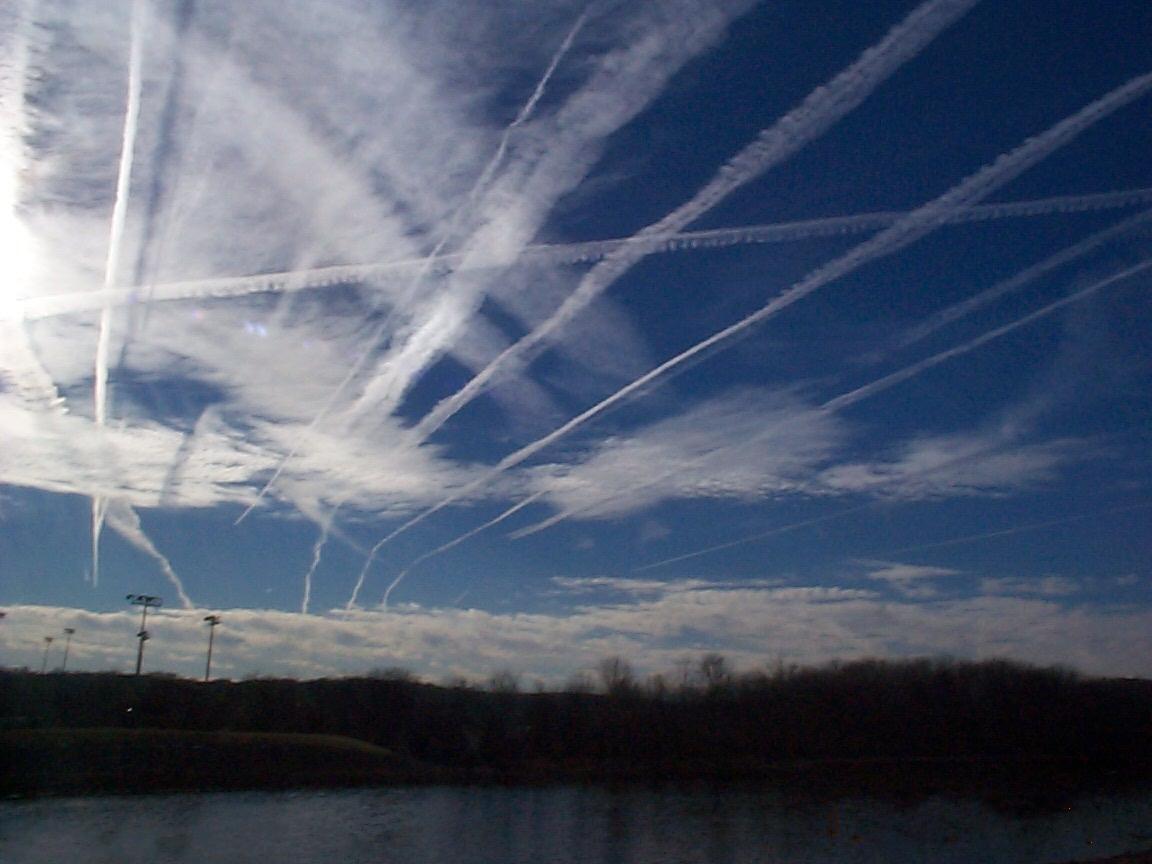
Which does not explain why it seems the entire blogosphere -- particularly folks from Orange County and therefore with some bleedover into the right-wing blogosphere (credit where it's due; there is an update) -- went so suddenly nuts assuming that a perfectly ordinary contrail left behind a perfectly ordinary flight, which an educated guess identifies as U.S. Air Flight 808, from Honolulu to Phoenix. There are cool heads out there in the O.C., and others who have pointed out that this wouldn't be the first time an ordinary contrail has caused a panic.
If you're interested in the subject, learn more about contrails here. If you were having fun panicking, don't let anything I've said here slow you down. But no one is in any danger from U.S. Air Flight 808. This was not a mysterious missile. This website has an image of what a west coast missile launch looks like; notice how it is clearly visible from Inyokern, a small community 160 miles east by northeast of the Vandenburg AFB launch site. My own experience -- and I'm the sort of guy who regularly looks up into the sky -- was that I haven't seen anything remarkable up there for weeks since the last F-35 test flights. There is nothing to panic about, yet people seemed eager to panic and indeed, to politicize it. I wonder what sort of free-floating anxiety is out there that fed this silly, irrational panic.
Labels:
California,
Domestic Politics,
News,
Science
Living A Lie, Not Developing Marketable Skills
When a pastor loses his (or her) faith, that's a real problem. Pastors may develop some marketable skills but apparently for some it's hard to market them, especially in a tough job market. I feel more than a little bit bad for these guys; they're kind of trapped in a job that makes them feel like hypocrites but have no real other way to provide for their families. I can't help but think this is nothing particularly new; I wonder how many people have been preached to by clergy (of any religion) who don't really believe what they're saying.
November 7, 2010
I Use A Laptop Often
Fortunately there are some things I only need to worry about with respect to comfort.
Labels:
Technology,
Unimportant but Mildly Amusing
November 5, 2010
Now That's Progress
 Labels:
California,
Lighting Our Money On Fire,
Travel
Labels:
California,
Lighting Our Money On Fire,
Travel
November 4, 2010
What He Said
When I don't write about something here, one of the reasons why is that I don't think I have anything new or insightful or useful to add to a particular subject. The subject of three Justices of the Iowa Supreme Court getting voted out of office because they ruled in favor of a right of same-sex marriage under that the Iowa Constitution's Equal Protections guarantee has just become such a subject.
Dan from Bleakonomy has occupied the field. And much more succinctly than I would have. I also want to extend to Dan thanks for writing the post about Oklahoma's Measure 755 which inspired me to produce not one but two posts on that same subject, posts with which I've had quite a bit of success with recently.
Dan from Bleakonomy has occupied the field. And much more succinctly than I would have. I also want to extend to Dan thanks for writing the post about Oklahoma's Measure 755 which inspired me to produce not one but two posts on that same subject, posts with which I've had quite a bit of success with recently.
Labels:
2010 Election,
Link Love,
Same-Sex Marriage
November 3, 2010
Instructor Ennui
There's a lot of bullshit involved in teaching. A lot of angst from students who can't seem to handle that they get questions wrong. A lot of paperwork and bureaucracy from the administration. A lot of claims of being liked by students who are obviously insincere. A lot of self-doubt about presenting material in a way that would seem to make it virtually impossible for anyone to do poorly but the awful spectacle of seeing it happen anyway. And for me, it means cutting off my time in the office, dealing with clients and their problems, a little bit earlier than the partners would probably prefer.
I came back from teaching tonight deeply dispirited about the whole endeavor. I just wasn't having any fun at all, even during a class with a fun subject. I felt this way last week, too, and thought it was the result of inadequate preparation. But this week I was prepared and I know I did well. Still, when I got home, I told The Wife that I wasn't going to take any more teaching gigs from anyone; it wasn't fun and wasn't worth the money or the frustration of putting up with the bullshit. I'd rather have been at home with The Wife and the critters, even if it meant less money. I'm up late reconsidering that -- but not very seriously.
This sort of thing can't be unique to my experience. It's not soul-crushing the way some other kinds of professional drudgery can be, but it was wearying to be up there facing a room full of rebellious college students who just plain didn't figure out the material and seemed to think that it was somehow not their fault. Which bugged me because, didn't I make the material interesting? Didn't I tell them what to look for when they studied and prepared their quiz answers? How do I deal with the fact that half my students probably don't belong in college at all but I'm not allowed to tell them that? Particularly for those Readers who teach adults, how do you handle this sort of thing?
I came back from teaching tonight deeply dispirited about the whole endeavor. I just wasn't having any fun at all, even during a class with a fun subject. I felt this way last week, too, and thought it was the result of inadequate preparation. But this week I was prepared and I know I did well. Still, when I got home, I told The Wife that I wasn't going to take any more teaching gigs from anyone; it wasn't fun and wasn't worth the money or the frustration of putting up with the bullshit. I'd rather have been at home with The Wife and the critters, even if it meant less money. I'm up late reconsidering that -- but not very seriously.
This sort of thing can't be unique to my experience. It's not soul-crushing the way some other kinds of professional drudgery can be, but it was wearying to be up there facing a room full of rebellious college students who just plain didn't figure out the material and seemed to think that it was somehow not their fault. Which bugged me because, didn't I make the material interesting? Didn't I tell them what to look for when they studied and prepared their quiz answers? How do I deal with the fact that half my students probably don't belong in college at all but I'm not allowed to tell them that? Particularly for those Readers who teach adults, how do you handle this sort of thing?
Labels:
Teaching
Advice About Two Years Too Late
Matt Yglesias suggests that the appropriate response by President Obama to the setbacks he and his party just sustained is to withdraw to the White House and make greater use of executive powers -- to do things like appointing more judges, aggressively negotiate trade agreements with major trading partners, and using regulatory and priority-setting power to bypass Congress towards encouraging economic activity. In other words, he needs to stop being the Democrats' Congressional-negotiator-in-chief and start being the President.
You'll pardon me if I say, "I told you so." Nearly three years ago, I mused:
Which is why it's telling, and of mid-range importance, that so many Republicans became Governors this time around. They are the farm team for the 2012, 2016, and 2020 Presidential election cycles. In the meantime, it's interesting to see liberals pointing out that President Obama needs to stop being Senator Obama. But this begs the question: shouldn't he have been doing that all along?
You'll pardon me if I say, "I told you so." Nearly three years ago, I mused:
Personally, I think that legislative service is a relatively poor way to train someone for executive leadership. Legislative service is inherently a deliberative process. It involves seeking consensus and compromise amongst people who are more or less equals. Chairs of Congressional committees certainly wield great power, but they do so because they have the backing of their peers and therefore concentrate the power of the entire Congress into themselves, at least within their areas of speciality.Leaving aside a spelling mistake which I should have corrected, I stand by those remarks. Nor do I think I was particularly unique or insightful back during the campaign to observe that Barack Obama's very first experience as an executive would be as President of the United States. He was never Governor of Illinois, never ran any kind of an enterprise like a university, never even ran the law firms he worked in. Knowing what to delegate and what not to, judging the character and competence of subordinates and figuring out how much leash to keep them on, and finding the right advisers to filter extraneous information and get the important data where it ought to be are difficult things to do.
Being a legislator is great experience for learning how to make deals. It isn't a great way to learn how to delegate tasks, how to read peoples' abilities and how to pick amongst people for various jobs, how to set priorities. Executive power is taking the helm of an organization; it is not exercised by seeking consensus and compromise, but rather through personal charisma and the dissemination of a common set of visions, goals, and values. Ultimately, being President isn't about making deals, it's about taking charge. So I have to disagree with those among you who picked service in the Congress as the best qualifier for the White House. I'd have picked "Cabinet service" before "Congressional service." But that's just me.
Which is why it's telling, and of mid-range importance, that so many Republicans became Governors this time around. They are the farm team for the 2012, 2016, and 2020 Presidential election cycles. In the meantime, it's interesting to see liberals pointing out that President Obama needs to stop being Senator Obama. But this begs the question: shouldn't he have been doing that all along?
Labels:
2010 Election,
Barack Obama,
Government
Better Than Losing
I got notice today of my plaintiff's summary judgment motion being granted in a bitter property ownership case. Maybe this case isn't over yet, but lemme tell you all: I like winning.
Published with Blogger-droid v1.6.3
Labels:
Law
November 2, 2010
For Your Listening Pleasure
Jeff Beck and Joss Stone.
There's something quite nice about British musicians playing American blues.
There's something quite nice about British musicians playing American blues.
Labels:
Music
Premortem 2010
Ten months ago, I made a few SWAGs about (among other things) politics. Those SWAGs included the following:
My prediction for California is much closer to what has actually happened than what looks like is about to happen at the Federal level.
California is indeed poised to send back functionally all non-termed members of the Legislature back to Sacramento; those seats for which the incumbent is termed out appear poised for retention by the incumbent's party. There may well be no shift in the partisan makeup of the California Legislature at all.
Federally, I made my prediction believing that the bad general economic conditions present at the end of 2009 would not persist and be mitigated somewhat. I hoped that would be true. Now, where I predicted a gain by Republicans of two or three seats in the Senate, it looks more like seven. That doesn't leave Democrats firmly in control of that body, but they will still be the majority.
The House, however, appears poised for a reversal of control. Right now, Democrats have 255 seats, Republicans 178, and there are two vacancies. The magic number is a net gain of 39 seats for Republicans. My predicted gain of roughly ten seats will be far exceeded; the best predictions available is a shift of fifty-five (!) seats, which would be enough for the GOP to re-take the Speaker's chair.
I think what happened was that the election of Scott Brown earlier this year gave everyone a test of the political waters. Much like I thought, the Republicans found that running a campaign against President Obama and in particular health care reform was potent stuff; the Democrats found that running against President Bush was a non-starter. Why they ever thought to run against Bush during mid-term elections while they controlled the White House is absolutely beyond me.
What happened was that Democrats found that their brand had become toxic and they had no target to point to and say, "But we don't suck as bad as them!" anymore. The best they came up with were the Not-Ready-For-Primetime-Players like Sharron Angle, Christine O'Donnell, and Joe Miller -- but in states with larger populations, even the more conservative of Republican nominees -- Rick Rubio, Pat Toomey, Mark Kirk -- had enough experience and polish to give lie to the idea that cosnervative ideology necessarily means silliness.
I see no reason to think, however, that this election represents an embrace by the electorate of "Republican ideas." Rather, it is a rejection of "Democratic ideas," specifically health care reform. If there is going to be a common thread in the stories at the House level, it will be that Democrats from marginal districts who voted for health care reform get thrown out, while Democrats who can say that they bucked their own party on this one issue stand a reasonable chance of hanging on to their seats.
The result of this will be that the Republicans in office for the 112nd Congress will believe that they have been rewarded for being "The Party Of No" and will double down on doing nothing. The chances that the Obamacare bill will actually get repealed are functionally nil -- the President still holds the veto pen, even if a repeal makes it through the Senate. But there is a reasonable chance, even a probability, that Obamacare will be whittled back incrementally. The political football will be the individual mandate. This strikes me as odd -- the Republicans will realize electoral gains and make political hay during the next cycle, by fighting for the right of people to not have health insurance if they don't have the money to buy it. But there you have it.
Downballot, at least here in California, the real prize is redistricting. Lots of people are focused on Prop. 19, which I predicted a while back and continue to believe will be a very close vote. Right now, I'm pessimistic about whether it will pass. But the big issue is Prop. 20 and Prop. 27. In the last election, the voters passed Prop. 11, which delegated legislative redistricting to a bipartisan panel of 120 people, 40 Democrats, 40 Republicans, and 40 independents. Prop. 27 would repeal Prop. 11. Prop. 20 would extend the power of the panel to Congressional districts as well. I have long thought that the heavily-gerrymandered districts are at the root of the political polarization which has effectively paralyzed California's fisc.
This will be somewhat mooted if Prop. 25 passes -- this would reduce the requirement for passage of a budget out of the Legislature from two-thirds to a simple majority. The result of this would be to eliminate the only power that the minority party in the Legislature has, which is to block passage of the budget. Since the 1950's, Democrats have been in charge of the Legislature and for most of that time, Republicans have used the two-thirds rule to slow or mitigate the creep of tax increases which Democrats would have implemented to pay for the expansion of government services that they nevertheless pass. Since Republicans will not allow taxes to be significantly increased to pay for this, the Democrats have financed these things by selling them piecemeal to the voters directly through bond measures and had to content themselves with only incremental increases in taxes and hoping that inflation would catch up with the bonds.
How long could such a thing be sustained? Fifty-six years, as it turns out, until a national economic crash, hitting particularly hard here, caused existing revenue to drop through the floor.
So these are the big issues and the big forces I see at play right now. I want the Republicans to do better in Sacramento; there is little doubt in my mind that state taxes are already at such heights that California's economy suffers from a drag imposed by the government. This means we need to keep the two-thirds rule and try to fashion more logical and balanced districts in the future so that the Legislature is not run like an old-style Russian Soviet. At the Federal level, I'm not a fan of Obamacare and wouldn't mind seeing it repealed.
All in all, I find reason to be contented and moderately optimistic about the elections today. I don't relish the idea of gridlock and I would like it if the Republicans actually stuck their necks out and proposed actual policies instead of simply saying "Let's go back to the way things were in [mumble mumble]." The gold old days under George W. Bush weren't really all that good, especially from a fiscal perspective. Still, I'm encouraged to see that they are at least paying lip service to the idea of watching our collective money, and I can at least hope, perhaps forlornly, that this ethic by the voters will trickle down to the state level here such that we see institutional steps to keep California's finances in check retained and strengthened.
Foolishly, Democrats will campaign in 2010 against George W. Bush. This will fail and result in gains by Republicans, but more in the House than the Senate. Congressional Republicans will realize a net gain of only two or three seats in the Senate, leaving the Democrats still firmly in control of that body and reviving talks of abolishing the filibuster. But, net gains in the House of Representatives will be such that the Democrats' majority in the lower chamber will be roughly ten seats and Republicans will optimistically talk of re-taking the House in 2012.
* * *A reconciled health care "reform" bill will not be passed out of Congress until March or maybe even early April. Its effect will be to very moderately increase taxes on middle-class Americans, only negligibly affect their actual health care options, and substantially inflate both the governmental deficit and the profits of enterprise-level health care providers.
* * *California will increase sales taxes to 10.5% or higher, resulting in the highest sales tax in the nation. Despite this, functionally all incumbents in the Legislature eligible for re-election will be re-elected in November and the Democrat nominee (who right now looks like Jerry Brown) will win the Governorship.
My prediction for California is much closer to what has actually happened than what looks like is about to happen at the Federal level.
California is indeed poised to send back functionally all non-termed members of the Legislature back to Sacramento; those seats for which the incumbent is termed out appear poised for retention by the incumbent's party. There may well be no shift in the partisan makeup of the California Legislature at all.
Federally, I made my prediction believing that the bad general economic conditions present at the end of 2009 would not persist and be mitigated somewhat. I hoped that would be true. Now, where I predicted a gain by Republicans of two or three seats in the Senate, it looks more like seven. That doesn't leave Democrats firmly in control of that body, but they will still be the majority.
The House, however, appears poised for a reversal of control. Right now, Democrats have 255 seats, Republicans 178, and there are two vacancies. The magic number is a net gain of 39 seats for Republicans. My predicted gain of roughly ten seats will be far exceeded; the best predictions available is a shift of fifty-five (!) seats, which would be enough for the GOP to re-take the Speaker's chair.
I think what happened was that the election of Scott Brown earlier this year gave everyone a test of the political waters. Much like I thought, the Republicans found that running a campaign against President Obama and in particular health care reform was potent stuff; the Democrats found that running against President Bush was a non-starter. Why they ever thought to run against Bush during mid-term elections while they controlled the White House is absolutely beyond me.
What happened was that Democrats found that their brand had become toxic and they had no target to point to and say, "But we don't suck as bad as them!" anymore. The best they came up with were the Not-Ready-For-Primetime-Players like Sharron Angle, Christine O'Donnell, and Joe Miller -- but in states with larger populations, even the more conservative of Republican nominees -- Rick Rubio, Pat Toomey, Mark Kirk -- had enough experience and polish to give lie to the idea that cosnervative ideology necessarily means silliness.
I see no reason to think, however, that this election represents an embrace by the electorate of "Republican ideas." Rather, it is a rejection of "Democratic ideas," specifically health care reform. If there is going to be a common thread in the stories at the House level, it will be that Democrats from marginal districts who voted for health care reform get thrown out, while Democrats who can say that they bucked their own party on this one issue stand a reasonable chance of hanging on to their seats.
The result of this will be that the Republicans in office for the 112nd Congress will believe that they have been rewarded for being "The Party Of No" and will double down on doing nothing. The chances that the Obamacare bill will actually get repealed are functionally nil -- the President still holds the veto pen, even if a repeal makes it through the Senate. But there is a reasonable chance, even a probability, that Obamacare will be whittled back incrementally. The political football will be the individual mandate. This strikes me as odd -- the Republicans will realize electoral gains and make political hay during the next cycle, by fighting for the right of people to not have health insurance if they don't have the money to buy it. But there you have it.
Downballot, at least here in California, the real prize is redistricting. Lots of people are focused on Prop. 19, which I predicted a while back and continue to believe will be a very close vote. Right now, I'm pessimistic about whether it will pass. But the big issue is Prop. 20 and Prop. 27. In the last election, the voters passed Prop. 11, which delegated legislative redistricting to a bipartisan panel of 120 people, 40 Democrats, 40 Republicans, and 40 independents. Prop. 27 would repeal Prop. 11. Prop. 20 would extend the power of the panel to Congressional districts as well. I have long thought that the heavily-gerrymandered districts are at the root of the political polarization which has effectively paralyzed California's fisc.
This will be somewhat mooted if Prop. 25 passes -- this would reduce the requirement for passage of a budget out of the Legislature from two-thirds to a simple majority. The result of this would be to eliminate the only power that the minority party in the Legislature has, which is to block passage of the budget. Since the 1950's, Democrats have been in charge of the Legislature and for most of that time, Republicans have used the two-thirds rule to slow or mitigate the creep of tax increases which Democrats would have implemented to pay for the expansion of government services that they nevertheless pass. Since Republicans will not allow taxes to be significantly increased to pay for this, the Democrats have financed these things by selling them piecemeal to the voters directly through bond measures and had to content themselves with only incremental increases in taxes and hoping that inflation would catch up with the bonds.
How long could such a thing be sustained? Fifty-six years, as it turns out, until a national economic crash, hitting particularly hard here, caused existing revenue to drop through the floor.
So these are the big issues and the big forces I see at play right now. I want the Republicans to do better in Sacramento; there is little doubt in my mind that state taxes are already at such heights that California's economy suffers from a drag imposed by the government. This means we need to keep the two-thirds rule and try to fashion more logical and balanced districts in the future so that the Legislature is not run like an old-style Russian Soviet. At the Federal level, I'm not a fan of Obamacare and wouldn't mind seeing it repealed.
All in all, I find reason to be contented and moderately optimistic about the elections today. I don't relish the idea of gridlock and I would like it if the Republicans actually stuck their necks out and proposed actual policies instead of simply saying "Let's go back to the way things were in [mumble mumble]." The gold old days under George W. Bush weren't really all that good, especially from a fiscal perspective. Still, I'm encouraged to see that they are at least paying lip service to the idea of watching our collective money, and I can at least hope, perhaps forlornly, that this ethic by the voters will trickle down to the state level here such that we see institutional steps to keep California's finances in check retained and strengthened.
November 1, 2010
Quick Memo
TO: Carl Paladino, candidate for the office of Governor of New York
FROM: Burt Likko, the Transplanted Lawyer
DATE: November 1, 2010
RE: Your recent photograph at Halloween party
Mr. Paladino:
While reading one of my favorite blogs (linked above in the subject line), I saw a photograph of you at a Halloween party in which you seemed to be allowing your picture to be taken next to a man wearing blackface. Racial politics being as complex as they are in today's ever-changing social and cultural milieu, it occurred to me that you may have been confused and (perhaps because it appears there may have been moderate amounts of alcohol being consumed at this party) thus allowed your politician's natural reserve of inhibition to ebb. Because I've no particular love for Andrew Cuomo, I thought you might like to know that this photograph could tend to make people think of you as something of a douche bag.
 This reminded me that there are decision-making matricies and flowcharts which can assist in handling difficult and nuanced situations like this. I have reproduced the relevant portion of the flowchart to the right in this memo. Suffice to say that I advise against allowing future such photographs to be taken, and to issue an appropriate explanatory statement at your earliest convenience.
Your apparent intoxication, squint, and tongue sticking out of your mouth do not add luster to this incident. However, the primary concern is the fact that you allowed visual evidence of your presence at a party where someone was wearing blackface. While perhaps not as problematic as being photographed while wearing a Waffen SS uniform, this is still well within the category of "pretty bad." Hopefully, this will assist you in the future should you find yourself "on the spot" and need to make a snap decision. Good luck tomorrow (you'll need it) and in your future electoral endeavors!
-TL
FROM: Burt Likko, the Transplanted Lawyer
DATE: November 1, 2010
RE: Your recent photograph at Halloween party
Mr. Paladino:
While reading one of my favorite blogs (linked above in the subject line), I saw a photograph of you at a Halloween party in which you seemed to be allowing your picture to be taken next to a man wearing blackface. Racial politics being as complex as they are in today's ever-changing social and cultural milieu, it occurred to me that you may have been confused and (perhaps because it appears there may have been moderate amounts of alcohol being consumed at this party) thus allowed your politician's natural reserve of inhibition to ebb. Because I've no particular love for Andrew Cuomo, I thought you might like to know that this photograph could tend to make people think of you as something of a douche bag.
 This reminded me that there are decision-making matricies and flowcharts which can assist in handling difficult and nuanced situations like this. I have reproduced the relevant portion of the flowchart to the right in this memo. Suffice to say that I advise against allowing future such photographs to be taken, and to issue an appropriate explanatory statement at your earliest convenience.
 Your apparent intoxication, squint, and tongue sticking out of your mouth do not add luster to this incident. However, the primary concern is the fact that you allowed visual evidence of your presence at a party where someone was wearing blackface. While perhaps not as problematic as being photographed while wearing a Waffen SS uniform, this is still well within the category of "pretty bad." Hopefully, this will assist you in the future should you find yourself "on the spot" and need to make a snap decision. Good luck tomorrow (you'll need it) and in your future electoral endeavors!
-TL
Labels:
2010 Election,
Domestic Politics,
Link Love
October 31, 2010
Cosmos
I've been watching Cosmos, the science miniseries series that originally aired on PBS back in 1980. You can see them all for free on hulu. Some of the science is old news now, the graphics and the hairstyles and the clothing are definitely dated. But it still holds up as an enjoyable way to spend your time.
The stagings of historical events hold up and help bring to mind some idea of what the progress of science must have been like to the people of the periods when it happened. The soundtrack by Vangelis remains beautiful, even if electronic music has advanced considerably since the Eighties.
Most of all, there is the writing and narration of Carl Sagan. Sagan was a remarkably effective ambassador for science to the popular world. Cosmos stands as a brilliant paean to the joy of knowledge, learning, clear thought, and most of all the power of science. If the science is old news now, it makes no bones about that -- the science was new when the series was made but Sagan was clear that he fully expected the work of future generations to surpass what he was describing. At the end of the day, he describes science as a process, as an attitude. And it is an attitude full of awe, wonder, hope, and joy.
The stagings of historical events hold up and help bring to mind some idea of what the progress of science must have been like to the people of the periods when it happened. The soundtrack by Vangelis remains beautiful, even if electronic music has advanced considerably since the Eighties.
Most of all, there is the writing and narration of Carl Sagan. Sagan was a remarkably effective ambassador for science to the popular world. Cosmos stands as a brilliant paean to the joy of knowledge, learning, clear thought, and most of all the power of science. If the science is old news now, it makes no bones about that -- the science was new when the series was made but Sagan was clear that he fully expected the work of future generations to surpass what he was describing. At the end of the day, he describes science as a process, as an attitude. And it is an attitude full of awe, wonder, hope, and joy.
Labels:
Science
Subscribe to:
Posts (Atom)

 Posts
Posts