There's lots of stuff I don't know that weighs on my mind tonight.
...I don't know why it is that some things just irritate me so much. I'm happy to pitch in and do household chores and do my part to maintain the house. But sometimes, seemingly simple tasks grow very elaborate, and I have a hard time concealing or controlling my irritation with that.
...I don't know how it came to pass that we spent so much money on the holidays. I hope we can figure out a way to pay for it all.
...I don't know why it should be that trying to lose a few pounds should be such a traumatic process. You have to eat less, which means it's easy for one to become short-tempered. You start thinking about your food more, which means you have to start making choices that are aimed at goals other than the pleasure of eating. You start looking in the mirror more and disapproving more of what you see there. Isn't there some sort of way to do this and still be happy?
...I don't know why I don't like tomatoes more than I do. I ought to like them. I'm part Italian and I'm a big advocate of cooking with fresh fruits and vegetables. They're packed full of flavor (when they're ripe, that is) and I like most sauces and soup bases made from tomatoes. But confronted with one, I lose my nerve and I can't bring myself to eat the thing. I know it's going to be gushy and slimy inside.
...I don't know how I lucked out into getting such a great wife. I want to get her something nice for the holidays (other than the computer she now uses) but I don't know what that will be or how I will afford it. But I've got to figure something out!
...I don't know how my dogs can sleep so much. Isn't there a quota for how many hours you can sleep in day? Yet they find a way to function and don't have any trouble sleeping again when they want to -- or when it's their bedtime. I don't know how I can sleep so little, but I don't ever feel like I get enough. I don't know how my cat can make so much noise, but she can.
...I don't know how parents do it. Seeing our neighbors interact with their kids astonishes me; they're both a few years older than The Wife and I and have three girls, ages three to seven. You can imagine the activity level -- yikes. Yet somehow they manage to keep their tempers. I can't imagine how much less sleep I'd get, and how much more stress I'd feel, if The Wife and I had young 'uns running around Soffit House.
...I don't know a surprising amount of sports trivia, for someone who enjoys sports as much as I do. Some of it sticks, some of it doesn't, and I haven't much excuse for my failure to perform well in contests or games testing my knowledge of sports trivia.
...I don't know what makes me nasally congested so often here in California's High Desert, or why I've been getting headaches so much. But I suspect that the two things are related.
...I don't know how we're going to pack all of our holiday gifts into shipping boxes; the gifts wound up being quite bulky.
...I don't know what's making so much noise tonight, but it sounds like there's a rock band practicing at the Catholic church across the street. Wherever it's coming from, it's irritating. A glass of wine before bed might help me ignore it, but I don't know if that plan will work or not, either.
...I don't know whether I'll go to watch the Packers game tomorrow or not. Yes, it could clinch the division and/or a playoff spot for them, and yes, it's against the Raiders. But I've better things to be doing with my money and my time, at least this time around. Maybe the game will be simulcast on the internet so I can watch it that way.
December 8, 2007
December 7, 2007
Immoderate Islam
I’ve bashed on Mitt Romney enough for a twenty-four hour period. Now it’s time to bash on Muslims again for foisting off their brand of violent, misogynistic lunacy on the rest of us. Specifically, I refer to the utter and barbaric cruelty of Shari’a law. Go ahead and read the linked op-ed (by my latest hero, Somali/Dutch humanist Ayaan Hirsi Ali) and shudder in horror to think of what happens when religion is given power over the implements of government. Go ahead and read about "The Girl From Qatif" and try to not be outraged.
Ali raises an excellent point: where are all of these so-called “Islamic moderates” who join us Westerners in being outraged by things like this? Why are no Muslim nations or leaders critical of the Saudis, Sudanese, or Bangladeshis when their co-religionists perpetrate these outrageous human rights abuses? Whether their silence is the result of feelings of fear or feelings of fraternity, it is still inexcusable. Evil is evil, no matter what mask it wears.
I call “bullshit.” The Koran is just another collection of pretty-sounding fairy tales (I’ve heard the first Sura sung in Arabic, and it is quite pretty) bearing little resemblance to the world in which it was written, and even less to the world we live in today. Any modern, industrialized society that would claim a seat at the table of civilization in the modern era ought not to conduct itself according to the social code of Bronze Age nomads.
Ali raises an excellent point: where are all of these so-called “Islamic moderates” who join us Westerners in being outraged by things like this? Why are no Muslim nations or leaders critical of the Saudis, Sudanese, or Bangladeshis when their co-religionists perpetrate these outrageous human rights abuses? Whether their silence is the result of feelings of fear or feelings of fraternity, it is still inexcusable. Evil is evil, no matter what mask it wears.
I call “bullshit.” The Koran is just another collection of pretty-sounding fairy tales (I’ve heard the first Sura sung in Arabic, and it is quite pretty) bearing little resemblance to the world in which it was written, and even less to the world we live in today. Any modern, industrialized society that would claim a seat at the table of civilization in the modern era ought not to conduct itself according to the social code of Bronze Age nomads.
More Thoughts On Romney
Some of you may think that I have a chip on my shoulder about atheists and their participation in American civic life, so I've taken offense too easily at Romney's remarks. However, before you pronounce that judgment, read this.
I'm not overreacting. I and my fellow non-believers have been demonized as part of a desparate attempt to save a sinking campaign. Romney and his aides refuse to deny that they've done this. Sure, there are many times as many theists as seculars in America. But by some estimations we are about 15% of the total population -- proportionally about as many as there are African-Americans compared to other racial groups. If Romney had demonized that minority instead of the one he did, how would you have reacted?
That is the problem with conflating patriotism with religiosity -- it implies that irreligious people are also unpatriotic. Compare Romney's statements with those of John Fitzgerald Kennedy, spoken nearly half a century ago:
I'm not overreacting. I and my fellow non-believers have been demonized as part of a desparate attempt to save a sinking campaign. Romney and his aides refuse to deny that they've done this. Sure, there are many times as many theists as seculars in America. But by some estimations we are about 15% of the total population -- proportionally about as many as there are African-Americans compared to other racial groups. If Romney had demonized that minority instead of the one he did, how would you have reacted?
That is the problem with conflating patriotism with religiosity -- it implies that irreligious people are also unpatriotic. Compare Romney's statements with those of John Fitzgerald Kennedy, spoken nearly half a century ago:
I believe in an America where the separation of church and state is absolute, where no Catholic prelate would tell the president (should he be Catholic) how to act, and no Protestant minister would tell his parishioners for whom to vote; where no church or church school is granted any public funds or political preference; and where no man is denied public office merely because his religion differs from the president who might appoint him or the people who might elect him.Compare, also, Romney's sentiments to those of Thomas Jefferson (he who referenced the "Creator" in the Declaration of Independence):
Believing with you that religion is a matter which lies solely between Man & his God, that he owes account to none other for his faith or his worship, that the legitimate powers of government reach actions only, & not opinions, I contemplate with sovereign reverence that act of the whole American people which declared that their legislature should "make no law respecting an establishment of religion, or prohibiting the free exercise thereof," thus building a wall of separation between Church & State.Or, consider the Supreme Court of the United States:
We repeat and again reaffirm that neither a State nor the Federal Government can constitutionally force a person to profess a belief or disbelief in any religion. Neither can constitutionally pass laws or impose requirements which aid all religions as against non-believers, and neither can aid those religions based on a belief in the existence of God as against those religions founded on different beliefs. Torasco v. Watkins (1961) 367 U.S. 488.Or, consider the words of Founding Father James Iredell, who said in the North Carolina Supreme Court:
...it is objected that the people of America may, perhaps, choose representatives who have no religion at all, and that pagans and Mahometans may be admitted into offices. But how is it possible to exclude any set of men, without taking away that principle of religious freedom which we ourselves so warmly contend for?Even if you're religious, please don't vote for a theocrat. Understand what such a vote is a vote for. Attacking a minority for short-term political gain is bad politics, bad policy, and just plain wrong. It is Governor Romney who is out of step with the ideals, traditions and laws of this nation, not the atheists he seeks to portray as lacking in patriotism or congruity with the American ideal. You've got plenty of non-theocratic choices available to you in this election.

 Labels:
2008 Election,
Atheism,
Constitutional Law,
Mitt Romney,
Religion
Labels:
2008 Election,
Atheism,
Constitutional Law,
Mitt Romney,
Religion
December 6, 2007
Am I Supposed To Like Being The Whipping Boy?
Let me get a few things out of the way, for the benefit of the religious advocates who occasionally comment here. First of all, your comments are welcome, whether I agree with you or not. In fact, disagreements keep things interesting around here. That doesn't mean I think you're right; it means I think you're fun to spar with and it keeps us all on our toes to have a lively debate.
Secondly, I don't equate religion with immorality. I think we can all agree that whether someone is outwardly religious or not has little to do with whether that person is actually morally good or bad. I know that sometimes I give the impression that I believe religion is simply bad; that is a rhetorical excess on my part. I think sometimes religion has a bad effect on people. That's different than saying religion is inherently bad. I'm not Richard Dawkins.
And third, I'm conceding, right out of the starting gate, that religion has played a significant role in the history of this country, that religious freedom was and remains integral to the idea of what it is to be an American, and that many of the Founders of our nation were deeply religious people. I do not, and never have, proposed that government turn a blind eye to religion, pretend that it does not exist, or act as though religious institutions do not play significant roles in the lives of Americans. I am myself, to a significant extent, the product of some of those religious institutions -- I was raised in the Catholic tradition, received some of my education at Catholic schools, and I have little but gratitude for the teachers and others affiliated with those institutions who tried to convey their knowledge, ethics, and life skills to me. So I recognize and affirm that religion can be a powerful force for good.
So, with that background, I agree with one of Governor Romney's remarks about religion and civic life very enthusiastically:
Must I also add that atheism is not a religion? It is the absence of religion. Atheism is to religion as vacuum is to matter. Secularism is also not a religion, it is the disregard of religion. A secularist regards religion in the same manner that he regards a movie -- a story of variable entertainment or intellectual value, but definitely not something to be confused with reality. To base one's civic life on religious teachings view political priorities through a Biblical lens makes as much sense to a secularist as it would to organize one's life around the solipsistic "philosophy" underlying The Matrix.
Romney, on the other hand, seems to believe that the Founding of the nation was a religious act:
Secondly, we come back to a point that I brought up a couple of weeks ago -- do our rights as human beings come from God or do they come from the fact of our humanity? Religionists could respond to that by saying "There's no difference between those two positions," but they do not and commenters here did not do that, either. Instead, they are quick to take the position that these sorts of rights -- religious liberty, free speech, due process, and so on -- come from God, period, full stop.
For myself, I find such an assertion meaningless, because I believe that there is no God. It makes no more sense to attribute rights to God (meaning Jehovah) than it does to attribute them to a pantheon of Greek or Norse deities, or to the Tooth Fairy, or to Colonel Sanders. All of those propositions are equally ridiculous to me. (To paraphrase Robert Green Ingersoll, when you really understand why you don't believe your rights were given to you by the Tooth Fairy, you will also understand why I don't believe they came from Jehovah. Until then, keep on thinking about that one.) So, if Romney wanted to make the claim that we have these rights because we are human, and we are human because that's how God made us, that would have been one thing and it would have made some level of sense to me.
But he -- and pretty much every other religionist I've spoken to recently about the subject or who has commented here or in e-mail to me -- has failed to make that point, at least in terms that were clear to me. Instead, the impression I'm left with is that the creation of Man was one thing God did, and the bestowal of rights in him was something else that God did; a separate act. God could have made Man and not bestowed rights upon him; and by implication, there may well be people who were not blessed with those inherent natural rights. Romney returns forcefully to this point in the last section quoted above: "Americans acknowledge that liberty is a gift of God, not an indulgence of government."
Surely, a man as smart as Governor Romney is has taken a good look at the early history of the nation and he has at least been exposed to the way that the Constitution was created. To be sure, Ben Franklin asked that sessions of the Constitutional Convention begin with a prayer. But I'm not talking about an invocation of divine authority (an authority whose existence I do not acknowledge) but rather about the political activity that was going on in Philadelphia that summer. To understand that activity, you've got to look at it in context.
The United States of America existed before the Constitution of 1787. Its existence as a formally-organized, independent political entity began on July 4, 1776; it existed as a nation in the hearts and minds of its citizens more than a year before that; we commonly think of the Revolution beginning on June 17, 1775 at the Battle of Bunker Hill. Certainly from the time of the Declaration of Independence to the ratification of the current Constitution on June 21, 1788 when New Hampshire became the ninth state to ratify it, the United States were governed by the Articles of Confederation. So for twelve years, there was a different form of government here, the form of government originally set forth by the Founders. As many students of history know, the Articles of Confederation set up a very weak national government and a close look at the relationship of that government to the several states reveals that as a functional matter, the national government had no real power whatsoever -- which of course is why the Constitution of 1787 was drafted in the first place, and despite some misgivings of the anti-Federalists, it's worked out pretty well.
A close look at the Declaration of Independence, and at the pre-1787 constitutions of the several States, is revealing. I don't mean the single oblique reference to the "Creator" in the Declaration (as if that single reference proved anything about the political thought going on or the objective existence of such a Creator); rather, I'm referring to the reason why the Declaration was written in the first place.
See, the Founders were revolutionaries and Enlightenment-era radicals. Before you get your dudgeon up about my exclusion of God from the motives of the Founders, think for a moment about what that really means. They believed that government existed not because it was the command of God that it exist, but because it was the result of a social contract. Human beings form social contracts from the state of nature to provide for their common benefit and protection. They agree to submit themselves to the rules that this government will create, because they recognize that it is ultimately to their benefit to do so, even if it means giving up a measure of their individual autonomy and if that government will compel them to do things they don't want to do in the short run.
Thus, the government is the guarantor, not the grantor, of the rights of its individual citizens. The government is only a legitimate repository of the power delegated to it by its citizens so long as it protects and advances and protects the rights of its citizens. When it stops doing so, the citizens ultimately have a right to opt out of that government and form a new one better able to protect their interests. This is not a step to be taken lightly nor as a result of petty grievances, but at some point, when it becomes clear that the government has become tyrannical, then a revolution is justified because the government, and not the people, has failed to fulfill its end of the social contract.
This should all be familiar to those of you who remember high school civics, and it certainly should be familiar to lawyers who have studied Constitutional law in some depth. But God, you will notice, is not a party to the social contract. Only humans are. Where humans got their rights from (in an ontological sense) is not a matter which Constitutional law addresses any more than it addresses where they got their fingers. But you should also see that these rights are not dispensed by the fiat of the government, whether that government be a king, a parliament, the military, or a cleric.
Here's how the Founders thought about individual rights and the government: the government must respect our individual rights because we never gave it the power to trample on them in the first place. Power flows up from the people to the states, and then from the states to the Federal government. Rights not enumerated in the Constitution are reserved to the people and to the states -- a proviso which finds enumeration in the Ninth and Tenth Amendments to the Constitution.
So, for Romney (or Napolitano, or others) to suggest that our system of government is founded upon God-given rights is to ignore the political theory underlying the Constitution; it conveniently sidesteps some very high-level political thinking going on amongst these very smart, and some of them very religious, men who put together the framework of our nation. Romney (and Napolitano) should and probably does know better. However, it suits his political purposes to shade the truth and play to an emerging state religion of Christianity blended with militaristic patriotism.
Finally, and this is what really pissed me off the most, Romney engages in a classic political maneuver -- the sidestep. The theological differences between evangelical Christianity and the teachings of the Church of the Latter-Day Saints are deep and profound to those who hold that one or the other are true. Both Mormons and Baptists hold that Jesus was the son of God. But while one might say that assigning the name Jehovah or Elihu to God doesn't matter much, I suspect it does matter to some whether Lucifer was Jesus' misbehaving brother and whether they all came from the planet Kolob.* This isn't like Lutherans and Methodists politely agreeing to disagree on whether local churches should be governed by councils of lay members or by the presiding ministers.
How, then, to deal with the fact that most Christians would think such beliefs are, well, really weird? Direct that anger and suspicion elsewhere. And who do Christians mistrust more than people of different religions? People with no religion at all. People, in other words, like me. Romney says, by way of exclusion, "Hey, at least I'm not an atheist!"
A commitment to "the equality of human kind, the obligation to serve one another, and a steadfast commitment to liberty" require no subscription to any religion at all. As I've suggested in the past, one way religion has been (mis)used is to rationalize reasons for failing to live up to those ideals. That's not to say that secular ideas cannot be similarly misused, by the way, but it is to say that those sorts of civic virtues (equality, fraternity, and liberty) are in no way religious -- if one's religion motivates one to behave in fulfillment of those virtues, great, but religion isn't the only way there or, if I may be so bold, not even necessarily the best way there. Particularly on the whole equality thing, Governor -- doesn't Mormonism teach that the servants of Lucifer were cursed with darkened skin?
The nobility of America, and the men and women of this nation who fought and sacrificed for the cause of liberty, is not reasonably subject to debate, as far as I'm concerned. Sure, some of us have been less than noble from time to time; we're no different than anyone else in that respect. But as a whole, we Americans are an astonishingly decent and moral people. Some of us are that way because of our faiths; some of us are that way despite our faiths; some of us are that way and have no faith at all.
But I notice that in this description of our great good works, you do not reference God as the motive force. Rather, it is our goodness and our commitment to freedom which has motivated us to do these great things. While faith in God and belief in liberty are not inconsistent, they are also not the same thing.
And do not forget, Governor, that some of those men and women who fought and sacrified were not believers. Were their sacrifices, including their lives, any less valuable or worthy of praise than those of the believers?
That's why Romney pissed me off. He demonized me and my fellow atheists. We're not bad people and we don't like it when people call us bad. You don't need God to be good. But you do need to understand the political ideas that underlie America in order to present a compelling case for your suitability to lead it. Romney either doesn't understand any of this, or worse yet, is willing to disregard it in order to pander to a segment of the electorate.
I'll not vote for Mitt Romney, either in the upcoming Presidential primary, or the general election if he is nominated. I urge you all to do the same.
* For you non-Mormons out there, take a moment to think about why it's ridiculous to propose that Lucifer was Jesus' brother and that God did not come from the planet Kolob. I can't think of a reason why a reasonable person, who accepts the basic concept of theism, should reject that world view and instead adopt a different one.
Secondly, I don't equate religion with immorality. I think we can all agree that whether someone is outwardly religious or not has little to do with whether that person is actually morally good or bad. I know that sometimes I give the impression that I believe religion is simply bad; that is a rhetorical excess on my part. I think sometimes religion has a bad effect on people. That's different than saying religion is inherently bad. I'm not Richard Dawkins.
And third, I'm conceding, right out of the starting gate, that religion has played a significant role in the history of this country, that religious freedom was and remains integral to the idea of what it is to be an American, and that many of the Founders of our nation were deeply religious people. I do not, and never have, proposed that government turn a blind eye to religion, pretend that it does not exist, or act as though religious institutions do not play significant roles in the lives of Americans. I am myself, to a significant extent, the product of some of those religious institutions -- I was raised in the Catholic tradition, received some of my education at Catholic schools, and I have little but gratitude for the teachers and others affiliated with those institutions who tried to convey their knowledge, ethics, and life skills to me. So I recognize and affirm that religion can be a powerful force for good.
So, with that background, I agree with one of Governor Romney's remarks about religion and civic life very enthusiastically:
We separate church and state affairs in this country, and for good reason. No religion should dictate to the state nor should the state interfere with the free practice of religion.This is not particularly controversial, as a statement of theory and as an ideal. But the rest of the paragraph certainly feels like he takes dead aim at me and people like me:
But in recent years, the notion of the separation of church and state has been taken by some well beyond its original meaning. They seek to remove from the public domain any acknowledgment of God. Religion is seen as merely a private affair with no place in public life. It is as if they are intent on establishing a new religion in America - the religion of secularism. They are wrong.I disagree that those of us who take seriously the idea of separation of church and state believe that there is no place for people to acknowledge God. We say there is no place for the government to acknowledge God. Individuals may do so all they like -- when they speak as individuals and not as representatives of the government. This means that when people discharge their official duties, they ought to give some thought to how people who have different beliefs than themselves would take their references to the divine. A Jew, asked to listen politely while a government official publicly prays to Jesus, is somewhat excluded from that prayer. So is a Muslim or a Hindu or a Buddhist -- or an atheist.
Must I also add that atheism is not a religion? It is the absence of religion. Atheism is to religion as vacuum is to matter. Secularism is also not a religion, it is the disregard of religion. A secularist regards religion in the same manner that he regards a movie -- a story of variable entertainment or intellectual value, but definitely not something to be confused with reality. To base one's civic life on religious teachings view political priorities through a Biblical lens makes as much sense to a secularist as it would to organize one's life around the solipsistic "philosophy" underlying The Matrix.
Romney, on the other hand, seems to believe that the Founding of the nation was a religious act:
The founders proscribed the establishment of a state religion, but they did not countenance the elimination of religion from the public square. We are a nation 'Under God' and in God, we do indeed trust. We should acknowledge the Creator as did the Founders - in ceremony and word. He should remain on our currency, in our pledge, in the teaching of our history, and during the holiday season, nativity scenes and menorahs should be welcome in our public places. Our greatness would not long endure without judges who respect the foundation of faith upon which our constitution rests. I will take care to separate the affairs of government from any religion, but I will not separate us from 'the God who gave us liberty.' ... Americans acknowledge that liberty is a gift of God, not an indulgence of government.First of all, the sorts of references that Romney makes to historical references to God, for the most part, were not enacted by the Founders, but generations later, during the Civil War and later. "In God We Trust" did not become the motto of the nation until the Civil War, and it did not appear on currency until then, either. "Under God" did not find inclusion in the Pledge of Allegiance until the 1950's. And I don't think that there were a lot of menorahs on public display anywhere in America until at least the 1960's, at least in most places.
Secondly, we come back to a point that I brought up a couple of weeks ago -- do our rights as human beings come from God or do they come from the fact of our humanity? Religionists could respond to that by saying "There's no difference between those two positions," but they do not and commenters here did not do that, either. Instead, they are quick to take the position that these sorts of rights -- religious liberty, free speech, due process, and so on -- come from God, period, full stop.
For myself, I find such an assertion meaningless, because I believe that there is no God. It makes no more sense to attribute rights to God (meaning Jehovah) than it does to attribute them to a pantheon of Greek or Norse deities, or to the Tooth Fairy, or to Colonel Sanders. All of those propositions are equally ridiculous to me. (To paraphrase Robert Green Ingersoll, when you really understand why you don't believe your rights were given to you by the Tooth Fairy, you will also understand why I don't believe they came from Jehovah. Until then, keep on thinking about that one.) So, if Romney wanted to make the claim that we have these rights because we are human, and we are human because that's how God made us, that would have been one thing and it would have made some level of sense to me.
But he -- and pretty much every other religionist I've spoken to recently about the subject or who has commented here or in e-mail to me -- has failed to make that point, at least in terms that were clear to me. Instead, the impression I'm left with is that the creation of Man was one thing God did, and the bestowal of rights in him was something else that God did; a separate act. God could have made Man and not bestowed rights upon him; and by implication, there may well be people who were not blessed with those inherent natural rights. Romney returns forcefully to this point in the last section quoted above: "Americans acknowledge that liberty is a gift of God, not an indulgence of government."
Surely, a man as smart as Governor Romney is has taken a good look at the early history of the nation and he has at least been exposed to the way that the Constitution was created. To be sure, Ben Franklin asked that sessions of the Constitutional Convention begin with a prayer. But I'm not talking about an invocation of divine authority (an authority whose existence I do not acknowledge) but rather about the political activity that was going on in Philadelphia that summer. To understand that activity, you've got to look at it in context.
The United States of America existed before the Constitution of 1787. Its existence as a formally-organized, independent political entity began on July 4, 1776; it existed as a nation in the hearts and minds of its citizens more than a year before that; we commonly think of the Revolution beginning on June 17, 1775 at the Battle of Bunker Hill. Certainly from the time of the Declaration of Independence to the ratification of the current Constitution on June 21, 1788 when New Hampshire became the ninth state to ratify it, the United States were governed by the Articles of Confederation. So for twelve years, there was a different form of government here, the form of government originally set forth by the Founders. As many students of history know, the Articles of Confederation set up a very weak national government and a close look at the relationship of that government to the several states reveals that as a functional matter, the national government had no real power whatsoever -- which of course is why the Constitution of 1787 was drafted in the first place, and despite some misgivings of the anti-Federalists, it's worked out pretty well.
A close look at the Declaration of Independence, and at the pre-1787 constitutions of the several States, is revealing. I don't mean the single oblique reference to the "Creator" in the Declaration (as if that single reference proved anything about the political thought going on or the objective existence of such a Creator); rather, I'm referring to the reason why the Declaration was written in the first place.
See, the Founders were revolutionaries and Enlightenment-era radicals. Before you get your dudgeon up about my exclusion of God from the motives of the Founders, think for a moment about what that really means. They believed that government existed not because it was the command of God that it exist, but because it was the result of a social contract. Human beings form social contracts from the state of nature to provide for their common benefit and protection. They agree to submit themselves to the rules that this government will create, because they recognize that it is ultimately to their benefit to do so, even if it means giving up a measure of their individual autonomy and if that government will compel them to do things they don't want to do in the short run.
Thus, the government is the guarantor, not the grantor, of the rights of its individual citizens. The government is only a legitimate repository of the power delegated to it by its citizens so long as it protects and advances and protects the rights of its citizens. When it stops doing so, the citizens ultimately have a right to opt out of that government and form a new one better able to protect their interests. This is not a step to be taken lightly nor as a result of petty grievances, but at some point, when it becomes clear that the government has become tyrannical, then a revolution is justified because the government, and not the people, has failed to fulfill its end of the social contract.
This should all be familiar to those of you who remember high school civics, and it certainly should be familiar to lawyers who have studied Constitutional law in some depth. But God, you will notice, is not a party to the social contract. Only humans are. Where humans got their rights from (in an ontological sense) is not a matter which Constitutional law addresses any more than it addresses where they got their fingers. But you should also see that these rights are not dispensed by the fiat of the government, whether that government be a king, a parliament, the military, or a cleric.
Here's how the Founders thought about individual rights and the government: the government must respect our individual rights because we never gave it the power to trample on them in the first place. Power flows up from the people to the states, and then from the states to the Federal government. Rights not enumerated in the Constitution are reserved to the people and to the states -- a proviso which finds enumeration in the Ninth and Tenth Amendments to the Constitution.
So, for Romney (or Napolitano, or others) to suggest that our system of government is founded upon God-given rights is to ignore the political theory underlying the Constitution; it conveniently sidesteps some very high-level political thinking going on amongst these very smart, and some of them very religious, men who put together the framework of our nation. Romney (and Napolitano) should and probably does know better. However, it suits his political purposes to shade the truth and play to an emerging state religion of Christianity blended with militaristic patriotism.
Finally, and this is what really pissed me off the most, Romney engages in a classic political maneuver -- the sidestep. The theological differences between evangelical Christianity and the teachings of the Church of the Latter-Day Saints are deep and profound to those who hold that one or the other are true. Both Mormons and Baptists hold that Jesus was the son of God. But while one might say that assigning the name Jehovah or Elihu to God doesn't matter much, I suspect it does matter to some whether Lucifer was Jesus' misbehaving brother and whether they all came from the planet Kolob.* This isn't like Lutherans and Methodists politely agreeing to disagree on whether local churches should be governed by councils of lay members or by the presiding ministers.
How, then, to deal with the fact that most Christians would think such beliefs are, well, really weird? Direct that anger and suspicion elsewhere. And who do Christians mistrust more than people of different religions? People with no religion at all. People, in other words, like me. Romney says, by way of exclusion, "Hey, at least I'm not an atheist!"
Any believer in religious freedom, any person who has knelt in prayer to the Almighty, has a friend and ally in me. And so it is for hundreds of millions of our countrymen: we do not insist on a single strain of religion - rather, we welcome our nation's symphony of faith.What about me, Governor Romney? Am I who doubts any less an American than you who believes? Does my denial of that God who you worship render my music an unwelcome instrument in this "symphony of faith"?
Nor would I separate us from our religious heritage. Perhaps the most important question to ask a person of faith who seeks a political office, is this: does he share these American values: the equality of human kind, the obligation to serve one another, and a steadfast commitment to liberty?
A commitment to "the equality of human kind, the obligation to serve one another, and a steadfast commitment to liberty" require no subscription to any religion at all. As I've suggested in the past, one way religion has been (mis)used is to rationalize reasons for failing to live up to those ideals. That's not to say that secular ideas cannot be similarly misused, by the way, but it is to say that those sorts of civic virtues (equality, fraternity, and liberty) are in no way religious -- if one's religion motivates one to behave in fulfillment of those virtues, great, but religion isn't the only way there or, if I may be so bold, not even necessarily the best way there. Particularly on the whole equality thing, Governor -- doesn't Mormonism teach that the servants of Lucifer were cursed with darkened skin?
No people in the history of the world have sacrificed as much for liberty. The lives of hundreds of thousands of America's sons and daughters were laid down during the last century to preserve freedom, for us and for freedom loving people throughout the world. America took nothing from that Century's terrible wars - no land from Germany or Japan or Korea; no treasure; no oath of fealty. America's resolve in the defense of liberty has been tested time and again. It has not been found wanting, nor must it ever be. America must never falter in holding high the banner of freedom.
The nobility of America, and the men and women of this nation who fought and sacrificed for the cause of liberty, is not reasonably subject to debate, as far as I'm concerned. Sure, some of us have been less than noble from time to time; we're no different than anyone else in that respect. But as a whole, we Americans are an astonishingly decent and moral people. Some of us are that way because of our faiths; some of us are that way despite our faiths; some of us are that way and have no faith at all.
But I notice that in this description of our great good works, you do not reference God as the motive force. Rather, it is our goodness and our commitment to freedom which has motivated us to do these great things. While faith in God and belief in liberty are not inconsistent, they are also not the same thing.
And do not forget, Governor, that some of those men and women who fought and sacrified were not believers. Were their sacrifices, including their lives, any less valuable or worthy of praise than those of the believers?
That's why Romney pissed me off. He demonized me and my fellow atheists. We're not bad people and we don't like it when people call us bad. You don't need God to be good. But you do need to understand the political ideas that underlie America in order to present a compelling case for your suitability to lead it. Romney either doesn't understand any of this, or worse yet, is willing to disregard it in order to pander to a segment of the electorate.
I'll not vote for Mitt Romney, either in the upcoming Presidential primary, or the general election if he is nominated. I urge you all to do the same.
* For you non-Mormons out there, take a moment to think about why it's ridiculous to propose that Lucifer was Jesus' brother and that God did not come from the planet Kolob. I can't think of a reason why a reasonable person, who accepts the basic concept of theism, should reject that world view and instead adopt a different one.
Preview of Coming Attractions
Good thing I was already skeptical of Romney. I'm also downgrading my rating of him on separation of church and state. I will have much to say about his speech in College Station, Texas later tonight. And no, I won't be addressing the contention that many of the Founders were deeply religious people, for so many of them were, or that a lot of deeply religious people have done a lot of really good things. But I will be taking exception, once again, to the vision of human rights as a gift from God, an erroneous understanding of the political philosophy underlying the Founding which Romney seems to share. I don't have time for more right now, though.
Labels:
2008 Election,
Mitt Romney,
Religion
For Anyone Who Thinks Being A Lawyer Is Not A Big Deal
I found it helpful to be reminded of what a struggle it can be to get that bar card.
Labels:
Law
December 5, 2007
Right Wing Fabulism
 I don't usually read the Huffington Post, but today I came across two separate links from separate sources that led back to it, and both were pretty interesting. I mentioned the first one, about a re-brewing political scandal, in the post below. This link led me back to the HuffPost without my ever intending to go there. But after reading it, I was moved to write again.
Some of you may recall that I wrote a while back, condemning pretty harshly the confabulations of Scott Beauchamp, The New Republic's "Baghdad Diarist" who seems to have fabricated stories about American soldiers engaged in shocking misconduct while serving in Iraq. Beauchamp's stories were particularly damaging because, unfortunately, some of our soldiers have acquitted themselves dishonorably and innocent people have been hurt and killed as a result. (The Marine in question in the linked article steadfastly insists he is innocent of any wrongdoing, and the military equivalent of an indictment came down only for negligent homicide, not for murder just last month, so it would seem that some of the initial reporting on that incident was exaggerated, too, or at least gave an exaggerated gloss on the facts.)
But I'm not writing about soldiers committing crimes or otherwise doing irresponsible things in war zones. I'm writing about new media correspondents making stuff up, either out of whole cloth or embellishing stories to the point that they stop resembling reality. It looks like the right-wing new media is not immune to this problem, and I find myself as repelled by it when it happens on the right as when it happened on the left.
So, rather convincingly, a left-wing fact-checker has determined that a mercenary-journalist writing for National Review Online has apparently manufactured a bunch of stuff, too. He more or less admits his embellishment and his inability to "source" his reporting, which is a departure from The New Republic's insistence that they were reporting the truth for eight months after the rest of the world figured out the guy's pants were on fire, as well as its denial that the fact that the correspondent's wife was also his in-house fact-checker created a significant journalistic conflict of interest.
National Review is free from those collateral problems (it may have a different sort of collateral problem, to wit, an editor's attributing to Arabs a racial characteristic of veracity deficiency, which is a stone National Review ought not to be picking up, much less throwing, right about now), but the basic one -- it is publishing stuff that is not necessarily "true" so much as "made up out of whole cloth" -- remains. Their correspondent draws a distinction between commentary and opinion on the one hand, and reporting facts in an original format on the other, and he is right to point out that blogging, at least the way it's done at the moment, does not always distinguish between the two.
The big lesson: don't believe everything you read on the internet; it often pays to look deeper. Sadly, we can no longer even rely on the fact that journalists have editors who care about reporting the truth, and who fear defamation lawsuits, will tell us the truth since that hasn't slowed down unscrupulous journalists as far up the food chain as the New York Times. Now, I'm going to have to look just a little bit deeper into what was going on in the post below.
If truth ceases to have meaning, if people of different political opinions can perceive different realities, if one's opinion creates one's facts as opposed to simply coloring one's impressions of them, that's a big problem. People who make decisions based on their subjective realities nevertheless have an impact on the real, objective reality, the one that we all share. And when we can't see things with our own eyes and know them from personal experience, we have to rely on what others learn and tell us. When those people don't tell us the truth, all sorts of unintended consequences, rarely good ones, start to kick in.
Labels:
Blog,
Ethics and Morality,
News
Willie Horton In Arkansas?
The report on Mike Huckabee’s agitation to parole a serial rapist comes from the Huffington Post, which I hardly consider an unbiased source. Here, however, are the digested facts of the article, which until the break are all apparently accurate enough to pass muster for publication.
In 1984, 37-year-old Wayne Dumond raped 17-year-old cheerleader Ashley Stevens inForest City , Arkansas Clinton
Mike Huckabee won the gubernatorial race inArkansas
Accordingly, Governor Huckabee opened a parole investigation for Dumond. The parole investigation recommended that Dumond be paroled, and a public outcry ensued. (Please mentally mark this spot in the narrative, Loyal Reader. We’ll be returning here shortly.) However, Huckabee disregarded the outburst of protest to the advice of the parole board, and commuted Dumond’s sentence to time served, in September of 1999. Note that Huckabee did not pardon Dumond or otherwise exonerate him of the crime; instead, he commuted Dumond’s sentence, meaning that he thought Dumond had been punished enough.
Things worked out very badly after that. In August of 2000, Dumond moved toSmithville , Missouri September 1, 2005 , Missouri prosecutors were preparing a capital murder case against Dumond for Andrasek’s murder, but Dumond, aged 58, died of natural causes in a Missouri
Now, let’s please return to that previously-marked spot in the mental narrative. Why did Huckabee take what appears to have been a significant political risk and let Dumond walk out of prison?
Let's look at his side of the story first: Both as Governor and as a candidate for President, Huckabee and his staff have said that Huckabee paroled Dumond on the advice of the parole investigation board, and because Huckabee’s review of the facts indicated that there was little danger that Dumond would commit violent crimes again if released. In Huckabee’s campaign book “From Hope To Higher Ground,” he stated that he was moved to feel compassion for Dumond because while awaiting trial for the rape of Stevens, unknown assailants allegedly broke into his house, hogtied him, and crudely removed his testicles; and because his religious faith guided him to act with compassion for those who seek forgiveness for their past misdeeds.**
 The HuffPost, however, rehashes information that the journalist originally reported in the Arkansas Times in 2002, indicating that Huckabee had been given letters by other women who claimed to have been raped by Dumond but ignored them, that he met improperly with the parole board and also improperly excluded a secretary from taking a transcript of the meeting, had someone juggle Dumond’s eligibility to apply for parole so he could do so earlier than would have otherwise been allowed, and appeared to have pre-judged the case during the initial review by announcing that he thought Dumond had “got a raw deal.”
Huckabee (or more properly, his campaign spokesperson), has recently denied all of this, and thinks that the raising of the story is a good sign of the viability of his candidacy, because he is now worthy of being made the victim of a “dirty trick”. In the past, Huckabee has stated that he never saw any of the other victims’ letters, or otherwise heard that this crime was part of a pattern of behavior by Dumond (a position from which he later partially, but not completely, backpedalled). The HuffPost’s reporter has some information, and a source who worked on the matter with Governor Huckabee, who suggests that no, the Governor did read the letters before deciding to parole Dumond.
Now, I have no problem with Huckabee opening up a parole investigation and listening seriously to the advice of the investigators who reported to him. That’s what Governors are supposed to do – if there is a serious question that someone has been wrongfully convicted of a crime, that’s why Governors have pardoning and commutation power in the first place. Bear in mind, the President has similar power. The investigators also seemed to take their time investigating the case, so we have to assume that they did so in a non-frivolous manner and gave advice to the Governor accordingly.
I also have no particular difficulty with people who are close to a public official bringing matters known to them to the official’s attention. If you knew of something you thought to be an injustice, and you also knew the Governor socially, you’d mention it to her, too – and she’d be right to look into it. Once that happens, the public official should treat such a matter like any other, but I don’t have a problem with political supporters of Huckabee suggesting to him that perhaps Dumond was innocent and he should take a closer look to see if the prosecution and conviction had been politically motivated rather than based on the merits of the case.
And finally, remember that it now seems from the information above that Dumond should not have been paroled. In 1999 when the parole was given, though, things might have looked a little different – the two rape/murders inMissouri
I don’t think that we can definitively say that paroling Dumond was, viewed prospectively and not retrospectively, a bad call for Governor Huckabee to have made, if he was acting in good faith. Just because it turned out as terribly as it did does not necessarily mean that Huckabee did anything wrong. But, if the claims in the report are right, that puts a different gloss on things entirely. It suggests a pre-judgment of the case based on partisan animosity towards Bill Clinton; it suggests a willingness to follow the political pressure and influence of political supporters with such zeal as to disregard facts that lead away from the result that those supporters urge.
It also suggests a willingness to bury and suppress evidence of politically embarrassing activities, because Huckabee refuses to release the documents used in the consideration of Dumond’s case. The cover-up is what looks bad to me here. It makes it look like Huckabee is guilty of the kind of corruption I describe above; it makes it look more like Huckabee was not acting in good faith. Certainly it’s a reminder that the power of an executive is great, and consequential. It’s also a reminder that such power can easily be abused when it’s placed in even the hands of a basically decent person.
The question now is whether Huckabee’s basic decency got submerged under political pressures. Right now, I don’t think I have enough information to make a decision about that, and I’m saddened that I even have to ask.
In 1984, 37-year-old Wayne Dumond raped 17-year-old cheerleader Ashley Stevens in
Mike Huckabee won the gubernatorial race in
Accordingly, Governor Huckabee opened a parole investigation for Dumond. The parole investigation recommended that Dumond be paroled, and a public outcry ensued. (Please mentally mark this spot in the narrative, Loyal Reader. We’ll be returning here shortly.) However, Huckabee disregarded the outburst of protest to the advice of the parole board, and commuted Dumond’s sentence to time served, in September of 1999. Note that Huckabee did not pardon Dumond or otherwise exonerate him of the crime; instead, he commuted Dumond’s sentence, meaning that he thought Dumond had been punished enough.
Things worked out very badly after that. In August of 2000, Dumond moved to
Now, let’s please return to that previously-marked spot in the mental narrative. Why did Huckabee take what appears to have been a significant political risk and let Dumond walk out of prison?
Let's look at his side of the story first: Both as Governor and as a candidate for President, Huckabee and his staff have said that Huckabee paroled Dumond on the advice of the parole investigation board, and because Huckabee’s review of the facts indicated that there was little danger that Dumond would commit violent crimes again if released. In Huckabee’s campaign book “From Hope To Higher Ground,” he stated that he was moved to feel compassion for Dumond because while awaiting trial for the rape of Stevens, unknown assailants allegedly broke into his house, hogtied him, and crudely removed his testicles; and because his religious faith guided him to act with compassion for those who seek forgiveness for their past misdeeds.**
 The HuffPost, however, rehashes information that the journalist originally reported in the Arkansas Times in 2002, indicating that Huckabee had been given letters by other women who claimed to have been raped by Dumond but ignored them, that he met improperly with the parole board and also improperly excluded a secretary from taking a transcript of the meeting, had someone juggle Dumond’s eligibility to apply for parole so he could do so earlier than would have otherwise been allowed, and appeared to have pre-judged the case during the initial review by announcing that he thought Dumond had “got a raw deal.”
Huckabee (or more properly, his campaign spokesperson), has recently denied all of this, and thinks that the raising of the story is a good sign of the viability of his candidacy, because he is now worthy of being made the victim of a “dirty trick”. In the past, Huckabee has stated that he never saw any of the other victims’ letters, or otherwise heard that this crime was part of a pattern of behavior by Dumond (a position from which he later partially, but not completely, backpedalled). The HuffPost’s reporter has some information, and a source who worked on the matter with Governor Huckabee, who suggests that no, the Governor did read the letters before deciding to parole Dumond.
Now, I have no problem with Huckabee opening up a parole investigation and listening seriously to the advice of the investigators who reported to him. That’s what Governors are supposed to do – if there is a serious question that someone has been wrongfully convicted of a crime, that’s why Governors have pardoning and commutation power in the first place. Bear in mind, the President has similar power. The investigators also seemed to take their time investigating the case, so we have to assume that they did so in a non-frivolous manner and gave advice to the Governor accordingly.
I also have no particular difficulty with people who are close to a public official bringing matters known to them to the official’s attention. If you knew of something you thought to be an injustice, and you also knew the Governor socially, you’d mention it to her, too – and she’d be right to look into it. Once that happens, the public official should treat such a matter like any other, but I don’t have a problem with political supporters of Huckabee suggesting to him that perhaps Dumond was innocent and he should take a closer look to see if the prosecution and conviction had been politically motivated rather than based on the merits of the case.
And finally, remember that it now seems from the information above that Dumond should not have been paroled. In 1999 when the parole was given, though, things might have looked a little different – the two rape/murders in
I don’t think that we can definitively say that paroling Dumond was, viewed prospectively and not retrospectively, a bad call for Governor Huckabee to have made, if he was acting in good faith. Just because it turned out as terribly as it did does not necessarily mean that Huckabee did anything wrong. But, if the claims in the report are right, that puts a different gloss on things entirely. It suggests a pre-judgment of the case based on partisan animosity towards Bill Clinton; it suggests a willingness to follow the political pressure and influence of political supporters with such zeal as to disregard facts that lead away from the result that those supporters urge.
It also suggests a willingness to bury and suppress evidence of politically embarrassing activities, because Huckabee refuses to release the documents used in the consideration of Dumond’s case. The cover-up is what looks bad to me here. It makes it look like Huckabee is guilty of the kind of corruption I describe above; it makes it look more like Huckabee was not acting in good faith. Certainly it’s a reminder that the power of an executive is great, and consequential. It’s also a reminder that such power can easily be abused when it’s placed in even the hands of a basically decent person.
The question now is whether Huckabee’s basic decency got submerged under political pressures. Right now, I don’t think I have enough information to make a decision about that, and I’m saddened that I even have to ask.
* I originally wrote "she accused Dumond of the crime," but obviously, it's quite unlikely that she did.
** I might uncharitably suggest that if this is an illustration of how Huckabee’s religion “drives” his decisions as a public official, that suggests a decidedly irrational decision matrix, one undesirable for the Presidency. But for reasons that I argue in the body of the post (and others) I don’t think that would be completely fair. We can’t judge Huckabee’s decision to parole Dumond based on what happened afterwards and as I conclude, the real issue is whether he was acting in good faith or not during the parole investigation. As to that issue, his religiosity is ultimately irrelevant.
***Apparently, pathologically imbalanced people sometimes do things like that to gain control over their own impulses or out of guilt. Maybe his wife did it to him. Maybe friends or relatives of one of his victims did it to him, which seems the most likely scenario to me. Or, who knows, maybe Clinton sent out thugs to do it – which some people seem to have thought although it seems doubtful on the order of the “Santa Claus Theory” to me. But we should also not forget functioning testicles are not necessary to acheive an erection, so a castrated man could still commit an act of rape.
Labels:
2008 Election,
Crime and Punishment,
Mike Huckabee,
Scandal

December 4, 2007
No, This Is Not An Assault On Christianity (Updated)
 I didn’t even know that
 Update: Added the picture of the two seals.
Labels:
California,
Constitutional Law,
Law,
Religion
But Of Course There's A Double Standard
In the WaPo today, Richard Cohen fumes that "It is absurd that [Mitt] Romney feels compelled to deliver a speech defending his beliefs and that [Mike] Huckabee does not have to explain how, in this day and age, he does not believe in evolution." (Cohen previously wrote of Romney "You name the issue and he's been for it and against it -- gun control, abortion, gay rights. Call this what you may, it is proof that Romney is not enslaved by any dogma.")
As I wrote in my much-delayed analysis of Romney and his platform last night, one of the things I found myself surprised about was that despite having malleable beliefs about a great many issues, one that he seems to stand firm on is the separation of church and state. There is no reason at all to doubt the sincerity of his faith, and at the same time little reason to fear that whatever he believes about the divine and the supernatural will have the slightest influence on how he would govern the country.
The new front-runner in Iowa, Mike Huckabee, presents quite the opposite problem -- he is an ordained minister of a mainstream Christian denomination, but his also quite explicit that "My faith is my life - it defines me. My faith doesn't influence my decisions, it drives them. For example, when it comes to the environment, I believe in being a good steward of the earth. I don't separate my faith from my personal and professional lives." I don't understand a word of this. Huckabee fails to relate environmental stewardship to his faith here; perhaps there is some sort of a rhetorical shortcut he is taking that makes more sense to someone who is faithful that I am missing. More importantly, I really don't understand the difference between "influencing" a decision and "driving" it. To "drive" a decision suggests being a motive force, a reason why a decision is made, as in: "I invaded Iran because my faith drove me to that decision," or more simply, "God told me to do it."
Both Romney and Huckabee are, apparently, strong in their personal religious beliefs and as moral and upright as politicians can possibly be. It's not like the Book of Mormon professes that people should do objectively evil things, either (as least, no more so than the mainstream Christian Bible). So, Cohen asks, why is it Romney, who has to make an elaborate apology for his faith while Huckabee does not? Cohen sees a double standard here.
And of course there's a double standard. "Mainstream" Christians simply presume that they are right about all matters theological and from there have varying degrees of tolerance for the rest of us who err from the truth. My experience in Tennessee leads me to think that your typical Baptist there considers both Catholics and Mormons to simply not be Christians at all, but rather to practice polytheistic worship practices in which one of the many deities worshipped has the same name as the Jesus that "real" Christians worship.
That's one extreme, and it is directly to people who think that way that Romney will speak Thursday night in College Station, Texas. The other extreme is represented by Huckabee himself, who is very clear in saying that "I have much more respect for an honest atheist than a disingenuous believer." (Thanks, Guv!) A more mystical approach honors the methods and thoughts of "seekers" of all sorts, and shows as much respect for ethical thought and moral conduct as it does for matters theological. But despite this tolerant attitude he is nevertheless absolutely certain, to the very core of his being, that he is right and Romney is wrong. He doesn't need anything like what I would call objective evidence to support this absolutist, black-and-white world view; he only needs the Bible. While Huckabee (who seems to be a fundamentally decent man, but so does George W. Bush, so that tells you something about decency in government) may be tolerant of Romney's personal choices, he is also saddened by them, because he knows (without evidence) Romney is wrong.
And so do the very voters to whom Romney is attempting to appeal. And that's the double standard. Romney has been set up to attempt to appeal to evangelical voters not to tolerate his differing belief system, but to disregard it.
Romney, in seeking the Republican nomination for President, steps into a world where this kind of arrogant faith has been caressed and massaged by Republican political leaders for a generation. They need only to engage in the free exercise of their faith for that faith to inform them that they are right and everyone else is wrong. How can you not develop some degree of intellectual arrogance when you are fed a steady diet of "We're right and we're going to heaven because of it, and everyone else is completely wrong and going to hell for it" -- at least twice on Sunday, once Wednesday evenings, on high religious holidays, and for many, with supplemental repetitions in Bible Study classes and social activities organized around the church?
Two generations ago, John Kennedy could say that of course he would not take marching orders from the Vatican and that the happenstance of his Catholicism would have nothing meaningful to do with the way he would lead America. He could do that because Protestants had never before been encouraged to integrate their faith and their politics to any significant degree. The Prohibition movement had a significant religious component to it, to be sure, but no one attempted to pick up the Prohibition churches and mobilize them towards any other issue. Certainly no one tried to mobilize Prohibition churches towards a political party. So Kennedy simply had to assure them that he was his own man, capable of thinking and deciding things without consulting the Pope first -- a fairly easy burden for a man with his forceful personality to carry. And the Protestants to whom he had to make that appeal, as much as they preferred their own faith to that of others, had the ability to see that faith and politics were different things, and they were being asked to make a political, and not a religious, choice.
But that's just the kind of distinction that has been blurred today. The second-generation religious voters out there are overwhelmingly Republican and they have become so well-organized and mobilized that they represent something like 25% of the Republican primary vote. They have developed not just a common identity as evangelical Christians but a multi-faceted political platform, with issues like abortion, gun control, taxes, education policy, and foreign relations all related specifically back to Biblical authority. And you can't run for President (as a Republican) without making a meaningful appeal to this group. And these folks know that their theology is right and everyone else's is wrong. Since their politics flow from their theology, they know, then, that their politics are right and everyone else's is wrong -- "right" and "wrong" taking on moral weight here.
The Protestant leaders of 1960 also confronted a world that, while polarized along its own terms, had not yet twisted its partisan splits to conform to the ideological differences of the day. The Democrats were not the "pro-civil rights party" and the Republicans were not the "anti-integration" party; there were plenty of Republicans who insisted on the "progressive" stance towards racial issues (Eisenhower, who ordered the troops to integrate the schools) and plenty of Democrats who resisted civil rights laws and integration (Strom Thurmond was a Democrat in those days). So it was a more complex, ambiguous time than now. Kennedy could navigate through that ambiguity and explain why he was a good political choice for those people to make.
Romney is not operating in a similar kind of political landscape. He has to appeal to people with a polarized view of the world -- a view that has welded together religion, morality, and politics into a single amalgam. Now, he's certainly with his target voters on the issues. But because these folks presume that politics is built upon a bedrock of theology, and they see that Romney's theology is quite different from their own, they distrust him. Unlike the Protestants of yesteryear considering whether to vote for the Catholic JFK, the linkage between politics and religion has been made in the minds of those voters today. And because of that, these voters will always mistrust Romney no matter what he says Thursday.
I think they should mistrust Romney, but for a different reason -- he's flip-flopped so much on so many issues that no one can really know what he stands for or what direction he wants to take the government. You can't believe the words coming out of his mouth. I also think, after reading a lot of his campaign website, that he has a "Powerpoint" mentality about the government. He selectively edits facts and presents vapid bromides as solutions to real problems. His "solutions" are all superficial and his "action plan" is to shuffle off problems to other people to solve later, in order to reap short-term political benefits, with the result that people with less authority will be forced to confront a magnified issue. But this is, after all, what he did as the managing partner of Bain Capital and Governor of Massachusetts. None of this has anything to do with his theology, though.
As I wrote in my much-delayed analysis of Romney and his platform last night, one of the things I found myself surprised about was that despite having malleable beliefs about a great many issues, one that he seems to stand firm on is the separation of church and state. There is no reason at all to doubt the sincerity of his faith, and at the same time little reason to fear that whatever he believes about the divine and the supernatural will have the slightest influence on how he would govern the country.
The new front-runner in Iowa, Mike Huckabee, presents quite the opposite problem -- he is an ordained minister of a mainstream Christian denomination, but his also quite explicit that "My faith is my life - it defines me. My faith doesn't influence my decisions, it drives them. For example, when it comes to the environment, I believe in being a good steward of the earth. I don't separate my faith from my personal and professional lives." I don't understand a word of this. Huckabee fails to relate environmental stewardship to his faith here; perhaps there is some sort of a rhetorical shortcut he is taking that makes more sense to someone who is faithful that I am missing. More importantly, I really don't understand the difference between "influencing" a decision and "driving" it. To "drive" a decision suggests being a motive force, a reason why a decision is made, as in: "I invaded Iran because my faith drove me to that decision," or more simply, "God told me to do it."
Both Romney and Huckabee are, apparently, strong in their personal religious beliefs and as moral and upright as politicians can possibly be. It's not like the Book of Mormon professes that people should do objectively evil things, either (as least, no more so than the mainstream Christian Bible). So, Cohen asks, why is it Romney, who has to make an elaborate apology for his faith while Huckabee does not? Cohen sees a double standard here.
And of course there's a double standard. "Mainstream" Christians simply presume that they are right about all matters theological and from there have varying degrees of tolerance for the rest of us who err from the truth. My experience in Tennessee leads me to think that your typical Baptist there considers both Catholics and Mormons to simply not be Christians at all, but rather to practice polytheistic worship practices in which one of the many deities worshipped has the same name as the Jesus that "real" Christians worship.
That's one extreme, and it is directly to people who think that way that Romney will speak Thursday night in College Station, Texas. The other extreme is represented by Huckabee himself, who is very clear in saying that "I have much more respect for an honest atheist than a disingenuous believer." (Thanks, Guv!) A more mystical approach honors the methods and thoughts of "seekers" of all sorts, and shows as much respect for ethical thought and moral conduct as it does for matters theological. But despite this tolerant attitude he is nevertheless absolutely certain, to the very core of his being, that he is right and Romney is wrong. He doesn't need anything like what I would call objective evidence to support this absolutist, black-and-white world view; he only needs the Bible. While Huckabee (who seems to be a fundamentally decent man, but so does George W. Bush, so that tells you something about decency in government) may be tolerant of Romney's personal choices, he is also saddened by them, because he knows (without evidence) Romney is wrong.
And so do the very voters to whom Romney is attempting to appeal. And that's the double standard. Romney has been set up to attempt to appeal to evangelical voters not to tolerate his differing belief system, but to disregard it.
Romney, in seeking the Republican nomination for President, steps into a world where this kind of arrogant faith has been caressed and massaged by Republican political leaders for a generation. They need only to engage in the free exercise of their faith for that faith to inform them that they are right and everyone else is wrong. How can you not develop some degree of intellectual arrogance when you are fed a steady diet of "We're right and we're going to heaven because of it, and everyone else is completely wrong and going to hell for it" -- at least twice on Sunday, once Wednesday evenings, on high religious holidays, and for many, with supplemental repetitions in Bible Study classes and social activities organized around the church?
Two generations ago, John Kennedy could say that of course he would not take marching orders from the Vatican and that the happenstance of his Catholicism would have nothing meaningful to do with the way he would lead America. He could do that because Protestants had never before been encouraged to integrate their faith and their politics to any significant degree. The Prohibition movement had a significant religious component to it, to be sure, but no one attempted to pick up the Prohibition churches and mobilize them towards any other issue. Certainly no one tried to mobilize Prohibition churches towards a political party. So Kennedy simply had to assure them that he was his own man, capable of thinking and deciding things without consulting the Pope first -- a fairly easy burden for a man with his forceful personality to carry. And the Protestants to whom he had to make that appeal, as much as they preferred their own faith to that of others, had the ability to see that faith and politics were different things, and they were being asked to make a political, and not a religious, choice.
But that's just the kind of distinction that has been blurred today. The second-generation religious voters out there are overwhelmingly Republican and they have become so well-organized and mobilized that they represent something like 25% of the Republican primary vote. They have developed not just a common identity as evangelical Christians but a multi-faceted political platform, with issues like abortion, gun control, taxes, education policy, and foreign relations all related specifically back to Biblical authority. And you can't run for President (as a Republican) without making a meaningful appeal to this group. And these folks know that their theology is right and everyone else's is wrong. Since their politics flow from their theology, they know, then, that their politics are right and everyone else's is wrong -- "right" and "wrong" taking on moral weight here.
The Protestant leaders of 1960 also confronted a world that, while polarized along its own terms, had not yet twisted its partisan splits to conform to the ideological differences of the day. The Democrats were not the "pro-civil rights party" and the Republicans were not the "anti-integration" party; there were plenty of Republicans who insisted on the "progressive" stance towards racial issues (Eisenhower, who ordered the troops to integrate the schools) and plenty of Democrats who resisted civil rights laws and integration (Strom Thurmond was a Democrat in those days). So it was a more complex, ambiguous time than now. Kennedy could navigate through that ambiguity and explain why he was a good political choice for those people to make.
Romney is not operating in a similar kind of political landscape. He has to appeal to people with a polarized view of the world -- a view that has welded together religion, morality, and politics into a single amalgam. Now, he's certainly with his target voters on the issues. But because these folks presume that politics is built upon a bedrock of theology, and they see that Romney's theology is quite different from their own, they distrust him. Unlike the Protestants of yesteryear considering whether to vote for the Catholic JFK, the linkage between politics and religion has been made in the minds of those voters today. And because of that, these voters will always mistrust Romney no matter what he says Thursday.
I think they should mistrust Romney, but for a different reason -- he's flip-flopped so much on so many issues that no one can really know what he stands for or what direction he wants to take the government. You can't believe the words coming out of his mouth. I also think, after reading a lot of his campaign website, that he has a "Powerpoint" mentality about the government. He selectively edits facts and presents vapid bromides as solutions to real problems. His "solutions" are all superficial and his "action plan" is to shuffle off problems to other people to solve later, in order to reap short-term political benefits, with the result that people with less authority will be forced to confront a magnified issue. But this is, after all, what he did as the managing partner of Bain Capital and Governor of Massachusetts. None of this has anything to do with his theology, though.
Labels:
2008 Election,
Mitt Romney,
Religion,
Republican Reboot
December 3, 2007
Improbability, Or, My First Step Towards Atheism
Can we all agree that there are some theories that are simply not worth considering? I'm not talking (specifically) about theories like evolution or theism. Just, in a general sense, some proposed explanations are, on their face, so ridiculous that they need not merit further intellectual consideration.
Consider the odd phenomenon of how presents find their way under the trees in the homes of American and European children on the morning of December 25 each year. How does this happen?
Parents often propose the "Santa Claus theory" when asked to explain this by the delighted children. This theory posits that an older man and his wife live at the North Pole, wearing red fur clothes with white trim, and surrounded by a horde of well-organized and industrious elves. This man spends most of the year making a list of children who have been naughty or nice. On one night a year, he packs up the products of the elves' labor into a large sack, which he throws over his shoulder, and then rides in a flying sleigh pulled by nine reindeer, the lead animal of which has a shining red nose so bright it can illuminate the sleigh's flightpath through fog and clouds. The sleigh alights on the roof of each house in which there resides a nice (and not naughty) boy or girl, and the man exits the sleigh, travels down the chimney with the bag of toys, deposits them under the tree, then traverses back up the chimney and into the sleigh, and moves on to the next house. If he can do this for an average of 34 microseconds for each of the two to two and a half billion houses (concentrated along a very complex and efficient route with great emphasis on Europe and North America), he could just barely finish his task in the approximately 36 hours available to him (because of time zone changes and the rotation of the earth). He does all of this without any kind of payment or other compensation, aside from the occasional gift of milk and cookies. Sadly, it would seem that in order to do this, he would need to travel along an astonishingly complex and efficient route, at about Mach 5 in between the houses on his route, which would force him and his sleigh to encounter such massive air resistance that, without some kind of heat shield, the whole contraption would burst into flames and be reduced to a fine gaseous vapor, not like a meteorite, after about 4 microseconds of travel. Not to mention that there is no solid land under the North Pole, only surface ice which periodically buckles and uplifts, causing astonishing danger to anyone or anything that might happen to be on top of it.
Or, we could suggest that maybe all of the parents and grandparents of these children put them there and attributed their actions to a mythical figure for their own amusement.
Now, this example tells us two things. First, the "massive conspiracy" argument, while often ridiculous, does occasionally have merit. Is there not a massive conspiracy to tell little kids things that we know aren't true, in order to get them to change their behavior? Here's a fairly typical statement: "You'd better be nice to your mother, little Johnny, or Santa Claus will hear about it and you won't get any presents for Christmas."
 (This statement, by the way, meets the legal definition of the tort of fraud. The elements of fraud are:
1. A misrepresentation of fact by the defendant, either by omission or explicit statements.
2. The defendant intends that the plaintiff believe that the statement is true.
3. The defendant intends that the plaintiff rely to his detriment on the truth of that statement.
4. The defendant knows that the statement is untrue at the time it is made.
5. The plaintiff actually does rely upon the representation made to him.
6. A reasonable person, similarly situated to the plaintiff, would also have so relied upon the statement.
Well, a reasonable four-year-old believes what his parents tell him is true, and would forego his pleasurable activity of doing whatever fun thing it was that pissed off his mom, faced with the possibility that continuing would cause Santa Claus to skip their house that year. Certainly, it's the parents' intent that their child change his behavior by making that statement. Bingo, you've got not just a lie but actual fraud. Note that while no one suggests that a parent proposing the "Santa Claus Theory" is doing so maliciously, malice is not an element of the tort. But I digress.)
Second, and more important, the "Santa Claus Theory" demonstrates that sometimes people say things that sound pleasant but which we know right away and perfectly well aren't true and which we would never consider as serious possibilities -- and which are not worthy of even a moment's serious consideration. Rejecting such preposterous theories out of hand, I submit, does not make one "closed-minded" to any meaningful extent.
Figuring this out, as I did at a fairly young age, was probably the first step I took towards becoming an atheist. It was here that I realized that these stories of magical beings who did these amazing things just didn't have anything to do with reality, and it was much, much more likely that my parents were the ones who were doing all this.
It wasn't that big a step to admit to myself that if I didn't believe in that story, there were other stories that also seemed to not merit real consideration. How did all those eggs get hidden throughout the house? How did that money get under my pillow when a tooth fell out? Plausible explanations were simply more satisfying, intellectually, than the ones proffered to me initially. Now, it took me a lot longer to apply that same thought process to the astonishingly improbable stories in the Bible, and even longer than that to overcome the great peer pressure of society as a whole to conform to those beliefs and instead admit to myself what I really thought -- but I did get there. You can, too; you've already taken several steps down that path.
Sure, Santa is a fun story. But I liked Christmas better when I knew that the presents all came from my family and not from some strange Caucasian guy living in the middle of the Arctic Ocean who dressed like a human Coke bottle. Knowing that there were real people who I could touch and hug and reciprocate their love and generosity was immensely more satisfying. Which remains, to this day, my favorite thing about the end-of-year holidays like Christmas. That's the great thing -- rejecting the mythology behind it has enhanced my joy of the season. The holiday season for me has nothing to do with fairy tales and legends; it's now only about celebrating love for friends and family.
Consider the odd phenomenon of how presents find their way under the trees in the homes of American and European children on the morning of December 25 each year. How does this happen?
Parents often propose the "Santa Claus theory" when asked to explain this by the delighted children. This theory posits that an older man and his wife live at the North Pole, wearing red fur clothes with white trim, and surrounded by a horde of well-organized and industrious elves. This man spends most of the year making a list of children who have been naughty or nice. On one night a year, he packs up the products of the elves' labor into a large sack, which he throws over his shoulder, and then rides in a flying sleigh pulled by nine reindeer, the lead animal of which has a shining red nose so bright it can illuminate the sleigh's flightpath through fog and clouds. The sleigh alights on the roof of each house in which there resides a nice (and not naughty) boy or girl, and the man exits the sleigh, travels down the chimney with the bag of toys, deposits them under the tree, then traverses back up the chimney and into the sleigh, and moves on to the next house. If he can do this for an average of 34 microseconds for each of the two to two and a half billion houses (concentrated along a very complex and efficient route with great emphasis on Europe and North America), he could just barely finish his task in the approximately 36 hours available to him (because of time zone changes and the rotation of the earth). He does all of this without any kind of payment or other compensation, aside from the occasional gift of milk and cookies. Sadly, it would seem that in order to do this, he would need to travel along an astonishingly complex and efficient route, at about Mach 5 in between the houses on his route, which would force him and his sleigh to encounter such massive air resistance that, without some kind of heat shield, the whole contraption would burst into flames and be reduced to a fine gaseous vapor, not like a meteorite, after about 4 microseconds of travel. Not to mention that there is no solid land under the North Pole, only surface ice which periodically buckles and uplifts, causing astonishing danger to anyone or anything that might happen to be on top of it.
Or, we could suggest that maybe all of the parents and grandparents of these children put them there and attributed their actions to a mythical figure for their own amusement.
Now, this example tells us two things. First, the "massive conspiracy" argument, while often ridiculous, does occasionally have merit. Is there not a massive conspiracy to tell little kids things that we know aren't true, in order to get them to change their behavior? Here's a fairly typical statement: "You'd better be nice to your mother, little Johnny, or Santa Claus will hear about it and you won't get any presents for Christmas."
 (This statement, by the way, meets the legal definition of the tort of fraud. The elements of fraud are:
1. A misrepresentation of fact by the defendant, either by omission or explicit statements.
2. The defendant intends that the plaintiff believe that the statement is true.
3. The defendant intends that the plaintiff rely to his detriment on the truth of that statement.
4. The defendant knows that the statement is untrue at the time it is made.
5. The plaintiff actually does rely upon the representation made to him.
6. A reasonable person, similarly situated to the plaintiff, would also have so relied upon the statement.
Well, a reasonable four-year-old believes what his parents tell him is true, and would forego his pleasurable activity of doing whatever fun thing it was that pissed off his mom, faced with the possibility that continuing would cause Santa Claus to skip their house that year. Certainly, it's the parents' intent that their child change his behavior by making that statement. Bingo, you've got not just a lie but actual fraud. Note that while no one suggests that a parent proposing the "Santa Claus Theory" is doing so maliciously, malice is not an element of the tort. But I digress.)
Second, and more important, the "Santa Claus Theory" demonstrates that sometimes people say things that sound pleasant but which we know right away and perfectly well aren't true and which we would never consider as serious possibilities -- and which are not worthy of even a moment's serious consideration. Rejecting such preposterous theories out of hand, I submit, does not make one "closed-minded" to any meaningful extent.
Figuring this out, as I did at a fairly young age, was probably the first step I took towards becoming an atheist. It was here that I realized that these stories of magical beings who did these amazing things just didn't have anything to do with reality, and it was much, much more likely that my parents were the ones who were doing all this.
It wasn't that big a step to admit to myself that if I didn't believe in that story, there were other stories that also seemed to not merit real consideration. How did all those eggs get hidden throughout the house? How did that money get under my pillow when a tooth fell out? Plausible explanations were simply more satisfying, intellectually, than the ones proffered to me initially. Now, it took me a lot longer to apply that same thought process to the astonishingly improbable stories in the Bible, and even longer than that to overcome the great peer pressure of society as a whole to conform to those beliefs and instead admit to myself what I really thought -- but I did get there. You can, too; you've already taken several steps down that path.
Sure, Santa is a fun story. But I liked Christmas better when I knew that the presents all came from my family and not from some strange Caucasian guy living in the middle of the Arctic Ocean who dressed like a human Coke bottle. Knowing that there were real people who I could touch and hug and reciprocate their love and generosity was immensely more satisfying. Which remains, to this day, my favorite thing about the end-of-year holidays like Christmas. That's the great thing -- rejecting the mythology behind it has enhanced my joy of the season. The holiday season for me has nothing to do with fairy tales and legends; it's now only about celebrating love for friends and family.
Labels:
'Tis The Season,
Atheism,
Friends and Family
Four Weeks Left
The New England Patriots are 12-0, having just barely escaped both the Eagles and the Ravens in their last two games. If the Pats can win two more games, they will have locked up home field advantage throughout the playoffs, and will have no more incentive to win their final two games. Their next three games are at home -- Pittsburgh, the Jets, and Miami -- and their last game is at the New York Giants. If the Pats can't beat the Jets and Miami, they don't deserve to be in the playoffs, much less at home there.
Indianapolis is recovered from two narrow losses, one to New England and one to San Diego; they lost those two games by a combined total of six points. Peyton threw four strikes Sunday. There's a reason why they're the Super Bowl champions and they cannot be counted out of anything, including beating the Pats in the AFC Championship game. I'm not saying the Pats wouldn't be favored, or that they shouldn't be -- I'm saying there's a reason they play these games on the field and not on PlayStation.
With that said, The AFC's wild card spots will be given to Jacksonville and Cleveland. Period. Full stop. There is no reasonably foreseeable way that can't happen. The only real issue left to work out in the AFC is how to seed them against San Diego and Pittsburgh.
In the NFC, it seems that if you have a winning record, you're in the playoffs. Even that may not be necessary. As of right now, the wild-card teams would be the New York Football Giants (8-4) and either Detroit, Minnesota, or Arizona. All of them have 6-6 records right now; at the moment, Detroit holds the edge in tiebreaker priority with a better division record than the other two teams (the record of head-to-head competition between these three teams does not break the ties except as between Detroit and Arizona).
At the top of the ticket, Dallas is to New England as Green Bay is to Indianapolis. These four teams have the inside track -- the far inside track -- to go all the way to The Big Game (r) XLII in Phoenix this February. Now, it's conceivable that a Republican will win the White House in November, which is about as likely as the possibility that the NFC champion will win the Super Bowl. Yes, I know New England has stumbled a bit in the past two games. But the idea of either the Packers or the Cowboys beating either the Colts or the Patriots is about as likely as the prospect of a Republican beating Hillary Clinton next November.
All the same, I would prefer to see the Packers take that trip instead of the Cowboys -- and even the Dallas media concedes that this is a realistic possibility. Dallas lost by 10, beating Green Bay without Brett Favre, Kabeer Gbaja-Biamila, and Charles Woodson. They will not have such an advantage in January.
Although we should have Favre back for the Oakland game next Sunday, Aaron Rodgers really did look good for most of the game against the Cowboys and that gives me hope for the future. A younger quarterback would have been completely overwhelmed by that defense. Rodgers kept his head on and snaked them for several first-down runs himself. His athleticism is not on the level of, say, a Michael Vick by any means, but that's probably a good thing because his job is not to be a high-priced running back. But one thing is, Rodgers needs a shave and a haircut -- badly.
Mathematically eliminated from playoff contention: New York Jets, Miami, San Francisco, and St. Louis. Effectively eliminated from playoff contention: Atlanta, Baltimore, Carolina, Chicago, Cincinnati, Denver, Houston, Kansas City, New Orleans, Oakland, Philadelphia, and Washington. Teams with something left to fight for: for the next two weeks, everyone not mentioned in this paragraph.
Indianapolis is recovered from two narrow losses, one to New England and one to San Diego; they lost those two games by a combined total of six points. Peyton threw four strikes Sunday. There's a reason why they're the Super Bowl champions and they cannot be counted out of anything, including beating the Pats in the AFC Championship game. I'm not saying the Pats wouldn't be favored, or that they shouldn't be -- I'm saying there's a reason they play these games on the field and not on PlayStation.
With that said, The AFC's wild card spots will be given to Jacksonville and Cleveland. Period. Full stop. There is no reasonably foreseeable way that can't happen. The only real issue left to work out in the AFC is how to seed them against San Diego and Pittsburgh.
In the NFC, it seems that if you have a winning record, you're in the playoffs. Even that may not be necessary. As of right now, the wild-card teams would be the New York Football Giants (8-4) and either Detroit, Minnesota, or Arizona. All of them have 6-6 records right now; at the moment, Detroit holds the edge in tiebreaker priority with a better division record than the other two teams (the record of head-to-head competition between these three teams does not break the ties except as between Detroit and Arizona).
At the top of the ticket, Dallas is to New England as Green Bay is to Indianapolis. These four teams have the inside track -- the far inside track -- to go all the way to The Big Game (r) XLII in Phoenix this February. Now, it's conceivable that a Republican will win the White House in November, which is about as likely as the possibility that the NFC champion will win the Super Bowl. Yes, I know New England has stumbled a bit in the past two games. But the idea of either the Packers or the Cowboys beating either the Colts or the Patriots is about as likely as the prospect of a Republican beating Hillary Clinton next November.
All the same, I would prefer to see the Packers take that trip instead of the Cowboys -- and even the Dallas media concedes that this is a realistic possibility. Dallas lost by 10, beating Green Bay without Brett Favre, Kabeer Gbaja-Biamila, and Charles Woodson. They will not have such an advantage in January.
Although we should have Favre back for the Oakland game next Sunday, Aaron Rodgers really did look good for most of the game against the Cowboys and that gives me hope for the future. A younger quarterback would have been completely overwhelmed by that defense. Rodgers kept his head on and snaked them for several first-down runs himself. His athleticism is not on the level of, say, a Michael Vick by any means, but that's probably a good thing because his job is not to be a high-priced running back. But one thing is, Rodgers needs a shave and a haircut -- badly.
Mathematically eliminated from playoff contention: New York Jets, Miami, San Francisco, and St. Louis. Effectively eliminated from playoff contention: Atlanta, Baltimore, Carolina, Chicago, Cincinnati, Denver, Houston, Kansas City, New Orleans, Oakland, Philadelphia, and Washington. Teams with something left to fight for: for the next two weeks, everyone not mentioned in this paragraph.
Labels:
2008 Election,
Sports
Candidate Analysis of Mitt Romney
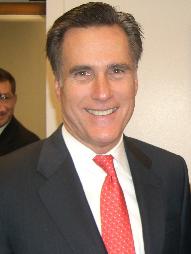 Biography
W. Mitt Romney will be 61 years old on the next Inauguration Day.
He is the son of a very political family; his father was the Governor of Michigan, was one of Richard Nixon's Secretaries for Housing and Urban Development, and ran for President in 1968 as a Republican. His mother unsuccessfully sought the Republican nominee for U.S. Senate from Massachusetts in 1970. He is a practicing member of the Church of Jesus Christ of the Latter-Day Saints, having served as a Bishop (leader of an individual church) and Stake President (leader of a local group of churches) and regularly attending temple. He has never served in the military; during the Vietnam era, he was in college and graduate school, as well as thirty months in France serving on a religious mission. While in France, he was injured in a serious automobile accident in which one person was killed (the fault was the other driver's). Upon returning to the U.S. in 1968, he married his high school sweetheart (a convert to Mormonism) and went to Brigham Young University, where he graduated summa cum laude in 1971, and went on to get a joint JD/MBA at Harvard, which he earned cum laude for law school and earned honors for being in the top 5% of his B-school class. He and his wife have five adult sons and eleven grandchildren; his sons support Gov. Romney's big for President by jointly writing a campaign blog, to which their parents sometimes contribute.
Unlike most of the candidates for President, Romney has never formally practiced law. Instead, he began his private career in a business consulting group in 1975. Three years later, he became vice-President of Bain & Company and later ran a spin-off of that company, Bain Capital, that specialized in leveraged buyouts of other entities. He grew very wealthy at Bain, and later returned to the parent company and steered it out of a financial crisis. His personal wealth has been estimated as high as a quarter of a billion dollars. He left Bain in 1998 to take over the distressed Salt Lake Olympics Committee, and takes credit for pulling the 2002 Winter Olympics out of a mire of debt and bribery into an enterprise that actually generated a profit of $100 million (note, though, that the "profit" figure ignores nearly $225 million for security costs donated or paid by other entities, mainly the Federal government, that SLOC did not pay back).
Political Experience
In 1994, Romney won the Republican nomination for Senate in Massachusetts (for the same seat his mother had run for and lost 24 years earlier), against Ted Kennedy. Kennedy won by a margin of 58-41. After the 2002 Olympics, became the Republican nominee for Governor of Massachusetts and despite claims by Democrats that he was a carpetbagger from Utah, Romney was handily elected. He resisted the high-profile decision of the Supreme Judicial Court of Massachusetts to issue marriage licenses to same-sex couples, but after that drama played out in favor of same-sex marriage, reluctantly complied with the ruling and instructed town clerks to issue the licenses -- but only to Massachusetts residents, saying that he did not want his state to become the "Las Vegas of gay marriage." Romney declined the opportunity to seek a second term as governor of Massachusetts and left office in early 2007 with a 43% approval rating.
On The Issues
Abortion: Rating: Quite famously switched from pro-choice to pro-life, some time between the middle of his term as Governor until before he ran for President. He claims to have switched opinions while researching cloning and stem cell researching; however, I had some difficulty finding evidence of pro-life statements he made before declaring his candidacy for President. Rating: 0 of 1 points.
Amending the Constitution: Has consistently opposed the idea of same-sex marriage and supports Constitutional amendment to that effect. Stops just short of endorsing human life amendment. Rating: 1 of 6 points.
Anti-Terrorism Policy: Proposes increasing size of military by 100,000 troops and pledges to spend at least 4% of the U.S. GDP on defense. In 2006, GDP was $13.13 trillion; in 2006, defense spending was $419.3 billion, meaning that currently, a little bit over 3.2% of GDP goes there now, so his target defense budget for 2009-10 would be about half a trillion dollars. Would liberally spend money on a "new Marshall Plan" to boost prestige and power of moderate Muslims around the world, and rededicate military forces in Muslim nations to nation-building and counter-insurgency measures under leadership of special forces. Rating: 4 of 7 points.
Balanced Budget: As Governor, Romney claims to have balanced the state's bloated budget without raising taxes through a combination of efficiency measures, spending restrictions, closing loopholes in the tax laws; however, a tax hike passed just before his administration kicked in after he took office, and he significantly raised "fees" like driver's license fees and tuition-like fees for state universities (he claims that the amount of raised fees was minute compared to the spending cuts), and the bulk of his spending cuts were in the form of grants to local governments, most of which responded by raising local taxes. Romney used his line-item veto power hundreds of times as Governor, but was overruled on virtually all of them, resulting in continuing actual operating deficits for Massachusetts' government. His anti-terrorism policies sound very expensive. Rating: 4 of 8 points.
Civil Liberties: Rating: Purchased a lifetime membership in the NRA just before running for President but still supports "assault weapons" ban; claims of rabbit hunting experience as a small boy as engendering sympathy for hunters turns out to be untrue; he's been hunting exactly twice in his life. Supports "Don't Ask, Don't Tell" policy regarding gays in the military. Reluctantly supported domestic partnerships as Governor of Massachusetts as an alternative to same-sex marriage imposed by state court decision, but now opposes them. Supports the PATRIOT Act. Would aggressively enforce obscenity laws and "get tough" on retailers who sell violent video games. Critical of news reporters who publish stories about national security issues. Rating: 0 of 9 points.
Education: Once supported abolishing Department of Education, but now a backer of No Child Left Behind Act. Endorses home schooling tax credit. Would encourage greater parental control of childrens' curricula. Rating: 2 of 5 points.
Environment: Rating: Supports oil drilling in Arctic National Wildlife Refuge; tax credits for oil companies that improve refinery capacity and efficiency. Praised Mayor of Salt Lake City for resisting environmental objections to mountainside display of electric light bulb Olympic Ring formation. Environment not mentioned on campaign website. 0 of 4 points.
Free Trade: Believes free trade is good economically for under-developed nations and the U.S.; supports NAFTA and CAFTA. Sees opportunities, not threats, in emerging Asian markets. Rating: 5 of 5 points.
Generalized Foreign Policy: Values allies in Muslim nations and democratic trading partners in the Americas. Distinguishes between "resolve" and "arrogance." Would "isolate" Iran diplomatically. Little discussion of policy towards European Union or Russia. Would appoint an "ambassador-at-large" whose portfolio would be described as "preventing nuclear terror." Rating: 3 of 6 points.
Health Care Reform: Initially supported states as experimental laboratories for different systems, but now proposes federalized improvements to system. Would indirectly "deregulate" health care insurers, by providing tax and grant incentives to states; increase Medicare block grants to states while decreasing directed funding and funding for "no pay" patients. Expand scope of HSA's and use high technology to make healthcare insurance funding and scope of coverage more transparent. Rating: 1 of 3 points.
Immigration Policy: Substantially critical of "sanctuary cities" but seems to have done little to restrict such local governments in Massachusetts. Supports ocean-to-ocean physical and technological fence on Mexican border; proposes enhanced employer verification system and withholding federal grants from "sanctuary" cities. Promises to veto amnesty legislation. Would increase student visas and streamline legal immigration for high-skill workers from abroad. Campaign website uses highly deceptive graph to incorrectly suggest recent spike in illegal immigration. Rating: 2 of 5 points.
Iraq: Correctly calls Iraq an "unmitigated mess" and is critical of pre-war planning. Supported troop surge, but envisions a transition period in which Iraqi military and police strengthen and U.S. troops provide logistical and intelligence support, and eventually withdraw to "standby" positions. Opposes withdrawal of troops. Rating: 6 of 6 points.
Korea: Skeptical of new agreement, suspicious that North Korea will "cheat." Policy otherwise sketchy. Rating: 3 of 5 points.
Middle East Peace Process: Approves of Israeli security fence. Subsumes Palestinian-Israeli peace process into struggle against "jihadism," with focus being on Iran and its proxies. Opposes, at the moment, the creation of a Palestinian state, but suggests that such a thing could be possible in the future. Rating: 2 of 4 points.
Science and Technology: As Governor, focused on infrastructure renewal, and directed substantial investment of funds in nanotechnology research. Campaign focus appears to be on elementary and high school education with little emphasis on collegiate and graduate work. Rating: 2 of 4 points.
Separation of Church and State: Previously disapproved of school prayer. Demonstrates ability to distinguish between teachings of his church and government policies. As America's first significant Mormon candidate for President, feels great pressure to continue to do so as well as promoting religious tolerance. As Governor, opposed teaching intelligent design in public schools. As Presidential candidate, castigated secularists for trying to exclude religion from the public square and promised those who bow their heads in praise of God that they would have a friend in President Romney; demonized atheists to curry favor with the religious right. Rating: 1 of 5 points.
Social Security Reform: Wants both parties to negotiate behind closed doors to reform system. Resulting reform should honor existing entitlement commitments, permit private accounts as alternatives, not raise taxes, and index increases in benefits to prices rather than wages. Rating: 1 of 5 points.
Taxes: Supply-sider. While Romney claims to have never raised taxes while Governor, state user "fees" for many services did increase dramatically, and his efforts to balance the state budget appear to have shifted spending liability and authority to more local governments, which then had little choice but to raise taxes. He pushed for and acheived a decrease in the state income tax, and decreased and eliminated other taxes to incentivize business growth. Rating: 4 of 5 points.
Tort Reform: Cap non-economic and punitive damage awards in medical malpractice cases. Rating: 0 of 3 points.
Torture of U.S. Prisoners: Supports "enhanced interrogation techniques" in circumstances where there is a ticking time bomb." Will not define "torture." Reserves to himself, as President, the ultimate judgment of the difference between the two, and does not consider himself accountable to anyone for exercising that discretion. Rating: 0 of 4 points.
Overall Impression: Romney's defining characteristic appears to be the plasticity of his belief system. On abortion, guns, gay rights, and who knows what other hot-button issues, he's reversed himself with remarkable ease. Put favorably, this means he's willing to learn and grow and respond to new information; but it's substantially more likely that he's simply saying whatever he thinks he needs to say in order to get elected, which calls his honesty into serious question. In terms of real core attributes, his positives include a very substantial business background and as with Giuliani, the promise of a genuinely competent executive running the government although the manner in which he turned around Massachusetts and the Olympics both seem to have involved shifting costs to others rather than eliminating them altogether. However, I am surprised to find myself so pleased by his attitudes towards separation of church and state, which seems to be one of the few beliefs that he has which are both persistent throughout his career and in congruity with my way of thinking on the issue. No matter what his rating on this or any other issue, though, it's difficult for me to see how anyone can trust this man. He's changed his mind on so many issues just before he launched his bid for President that no one, of any political stripe, can have any real idea of what Slick Mitt would actually do if he's in office.
Total score: 41 of 100.
Up next: Hillary Rodham Clinton.
Good News Monday
Good news on the international front brought to you today by the BBC.
First, it appears that our evaluation (meaning that of the United States) of the threat of a nuclear Iran has been ratcheted down from "high alert" to merely "on guard." That's about where the anxiety level should be for detente and containment, which seem to be the only strategies that are both realistic and effective for dealing with Iran. Holy crap do we not want to go to war with Iran. Not that we wouldn't win on the battlefield, but turning all of central Asia into an anarchy and nearly every Muslim in the world into an America-hater (as opposed to only a significant fraction of them, as we've done now) would be decidedly not in our best mid- or long-term interests. And for the future, proceed with all due care, Madam President!
Second, by a very narrow margin, Venezuelans have chosen democracy. A few days ago, I wrote about Hugo Chavez's bid to be able to run for President indefinitely and otherwise make himself the effective dictator of that country. By a margin of 49%-51%, votes chose "No" over "Si" to that proposed Constitutional change; Chavez himself seems to have accepted that defeat at the polls. He may try again in the future, but for now, he's still looking at term limits in a year or two. (Good riddance.)
Finally, Sudan's President has agreed to allow the teacher who let her schoolchildren name their teddy bear "Mohammed" go back to the UK with a pardon, and indeed a pardon given while her head was still attached to her neck, so the pardon will actually do her some good. Apparently some Muslim members of the House of Lords appealed to the "President" of Sudan and persuaded him that things would be better this way. No doubt they were right.
So, there you have it. Sometimes, good things do happen in the world.
First, it appears that our evaluation (meaning that of the United States) of the threat of a nuclear Iran has been ratcheted down from "high alert" to merely "on guard." That's about where the anxiety level should be for detente and containment, which seem to be the only strategies that are both realistic and effective for dealing with Iran. Holy crap do we not want to go to war with Iran. Not that we wouldn't win on the battlefield, but turning all of central Asia into an anarchy and nearly every Muslim in the world into an America-hater (as opposed to only a significant fraction of them, as we've done now) would be decidedly not in our best mid- or long-term interests. And for the future, proceed with all due care, Madam President!
Second, by a very narrow margin, Venezuelans have chosen democracy. A few days ago, I wrote about Hugo Chavez's bid to be able to run for President indefinitely and otherwise make himself the effective dictator of that country. By a margin of 49%-51%, votes chose "No" over "Si" to that proposed Constitutional change; Chavez himself seems to have accepted that defeat at the polls. He may try again in the future, but for now, he's still looking at term limits in a year or two. (Good riddance.)
Finally, Sudan's President has agreed to allow the teacher who let her schoolchildren name their teddy bear "Mohammed" go back to the UK with a pardon, and indeed a pardon given while her head was still attached to her neck, so the pardon will actually do her some good. Apparently some Muslim members of the House of Lords appealed to the "President" of Sudan and persuaded him that things would be better this way. No doubt they were right.
So, there you have it. Sometimes, good things do happen in the world.
Labels:
Crime and Punishment,
International Politics,
Iran,
Religion,
Venezuela
December 1, 2007
Movie Review: The Golden Compass
 The Wife and I went to a sneak preview screening of The Golden Compass tonight.
I left the movie feeling unsatisfied, although I can't precisely explain why. Part of it surely was all of the religious controversy surrounding the movie, with the Catholic League and some other Christian groups condemning the film (without having seen it) as promoting atheism. I suppose I was sort of hoping for a crypto-atheist manifesto to be evident from the film, and that is the source of my unease. I've no reason to have been disappointed.
There was nothing pro-atheist in the movie at all.
There was plenty of disestablishmentarianism and anti-authoritarianism, but nothing at all about religion. You'd have to read between the lines, and pretty closely, to see an anti-religious agenda here. If you don't approach the movie specifically looking for an attack on religion, you won't find one here. (Of course, if that chip is already on your shoulder, that's a different matter entirely.)
The heavies in the film, called the "Magisterium," who claim to be the representatives of the "Authority," are just that -- Authority, pure and simple; Authority as archetype. The officers of the Magisterium wear distinctive vestments, which I suppose might be considered vaguely clerical in nature, but it was all about authority and power. But their minions wear what look like military uniforms, not vestments.
If you wanted to look for religion in this movie, I suppose you could find it, but if that's how the movie is working, it's at a very deep and subtle level. And it's not as if the filmmakers weren't capable of using the medium for allegory, either; they did so on occasion in a fairly heavy-handed way. The script is not a model of elegance or subtlety, although it does get the job done.
Visually, it's a tour de force of what CGI animation can do with skillful artists involved at all phases of production. I've never seen better CGI, particularly with all of the animals. One of the premises of the movie is that it is set in an alternative world where a person's soul is manifestly real -- because it takes the form of an animal companion called a "daemon." Daniel Craig's daemon is a leopard; Nicole Kidman's is a monkey. The young heroine has a daemon, too -- but before puberty, the shape of that daemon can change at a moment's notice. This was one of the more interesting allegories there -- children are malleable, changeable, and their true personalities and forms have not yet been set; thus, in this world, their daemons can change, too.
Because pretty much everybody has an animal daemon, who is the external reality of their soul, the daemon projects what's going on inside the person's mind, or more particularly their emotional state. So, the filmmakers accomplish this by digitally manipulating the animal working with the actor, so that the animal's face and activities represent the emotion the character is feeling. When the person is threatened, the daemon becomes aggressive; when the person is scared, the daemon tries to hide.
Dialogue between the person and the daemon also provides for a convenience of exposition. This is done somewhat clunkily once or twice, but it's useful early on in the film to explain how this alternative world works. I suppose if I had read the books that the film was based on, I wouldn't have needed the exposition at all, but having not read them, I often felt like there was more going on in that world than I really understood. In a way that was good, but it also kept me off my balance for much of the movie.
And it is a beautiful world indeed. The architecture of the buildings combines Gothic, Rococo, and Art Deco elements seamlessly. Nicole Kidman is stunning -- she looks like she walked straight out of Sam Spade's office in 1947. She also shows her chops as an actor (except, I thought, for the last scene in which she had significant dialogue) and is silky-smooth when she tries to seduce another character. Daniel Craig is underused, both for his rugged good looks and his newfound star quality (he is James Bond, after all).
 The gorgeous mattes incorporate elements of the London of our world (like St. Pauls' Cathedral and the now-famous Swiss Re "Gherkin" Tower) with the fantastic Art Deco world of this alternative, magical reality in which people travel in airships and paddlewheel-powered ocean liners, and rifles and longbows happily coexist in the hands of soldiers who rightly fear the warrior "Ice Bears." Real places like Svalbard, Norway and recognizable maps of Europe add an eerie verisimlitude to the obviously fantastical world that blends magic and technology with casual ease.
Pleasant surprises in the casting include Derek Jacobi and Christopher Lee. I knew Sam Elliot was in the movie, and his presence alone makes a Norwegian hunting outpost on a remote, glacial island north of Norway feel like an old West movie set in the foothills of the Wyoming Rockies. Kathy Bates and Ian McKellan do easily recognizable voice-over work. The score is orchestral and epic in its scope. Much of the movie takes place in snow-bound settings, which dovetailed into the cold weather we've been experiencing in real life.
The ice bear fight was awesome, the most exciting part of the movie for me. Yes, it's all computer graphics, but so what? They looked like bears fighting, not like people in bear suits fighting. And it was an intense fight.
The movie is not for people who are lovers of unambiguous portrayals of moral issues. The hero of the film is, to say the least, veracity-deficient. This turns out to be an asset in a difficult situation, which leaves you questioning the value of truth. You are also asked to decide whether things like truthfulness, even if good, are more important than other good sorts of attributes like loyalty and courage.
So too will you question the value of conformity to order and law, particularly when you are asked to do something obviously painful "for your own good." There is little doubt that the government of this world is evil, but the true reach of its evil power is far from clear.
Finally, you are also asked to question the motives of someone you think is a bad guy, and that issue remains unresolved at the end of the movie -- and that, in turn, makes me, at least, question the motives of someone who is apparently supposed to be a good guy, too. But that kind of ambiguity is of great interest to me and I liked that. Their motivations are not yet fully clear or their moral status resolved by the end of the movie, but there are two more movies to make in this series.
Then, too, there is a discussion of what a Christian might call "original sin," and there is a cryptic substance called "Dust" which is the subject of a great social conspiracy of silence and discussion of which is assigned great moral weight. Both of these, I suspect, will ultimately be found to relate to sex, and attaining a sexual identity seems to conform with having one's daemon "settle" or achieve a permanent form. But, at least in this world, these matters also seem to have been substantially politicized, such that discussion of the subject is a threat to the government as well. Presumably in later films, we will learn more about this subject; for now, it is all quite mysterious.
Overall, I did enjoy the movie; it took me to another world for nearly two hours and provided good entertainment for the price of two regular tickets. Fan enthusiasm was evident; people cheered for the title credits and applauded at the Fellowship Of The Ring-like end of the movie. Hopefully, it won't be too long before the next film, which will probably be called The Subtle Knife, is issued. For the rest of you, the movie's general release date is December 7, next Friday. Go see it, and don't go looking for religion or atheism; disabuse yourself of the idea that this movie has any such agenda one way or the other (even if you think the book it is based on did have such an agenda). Just go see the movie as an escapist fantasy, and I bet you'll enjoy it just fine.
Labels:
Movies
Country Music Is Too Damned Wholesome
While at the hardware store today, I couldn't hear what The Wife was saying to me because the people who run the store were playing the local country music station really loudly. And the lyrics were all so... nice! Not "nice" in the sense of "pleasant" or "enjoyable;" most of the rhymes were at or below the level of Sting ("Giant steps are what you take / Walking on the moon / I hope my legs don't break / Walking on the moon") at his least imaginative. No, I mean "nice" in terms of having been written with an eye towards offending no one at all about anything, and thereby reducing the content of the song to a pablum.
One stood out as particularly saccharine: a song about a young boy who liked his dad so he wanted to eat all his food so he could grow up to wear a cowboy hat and camouflage pants. The musical arrangement had successfully taken any hint of an edge off the song; it was all slickly-produced fiddles and twangy harmonies. I guess I understand why some people would want to not hear about death and sadness and broken families all the time. Still, this is not my style, and I'm not just talking about the fiddle and the slide guitar. This was so sweet it damn near put me in diabetic shock.
One stood out as particularly saccharine: a song about a young boy who liked his dad so he wanted to eat all his food so he could grow up to wear a cowboy hat and camouflage pants. The musical arrangement had successfully taken any hint of an edge off the song; it was all slickly-produced fiddles and twangy harmonies. I guess I understand why some people would want to not hear about death and sadness and broken families all the time. Still, this is not my style, and I'm not just talking about the fiddle and the slide guitar. This was so sweet it damn near put me in diabetic shock.
Labels:
Music
Subscribe to:
Posts (Atom)

 Posts
Posts