Today, I got a small case settled. It wasn't a big injury nor a big deal, and a very small amount of money is changing hands. I'm not getting a fee, and the bulk of the money is going to resolve the clients' medical bills. My clients are simple people, without much education, and they are trying hard to get by in a tough world. But when I told them that their case was resolved and their medical bills would be paid and there would be a little bit of money left over for them, they were so grateful. It was astonishing to me. How could such a small case cause so much gratitude?
Then I remembered what I preach to younger lawyers and law clerks -- every case is big to the people involved. This was the biggest case that these people will ever be involved in, Gods willing, and it makes a difference to them. They put their trust in me and when I brought them back something, it validated that trust. They think I fulfilled my promise to them.
Even if I think it was a small-stakes case, perhaps I've spent so much time thinking about my own economic needs, the pressures on me to settle cases and bring home big fees, and high-brow legal theories to try and wrestle with opposing parties that I'd kind of lost sight of a few basic facts. For a lot of hard-working people, one thousand dollars is a lot of money that will make a real impact on their lives. For a lot of my clients, the legal system is a mysterious, alien world full of powerful people in suits throwing around language they don't understand. When their advocate in that world tells them they're getting something out of the system, their faith in that system is renewed. And that renews my faith in the system, too.
So yes, it's a small settlement, I believe it's the smallest settlement that I've been a part of for eight years. But I'm as happy with it as I would be if it were ten or fifty times as much, all because my client really appreciated what I did. I can, and frequently do, beat my head against the wall for million-dollar claims. But when a client is falling all over herself to express her pleasure at what may be a thousand-dollar net return for her, it forcefully reminds me that the legal system is about people, about resolving disputes, and making my clients' lives better.
My clients think they won today -- so that means that they did win today. That, in turn, means that I won today. And that's why I do what I do for a living.
January 26, 2006
January 25, 2006
Shift_Employers
Yesterday was surreal enough. Today I got to work on withdrawal arrangements for all my cases. Those amongst the Loyal Readership who are not attorneys may not be aware that I cannot simply quit a case; I need the court's permission. Since The Great Man is not going to be paying my salary anymore after Tuesday, I will not be paid for fulfilling my responsibilities to my clients. So if I do not file motions requesting the court's permission to be relieved of my duties as counsel for these people, I will continue to be their attorney, responsible for representing their interests, even though no one is paying me to do so. So that's what the motions are all about. There are financial interests to be divvied up with HBL, letters to be written to nearly 200 people, and a lot of other work involved. All this so The Great Man can hire a lawyer who will accept half my salary to do my job.
I've been pursuing every employment lead I can find. It seems like there is some demand for an attorney of my experience and background in Nashville. Nissan of North America is looking for a California-licensed attorney to assist with transferring operations from Gardena to Tennessee and for Sarbanes-Oxley compliance. I already know how to do the former and I can hopefully get a few pointers on the latter from a good friend back in California. (If you are a CPA-JD working at a Big Four firm who was in my wedding party, I'm talking about you.) There are several CA-TN attorneys out there, but the population is somewhat narrow and I expect that whatever attorneys from Nissan's former headquarters in Gardena are going to transfer out here and try to waive in to the bar. Not all of them will make it thanks to some wrinkles in the Tennessee admissions policies. So hopefully, I've got a leg up on my competition there.
If I seem a little bitter it's because it's been a rough day on the emotional front. Many of these clients and cases are ones that I find myself loath to part with, not for the money but because I've come to care about the people and about the cases. And then there's the personal impact: I haven't been exactly happy in my soon-to-be-former employment situation, but it's the only situation I'd been able to find for myself. A job which one dislikes but which pays is better than no job at all. The prospect of returning to effective unemployment is very scary. Waiting for responses from potential employers is tough. Following up with phone calls and e-mails is apparently part of the game now, and I'm not sure about the protocol for how long one should wait.
Nashville would be kind of cool. Not that far to move; we'd still have to sell La Casita Knoxvilla and find a suitable residence in Middle Tennessee, but the logistics involved in that would be relatively easy to handle. And maybe people struggle a little bit less in a more cosmopolitan city like Nashville. Every time I've been there so far I've come away pleased. So we'll see. All I can do now is try as hard as I can and hope for the best.
I've been pursuing every employment lead I can find. It seems like there is some demand for an attorney of my experience and background in Nashville. Nissan of North America is looking for a California-licensed attorney to assist with transferring operations from Gardena to Tennessee and for Sarbanes-Oxley compliance. I already know how to do the former and I can hopefully get a few pointers on the latter from a good friend back in California. (If you are a CPA-JD working at a Big Four firm who was in my wedding party, I'm talking about you.) There are several CA-TN attorneys out there, but the population is somewhat narrow and I expect that whatever attorneys from Nissan's former headquarters in Gardena are going to transfer out here and try to waive in to the bar. Not all of them will make it thanks to some wrinkles in the Tennessee admissions policies. So hopefully, I've got a leg up on my competition there.
If I seem a little bitter it's because it's been a rough day on the emotional front. Many of these clients and cases are ones that I find myself loath to part with, not for the money but because I've come to care about the people and about the cases. And then there's the personal impact: I haven't been exactly happy in my soon-to-be-former employment situation, but it's the only situation I'd been able to find for myself. A job which one dislikes but which pays is better than no job at all. The prospect of returning to effective unemployment is very scary. Waiting for responses from potential employers is tough. Following up with phone calls and e-mails is apparently part of the game now, and I'm not sure about the protocol for how long one should wait.
Nashville would be kind of cool. Not that far to move; we'd still have to sell La Casita Knoxvilla and find a suitable residence in Middle Tennessee, but the logistics involved in that would be relatively easy to handle. And maybe people struggle a little bit less in a more cosmopolitan city like Nashville. Every time I've been there so far I've come away pleased. So we'll see. All I can do now is try as hard as I can and hope for the best.


January 24, 2006
Meeting My Replacement
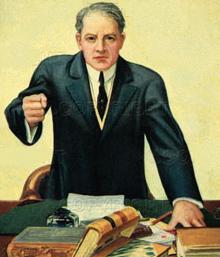 Today, I got to meet a young lawyer who it appears will replace me at the Law Office of the Great Man. A surreal experience. He's about ten years younger than me, a nice enough guy, eager to work and desparate to get his career started. The poor dude's been doing a menial, non-legal job and living at his parent's house in order to survive for nearly a year while he's been looking for a job. He's got a good resume for an attorney of his vintage; he went to Rutgers Law School which sounds pretty good in my book. Problem is, in Knoxville there is a definite hierarchy of law schools which one can attent, in order of preference:
1. The University of Tennessee
2. Vanderbilt University
3. Memphis University
4. Nashville School of Law
5. Anywhere else (including Harvard or Yale)
As a fellow alumnus of Law School #5, I have a lot of sympathy for him. Actually, I have sympathy for him in a lot of ways. I tried to talk straight with him, within the boundaries of professionalism. He deserves to know what he's getting in to, although he got more than enough face time with The Great Man today to have a pretty clear picture of that as well.
But, by this time next week it appears I will be unemployed. As this guy's experience demonstrates, jobs are hard to come by in Knoxville. I'm wondering very seriously how much of a loss The Wife and I are going to have to take on La Casita Knoxvilla should we have to sell it after next month.
Auto Parts
 The right-hand rear turn signal went out on the Saturn. So after work, The Wife and I drove to the nearest auto parts store, which was the Napa store in Fountain City, on the corner of Broadway and Essary (next to Litton's, the most overrated hamburger place on Earth).
 Upon arriving at the store at 6:20 p.m., we found it closed. To the right is a picture of the posted hours of operation of this auto parts store. Who, exactly, are their customers? Stay-at-home housewives? Don't they think that people work for a living from eight to six? Do they expect that everyone will be able to get out of work and run to the auto parts store, or get into the store precisely when it opens, buy their part in two minutes, and drive off to work?
Fortunately, Napa's competitor, AutoTrak, was open just down the street until 10:00 p.m. and able to provide us with service. But I'm beginning to think that the intersection of Broadway and Essary is the very epicenter of struggling, beginning with the design of the intersection, including the ick-burgers at Littons, the three untimed signal lights in a 100' distance, the limited hours of service at the auto parts store, the gas-station-that-is-not-a-casino, and concluding with the people who fish in Fountain City Park's fountain-fed goose pond.
All They Wanted Was A Warrant
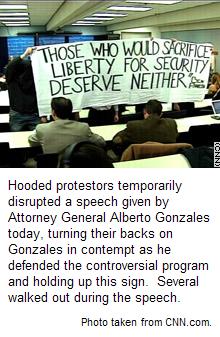 Both the President and the Attorney General have protested that Congressional leaders were kept informed of the domestic surveillance program, and that it was periodically reviewed within the White House for compliance with civil liberties. I doubt the latter portion is true, given the causal attitude that the Bush Administration has evidenced towards civil liberties in other contexts in the post 9/11 world. And Congressional leaders seem to suggest that they were not informed of the plan, and at any rate, "keeping them advised" is not the same thing as "earning their approval."
Simply put, it's not too much to ask that the government get a warrant to monitor communications. Contrary to claims from the White House, it is not cumbersome to get a warrant three days after the fact of surveillance. I just don't understand how it could be cumbersome, and apparently no one can be told that without learning confidential information. So we just have to take their word for it that they're not monitoring our phone calls or e-mails.
I've discussed world events with my cousins in Italy via e-mail. I wonder, were my e-mails read? Surely the NSA algorithms are trained to look for communications in a multiplicity of languages and if Google and Altavista can automatically translate Italian, it's a safe bet the NSA is a few steps ahead of them and can readily comprehend my poor attempts at communicating in that language -- and my cousins write back in English, too.
January 23, 2006
Idealism and Argument
There was very little in the white paper that surprised me. Congress authorized the President to use military force to hunt down al Qaeda, and gathering intelligence is inherently part of using military force. Referring to Quirin v. United States, the paper convincingly argues that if al Qaeda is acting within the borders of the United States, the President may use military and military-related assets to respond to them, and I don't think many sane people would disagree with that. But this begs the question of why the President and his minions did not seek warrants for doing so, particularly given the flexible and secret mechanism provided by FISA. The response is, "They didn't have to, after all, we do warrantless searches of people we don't even suspect of crimes all the time":
You can see where Gonzalez is going with this with respect to the government's desire to collect information regarding communications with suspected terrorists.
I have two reactions to this -- first of all, holy crap, that's a lot of different searches that police can undertake without warrants and even without suspicion. I'm not sure that I agree with all of those precedents, either. Sitz authorizes a suspicionless drunk-driving stop; Martinez-Fuente authorizes a suspicionless search for illegal aliens. Both were found to be "distinguishable from ordinary general crime control." No reason at all to believe that any particular person is committing a crime, and no warrant yet the searches are allowed noentheless.
Now, it does seem to me that the level of intrusion involved in these searches are minimal, especially when compared with the highly intrusive nature of a wiretap. The white paper earlier concedes that the reasonability of a search is determined by balancing the government's need for the information against the intrusiveness of the means of obtaining that information. Asking someone to stop and speak to a police officer, while not even getting out of the car, is a good deal different than being asked to get out of the car and perform a field sobriety test. A wiretap is about as intrusive upon one's reasonable expectation of privacy as one can reasonably get.
Second, if we accept the government's claims at face value (which I have so far) that the only communications being monitored are those between a U.S. citizen and a suspected al Qaeda member, then isn't there already a suspicion of criminal activity going on? Yes, I realize the argument that terrorism is better considered as a military problem than a criminal one, but we haven't got the Constitutional system in place to relegate everything to a military decision-making regine. So if we're really talking about people having conversations with serious bad guys, then why aren't there warrants being requested and issued? As I've pointed out before (and as lots of people also have pointed out before me) it's no great burden to get the warrant since the government can start wiretapping today and get the warrant three days from now. If the NSA finds out that Johnny is talking to Abdul, and Johnny is a suspected al-Qaeda member, then that seems to be to be enough reasonable suspicion -- probable cause, even, depending on how strong the intelligence is on Johnny -- to justify the issuance of a warrant.
The white paper nowhere argues that the government could not have practicably obtained these warrants. It argues instead that there was no Constitutional obligation to have done so, and the authorization of the use of military force against al Qaeda relieved whatever obligations might otherwise have been in place to seek a FISA warrant.
This can't be right. If it is, then Congress wrote the President a "blank check" when it authorized the use of force. The Supreme Court has specifically said that was not the case, even when giving a very deferential reading of Congress' actions and the powers delegated to the President thereunder. Hamidi v. Rumsfeld, 542 U.S. 507, 526 (plurality opinion by Justice O'Connor). This reading of the delegation of power to the President is overbroad and overreaching; Congress wanted the President to take out the bad guys in short order and he did his best to comply. Congress did not abdicate its role as a co-equal branch of the government, nor did it attempt to strip the courts of their power as a co-equal branch of the government, nor did Congress agree to a proclamation of martial law. Although the President has been authorized to use military force to go after our enemies, there are still limits to his power and I am convinced now that he has acted in excesss of them and to the detriment of the civil rights of American citizens.
The Wife thinks I'm being overly idealistic about all of this. Good. I'm glad to find I still have some idealism left in me after spending half my lifetime involved in issues of politics, policy, and law. I'm glad to discover that I still care about what's good about America, that I'm unwilling to sacrifice being an American just because some religious nut out there wants to blow us up. We can blow him up first and not stop being Americans in the process. That's what I want the President to do. If that means gathering intelligence from U.S. citizens, then the least he can do is get a warrant a few days after the fact. That's simply not too much to ask.
...the Supreme Court repeatedly has made clear that in situations involving "special needs" that go beyond a routine interest in law enforcement, the warrant requirement is inapplicable. See Vernonia, 515 U.S. at 653 (there are circumstances "‘when special needs, beyond the normal need for law enforcement, make the warrant and probable-cause requirement impracticable’") (quoting Griffin v. Wisconsin, 483 U.S. 868, 873 (1987)); see also McArthur, 531 U.S. at 330 ("When faced with special law enforcement needs, diminished expectations of privacy, minimal intrusions, or the like, the Court has found that certain general, or individual, circumstances may render a warrantless search or seizure reasonable."). ... one application in which the Court has found the warrant requirement inapplicable is in circumstances in which the Government faces an increased need to be able to react swiftly and flexibly, or when there are at stake interests in public safety beyond the interests in ordinary law enforcement. One important factor in establishing "special needs" is whether the Government is responding to an emergency that goes beyond the need for general crime control. See In re Sealed Case, 310 F.3d at 745-46.
Thus, the Court has permitted warrantless searches of property of students in public schools, see New Jersey v. T.L.O., 469 U.S. 325, 340 (1985) (noting that warrant requirement would "unduly interfere with the maintenance of the swift and informal disciplinary procedures needed in the schools"), to screen athletes and students involved in extracurricular activities at public schools for drug use, see Vernonia, 515 U.S. at 654-55; Earls, 536 U.S. at 829-38, to conduct drug testing of railroad personnel involved in train accidents, see Skinner v. Railway Labor Executives’ Ass’n, 489 U.S. 602, 634 (1989), and to search probationers’ homes, see Griffin, 483 U.S. 868. Many special needs doctrine and related cases have upheld suspicionless searches or seizures. See, e.g., Illinois v. Lidster, 540 U.S. 419, 427(2004) (implicitly relying on special needs doctrine to uphold use of automobile checkpoint to obtain information about recent hit-and-run accident); Earls, 536 U.S. at 829-38 (suspicionless drug testing of public school students involved in extracurricular activities); Michigan Dep’t of State Police v. Sitz, 496 U.S. 444, 449-55 (1990) (road block to check all motorists for signs of drunken driving); United States v. Martinez-Fuerte, 428 U.S. 543 (1976) (road block near the border to check vehicles for illegal immigrants); cf. In re Sealed Case, 310 F.3d at 745-46 (noting that suspicionless searches and seizures in one sense are a greater encroachment on privacy than electronic surveillance under FISA because they are not based on any particular suspicion, but "[o]n the other hand, wiretapping is a good deal more intrusive than an automobile stop accompanied by questioning"). To fall within the "special needs" exception to the warrant requirement, the purpose of the search must be distinguishable from ordinary general crime control. See, e.g., Ferguson v. Charleston, 532 U.S. 67 (2001); City of Indianapolis v. Edmond, 531 U.S. 32, 41 (2000).
You can see where Gonzalez is going with this with respect to the government's desire to collect information regarding communications with suspected terrorists.
I have two reactions to this -- first of all, holy crap, that's a lot of different searches that police can undertake without warrants and even without suspicion. I'm not sure that I agree with all of those precedents, either. Sitz authorizes a suspicionless drunk-driving stop; Martinez-Fuente authorizes a suspicionless search for illegal aliens. Both were found to be "distinguishable from ordinary general crime control." No reason at all to believe that any particular person is committing a crime, and no warrant yet the searches are allowed noentheless.
Now, it does seem to me that the level of intrusion involved in these searches are minimal, especially when compared with the highly intrusive nature of a wiretap. The white paper earlier concedes that the reasonability of a search is determined by balancing the government's need for the information against the intrusiveness of the means of obtaining that information. Asking someone to stop and speak to a police officer, while not even getting out of the car, is a good deal different than being asked to get out of the car and perform a field sobriety test. A wiretap is about as intrusive upon one's reasonable expectation of privacy as one can reasonably get.
Second, if we accept the government's claims at face value (which I have so far) that the only communications being monitored are those between a U.S. citizen and a suspected al Qaeda member, then isn't there already a suspicion of criminal activity going on? Yes, I realize the argument that terrorism is better considered as a military problem than a criminal one, but we haven't got the Constitutional system in place to relegate everything to a military decision-making regine. So if we're really talking about people having conversations with serious bad guys, then why aren't there warrants being requested and issued? As I've pointed out before (and as lots of people also have pointed out before me) it's no great burden to get the warrant since the government can start wiretapping today and get the warrant three days from now. If the NSA finds out that Johnny is talking to Abdul, and Johnny is a suspected al-Qaeda member, then that seems to be to be enough reasonable suspicion -- probable cause, even, depending on how strong the intelligence is on Johnny -- to justify the issuance of a warrant.
The white paper nowhere argues that the government could not have practicably obtained these warrants. It argues instead that there was no Constitutional obligation to have done so, and the authorization of the use of military force against al Qaeda relieved whatever obligations might otherwise have been in place to seek a FISA warrant.
This can't be right. If it is, then Congress wrote the President a "blank check" when it authorized the use of force. The Supreme Court has specifically said that was not the case, even when giving a very deferential reading of Congress' actions and the powers delegated to the President thereunder. Hamidi v. Rumsfeld, 542 U.S. 507, 526 (plurality opinion by Justice O'Connor). This reading of the delegation of power to the President is overbroad and overreaching; Congress wanted the President to take out the bad guys in short order and he did his best to comply. Congress did not abdicate its role as a co-equal branch of the government, nor did it attempt to strip the courts of their power as a co-equal branch of the government, nor did Congress agree to a proclamation of martial law. Although the President has been authorized to use military force to go after our enemies, there are still limits to his power and I am convinced now that he has acted in excesss of them and to the detriment of the civil rights of American citizens.
The Wife thinks I'm being overly idealistic about all of this. Good. I'm glad to find I still have some idealism left in me after spending half my lifetime involved in issues of politics, policy, and law. I'm glad to discover that I still care about what's good about America, that I'm unwilling to sacrifice being an American just because some religious nut out there wants to blow us up. We can blow him up first and not stop being Americans in the process. That's what I want the President to do. If that means gathering intelligence from U.S. citizens, then the least he can do is get a warrant a few days after the fact. That's simply not too much to ask.
Exploding The Myths
Take this portrait of a young lawyer as a lesson -- lawyers do not all lead glamorous lives, wear thousand-dollar suits, have encyclopedic knowledge of the law and everything else, and drive Mercedes-Benzes. The article describes a guy on the low end of the bell curve, to be sure, but it's part of the picture of what lawyers really are. I admire him -- he may not be the smartest lawyer around, and maybe he could have made more money inspecting asphalt for the state. But he's doing what he wants to do, putting in the time and doing the hard work it takes to learn the profession. He needs to learn what he can from working at the PD's office and get out before he gets burned out, though.
It makes me ask if I'm burned out (no, I'm just weary of a difficult job market) and if I've learned what I need to know in order to practice my profession (yes, but there's always more to learn) and whether there are alternatives for me like this guy could have had inspecting asphalt (I'm sure there are but I haven't a clue what they are yet). Anyway, I've got seven work days left here at the Law Offices of the Great Man and I need to fill that time with something useful and productive for my clients instead of feeling sorry for myself.
It makes me ask if I'm burned out (no, I'm just weary of a difficult job market) and if I've learned what I need to know in order to practice my profession (yes, but there's always more to learn) and whether there are alternatives for me like this guy could have had inspecting asphalt (I'm sure there are but I haven't a clue what they are yet). Anyway, I've got seven work days left here at the Law Offices of the Great Man and I need to fill that time with something useful and productive for my clients instead of feeling sorry for myself.
NBC Goes Back To The Well
"It'll be like Friends meets Friends, after Joey, starring all the same people with all the same characters!" As if we needed more proof that there are no new ideas in Hollywood. And you and I are going to watch it anyway.
UPDATE: Apparently the above-reported rumors are not true, according to different rumors.
UPDATE: Apparently the above-reported rumors are not true, according to different rumors.
January 22, 2006
If You're Right Half The Time, Just Be A Fan
Well, I predicted that Denver would squeak by Pittsburgh; that didn't happen as the Steelers dominated this afternoon. As I write, Seattle has gone up 34-7 over Carolina, fulfilling the other half of my prophecy. The Seahawks are amazingly dominant over the hapless Panthers; the Steelers were similarly dominant over the Broncos. So that makes things hard to predict. I had predicted a close set of conference championships, but both turned out to be one-sided. I'm batting about .500 for playoff picks; at least I'm not doing worse than chance. But there's no point in making picks unless you stick your neck out -- and I'll do so now for the Seattle Seahawks, who seem to be firing on all cylinders and put together a more complete package.
I'm going to have to start paying more attention to college basketball. The UT women's team is undefeated, ranked first in the nation, and about to play #2 Duke. But excellence is the norm for the Lady Vols. The UT men's team is getting more press because the men have so dramatically exceeded expectations with a brand-new coach, including Friday's defeat of #2 Florida. Not bad after just barely losing to #4 Memphis earlier last week.
And next month the Winter Olympics start. I admit to enjoying the Olympics in spite of the corruption, the bothersome tape delay presentation on TV, and the overt attempts to appeal to female viewers -- nothing wrong with attracting female viewers, but many male sports fans are turned off by it. Get over it; these are sports we don't usually watch and that makes them fun and unusual. So it's a good time to be a sports fan.
But my pick'em record isn't good enough to make it a good idea for me to lay down money.
Update: On Monday morning, I learned that Pittsburgh is a 3-and-a-half point favorite to win. I'm sticking with my pick of Seattle, though; and I'm not too proud to take the points.
I'm going to have to start paying more attention to college basketball. The UT women's team is undefeated, ranked first in the nation, and about to play #2 Duke. But excellence is the norm for the Lady Vols. The UT men's team is getting more press because the men have so dramatically exceeded expectations with a brand-new coach, including Friday's defeat of #2 Florida. Not bad after just barely losing to #4 Memphis earlier last week.
And next month the Winter Olympics start. I admit to enjoying the Olympics in spite of the corruption, the bothersome tape delay presentation on TV, and the overt attempts to appeal to female viewers -- nothing wrong with attracting female viewers, but many male sports fans are turned off by it. Get over it; these are sports we don't usually watch and that makes them fun and unusual. So it's a good time to be a sports fan.
But my pick'em record isn't good enough to make it a good idea for me to lay down money.
Update: On Monday morning, I learned that Pittsburgh is a 3-and-a-half point favorite to win. I'm sticking with my pick of Seattle, though; and I'm not too proud to take the points.
January 21, 2006
You'd Rather Not Get a Dog Kiss...
...when you've just had to pull the dog out from sticking her face in the kitty litter box. Doesn't matter how cute the dog is.
Yuck.
Yuck.
Tennessee Struggles
 Back in Los Angeles, I enjoyed listening to Kevin and Bean on KROQ. It was there that I first learned the phrase “struggle.” When used in the present (or near-past) tense, to describe the behavior of a person, the word means “to have difficulty completing a seemingly simple or easy task.”
 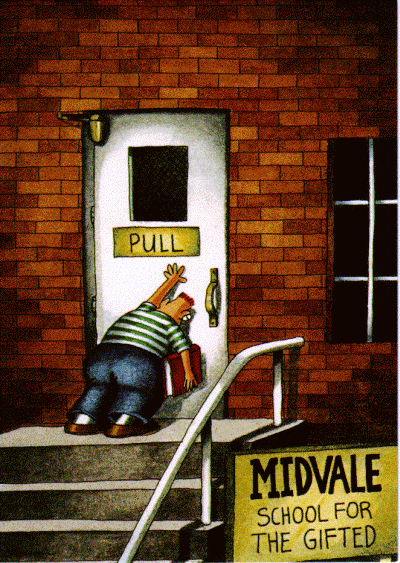 Trying to twist open that container of mayonnaise and failing, and then trying again, exerting all of your upper-body strength and again failing, and then running the lid under hot water, carefully drying off the lid, using a plastic grip tool and once again using all your might to turn the top of that lid, failing yet again, and then realizing it’s a flip-top squeeze bottle – that’s “struggling.”
Now, people all struggle from time to time, everywhere you go. Ask someone for “half a dozen” of something (other than donuts) and observe that blank look wash over their faces, that same uncomprehending look reminiscent of cows watching trains pass by the pasture, and you’ll see what I mean. But Tennesseans seem to struggle more than most people in most places I’ve been in. Still, the S.Q. (Struggler Quotient) is much higher here than pretty much any place I’ve ever been.
Some examples:
• The Wife recently had to wait in traffic for a woman to balance her checkbook during rush hour.
• The woman ahead of me at the Wal-Mart quick check-out lane who takes out her checkbook to buy a pack of cigarettes and has to ask whether they will take a check that is printed instead of handwritten. (Um, yes, I think they will.)
• Ask a Tennessean for directions to place “X.” You will be told “Y’all just go down to yer left, foller Kingston Pike, and turn right where Gooblefarg’s used to be. Then yer ‘bout three red lights away. Cain’t miss it.” Thanks.
• My personal favorite struggle is the “Tennessee Right Turn.” This is a traffic maneuver in which the driver, brings his or her vehicle to a complete stop, while in the flow of traffic, before beginning to turn the steering wheel to the right and apply the gas. The right-hand directional is never used. This is commonly done so the driver does not spill his or her beer while executing the dangerous right turn. The only time a Tennessean will not bring a vehicle to a near-complete stop while executing a right turn is when they are doing so at a red light. Such right-hand turns are taken at speed. So are all left-hand turns; after all, NASCAR drivers turn left without slowing down.
• On a related traffic note, the inability of Tennessee’s highway engineers to use a device commonly known as a “compass.” This is a magnet floating on a swivel, which will align itself to the Earth’s powerful magnetic field, telling the user what direction they are facing. (Brilliant!) However, the people who have laid out Tennessee’s highways lack the ability to maintain a straight line for more than about 150 yards at a time, so while on a westbound highway, one will frequently find oneself headed east-by-northeast.
• On still another traffic note, there’s downtown Knoxville. It’s not big, but it is unbelievably labyrinthe. Check out the five-way interchange on a satellite photo.
• Despite the foregoing, I've met lots of people who respond with fear and panic about the prospect of going to Knoxville (population: 173,890) because it’s “too urban.”
• Present a Tennessee bank with a cashier’s check for more than $1,000. The bank will put a five-day hold on the check before crediting your account.
• ATMs in Tennessee do not accept deposits. When asked why, bank officials will say, “not enough people use the ATM to make deposits, so we stopped doing that.” Huh? Did someone go into the bank and complain, “I notice that you offer other people a convenience that I don’t use personally. Please stop! It bothers me that other people are able to go about their business quickly and efficiently. Make them slow down and struggle like me, please, or I may just take my business elsewhere!”
• Leaving your manual transmission car in second gear because you’ve forgotten how to work the clutch. This makes accelerating from a stop rather challenging, and it makes going more than twenty-five miles an hour impossible.
• The guy who runs the Chevron station on Broadway and Hotel Avenue in Fountain City has a sign out front that says “No Lottery – No Beer – Not a Casino.” I’m glad you cleared that one up for me, Jack. I go up the street to the Citgo station which does have beer, does have the lottery, and get my gas there because he’s always five cents a gallon cheaper than you, and yet somehow I don’t get that Citgo station confused with a casino. I’ve been in real casinos. They have cocktail waitresses and lounge singers in real casinos, and to my knowledge, there’s none of that at the Citgo Qwickie Mart. So get off your high horse and lower your gas price to meet the market, dude.
• Most Tennesseeans see nothing wrong with using their Constitution to prohibit atheists from holding public office, even though the Constitution is self-contradictory on that point. The ban is found at Article IX, § 2, which reads: “No person who denies the being of God, or a future state of rewards and punishments, shall hold any office in the civil department of this state.” But, Article I, ¶ 4 provides that “no political or religious test, other than an oath to support the Constitution of the United States and of this state, shall ever be required as a qualification to any office or public trust under this state.” So can I hold office here or not?
• Here's the scenario: It’s 11:45 on Sunday morning and I want to get a six-pack of Sammys to enjoy while watching the Packer game at 1:00. Since at the time we lived out at The Estate At Louisville and it was a twenty-five minute drive to Wal-Mart, I’m kind of cutting it fine. The clerk wordlessly takes the beer off the counter and sets it behind him, and rings up the rest of my purchase. “What about the beer?” I ask. “Oh, it’s Sunday. I can’t sell you that before noon.” Because it’s much more sinful to buy the beer at 11:45 a.m. than it would have been fifteen minutes later. (That was more than a year ago, but I’m still pretty bitter about this incident.)
• Local law enforcement can't seem to get its act together about the FBI breaking up cockfighting rings.
• A quiz for Loyal Readers who are not Tennesseans: try and pronounce these place names for places around Knoxville: “Rhea County.” “Roane County.” “Cocke County.” “Blount County.” “Louisville.” “Maryville.” Here’s your Tennessee pronunciation guide: “Rhea” is pronounced “ray,” like “Sugar Ray” or “ray of light.” “Roane” is pronounced “rain,” like water falling from the sky. “Cocke” is pronounced “cock,” like a… rooster. “Blount” is pronounced “blunt,” like a slang term for a marijuana cigarette or the opposite of “pointy.” “Louisville” is not “Lou-EE-ville,” like the city in Kentucky; no, it’s “Lewisville.” And best of all is “Murrvll,” a one-syllable word used to describe the seat of Blount County. How'd you do?

• The Wife and I went out for dinner one night and she ordered a White Russian to drink. The kid behind the bar said, “No problem,” and then leaned over to his bar-back and asked for help. He’d never heard of a drink called a “White Russian” before. Shortly afterwards, she was presented with a pint glass full of milk and ice that might have had a shot of vodka mixed in, and a shot of Kaluha floated on top of this massive and weak “cocktail.” To his credit, he got the ingredients more or less right.
• I can’t begin to think of the number of times I’ve been out to eat here and asked for a beer. When I ask what kind of beer they have, the answer is always, “Oh, just name it, we’ve got everything!” I think to myself, “I sincerely doubt that.” “Everything” means big-name American brewers and a six-pack of Newcastle Brown thrown in for variety. They’ve never heard of Bass, much less
 Anchor Steam,* Sierra Nevada, or even Pete’s Wicked. They sometimes have Samuel Adams and sometimes there isn’t any in stock right now. Now, if the beer selection is limited to major brands, that’s one thing and I understand catering to your market. But don’t tell me that having Bud and Bud Light is “everything.”
• Poor white people in East Tennessee vote Republican, fly Confederate battle flags, and complain that people like me don’t know squat about history and are prejudiced against “real” Southerners – and they see no contradictions in any of this.
• Parents, called to a meeting about their childrens’ truancy from school, failed to show up.
This is not to say that there is no struggling elsewhere in the world. And sometimes I struggle along with the rest of humanity; everyone struggles sometimes. But damn, there’s a lot of it going on here. It’s a rare day when The Wife and I do not encounter strugglers. Those days are usually ones where we stay at home and don’t go out.
* To be fair, we have found a place that has Steam – on tap! It’s the Stir-Fry Café in Turkey Creek and I want to go back there just for the beer.
Valid Concern
My man Michael Reynolds is concerned that Battlestar Galactica just jumped the shark. I hope he's wrong, but the last episode, while intense and interesting, left me with a strange taste in my mouth and wondering how exactly the story arc will go foward.
Labels:
Battlestar Galactica
The Government's Defense of Its Domestic Surveillance Program
Thursday afternoon, the Department of Justice transmitted a white paper to Congress offering the Administration's legal defense of the domestic surveillance program which turned this nominal Republican away from supporting the President. The title link goes to the white paper itself. I haven't read it yet but will do so in my spare time this weekend. I do not expect to be convinced but will try to keep an open mind.
January 20, 2006
Marriage in Maryland
Today, a state court judge in Baltimore ruled that Maryland's statutory ban on same-sex marriages served no legitimate state interest. The opinion is not yet up on the Baltimore City Circuit Court website, but the link should go to it; it's hard to imagine the court wouldn't post the opinion. However, the ACLU, which brought the suit on behalf of nine gay and lesbian couples and a bereaved man, has posted the opinion on its website and you can read it here.
The common rebuttal to equal protection challenges to "defense of marriage" laws is the statement that "gays are free to marry; they can marry someone of the opposite sex like anyone else." But the judge responds to this argument on page 10, stating "...[the law] bars a man from marrying a male partner when a woman would enjoy right to marry that same male partner. As compared to the woman, the man is disadvantages soley because of his sex." Because of that, the judge said, the burden rests on the state to justify the law, not on the challengers to demonstrate that it is arbitrary (page 14).
However, the judge adds some dicta (pages 14-15) suggesting that even under the much more deferential rational basis test, a prohibition on same-sex marriages would nevertheless fail analysis, since "...this Court is unable to even find that the prohibition of same-sex marriage rationally relates to a legitimate state interest." For instance, applying this more deferential test, the Indiana Supreme Court upheld a prohibition on same-sex marriages because it found that the "special status" of marriage encouraged heretosexual couples who accidentally concieve to marry and raise their children together.
The court in Maryland today rejected that argument as predicated upon "...such broadly stated principles [and a] vast number of assumptions [which] exceeds the scope of legitimate legislative speculation;" the Court insisted that the Maryland Legislature required at least "rational speculation" to support such a law (pages 15-16). Here, I think the Court is on troublesome ground and it comes close to second-guessing the Legislature. It is for the Court to decide if the legislature was rational or not; not whether the Court agrees with a decision but rather whether that decision had some basis in reason and logic. It is an extraordinary thing for a court to find that a legislature acted on irrational speculation, as we see here.
Generally, the strong rhetorical flourishes in cases like this come at the end, and I like this bit of language quite a bit:
The common rebuttal to equal protection challenges to "defense of marriage" laws is the statement that "gays are free to marry; they can marry someone of the opposite sex like anyone else." But the judge responds to this argument on page 10, stating "...[the law] bars a man from marrying a male partner when a woman would enjoy right to marry that same male partner. As compared to the woman, the man is disadvantages soley because of his sex." Because of that, the judge said, the burden rests on the state to justify the law, not on the challengers to demonstrate that it is arbitrary (page 14).
However, the judge adds some dicta (pages 14-15) suggesting that even under the much more deferential rational basis test, a prohibition on same-sex marriages would nevertheless fail analysis, since "...this Court is unable to even find that the prohibition of same-sex marriage rationally relates to a legitimate state interest." For instance, applying this more deferential test, the Indiana Supreme Court upheld a prohibition on same-sex marriages because it found that the "special status" of marriage encouraged heretosexual couples who accidentally concieve to marry and raise their children together.
The court in Maryland today rejected that argument as predicated upon "...such broadly stated principles [and a] vast number of assumptions [which] exceeds the scope of legitimate legislative speculation;" the Court insisted that the Maryland Legislature required at least "rational speculation" to support such a law (pages 15-16). Here, I think the Court is on troublesome ground and it comes close to second-guessing the Legislature. It is for the Court to decide if the legislature was rational or not; not whether the Court agrees with a decision but rather whether that decision had some basis in reason and logic. It is an extraordinary thing for a court to find that a legislature acted on irrational speculation, as we see here.
Generally, the strong rhetorical flourishes in cases like this come at the end, and I like this bit of language quite a bit:
A long quote, I know. But I include it all, and the citations, so that the lawyers amongst the Loyal Readership can go and look at the cites. Most of them are by now pretty famous decisions. I, for one, applaud the Baltimore court for its gutsiness in sticking its neck out this way; the ruling is sure to attract controversy and criticism. It is for the judiciary to issue unpopular opinions when the unpopular opinion is the right one. This will be an unpopular opinion, but it is also correct.When tradition is the guise under which prejudice or animosity hides, it is not a legitimate state interest. See, e.g., Romer v. Evans, 517 U.S. 620, 634-35, 116 S.Ct. 120, 1628 (1996) (animus against homosexuals, a politically unpopular group, is not a legitimate state interest); Cleburne v. Cleburne, 473 U.S. 432, 448, 105 S.Ct. 3249, 3259 (1986) (prejudice against the mentally handicapped is not a legitimate state interest). Similarly, expressing moral disapproval of a class is not sufficient to sustain a classification where there is no other legitimate state interest. Lawrence v. Texas, 539 U.S. 558, 582-583, 123 S.Ct. 2472, 2486 (2003).
This Court has found that there is no other legitimate state interest rationally served by preventing same-sex marriage. Therefore, we need not engage in speculation as to whether § 2-201 was enacted out of prejudice or animus toward Maryland's homosexual population. Tradition and society values alone cannot sustain an otherwise unconstitutional classification. The Court is not unaware of the dramatic impact of its ruling, but it must not shy away from deciding significant legal issues when fairly presented to it for judicial determination. As others assessing the constitutionality of preventing same-sex marriage note, justifying the continued application of a classification through its past application is ‘circular reasoning, not analysis,’ and that it is not persuasive. Goodridge v. Department of Public Health, 440 Mass. 309, 798 N.E.2d 941, 961 n. 23 (Mass. 2003); Anderson v. King County, No. 04-2-04964-4-SEA, 2004 WL 1738447, at *8 (Wash. Super. Aug. 4, 2004).
January 19, 2006
Paralegals, Paralegals Everywhere
 Tonight was the ceremony for The Wife's paralegal certification class. The picture to the right is The Wife standing with a few of her fellow graduates (that's our friend Sharon, another graduate, to The Wife's right) at the ceremony. She looks great in her new suit, but the quality of the photo taken from my camera phone is not too high. I'll track down my digital camera from wherever it got to during the move and take better pictures soon.
The Wife has worked really hard the past five months to get this. It seems like a long time ago that she decided to do the class and she has been studying diligently, asking me lots of questions, stressing herself out (needlessly, in my opinion) and doing lots of reading. I'm proud of her for all her hard work, her ambition, and most of all her desire to stretch her intelligence and intellectual curiosity. The certificate -- which is already impressed on a wood plaque and looks nicer than my J.D. diploma -- really means something and I'm impressed with what she's done.
Along the way, I guest-taught a review session for the class, running about a dozen of the students through a torts hypo. Apparently I was quite a hit and a lot of the students praised me to the program officials. So tonight the primary teacher and the department chair offered me a gig teaching the torts segment of the class. I'll teach seven three-hour classes from March through May. (Assuming I'm still in Knoxville, of course.) I'm looking forward to it; teaching is something I've always enjoyed doing and people say I'm good at it. Having face-to-face interactions with people is a whole lot different than making posts on a computer, and it is a much more rewarding way to go. It will pay something, but I'm not expecting a whole lot of money for it. But, probably the most valuable thing about it is that I can now call myself an instructor with the University of Tennessee. Having a little bit of "Big Orange" to put on my resume will appreciably help my ability to find a new position.
This means that I need to put together lesson plans, but that shouldn't be too hard. I've done it for my online classes and I have the benefit of The Wife and her experiences going through the program to help me prepare. It also means late Thursday nights, but again that's not a huge burden since the class won't start until 6:00 p.m. It should be a lot of fun.
January 18, 2006
Suicide, Marijuana, Federalism, and the Scholastic Error
Yesterday, the Supreme Court upheld Oregon's assisted suicide law. Several months ago, that same Supreme Court also upheld the Federal Controlled Substances Act in the context of a state challenge to that law to permit the use of medical marijuana under a doctor's supervision. Why are these cases related? To the popular media, it's because both involve the use of drugs being prescribed in non-traditional ways, and whether people can use these drugs in these non-traditional ways. But what's really going on is much more interesting than that, at least to Con Law geeks like me. I like the ruling in the assisted-suicide case and I dislike the ruling in the medical marijuana case. But look past the results, at the reasoning.
Both cases involved issues of federalism and the extent of Congress' power under the Commerce Clause. In the medical marijuana case, the question was whether Congress has the power under to regulate (specifically, to prohibit) the cultivation, exchange, and consumption of marijuana, even if that substance never crosses state lines. The Supreme Court held that Congress has this power. But in the assisted suicide case, the issue was whether the Attorney General could intervene in and control the distribution of potentially lethal narcotics in the face of an Oregon state law authorizing a doctor, after some fairly stringent safeguards had been observed, to give those drugs to a patient. The Supreme Court held that the Attorney General did not have that power because Congress did not intend to regulate this kind of a medical transaction when it enacted the Controlled Substances Act.
Justice Thomas, in his dissent in the assisted-suicide case, pointed to a seeming contradiction between the two holdings. I think he's right to do so. Thomas voted in the minority in the marijuana case, on the basis primarily that locally-grown and locally-consumed marijuana does not affect interstate commerce. Having lost that vote, he treated the case as binding precedent and voted in favor of the Attorney General in the assisted suicide case. In other words, Thomas' first interpretation of the Constitution was that the federal government lacks the power to regulate a purely local medical transaction. But, finding himself in the minority in that case, he complied with precedent and then voted that yes, the federal government does have that power.
I discuss Justice Thomas first, because his dissenting opinions in both cases make it very clear that the Court has found no set standard, no bright line, not even any approximate principles, to guide the apportionment of power between the federal government and the several States.
Breaking down the votes, we see the patterns emerge. In the medical marijuana case, the majority (upholding the extension of Federal power) consisted of: Stevens, Kennedy, Souter, Ginsburg, and Breyer, with Scalia concurring in the judgment. O’Connor, Rehnquist, and Thomas dissented from the critical portions of the opinion (that is, they would have limited Federal power). In the assisted-suicide case, the majority (voting to limit Federal power) was Stevens, O'Connor, Kennedy, Souter, Ginsburg and Breyer, and the dissenters (voting to extend Federal power) were Roberts, Scalia, and Thomas.
So, the only justice who would have voted to extend Federal power in both cases was Scalia. A five-vote bloc of Stevens, Kennedy, Souter, Ginsburg, and Breyer carried the day in both cases. How very interesting. Scalia voted twice to give power to the Federal government. The "liberal" bloc of Stevens, Souter, Ginsburg, and Breyer took the "swing vote" of Kennedy and carried the day twice. I know there are some out there who think Kennedy has gone over to the liberal side and the result is a liberal majority on the Court. But the real picture is much more complex.
For Kennedy, the assisted-suicide case is one of Congressional intent. He states says that this was not Congress' intent, one way or the other, when it enacted the Controlled Substances Act. He does not seriously question that Congress could pass such a law if it chose, but he says that the Controlled Substances Act is not such a law, and the Attorney General's interpretation of the law to that effect is unreasonable. So Kennedy (and presumably, the rest of the majority) reconciles the cases by saying that "Congress could regulate suicide drugs, but it did regulate marijuana."
But I think it's pretty facile of Kennedy to decide these cases on the issue of Congressional intent. Congressional intent is not the issue. The extent of federal power is. The Attorney General's intepretation of the CSA was not unreasonable. It was aggressive, to be sure, and politically-motivated. I disagree with the political ends to which that interpretation was put -- I am in favor of medically-assisted suicide and I see the fingers of the pro-life movement all over the efforts to ban assisted suicide, so as a pro-choice thinker, I am repelled by the objective. But, the fact of the matter is, the Oregon law allowed doctors to prescribe regulated narcotics. And if Congress has the power to regulate these substances at all, then it also has the power to prohibit them, either in whole or in part, and under such circumstances as it sees fit to delimit within any rational relationship to any legitimate governmental objective. Indeed, it is much more likely that the drugs involved in the assisted suicides in Oregon were obtained through interstate commerce than the locally-grown marijuana in the other case, increasing Congress' apparent ability to regulate and control the use of those drugs.
So what do these cases, viewed together, tell us about Federalism? Well, the case from Oregon suggests that Lopez v. United States (Federal law criminalizing possession of handgun within specified distance of school is beyond scope of Congress' power to regulate interstate commerce) is not quite a dead letter and that there are indeed limits to the Federal commerce power. But we also have no clear indication of what those limits are, and Wickard v. Filburn (Congress may regulate a farmer's ability to grow wheat for his own personal consumption) is also very much alive. But by hiding behind the gloss of interpreting Congress' intent, and not giving us a clear picture of the contours of the Commerce power, the Court's majority has denied us any idea of what those limits really are.
So the cases are the result of reasoning from first principles, the classic Scholastic Error which stifled creativity, innovation, and enlightenment in most of the educated classes of medieval Europe. Relying upon the desirability of the result is not the way for a court to reach its result. That sort of thing is appropriate for politicians, and even lawyers functioning as advocates, but not for judges. Either the Commerce Clause has limits or it does not; either Congress has plenary authority to legislate as it sees fit, or it does not. The Supreme Court claims that in the abstract, there are limits, but in practice, we have seen exactly one case, Lopez, in which Congress has been found to exceed its limits. The legacy of Wickard and Heart of Atlanta Motel are that those limits have become effectively impossible to define.
A legal realist or a cynic might say that the limits are outcome-determinative -- that is, the Supreme Court doesn't like marijuana, but it does like assisted suicide; in the 1930's, it didn't like people not going along with New Deal economic regulations but in the 1980's, it did like people owning guns. But that is at once too simplistic and too complex. It seems to me -- even more cynically -- that the Court has voted the way it did at least in part because its members have no concrete idea of where the Commerce power ends. Maybe each individual Justice does, but there is no agreement between them, no consensus, so we are left with a case-by-case, pick-and-choose system. Since FDR tried to pack the court in the 1930's, the Supreme Court has been very sensitive to changes in the political wind and has taken care to keep its rulings within the range of what it perceives to be popularly-acceptable. Controversial sometimes, yes, but never so controversial to the point that a clear majority would reject the Court's rulings. This escalated dramatically in the 1980's during the failed nomination of Robert Bork to the Court. What we see today is the endgame of treating the Courts, particularly the Supreme Court, as a political football.
Both cases involved issues of federalism and the extent of Congress' power under the Commerce Clause. In the medical marijuana case, the question was whether Congress has the power under to regulate (specifically, to prohibit) the cultivation, exchange, and consumption of marijuana, even if that substance never crosses state lines. The Supreme Court held that Congress has this power. But in the assisted suicide case, the issue was whether the Attorney General could intervene in and control the distribution of potentially lethal narcotics in the face of an Oregon state law authorizing a doctor, after some fairly stringent safeguards had been observed, to give those drugs to a patient. The Supreme Court held that the Attorney General did not have that power because Congress did not intend to regulate this kind of a medical transaction when it enacted the Controlled Substances Act.
Justice Thomas, in his dissent in the assisted-suicide case, pointed to a seeming contradiction between the two holdings. I think he's right to do so. Thomas voted in the minority in the marijuana case, on the basis primarily that locally-grown and locally-consumed marijuana does not affect interstate commerce. Having lost that vote, he treated the case as binding precedent and voted in favor of the Attorney General in the assisted suicide case. In other words, Thomas' first interpretation of the Constitution was that the federal government lacks the power to regulate a purely local medical transaction. But, finding himself in the minority in that case, he complied with precedent and then voted that yes, the federal government does have that power.
I discuss Justice Thomas first, because his dissenting opinions in both cases make it very clear that the Court has found no set standard, no bright line, not even any approximate principles, to guide the apportionment of power between the federal government and the several States.
Breaking down the votes, we see the patterns emerge. In the medical marijuana case, the majority (upholding the extension of Federal power) consisted of: Stevens, Kennedy, Souter, Ginsburg, and Breyer, with Scalia concurring in the judgment. O’Connor, Rehnquist, and Thomas dissented from the critical portions of the opinion (that is, they would have limited Federal power). In the assisted-suicide case, the majority (voting to limit Federal power) was Stevens, O'Connor, Kennedy, Souter, Ginsburg and Breyer, and the dissenters (voting to extend Federal power) were Roberts, Scalia, and Thomas.
So, the only justice who would have voted to extend Federal power in both cases was Scalia. A five-vote bloc of Stevens, Kennedy, Souter, Ginsburg, and Breyer carried the day in both cases. How very interesting. Scalia voted twice to give power to the Federal government. The "liberal" bloc of Stevens, Souter, Ginsburg, and Breyer took the "swing vote" of Kennedy and carried the day twice. I know there are some out there who think Kennedy has gone over to the liberal side and the result is a liberal majority on the Court. But the real picture is much more complex.
For Kennedy, the assisted-suicide case is one of Congressional intent. He states says that this was not Congress' intent, one way or the other, when it enacted the Controlled Substances Act. He does not seriously question that Congress could pass such a law if it chose, but he says that the Controlled Substances Act is not such a law, and the Attorney General's interpretation of the law to that effect is unreasonable. So Kennedy (and presumably, the rest of the majority) reconciles the cases by saying that "Congress could regulate suicide drugs, but it did regulate marijuana."
But I think it's pretty facile of Kennedy to decide these cases on the issue of Congressional intent. Congressional intent is not the issue. The extent of federal power is. The Attorney General's intepretation of the CSA was not unreasonable. It was aggressive, to be sure, and politically-motivated. I disagree with the political ends to which that interpretation was put -- I am in favor of medically-assisted suicide and I see the fingers of the pro-life movement all over the efforts to ban assisted suicide, so as a pro-choice thinker, I am repelled by the objective. But, the fact of the matter is, the Oregon law allowed doctors to prescribe regulated narcotics. And if Congress has the power to regulate these substances at all, then it also has the power to prohibit them, either in whole or in part, and under such circumstances as it sees fit to delimit within any rational relationship to any legitimate governmental objective. Indeed, it is much more likely that the drugs involved in the assisted suicides in Oregon were obtained through interstate commerce than the locally-grown marijuana in the other case, increasing Congress' apparent ability to regulate and control the use of those drugs.
So what do these cases, viewed together, tell us about Federalism? Well, the case from Oregon suggests that Lopez v. United States (Federal law criminalizing possession of handgun within specified distance of school is beyond scope of Congress' power to regulate interstate commerce) is not quite a dead letter and that there are indeed limits to the Federal commerce power. But we also have no clear indication of what those limits are, and Wickard v. Filburn (Congress may regulate a farmer's ability to grow wheat for his own personal consumption) is also very much alive. But by hiding behind the gloss of interpreting Congress' intent, and not giving us a clear picture of the contours of the Commerce power, the Court's majority has denied us any idea of what those limits really are.
So the cases are the result of reasoning from first principles, the classic Scholastic Error which stifled creativity, innovation, and enlightenment in most of the educated classes of medieval Europe. Relying upon the desirability of the result is not the way for a court to reach its result. That sort of thing is appropriate for politicians, and even lawyers functioning as advocates, but not for judges. Either the Commerce Clause has limits or it does not; either Congress has plenary authority to legislate as it sees fit, or it does not. The Supreme Court claims that in the abstract, there are limits, but in practice, we have seen exactly one case, Lopez, in which Congress has been found to exceed its limits. The legacy of Wickard and Heart of Atlanta Motel are that those limits have become effectively impossible to define.
A legal realist or a cynic might say that the limits are outcome-determinative -- that is, the Supreme Court doesn't like marijuana, but it does like assisted suicide; in the 1930's, it didn't like people not going along with New Deal economic regulations but in the 1980's, it did like people owning guns. But that is at once too simplistic and too complex. It seems to me -- even more cynically -- that the Court has voted the way it did at least in part because its members have no concrete idea of where the Commerce power ends. Maybe each individual Justice does, but there is no agreement between them, no consensus, so we are left with a case-by-case, pick-and-choose system. Since FDR tried to pack the court in the 1930's, the Supreme Court has been very sensitive to changes in the political wind and has taken care to keep its rulings within the range of what it perceives to be popularly-acceptable. Controversial sometimes, yes, but never so controversial to the point that a clear majority would reject the Court's rulings. This escalated dramatically in the 1980's during the failed nomination of Robert Bork to the Court. What we see today is the endgame of treating the Courts, particularly the Supreme Court, as a political football.
January 17, 2006
Indirect Support for Controversial Theory
 A while back, I read a book called 1421: The Year The Chinese Discovered America. It has since been renamed as the scholarship has expanded
  and shown evidence of Chinese fleets from 1421-1423 discovering not only the Americas but also Africa, Antarctica, penetrating into the Arctic regions, exploring into the Mediterranean Sea and the north shores of Europe, and Australia.
There is evidence of "white" people in the Americas before Europeans were -- most notably encounters with settlements of "fair-skinned" peoples by European explorers penetrating as far inland as Colorado and Wisconsin. Compared to the Native Americans that would have been encountered by the European explorers, the descendents of Chinese colonists would have appeared "fair-skinned," and other physical differences between Europeans, Native Americans, and these people may have been mitigated through a few generations of intermarriage or the Europeans may simply have never met Chinese people before and did not know what to compare them to. Then, there are many similar elements of worship between Native American worship and theology to Buddhism and many similar trappings between Buddhist and Aztec priests, a sudden improvement in pottery techniques of Mesoamericans in the fifteenth century, and legends of the foretold return of the white-skinned explorers to the lands controlled by the Aztecs, which caused Aztec to initially fail to defend themselves from the Spanish conquistadores. There are artifacts like lacquer bowls and the sudden appearance of chickens as a food source about two generations before the documented dates of European arrival. None of this definitively proves that the Chinese sent explorers to the New World (and indeed all over the world) before the Europeans did, but it does raise the possibility as a plausible theory that neatly explains some otherwise very uncomfortably odd facts.
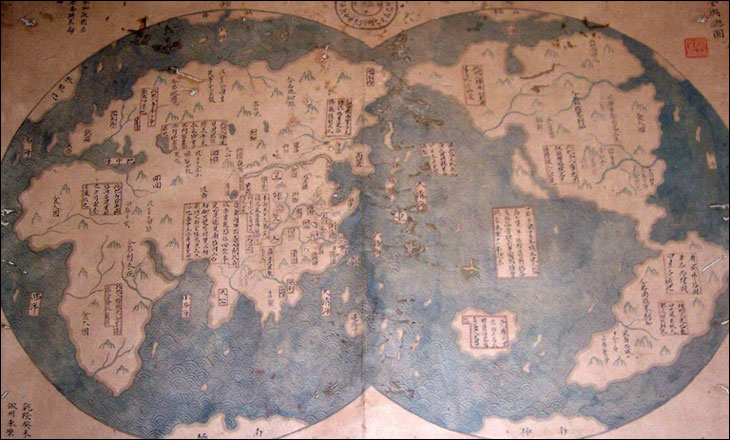 The link above points to a news article that I found through FARK this morning, showing a Chinese map from 1763 that purports to be a copy of another map from 1418 -- three years before the author of The Year The Chinese Discovered The World claims he can prove that the Chinese sailed to America. It kind of makes sense that the Chinese admirals would have sent out reconnaissance ships before investing such huge resources in the "Treasure Fleets," which were, up until the nineteenth century and the advent of steel and steam power, the largest ships ever built. The ships were intended to foster trade with foreign peoples and start colonies of Chinese in new lands; but before sending colonists and merchants to other places, it would have made sense to have found out if there were people there with goods worth trading for, and lands worth colonizing, in the first place. If the map is truthful in claiming to have been originally drawn in 1418, then that would have been the result of these voyages of reconnaissance. A reconnaissance trip would have been considerably less expensive and risky than sending the treasure ships out into uncharted waters.
The book is well worth the read and while it may not meet every test for absolute scientific or scholastic rigor, it is not harebrained, either. The book candidly deals with the failures of the Chinese navigators as well as their remarkable achievements, and the reasons why the Chinese economic and political system failed to sustain the trading and colonization efforts, and why the Chinese did not preserve this knowledge to provide future generations with better documentation of what happened. Some of the "evidence" cited is questionable -- for instance, the author's theory that the Bimini Road was a Chinese drydock -- but along the way it throws out some very interesting documented evidence for consideration, it is an intriguing and plausible idea.
January 16, 2006
Gum Should Not Taste Like Mustard
 A few weeks ago, the Wife bought these sour candies that I absolutely love. I’m seriously addicted to Ice Breakers Fruit Sours. They’ve got an intense taste and are laced with these interesting-looking little flavor crystals. My favorite flavor is tangerine. Yes, they are very sour (“tart” would probably be a better word). They’re sugar-free and calorie-free, so I eat them until my mouth hurts like this girl's does.
So yesterday, The Wife found a packet of the tangerine flavor candies on one side, and gum with the tangerine flavor crystals in them on the other. Oh, happy day! The gum comes in these little tiny globes, not in the traditional stick form one would normally expect gum to be sold as. The gum is also laced with the flavor crystals, and I was looking forward to a long-lasting, refreshing taste of intense sour but sweet tangerine flavor.
The experiment failed. For about one second, I had that wonderful tangerine flavor. Then, all the flavor crystals dissolved and there was nothing left but the gum. The sweetener leached out of the tiny little micro-ball of gum and left nothing but the textured, sticky stuff in my mouth. After about ten seconds, all the flavor was gone except for the gum itself, which tasted like mustard.
I’m not a big fan of mustard to begin with. I don’t put it on my hot dogs, bratwurst, or other sausages. I use mustard sparingly as a seasoning when I cook, both because I dislike the pungent taste that infiltrates the nostrils, and also because the intensity of mustard as a spice is quite strong – a little bit can completely dominate a sauce’s flavor. Now, maybe you like mustard. Good for you if you do. It’s a visually appealing condiment, I’ll grant you that. But you’ll have to concede one point, even if you are a mustard-lover:
Chewing gum should not taste like mustard. Ever.
Subscribe to:
Posts (Atom)

 Posts
Posts