I woke up this morning and the tip of my nose was sore and tender. I think this means that an adult pimple is erupting. Feels like I'm a little bit old to be getting pimples. But there it is -- a tender, pink spot right on the tip of my nose; it's been there all day. I wonder when I will have to do something about it.
I've also been sneezing for weeks. Big, massive sneezing fits, the likes of which I haven't had since I lived at The Estate At Louisville. There's something in the air, and I wasn't immunized to it when I got allegery therapy in Tennessee. While I haven't had ear pain like this unfortunate young man, I have had uncontrollable sneezes the past couple of weeks powerful enough to shoot pain through my shoulders all the way down to my wrists.
People are all apprehensive here in the High Desert tonight. There are clouds overhead and a cold wind is blowing. One woman, leaving the office tonight, said with genuine foreboding and no irony in her voice, "There's a thirty percent chance of rain tonight." Some tiny spatters of precipitation formed on my windshield on the way home. Oooooh.
And I heard a song the other day that I thought was really catchy and fun. Turns out it's been released for over a year now. "Jeez, what rock have you been living under?" The Wife asked. It's on a beer commercial and everything. Where have I been?
So that's a slice of life up in the High Desert.
November 27, 2006
November 26, 2006
Yeah, And I Could Have Started Tomy Romo This Week
 Turns out Sean Connery had been offered the role of Gandalf in the Lord of the Rings Trilogy for somewhere between 10% to 15% of the box office. The box office totals (not counting rental, pay-per-view, or DVD sales) for the trilogy was over a billion dollars for the U.S. alone.
Well, we all make mistakes sometimes. Look at the performance put in this weekend by a quarterback I assigned to ride the bench this week in my fantasy football league -- the one I play for money. Instead, I played Marc Bulger. So I know how you feel, Sir Sean.
November 25, 2006
SmartUSA
 The first time I saw one of these things in Europe I was almost amused; it is a very small car. But it didn't take long, seeing the narrow, twisty streets of European villages, to realize that the Smartcar is a good thing there. But the need to navigate narrow urban passages isn't the draw for a little car like this -- it's the low price tag and high fuel efficiency.
So I'm very pleased to see that DaimlerChrysler is soon going to begin importing the Smartcar to the U.S. In an age of climbing fuel prices, a small, efficient, low-pollution car is just the thing for urban markets here in the U.S.
The first time I saw one of these things in Europe I was almost amused; it is a very small car. But it didn't take long, seeing the narrow, twisty streets of European villages, to realize that the Smartcar is a good thing there. It can be a good thing here, too. Soccer moms, of course, will not be interested in this vehicle, but it's not aimed at them. It's aimed at urban dwellers and economy-car drivers.
The VW Beetle, and BMW's Mini Cooper, have both done very well here in the U.S. The Smartcar will do well, too. How long will it be before car enthusiasts start tricking these things out with mega-subwoofers, neon-highlighted Sprewheels, and hydraulics?

 Labels:
Cheerful For Once,
Technology
November 24, 2006
Taking Back Some Of What I've Said...
 ...about Canada, that is. Sure, I know they look like us, they talk like us (kind of) and they're right next door, so you can't really trust them. It's awfully suspicious that they've infiltrated our entertainment industry to such an extent. And they engage in media protectionism within their own borders.
But not only do Canadians have the good sense to adopt same-sex marriage democratically, but you've got to read this.
Oh, I hear you scoff now: "An industrialized country, eliminating all of its debt? Pish! Debt is a necessary tool for running a sophisticated government, particularly one as paternalistic as Canada's." I'd have no come-back to an objection like, "Canada's multi-party system is inherently unstable and when a new coalition or party takes power, this plan will go right into the loo." But, the province of Alberta has already figured out a way to not only eliminate its deficit spending but it paid off all of its debt last year. And even if Canada's leaders can't pull off eliminating Canada's national debt in fifteen years, at least that's what people in Ottawa are talking about doing.
So, the real question is, why aren't U.S. politicians trying to do something similar? Why isn't this on either party's agenda?
Labels:
Canada
You Can Keep This Kind of Progressivism
One would hope that not all self-identified political progressives, liberals, or neo-conservatives offered a prayer of this nature over their Thanksgiving dinners. And it is worth remembering that the Ann Coulters of the world have their cognates on the left. This guy just stepped into my hit parade. That'll teach you to piss off Instapundit, Tony Hendra.
Labels:
Domestic Politics
I've Got Rude
 So I'm sitting on the couch, talking with my father on the phone. The doorbell rings and The Wife gets up to answer it. We're not expecting anyone so I figure it's a solicitor of some kind; The Wife will say "no," and that will be that. But she doesn't come back for a while.
So I get up and sure enough, The Wife is standing there in the doorway and there's some kid with acne and looking all of seventeen years old. The Wife is holding this folded-up piece of paper with a bunch of photographs of magazine covers with prices listed on them. I say to my father, "Here, you can ask The Wife that," and hand the phone to her. The kid selling magazines hasn't come up for air the entire time, he's so busy spouting out his patter.
"Thanks, have a nice night," I say, closing the door.
"Well, you don't have to be rude about it!" he replies.
I finish closing the door and that ends the encounter. But I'm thinking to myself, "Dude, that wasn't even rude. It was firm. If you want rude, I've got lots of rude for you."
What's the difference between my "firm" and what I'm calling "rude?" The story goes, one of our friends, six months pregnant at the time, confronted a trespasser in her back yard with the phrase "You! Get the f--- out of my yard right now or I wil f---ing kill you!"
So it's probably just as well that this guy didn't get a taste of what real rude sounds like.
Labels:
Rented Mansion In The Desert,
The Wife
Encouragement
A friend sent me this site, of which I was not previously aware. There is some good news here, but more along the lines of encouragement than anything else. This far out from the election, surveys of this nature are more about name recognition than actual candidate preference. But the ability to index specific candidates against one another is quite useful. It's particularly useful to weed out the kinds of people who have a profile from those who don't and the kinds of people who are thought of as Presidential material and those who are not.
For the Democrats, the choices seem to be John Kerry, John Edwards, Hillary Rodham Clinton, and Al Gore, with Mark Warner as an also-ran. For the Republicans, the choices are Rudy Giuliani and John McCain, with also-rans including Mitt Romney, Condoleezza Rice, and Newt Gingrich. More or less absent from the list of viable candidates include Wesley Clark, George Allen, Bill Richardson, Bill Frist, and Tom Vilsack. McCain and Giuliani both look to be head and shoulders above the rest of the field.
It's easy to put too much weight on stuff like this -- simple name recognition is enough to top out polls like this. As the actual election starts to come closer in time, the public will learn more about the various candidates and the numbers will start to change. But all the same, it's a heads-up for the upcoming campaign.
People Being Ostriches About Gay Penguins
 Once upon a time (well, actually just a few years ago), two male penguins -- the father and another male named Roy and Silo by the zookeepers -- were observed trying to "hatch" a rock with, obviously, no results. Now, penguins can only care for and raise one chick at a time, and another mixed-gender pair of penguins had fertilized two eggs. So the zookeepers took one of those eggs and give it to Roy and Silo. The two males successfully hatched and raised the chick, a female named Tango, with no help from any female penguin.
Someone wrote a children's book about this, called "And Tango Makes Three." The book won many awards for children's books and, like a lot of children's books, hit the shelves of libraries around the country. Recently in Shiloh, Illinois (a rural exurb of St. Louis), a woman checked out and started reading the book to her son, and stopped when she realized that it was about a same-sex couple raising a child. She and a group of other local parents want the book removed from the children's section of the library. They think the book raises mature themes to which young children are not yet ready to be exposed.
This is really silly. It anthropomorphizes the penguins to a degree that is neither deserved nor logical. This is something that happens in nature, not in human society. Are we to conceal the fact that certain species of frogs can change gender when under environmental stress, just because some people disapprove of transsexuals? This imputes some degree of moral relevance to what animals do. Animals, however, are not moral actors and what an animal does has no moral significance.
One thing that seems likely to be going on here is that people who condemn human homosexuality do not want to admit that they are trying to justify their condemnation on some sort of "objective" ground -- rather than admitting that they subscribe to that belief based solely on their religious objections, they claim that homosexual behavior is somehow unnatural. So when similar behavior is observed in creatures other than humans, that becomes something of a problem -- and this sort of behavior is observed in a great many different species.
I suspect that most kids are capable of handling a lot more information than many adults seem willing to give them credit for. Most people would agree that cannibalism is morally bad in humans but that some animals are cannibalistic and that is simply nature at work. Kids can handle this truth. Perhaps the truth need not be depicted in as lurid or graphic a fashion as it is for adults, but that doesn't mean that the truth is something that kids should be concealed from. And the truth is that homosexual behavior, including sex and parenting, exists in nature. Acknowledging this fact does not mean that a parent cannot incorporate the moral teachings of his or her religion along with telling the child what is going on.
Now, I haven't read "And Tango Makes Three." I know that children's books sometimes anthropomorposize animals, and if this book does that, there may well be a subtext here that suggests that human homosexuals can raise children the same as human heterosexuals. Of course, homosexual couples can and actually do raise children in real life. Why it should be a surprise that a homosexual couple would do any of the same sorts of things that a heterosexual couple would (like, for instance, getting divorced after marrying earlier in life) is a mystery to me.
My point is that this is a lot of anger and concern resulting from people not minding their own business (by being upset when gay people want the same sorts of things straight people take for granted) and trying to impose their religious values on people who disagree with them in an authoritarian fashion. When these sorts get seeking some sort of justification for doing so -- and in the process finding themselves confronted with objective facts which, most unpleasantly, deprive them of justifications for their points of view and expose the irrationality of their prejudices.
 Gay penguins raise chicks. I think the story about two male penguins raising a chick together is kind of cute and presented in an age-appropriate way, it seems like it would make a fine children's story. But whether you agree or disagree with me on that point, hiding your head in the sand when faced with an unpleasant fact is not a good coping mechanism. And, since this sort of behavior does manifest itself in non-human species, please dispense with the phrase "crime against nature."
Labels:
Antiscience,
Ethics and Morality,
Same-Sex Marriage
No Florida Trip For A While
It's been a while since I made a post; that's not been for lack of activity but rather because of a surplus of it. I have some time today so I will have a chance to write more.
The big news is that today, as of about twenty minutes ago, my imminent trip to Fort Myers, Florida, is at least postponed if not cancelled outright. This is an immense relief as I not only did not want to be away from The Wife and my animals for something as stupid as this case, but I also was seriously dreading travelling on one of the busiest days of the year.
In other news, The Wife and I had a wonderful Thanksgiving dinner with some friends in Sherman Oaks. Good food, good friends, and good wine make for a marvelous time. As is something of our tradition, we went out to see a movie afterwards and enjoyed Stranger Than Fiction. Not as good as the Bond flick from last weekend, but it was another movie and seeing the movie at the Sherman Oaks Galleria was a reminder of how big a part of the economic and cultural landscape the movies are to Southern California.
Labels:
Blog,
California,
Friends and Family,
The Wife,
Travel
November 17, 2006
Movie Review: Casino Royale
 Daniel Craig is James Bond. If you had any doubts about that, you need to see the movie. He's cool, handsome, and credible. The movie has some great stunt and action sequences, a spectacular car scene (not an American-style chase but rather some really good FX), glamorous locations, attractive women, and sufficient verisimlitude to support a suspension of disbelief.
The producers have decided to reboot the franchise for the post-cold war era. We get to see James Bond earning his stripes as a "double-o" agent in modern times. Bond's first kill is very gritty. Daniel Craig delivers on the emotional toll that the job of killer super-spy takes on the character. Both The Wife and I liked the rough-around-the-edges Bond of this movie. It's also probably a good thing that Bond's gambling of choice has moved from baccarat to Texas Hold'em. It makes for a more dramatic showdown in the classy casino and dovetails nicely into the glacial cool that the character is supposed to exude.
I'd have given the movie an "R" instead of a "PG-13" for a scene of torture (which actually was not as credible as it could have been) and the sexuality scenes are also steamy adult fare despite the lack of overt nudity. Oh yes, and then there's the violence.
The opening scene in a Bond film, by convention, is usually only tangentially related to the rest of the plot, but that's often where the best stunts are found, and this is no exception. Get to the movie on time to see the opening -- although the half hour of previews and commercials they show before movies these days will make it hard for you to miss the opening scene anyway.
This is not to say the movie was flawless. Some of the gadget play was a bit silly, although it was not as over the top as in previous Bond flicks (The World Is Not Enough was the worst offender here). The bad guys were not as fully-developed as I would have liked, but on the other hand I suspect that we will be seeing more of them in the future as the franchise revives the long-forgotten SPECTRE as a source of interesting foils for Bond in the future. The overall plot is not hard to anticipate and the movie gets a little bit talky at times -- inevitable, I suppose, given that the focus of the movie is a poker tournament. And at more than two and a half hours in length, and with lots of pre-movie material to sit through, I have to advise not buying any beverages at all before the film.
But come on. When you go to a Bond film, you want a few things. You want Bond Girls, looking hot in slinky, revealing outfits. You want stunning action sequences. You want sexy cars and martinis shaken, not stirred. You want double-crosses and narrow escapes and espionage. You want exotic, beautiful locations. Casino Royale delivers all of this. It's worth the price of admission and three hours.
Labels:
Movies
The Kiwi Conundrum
Watch this video first. The animation is quite good and the story is compelling.
Now ask yourself:
Why is the kiwi bird crying at the end?
Do you admire the kiwi?
How is the kiwi any different from that guy in The Matrix who wanted to be re-inserted with his memory wiped?
Was the kiwi's sacrifice worth it?
Now ask yourself:
Why is the kiwi bird crying at the end?
Do you admire the kiwi?
How is the kiwi any different from that guy in The Matrix who wanted to be re-inserted with his memory wiped?
Was the kiwi's sacrifice worth it?
Labels:
Ethics and Morality,
Link Love
November 16, 2006
Lazing on Thursday Night
I should eulogize Milton Friedman. A man whose life was filled with mountainous achievements and one of the foremost champions of individual liberty. Or, I could do more work to prepare for my classes in January. But the fact is I'm burnt out from a heavy day, and the prospect of another heavy couple of days coming up. So I'm just watching some TV from a few days ago.
Labels:
News
Con Law Geeks, Take Note!
On NPR yesterday I heard about the greatest case ever -- it's like a hypo on a final exam, except it's real.
Missouri has a law that restricts a minor's ability to get an abortion without prior parental notification. But Illinois does not have such a law. Clinics and family planning services in Illinois have been advertising in St. Louis, which is right across the river, and their advertisements include (truthful) statements that there is no parental notification law in Illinois, so if a pregnant minor wants an abortion, she can get one in Illinois. Now, Missouri has made it a civil tort to assist a minor circumventing the Missouri parental consent law, and a court has indicated that it could hold an Illinois clinic civilly liable to a Missouri parent on the basis of the advertisement alone. Further, there are bills pending in Congress (and likely to be re-introduced in the next Congress) which would enact Federal criminal penalties for those who help minors cross state lines to get an abortion.
How many rich Constitutional issues can one case have? Abortion, federalism, inverse commerce clause, right to travel, privileges and immunities, freedom of speech, due process... It's a delicious case.
As to the merits, I'll give my first impressions because I need to get ready for work soon. I think Missouri loses, and if the Federal government steps in, it loses too.
On the First Amendment issue, it seems to me that the advertisement is commercial speech, which means it can be regulated more stringently than political speech but it cannot be prohibited entirely. That means that if the advertisement is truthful and not deceptive, it will pass a Constitutionally-acceptable content-sensitive regulation.
On the abortion issue, Missouri can have a parental notification law if it likes. It can also have a non-circumvention law to enable and enforce its parental notification law. But an attempt to longarm the non-circumvention law to the Illinois clinics is overreaching. The advertisement does not "assisting" the minor circumventing the Missouri law; it does not offer, for instance, transportation to the clinic.
On the federalism issue, the Federal government, should it intervene, does not have any interests in enforcing a Missouri health and safety law. Its interest is in regulating interstate commerce. Yes, this is interstate commercial activity as defined by the cases interpreting the Commerce Clause. But the Federal government's interest in health and safety is limited to Federal enclaves where Congress exercises police power. In this case, the Federal government is piggybacking its commerce regulation interest on a state's claimed health and safety interest; the Federal government needs an independent basis for its commerce regulation that affects an area of Federal concern. By definition, an area of Federal concern is not enforcing a state's law, particularly where a neighboring state has a contrary law.
On the inverse commerce clause issue, the facts of the case weigh against Missouri. Lots of businesses in East St. Louis advertise in the city of St. Louis, across the river. Lots of people travel back and forth between the two states to take advantage of differing laws. There are lots of cases where businesses in one state advertise business opportunities they offer which are illegal in the states where they advertise -- casinos in Atlantic City and Las Vegas trying to persuade Californians, New Yorkers, and Pennsylvanians to cross the state line and come gamble in Nevada or New Jersey come to mind.
As for due process, this requires that the civil liability be proportionate to the actual harm suffered. Given that Missouri's parental notification law does not prevent the minor in Missouri from getting an abortion once notification is made -- the abortion can still go forward even if the parent objects, and there is a judicial circumvention exception for cases where the minor fears for her own safety -- the damage the parent suffers is not their daughter's termination of her pregnancy. It is their loss of notification and the opportunity to attempt to persuade their daughter to not get the abortion. What is the measure of damages here?
That's enough to strike the Missouri law down.
Labels:
Constitutional Law
November 15, 2006
Bleg for Advice
We have to start one, and only one, of the following quarterbacks this week: Marc Bulger, Ben Roethlisberger, Tony Romo, or Charlie Frye. We only care about scoring; yardage, interceptions, and all the other stats kept on QB performance don't count. What do you think, Loyal Readers? Who's going to get the rock in the end zone the most?
Labels:
Sports
November 14, 2006
Rudy 2008 Begins
 I know it's a long shot and that McCain and Romney are moving to occupy the Republican field right now.
I know there are other center-right options, in both parties (i.e., Wesley Clark).
I know the likely problems with his candidacy -- he's in favor of gay rights; he seemed to treat his (already-failed) marriage and taxpayers' sense of propriety casually in the waning days of his mayorship; he's pro-choice. Being in favor of gay rights (equal to those of straight people, which is all gays are asking for) and pro-choice myself, I am prone to discount those attributes of his political resume as threats about the reaction of the religious right.
I know the bad rap that is being circulated against him -- that he was a lightweight mayor who really was neither very popular nor effective until New York was attacked on its local election day. I don't believe the bad rap. New York used to be a sinkhole of a city; crime and grime on the streets of New York was an embarassing national joke. By 2001, the city had turned around so much that it had become a popular tourist destination again and it was one of the safest cities in the country.
And I know the upside that he brings -- an easy familiarity with charismatic, active-leadership role; a familiarity with most of the broad issues facing the country (if not the minute details, which can, of course, be left to subordinates); a wealth of political capital upon which he can draw; and superb name and face recognition. Rather than a reminder of our fear and terror on the darkest day of our nation's recent history, he is rather a symbol of our hope and our confidence in rebuilding and becoming better than what we were.
It is for that reason more than anything else -- the hope and confidence that he brings to the table -- that I am so drawn to the idea of Rudolph Guiliani as the next President. Certainly, there will be some terrific political moments that require his presence -- a Presidential debate between Rudy and Hilary Clinton would be the best one-on-one political debate since Kennedy-Nixon; the dedication of the Freedom Tower in 2009; and it's high time an Italian-American held office. But those things are ornaments on the table. The meat and potatoes are a centrist political platform, cross-party and cross-regional appeal, broad-based political support, and the energy and skill to lead at the highest possible level.
Oh, and partisan Republicans of a more religious persuasion than I -- if you nominate him, Rudy can win. You picked George W. Bush in 2000 for no better reason than that. He will recapture the center of the voter spectrum, taking back the middle that was lost last week, and it's well within the realm of possibility that could take the balance of power in Congress back with him on his coattails. How about that for a good reason to swallow your desire for another evangelical and be willing to accept victory instead? There will be a place at the table for you if you get on board, even relatively late in the game.
So until he drops out of the running, Rudy's my guy in 2008.
Labels:
2008 Election
November 13, 2006
The Ghosts of Rome
 I just got through listening to a lengthy series of lectures about ancient Rome. I enjoyed it very much, but I thought that it was incomplete. The lecturer ended with the obligatory discussion of "Why did Rome fall?" and left it at that -- he did not provide a very deep analysis about the legacy of the Empire.
 If you think about it, the achievement of the Romans was exceptional. The legends say that Romulus founded Rome on April 21, 753 B.C. and we know that Byzantium fell on May 29, 1453, when the Venetians double-crossed their former patrons and allied with the Ottomans and breached the walls of Constantinople. A comparable achievement would be if the United States of America, which began its existence as a British colony at Jamestown, finally falls on July 19, 3811. I suppose to make the analogy complete, the original United States would have to fail first, and then an American extraterrestrial colony would have to endure for another thousand years afterwards; the point is that the Romans did quite well for themselves as a civilization and we should hope do equal their record.
So without further ado, I consider the ghosts of Rome, which are still with us today.
 Christianity: Probably the biggest and most pervasive single bequest from Rome is the religion which took it over. Europe became Christian because the Romans were Christians, and the Romans were unabashed exporters of their culture. In particular, the Byzantines were always very religious and theological debates several times threatened civil war. Certainly not all of Rome was Christianized by the collapse of the Western Empire in 476, but by then the "civilized" world had been Roman for a century.
 Rule of Law: I think this is even more important, although much more subtle, than Christianity. The rule of law over the rule of strong men was not a completely Roman innovation, but then again, neither was Christianity. Rome co-opted and transformed the idea that laws govern men, and created an empire built on that idea. Consuls, and later emperors, were subject to pre-existing rules and had to abide by them. Moreover, even when they were in a position to make the rules, they governed by way of altering the rules instead of simply dictating their desires. The Magna Charta had its roots in the Forum.
 Divided Government: In particular, the Republican Romans were obsessively concerned with achieving good government, realizing the will of the citizenry, and combatting corruption by dividing the powers of government amongst multiple office-holders. Frequent elections and rotating offices, vetoes, and checks and balances were created through hundreds of years of political wrangling by the Conscript Fathers serving in the Senate (and elsewhere). We have a President, a Congress (itself divded into two houses) and an independent judiciary because the Framers of our Constitution learned from the example of the Romans.
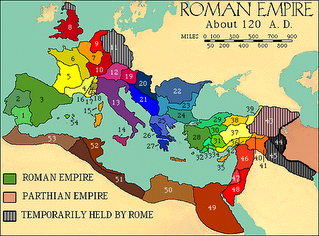 Federalism: Related to the idea of dividing government between multiple holders of office at the apex is the idea that government should be divided geographically. Roman government was initially created to govern a small city-state and the surrounding lands; as the lands under the sway of the Romans grew (explosively, during some phases of history), the solution was to establish local government to implement the will of the sovereign. Certainly, emperors and kings had governed remote lands through viceroys and other local officials before. The Romans, however, permitted their local governors a degree of flexibility, discretion and rule-making that had not been allowed previously, and the trend over the course of Roman history was for smaller and smaller political subdivisions. Click on the map to learn more about the various provinces of the empire.
 Violent Spectacle: The only complaint a Roman would have about modern professional football would be, much as modern rugby fans complain, that the players have too much armor and not enough personal risk. The visceral spectacle of athletic men (and sometimes women) clashing in violent and emotionally-charged ways is pure Rome. So too do the throngs of NASCAR fans, massing in numbers that dwarf football games, occupy the same seats as did the cheering masses at the Circus Maximus. The modern gladiators and chariot drivers do not often kill or even maim one another, but they please the crowd and enjoy rich rewards, both social and financial, for their toils and risks.
 Civil Engineering: The Romans made a profession out of civil engineering, which is to say the building of large, civic structures with intelligence and precision. They did this through a system of private donations and public donations. There had really been very little done by way of public works construction other than religous structures and palaces. But the idea that the public should pay for the construction of buildings and other enduring structures for the benefit of the public has proven enduring. In particular, the aquarius (the engineers who built and maintained the elaborate network of aqueducts and tunnels that carried fresh water to the cities) enjoyed an honored and critical position in Roman society.
 Bathing: 'Nuff said.
Women's Property Rights: Women in Roman society, quite unlike most other ancient civilizations, could own their own property and resort to the legal process to protect it. A woman's dowry remained her property, with her husband serving as a trustee for it. Along with this came an emphasis on educating women so that they could meaningfully control their property and otherwise serve a more effective supporting role for their families. While noble women were often married off to other noble men for dynastic and political reasons, both they and their less-privileged counterparts from lower segments of society had a significant measure of independence and prestige; and some managed to engage in business and commercial activity to an extent that a few became wealthy enough to privately endow public works projects, and inscriptions in their honor survive to this day.
 Concrete: The Romans were better at this than anyone in history. Modern concrete, made from Portland cement and small gravel aggregate, is inferior to ancient Roman concrete, mixed from lime and ash recovered from Vesuvius. Roman concrete set and cured faster than its modern equivalent, and was every bit as strong. It lasts forever, too, as the still-extant skeletons of Roman roads, aqueducts, and buildings prove most impressively. The Romans used a form of rebar, too; the evidence of which can be seen in the hundreds of iron studs visible on the Colosseum even today.
 Professional Military: The first armies were made from conscripts and commanded by officers drawn from the noble class. The Romans changed this by taking soldiers only from the body of the citizenry and drawing from both the noble and semi-noble classes of society for the officer corps. Beginning with a series of massive German invasions in the late second century B.C. and continuing through the fall of the Byzantine Empire, the Romans took all comers and made a career in the military an avenue for social and economic advancement for all segments of society. Even the leadership of the military became based on merit and ability rather than birth and wealth (although for the Romans, as for moderns, wealth and birth were always significant personal advantages). Our modern all-volunteer army, made up of a large number of people who seek to make their careers in the military, with its separate system of regimented and disciplined life, that seeks out and rewards merit, is the direct descendant of the legions.
Universal Citizenship: Perhaps the Romans made citizenship universal to broaden the tax base, but along with it came the concept of universal rights of property ownership, entitlement to due process of law, and nationalism.
 Empire of Europe: The vision of Europe unifed into a single polity has never vanished. It survived in the empire of Charlemange, the Holy Roman Empire, the Hapsburg kingdoms (particularly under Charles V), and the wars of Napoleon, Bismarck, and Hitler; and is finally knitting together on economic rather than military or religious grounds in the still-evolving European Union. The trappings of Roman imperialism survive, too; the king of Germany was called "Kaiser" (German for "Caesar"); the most popular name for currency in North Africa is the "dinar" (after the Roman denarius); eagles remain favored symbols of martial and national power; the months of the modern calendar are named after the Roman months -- and indeed the modern calendar, with only a few modifications, was invented by none other than Julius Caesar.
It is going too far to claim, as some historians do, that we are all Romans today. But it is not going too far at all to say that we are the heirs of the Empire. Very much of who and what we are today is because the Romans did what they did in classical and medieval times.
Labels:
History
November 11, 2006
Everybody Loves A Parade
 I've seen not nearly as much of The Wife as I would have liked for the past several weeks. She had a conference for Toastmasters and today, she got up early to volunteer for a Memorial Day parade. This latter volunteer project has been taking a lot out of her. It seems that the people putting the parade together have a deep wealth of good intentions and the organizational skills of FEMA responding to a natural disaster.
I dropped her off at six this morning at the parade site and came home; I expect that whenever I hear from her that it's all done and I should come get her that she will be full of frustration and anger, as she has been nearly every time she has gone to any meeting with any of these people. I think she needs to not get involved in this sort of thing again.
As for me, I'm going to catch another hour or so of sleep before I go to the office. Not that I don't like veterans myself, but I've no desire to attend the parade and knowing several veterans, most of whom feel as averse as I do about functions like this, I don't think a lot of vets will be upset that I'm choosing to use my Saturday to help my family and my clients instead of standing around watching a bunch of people walk down Lancaster Boulevard. I hope that the parade works out, and tonight I'll try and find something nice to do for The Wife tonight because once again, she deserves a reward of something she likes to do for all the hard work and emotion she has poured in to trying to help others.
Labels:
The Wife
November 9, 2006
How Cool Is This?
 Sailors in the South Pacific nation of Tonga have discovered a new island. A really new island -- three months ago it wasn't there. The picture was taken from this article which is worth reading for the additional picture of the miles-wide pumice raft. The blog of the people who chartered the yacht can be read here; it has lots of photographs of the emerging island and other natural phenomena around the area.
Labels:
Cheerful For Once,
Travel
Going Back To The Well One Last Time
I wanted to leave the Ted Haggard thing alone. I mean, I'd done more than enough already. But then I saw the story on FARK. Ted Haggard, who fell from an astonishing height of power and prestige after confessing to unspecified "sexual immoralities" (he was accused of having a years-long drug-tainted relationship with a male prostitute), has decided to go into rehab. Christian rehab. This apparently consists of having "...godly men who are clean themselves insert themselves in the life of the one who is struggling," with much laying of hands.
You know, having a bunch of guys "insert themselves" and "lay hands" on him doesn't sound like it's going to remediate homosexual behavior.
Okay, cheap-shot jokes based on statements taken out of context are beneath me, you might say. Apparently, you'd be incorrect if you did say it. But sometimes these things just write themselves.
Seriously, I must query as to whether the course of rehabilitation he's going to receive is that much different than the typical twelve-step program for redirecting addictive behavior -- one never stops being an alcoholic, for instance; one can controls the addiction but the addiction doesn't go away. Twelve-step programs don't claim to "cure" the addict. They claim to help the addict "recover." The twelve-steppers I've known seem to have a lot of things in common -- their addictions seem to be diverted from the harmful activity to a more harmless one (typically a religious affiliation or, if that is lacking, the twelve-step support group itself); the addict attempts to meld his personality and recreational activities into the twelve-step support group; and they all seem to drink prodigious quantities of coffee, even if their underlying addiction was not drinking.
This does not seem to be a traditional AA-style, twelve-step program, but it's way better than nothing. It's undeniably good that he's seeking reconciliation and forgiveness after admitting that he had a problem. Christianity teaches that there is redemption even for the worst sinner. I believe in second chances, particularly for those who learn from their humbling mistakes. Certainly I've made serious mistakes of my own in the past and needed some breathing room and time to bounce back; why shouldn't this guy be any different than that?
So it's time for me to dispense with the schadenfreude and to wish (former Rev.) Ted Haggard the best for as complete and speedy a recovery as can be possible and a reconciliation with his family.
You know, having a bunch of guys "insert themselves" and "lay hands" on him doesn't sound like it's going to remediate homosexual behavior.
>>cue rimshot sound effect<<
Okay, cheap-shot jokes based on statements taken out of context are beneath me, you might say. Apparently, you'd be incorrect if you did say it. But sometimes these things just write themselves.
Seriously, I must query as to whether the course of rehabilitation he's going to receive is that much different than the typical twelve-step program for redirecting addictive behavior -- one never stops being an alcoholic, for instance; one can controls the addiction but the addiction doesn't go away. Twelve-step programs don't claim to "cure" the addict. They claim to help the addict "recover." The twelve-steppers I've known seem to have a lot of things in common -- their addictions seem to be diverted from the harmful activity to a more harmless one (typically a religious affiliation or, if that is lacking, the twelve-step support group itself); the addict attempts to meld his personality and recreational activities into the twelve-step support group; and they all seem to drink prodigious quantities of coffee, even if their underlying addiction was not drinking.
This does not seem to be a traditional AA-style, twelve-step program, but it's way better than nothing. It's undeniably good that he's seeking reconciliation and forgiveness after admitting that he had a problem. Christianity teaches that there is redemption even for the worst sinner. I believe in second chances, particularly for those who learn from their humbling mistakes. Certainly I've made serious mistakes of my own in the past and needed some breathing room and time to bounce back; why shouldn't this guy be any different than that?
So it's time for me to dispense with the schadenfreude and to wish (former Rev.) Ted Haggard the best for as complete and speedy a recovery as can be possible and a reconciliation with his family.
November 8, 2006
I Ought To Be A Pundit
 Instapundit and Volokh have both offered the same opinion I did last night -- had the Republicans made any meaningful kind of an effort to keep libertarian-inclined voters within the fold, they would not now be wailing and gnashing their teeth over the loss of Congress to Nancy Pelosi and Ted Kennedy. To be fair, both Prof. Reynolds in Tennessee and Prof. Zywicki in Virginia have been saying these sorts of things (as have I) for quite some time. Difference is, I'm not a correspondent on a top-ten blog and I'm not a law professor at a major university. But the Loyal Readership does seem to be growing; I've been averaging nearly 100 hits a day, possibly fueled by the election.
Labels:
2006 Election,
Blog,
Link Love
Subscribe to:
Posts (Atom)

 Posts