Showing posts with label Atheism. Show all posts
Showing posts with label Atheism. Show all posts
February 3, 2011
January 11, 2011
Condemnation
Right around the holidays, American Atheists, Inc. used some of its money to rent space on a billboard near the entrance to the Lincoln Tunnel connecting Weehawken, New Jersey to Manhattan. They put up this image for one month:
 A Christian church didn't like this so much, so they responded in kind -- renting the same billboard space for the month following the AA billboard:
 This was exactly the right thing for the Christian church to do -- the remedy for speech you don't like is more speech of your own. The church's message was peaceful, pointed, and positive. While I don't necessarily agree with the message, I fully recognize their right to have done what they did, and I have nothing but praise for the way they went about exercising their right of self-expression.
Unfortunately, not everyone is as content as I to stand back and let others say what they have to say. The Friendly Atheist reports that this is what the church's billboard looked like yesterday:

This is totally and absolutely unacceptable. This atheist condemns the vandalism of the church's billboard, unequivocally, and I invite other atheists to do the same.
Now, it's not certain that the vandal is an atheist, but I'll admit that the motive of expressing disagreement with the content of the billboard seems substantially more likely than any other motive one might reasonably posit. He needs to knock it off. He's making the rest of us look bad.
Those Christians at the Times Square Church have the same right of expression that atheists do (and that everyone else does too, for that matter). Their church is, fundamentally, a collection of people, people of good faith and good intentions, who engaged a public debate in an appropriate and positive way. They paid good money to rent that billboard. For the month that they rented it, the billboard was effectively their property to have done with as they please (within reasonable limits which they obviously respected).
For someone else to come along and alter their message this way, however crudely, is stealing from them. Theft is not an appropriate form of expression. It is a crime.
Here's hoping the crime is detected and prosecuted. Vandal, even if you are a fellow atheist, you'll get no love from me. At least, not until you grow a pair, turn yourself in to the police, and apologize for what you've done.


Unfortunately, not everyone is as content as I to stand back and let others say what they have to say. The Friendly Atheist reports that this is what the church's billboard looked like yesterday:
This is totally and absolutely unacceptable. This atheist condemns the vandalism of the church's billboard, unequivocally, and I invite other atheists to do the same.
Now, it's not certain that the vandal is an atheist, but I'll admit that the motive of expressing disagreement with the content of the billboard seems substantially more likely than any other motive one might reasonably posit. He needs to knock it off. He's making the rest of us look bad.
Those Christians at the Times Square Church have the same right of expression that atheists do (and that everyone else does too, for that matter). Their church is, fundamentally, a collection of people, people of good faith and good intentions, who engaged a public debate in an appropriate and positive way. They paid good money to rent that billboard. For the month that they rented it, the billboard was effectively their property to have done with as they please (within reasonable limits which they obviously respected).
For someone else to come along and alter their message this way, however crudely, is stealing from them. Theft is not an appropriate form of expression. It is a crime.
Here's hoping the crime is detected and prosecuted. Vandal, even if you are a fellow atheist, you'll get no love from me. At least, not until you grow a pair, turn yourself in to the police, and apologize for what you've done.

 Labels:
Atheism,
Crime and Punishment,
Link Love,
Religion
Labels:
Atheism,
Crime and Punishment,
Link Love,
Religion
January 3, 2011
First Gig
Well, it didn't take very long after getting an online ordainment before word got out and some friends asked me to officiate over their wedding in a couple of months. Although I hadn't really been thinking about these two when I did it, I suppose in the back of my mind I knew they would be setting a date soon enough. I found it quite flattering to have them ask me
Another lawyer in the firm who has also been ordained tells me that it feels even better to actually do it and be right there when the happy couple declares their love for one another. Best of all, these friends are fellow atheists so they will surely wish to have a non-prophet ceremony. I'm really looking forward to it.
Another lawyer in the firm who has also been ordained tells me that it feels even better to actually do it and be right there when the happy couple declares their love for one another. Best of all, these friends are fellow atheists so they will surely wish to have a non-prophet ceremony. I'm really looking forward to it.
Labels:
Atheism
December 27, 2010
My Breaking Point: A Haiku
"Holy communion"
Is why I'm an atheist:
It's not human meat.
Labels:
Atheism
December 4, 2010
Atheism Can't Win
I'm not so sure that in the long run, all of these assumptions are correct, but let's just assume the author is right and due to intractable cultural, biological, and emotional factors, atheists will always be a minority in Western society.
As a member of such a permanent atheist minority, I would be willing to have the same sort of status that Jewish folks enjoy -- tolerated, respected, and integrated into society without needed to be closeted, with only the Helen Thomases of the world doubling down on bigoted nonsense about us, and being roundly condemned from all quarters for doing it. In nearly all segments of polite American society, anti-Semitism is socially unacceptable; it cost Ms. Thomas her job and will likely cost her some public respect and speaking engagements she otherwise would have enjoyed. You don't have to be Jewish to find this sort of thing objectionable. If atheism gets at least that much respect, that would be okay with me.
But as it is, when atheists dare to raise their voices and publicly identify themselves as such, they are met with nonsense like this -- people refusing to ride busses carrying advertisements saying "Millions Of Americans Are Good Without God." Note that the advertisement says nothing negative about Christians or Christianity at all, yet the ministers in the linked video act as though the advertisement were an existential threat. I suppose the Coalition of Reason ought to thank the ministers for reacting this way and magnifying the impact of buying advertisements on four busses -- there's no press more powerful than free press, and had these guys just kept their mouths shut and not sent out indignant press releases, it's likely that literally dozens of people in Ft. Worth would have noticed the advertisements. It's not like the advertisement was at the entrance to the Lincoln Tunnel or anything like that.
I don't see Christian leaders encouraging boycotts of busses advertising Jewish temples trying to attract parishioners for Hanukkah services. Perhaps more to the point, you don't see atheists boycotting busses carrying advertisements for Christian churches. What I do see, though, is that when I get together with my local nonbelievers' group in a public place to discuss philosophy, officious intermeddlers become so enraged out our mere existence that they interrupt our meeting to say that we "shouldn't be saying things like that in public" because it's "rude." (While remaining silent about the Christian prayer group loudly overstaying its reserved time in the room next to us.)
Still, I have some hope that encouraging people to think critically, embrace science, and consciously analyze their morality can, one person at a time and over the course of a long period of time, spread apathy to religion and thus free up economic and social resources for more productive kinds of efforts -- scientific and medical research, building hospitals instead of houses of worship, distributing textbooks* instead of holy books, and holding faithfully to the Constitution -- than the sometimes-beneficial, sometimes-not sorts of social activism coming out of religious institutions these days.
This doesn't mean I want everyone to abandon their religious beliefs; it means they should be free to believe as they wish, or not, as they choose, without significant social stigma. If in such an environment, atheists remain a small minority, so be it. If people make social policy and economic decisions without relying on millennia-old tracts of facially ridiculous mythology like the Torah, the Koran, or the Bible, that would make a better world than what we've got now.
* I've a thought about this subject, too, which I need to think through and may write about later today. That thought will not address issues of religion or atheism, however.
As a member of such a permanent atheist minority, I would be willing to have the same sort of status that Jewish folks enjoy -- tolerated, respected, and integrated into society without needed to be closeted, with only the Helen Thomases of the world doubling down on bigoted nonsense about us, and being roundly condemned from all quarters for doing it. In nearly all segments of polite American society, anti-Semitism is socially unacceptable; it cost Ms. Thomas her job and will likely cost her some public respect and speaking engagements she otherwise would have enjoyed. You don't have to be Jewish to find this sort of thing objectionable. If atheism gets at least that much respect, that would be okay with me.
But as it is, when atheists dare to raise their voices and publicly identify themselves as such, they are met with nonsense like this -- people refusing to ride busses carrying advertisements saying "Millions Of Americans Are Good Without God." Note that the advertisement says nothing negative about Christians or Christianity at all, yet the ministers in the linked video act as though the advertisement were an existential threat. I suppose the Coalition of Reason ought to thank the ministers for reacting this way and magnifying the impact of buying advertisements on four busses -- there's no press more powerful than free press, and had these guys just kept their mouths shut and not sent out indignant press releases, it's likely that literally dozens of people in Ft. Worth would have noticed the advertisements. It's not like the advertisement was at the entrance to the Lincoln Tunnel or anything like that.
I don't see Christian leaders encouraging boycotts of busses advertising Jewish temples trying to attract parishioners for Hanukkah services. Perhaps more to the point, you don't see atheists boycotting busses carrying advertisements for Christian churches. What I do see, though, is that when I get together with my local nonbelievers' group in a public place to discuss philosophy, officious intermeddlers become so enraged out our mere existence that they interrupt our meeting to say that we "shouldn't be saying things like that in public" because it's "rude." (While remaining silent about the Christian prayer group loudly overstaying its reserved time in the room next to us.)
Still, I have some hope that encouraging people to think critically, embrace science, and consciously analyze their morality can, one person at a time and over the course of a long period of time, spread apathy to religion and thus free up economic and social resources for more productive kinds of efforts -- scientific and medical research, building hospitals instead of houses of worship, distributing textbooks* instead of holy books, and holding faithfully to the Constitution -- than the sometimes-beneficial, sometimes-not sorts of social activism coming out of religious institutions these days.
This doesn't mean I want everyone to abandon their religious beliefs; it means they should be free to believe as they wish, or not, as they choose, without significant social stigma. If in such an environment, atheists remain a small minority, so be it. If people make social policy and economic decisions without relying on millennia-old tracts of facially ridiculous mythology like the Torah, the Koran, or the Bible, that would make a better world than what we've got now.
* I've a thought about this subject, too, which I need to think through and may write about later today. That thought will not address issues of religion or atheism, however.
Labels:
'Tis The Season,
Atheism,
Link Love,
News,
Religion
November 11, 2010
5 Questions From 2 Christians 4 Atheists
This one seems to be making the rounds on the Intertubes. It may not be particularly philosophically deep, but it is seemingly popular. I'm not about to make a video response as the authors solicit, although this guy's video response ends on a charming note. So I'll do a written response instead.
1. What kind of evidence would it take for you to believe in God? Not what would be a good start, but what evidence would actually convince you? And when we say "God," we're talking about a mind which is all-loving, all-powerful (meaning he can do everything but what is logically contradictory), all-knowing, and eternal.
Notice the rhetorical twist in the question: "We Christians can't seem to convince you atheists of the existence of God. So instead, please try to convince yourselves." Sorry; it doesn't work that way; this isn't Moot Court. As proponents of the claim that God exists, you bear the burden of proof. What that proof might be, I haven't a clue. Maybe such evidence exists; I haven't seen any after forty years of life but then again, I don't know what you've got to offer. So hit me with your best shot.
2. Is there anything I can do that would convince you that God exists? Like, could any argument we could make have the potential to sway you?
See my answer to question #1, above. One thing I'd suggest you do before trying is to see if your new, wonderful argument is really new and wonderful. And sorry, chances are that it isn't. In fact, chances are good that your argument is some variant of either the ontological argument or the cosmological argument, and I find neither to be convincing.
3. If you realized that an all-loving God existed, would you desire to have a relationship with Him? If you said "yes" to that question, would you want to have a relationship with Him just to get into heaven or for some other reason?
An all-loving God would be a nice friend to have for all sorts of reasons, the best reason being to enjoy and reciprocate the love and friendship offered. Now, note that according to your definition, God is all-powerful, all-knowing, and all-loving. As such, an all-loving, omnibenevolent God would put everyone into eternal paradise and bliss in the afterlife, regardless of whether they were sinners, apostates, or whatnot. So if an all-loving God existed (as you've defined Him), I wouldn't be worried about getting in to heaven at all; that God would put me in Heaven no matter what because He loves me the same way He loves you.
4. Have you ever met a Christian that lives their life in such a way that it is clear that they believe in an all-loving God? (Onscreen disclaimer: "I am not insinuating that only Christians can be moral") Meaning they live a life that is impressively kind, loving, and selfless.
Yes, I have met and known and in some cases formed warm friendships with many Christians whose kindness, capacity for love, and selflessness have impressed me and touched me deeply on an emotional level. Those friendships have deeply enriched my life. Similarly, I've met and been morally impressed by people who identify as Jewish, atheist, agnostic, Buddhist, Muslim, Hindu, or in the case of my favorite roommate from college, Zoroastrian. I do not think one's religiosity has any more relationship with one's moral worth than does one's shoe size.
5. Has the presence or lack of presence of such a person had any impact on your atheism?
None whatsoever. My love for my friends, and their love for me, does not change the fact that there is no evidence whatsoever to justify or even inspire belief in the supernatural, any more than such love (or the lack of such love) would change the speed of light or the force of gravity. The universe is utterly and absolutely indifferent to your feelings about it. God either exists or does not exist, regardless of whether Christians are good people or bad people.
1. What kind of evidence would it take for you to believe in God? Not what would be a good start, but what evidence would actually convince you? And when we say "God," we're talking about a mind which is all-loving, all-powerful (meaning he can do everything but what is logically contradictory), all-knowing, and eternal.
Notice the rhetorical twist in the question: "We Christians can't seem to convince you atheists of the existence of God. So instead, please try to convince yourselves." Sorry; it doesn't work that way; this isn't Moot Court. As proponents of the claim that God exists, you bear the burden of proof. What that proof might be, I haven't a clue. Maybe such evidence exists; I haven't seen any after forty years of life but then again, I don't know what you've got to offer. So hit me with your best shot.
2. Is there anything I can do that would convince you that God exists? Like, could any argument we could make have the potential to sway you?
See my answer to question #1, above. One thing I'd suggest you do before trying is to see if your new, wonderful argument is really new and wonderful. And sorry, chances are that it isn't. In fact, chances are good that your argument is some variant of either the ontological argument or the cosmological argument, and I find neither to be convincing.
3. If you realized that an all-loving God existed, would you desire to have a relationship with Him? If you said "yes" to that question, would you want to have a relationship with Him just to get into heaven or for some other reason?
An all-loving God would be a nice friend to have for all sorts of reasons, the best reason being to enjoy and reciprocate the love and friendship offered. Now, note that according to your definition, God is all-powerful, all-knowing, and all-loving. As such, an all-loving, omnibenevolent God would put everyone into eternal paradise and bliss in the afterlife, regardless of whether they were sinners, apostates, or whatnot. So if an all-loving God existed (as you've defined Him), I wouldn't be worried about getting in to heaven at all; that God would put me in Heaven no matter what because He loves me the same way He loves you.
4. Have you ever met a Christian that lives their life in such a way that it is clear that they believe in an all-loving God? (Onscreen disclaimer: "I am not insinuating that only Christians can be moral") Meaning they live a life that is impressively kind, loving, and selfless.
Yes, I have met and known and in some cases formed warm friendships with many Christians whose kindness, capacity for love, and selflessness have impressed me and touched me deeply on an emotional level. Those friendships have deeply enriched my life. Similarly, I've met and been morally impressed by people who identify as Jewish, atheist, agnostic, Buddhist, Muslim, Hindu, or in the case of my favorite roommate from college, Zoroastrian. I do not think one's religiosity has any more relationship with one's moral worth than does one's shoe size.
5. Has the presence or lack of presence of such a person had any impact on your atheism?
None whatsoever. My love for my friends, and their love for me, does not change the fact that there is no evidence whatsoever to justify or even inspire belief in the supernatural, any more than such love (or the lack of such love) would change the speed of light or the force of gravity. The universe is utterly and absolutely indifferent to your feelings about it. God either exists or does not exist, regardless of whether Christians are good people or bad people.
Labels:
Atheism,
Philosophy,
Religion,
Science
November 9, 2010
Living A Lie, Not Developing Marketable Skills
When a pastor loses his (or her) faith, that's a real problem. Pastors may develop some marketable skills but apparently for some it's hard to market them, especially in a tough job market. I feel more than a little bit bad for these guys; they're kind of trapped in a job that makes them feel like hypocrites but have no real other way to provide for their families. I can't help but think this is nothing particularly new; I wonder how many people have been preached to by clergy (of any religion) who don't really believe what they're saying.
October 21, 2010
Legal Proof: Not Collecting Stamps Is Not A Hobby
In preparing applications for 501(c)(3) status for various entities, I have often come across the statement that there is no definition for a “church” in the Internal Revenue Code; the examiners who determine whether a particular applicant for tax-exempt status is really a “church” or not just kind of eyeball it. Since “churches” receive favorable tax treatment, it would seem discriminatory of the government to make that favorable treatment available to groups of people who possess a favored belief about matters of religion (viz., “theists”) but to deny that same treatment to people who possess a disfavored belief (viz., “atheists”).
Now, I know that certain atheist groups are organized as “churches” for purposes of the Internal Revenue Service, but this has always seemed faintly ridiculous to me. Atheism, after all, is not a religion but rather the absence of religion – it’s been a common quip among non-believers for a while that atheism is a religion like bald is a hair color.
But still there are many who insist that no, atheism is a religion – one, because atheists invoke the religion clauses of the Constitution to assert their rights; two, because atheists do make propositions and claims (albeit sometimes more modest sorts of claims than their detractors would have the public believe) about the supernatural; and three (most bizarrely), because they think that not believing is somehow a more strenuous exercise of faith than believing.
And to be sure, a significant number of people who have only recently realized or publicly disclosed their atheism act a lot like the way recent converts to a more traditional sort of religion do – they “evangelize” and try to convince others to adopt their view of the world, they broadcast their thoughts on the issue repeatedly and unprompted, they exhibit scorn towards their former belief system and those who still adhere to it. One might call such people “angry atheists.” I prefer to be a “friendly atheist,” and I try not to give in to the occasional impulse to “anger.”
So in reading Popehat earlier today about NPR’s sacking of Juan Williams, (and drilling down into the links), I found that there is a legal definition of “religion.” And, sad to say for the professional Muslim-haters, the United States Government believes that Islam is a religion. The definition was an elaborate checklist of attributes about the subject matter, the likes of which are only produced by and for the benefit of lawyers. A religion is something that has:
Well, now that the Courts have spoken, we can finally answer the question of whether or not atheism is a religion! This, in turn, will help me answer the question of whether a group of atheists organized into some kind of formal community, can be a “church.” Let’s use the more elaborate Tenth Circuit test first:
(1) Ultimate ideas: Yes, atheism purports to answer fundamental questions about life, purpose, and death. It posits that there is no evidence for a supernatural creator of life, no evidence that life has an objective purpose, and that the best evidence available is that death is a final, irrevocable, and permanent loss of existence as a conscious, self-aware entity. While atheism properly understood does not posit these positions as certain truths, it’s probably fair to say that most atheists consider these propositions to be very likely to be true.
(2) Metaphysical belief: Yes, atheism addresses a reality which transcends the physical and immediately apparent world, by saying that there is no evidence for any such reality. Again, properly understood most strains of atheism would not flatly deny that such a reality exists, but would rather say that it is extremely unlikely to exist.
(3) Moral or ethical system: Nope. While atheists are at least as moral and ethical as theists, taken as populations and understanding that within both populations there are aberrations and outliers, there is no moral or ethical code which logically flows or is incorporated in a world view that is deeply skeptical about the supernatural.
(4) Comprehensiveness of beliefs: I don’t see it. Just as with a moral code, disbelief in the supernatural – at least, on its own – does not lead one to reach “answers to many of the problems and concerns that confront humans.” An atheist may be free to look to other ethical or moral or economic or philosophical systems for such answers, and indeed may be free to find such systems without regard to doctrines, teachings, or traditions to which their theistic counterparts might feel obliged to adhere, but atheism on its own does not offer such answers.
(5) Accoutrements of religion: Not a lot of these:
a. Founder, prophet or teacher? None that I know of. Maybe Socrates?
b. Important writings? I suppose a lot of people have read The God Delusion by Richard Dawkins recently, but you don’t have to have read or agree with Dawkins to be an atheist and there were lots of atheists before Dawkins wrote that (or any other) book. Moreovery, Myers says (93 F.3d at 1483) of important writings of a religion that they are “seminal, elemental, fundamental, or sacred writings. These writings often include creeds, tenets, precepts, commandments, prayers, scriptures, catechisms, chants, rites, or mantras.” That doesn’t sound much like The God Delusion to me.
c. Gathering places? I wish. One of our biggest problems with our local freethought group is finding a regular place to meet. That was also something of a problem back in Tennessee, where the group had to change venue when a local civic building was taken away and looking at their website now, it seems they are having to use more private homes as venues than a facility at the local community college.
d. Keepers of knowledge? The Myers case indicates that this means “clergy, ministers, priests, reverends, monks, shamans, teachers, or sages. By virtue of their enlightenment, experience, education, or training, these people are keepers and purveyors of religious knowledge.” Meyers, 95 F. 3d at 1483. If there are such people for atheists, no one has ever sent me the memo.
e. Ceremonies and rituals? What would this be – sleeping in on Sunday? I know there are some atheist groups that have a silly “reverse baptism” ritual in which a newly-announced atheist is treated with a blow-dryer. But no, there is no standardized or even commonly-accepted ritual for becoming or being an atheist.
f. Structure or organization? If you think atheists have structure or organization, you’ve obviously never tried to organize or impose structure on a group of atheists. “Herding cats” is a metaphor that comes to mind. Feeding them helps.
g. Holidays? Not so much. No atheist has ever gone to his boss and said, “I want off work tomorrow to celebrate Darwin’s birthday.” At least, no atheist who wanted to keep his job ever has.
h. Diet or fasting? No way! Why would we do that?
i. Appearance and clothing? I’ll concede that some atheists have a tendency to wear T-shirts with amusing slogans. But aside from that, no.
j. Propogation? “Most religious groups, thinking that they have something worthwhile or essential to offer non-believers, attempt to propagate their views and persuade others of their correctness. This is sometimes called ‘mission work,’ ‘witnessing,’ ‘converting,’ or proselytizing.” Meyers, 95 F.3d at 1484. While no one makes them do it and some of us find it tiresome when they do, there are some atheists who do try to “de-convert” their friends who are faithful and who explain why they find atheism to be a superior world view to theism. So I guess that yes, we have this accoutrement.
But overall, I don’t think atheism meets the Myers test. Atheism lacks a moral or ethical system, a comprehensiveness of belief, customary gathering places, formalized keepers of knowledge, ceremony and ritual, structure and organization, holidays, diet and fasting, and distinctive appearance and clothing.
What about the Ninth Circuit’s simpler three-part test in Alvarado? As it turns out, while it's phrased differently, Alvarado is a simplified form of the Myers test, with one very interesting omission:
(1) Does atheism “address [] fundamental and ultimate questions having to do with deep and imponderable matters”? Yes. See points (1) and (2) above under my Myers analysis.
(2) Is the atheistic system of belief “comprehensive in nature”? No. See point (4) in the Myers analysis.
(3) Is atheism recognizable “by the presence of certain formal and external signs”? No. Some atheists like to wear “scarlet A” T-shirts, but most do not. For the most part, we look and dress and act just like the rest of you! In fact, there might be an atheist sitting right next to you right now and you’d never know it! More to the point, atheism lacks most of the “accoutrements of religion” described in point (5) in the Myers analysis above.
So there you have it – in at least eighteen states and three territories, atheism is not a religion as that term is legally defined by controlling legal precedent.
I teased you before about the difference between the circuit tests. Here it is: in the Third and Ninth Circuits, a religion need not necessarily include a moral or ethical system. I suppose that some understanding of ancient pagan belief systems were fundamentally amoral, but even then, the pagan gods from time to time condemned or punished humans for their immoral conduct. Nevertheless, it does raise an issue of whether an ethical or moral code must be integrated into a belief system in order for that belief system to be a “religion.”
And if it's the case that you need not have a moral or ethical system in order to be religious, why should atheists be given any grief about their alleged lack of "objective" morality?
Now, I know that certain atheist groups are organized as “churches” for purposes of the Internal Revenue Service, but this has always seemed faintly ridiculous to me. Atheism, after all, is not a religion but rather the absence of religion – it’s been a common quip among non-believers for a while that atheism is a religion like bald is a hair color.
But still there are many who insist that no, atheism is a religion – one, because atheists invoke the religion clauses of the Constitution to assert their rights; two, because atheists do make propositions and claims (albeit sometimes more modest sorts of claims than their detractors would have the public believe) about the supernatural; and three (most bizarrely), because they think that not believing is somehow a more strenuous exercise of faith than believing.
And to be sure, a significant number of people who have only recently realized or publicly disclosed their atheism act a lot like the way recent converts to a more traditional sort of religion do – they “evangelize” and try to convince others to adopt their view of the world, they broadcast their thoughts on the issue repeatedly and unprompted, they exhibit scorn towards their former belief system and those who still adhere to it. One might call such people “angry atheists.” I prefer to be a “friendly atheist,” and I try not to give in to the occasional impulse to “anger.”
So in reading Popehat earlier today about NPR’s sacking of Juan Williams, (and drilling down into the links), I found that there is a legal definition of “religion.” And, sad to say for the professional Muslim-haters, the United States Government believes that Islam is a religion. The definition was an elaborate checklist of attributes about the subject matter, the likes of which are only produced by and for the benefit of lawyers. A religion is something that has:
(1) Ultimate ideas: fundamental questions about life, purpose, and death;United States v. Myers (10th Cir. 1996) 95 F.3d 1475, 1484. Alternatively, I also learn that the Third and Ninth Circuits define religion differently, looking at only three factors: (1) whether the belief system “addresses fundamental and ultimate questions having to do with deep and imponderable matters;” (2) whether the system “is comprehensive in nature;” and (3) whether it is recognizable “by the presence of certain formal and external signs.” Alvarado v. San Jose (9th Cir. 1996) 94 F.3d 1223, 1229; Malnak v. Yogi (3d Cir. 1979) 592 F.2d 197 (Adam, J., concurring).
(2) Metaphysical beliefs: beliefs addressing a reality which transcends the physical and immediately apparent world;
(3) Moral or ethical system: proscription of a particular manner of acting or a way of life that is moral or ethical;
(4) Comprehensiveness of beliefs: an overarching array of beliefs that coalesce to provide the believer with answers to many of the problems and concerns that confront humans;
(5) Accoutrements of religion: the presence of various external signs of religion, including
(a) a founder, prophet or teacher,
(b) important writings,
(c) gathering places,
(d) keepers of knowledge,
(e) ceremonies and rituals,
(f) structure or organization,
(g) holidays,
(h) diet or fasting,
(i) appearance and clothing) and
(j) propogation.
Well, now that the Courts have spoken, we can finally answer the question of whether or not atheism is a religion! This, in turn, will help me answer the question of whether a group of atheists organized into some kind of formal community, can be a “church.” Let’s use the more elaborate Tenth Circuit test first:
(1) Ultimate ideas: Yes, atheism purports to answer fundamental questions about life, purpose, and death. It posits that there is no evidence for a supernatural creator of life, no evidence that life has an objective purpose, and that the best evidence available is that death is a final, irrevocable, and permanent loss of existence as a conscious, self-aware entity. While atheism properly understood does not posit these positions as certain truths, it’s probably fair to say that most atheists consider these propositions to be very likely to be true.
(2) Metaphysical belief: Yes, atheism addresses a reality which transcends the physical and immediately apparent world, by saying that there is no evidence for any such reality. Again, properly understood most strains of atheism would not flatly deny that such a reality exists, but would rather say that it is extremely unlikely to exist.
(3) Moral or ethical system: Nope. While atheists are at least as moral and ethical as theists, taken as populations and understanding that within both populations there are aberrations and outliers, there is no moral or ethical code which logically flows or is incorporated in a world view that is deeply skeptical about the supernatural.
(4) Comprehensiveness of beliefs: I don’t see it. Just as with a moral code, disbelief in the supernatural – at least, on its own – does not lead one to reach “answers to many of the problems and concerns that confront humans.” An atheist may be free to look to other ethical or moral or economic or philosophical systems for such answers, and indeed may be free to find such systems without regard to doctrines, teachings, or traditions to which their theistic counterparts might feel obliged to adhere, but atheism on its own does not offer such answers.
(5) Accoutrements of religion: Not a lot of these:
a. Founder, prophet or teacher? None that I know of. Maybe Socrates?
b. Important writings? I suppose a lot of people have read The God Delusion by Richard Dawkins recently, but you don’t have to have read or agree with Dawkins to be an atheist and there were lots of atheists before Dawkins wrote that (or any other) book. Moreovery, Myers says (93 F.3d at 1483) of important writings of a religion that they are “seminal, elemental, fundamental, or sacred writings. These writings often include creeds, tenets, precepts, commandments, prayers, scriptures, catechisms, chants, rites, or mantras.” That doesn’t sound much like The God Delusion to me.
c. Gathering places? I wish. One of our biggest problems with our local freethought group is finding a regular place to meet. That was also something of a problem back in Tennessee, where the group had to change venue when a local civic building was taken away and looking at their website now, it seems they are having to use more private homes as venues than a facility at the local community college.
d. Keepers of knowledge? The Myers case indicates that this means “clergy, ministers, priests, reverends, monks, shamans, teachers, or sages. By virtue of their enlightenment, experience, education, or training, these people are keepers and purveyors of religious knowledge.” Meyers, 95 F. 3d at 1483. If there are such people for atheists, no one has ever sent me the memo.
e. Ceremonies and rituals? What would this be – sleeping in on Sunday? I know there are some atheist groups that have a silly “reverse baptism” ritual in which a newly-announced atheist is treated with a blow-dryer. But no, there is no standardized or even commonly-accepted ritual for becoming or being an atheist.
f. Structure or organization? If you think atheists have structure or organization, you’ve obviously never tried to organize or impose structure on a group of atheists. “Herding cats” is a metaphor that comes to mind. Feeding them helps.
g. Holidays? Not so much. No atheist has ever gone to his boss and said, “I want off work tomorrow to celebrate Darwin’s birthday.” At least, no atheist who wanted to keep his job ever has.
h. Diet or fasting? No way! Why would we do that?
i. Appearance and clothing? I’ll concede that some atheists have a tendency to wear T-shirts with amusing slogans. But aside from that, no.
j. Propogation? “Most religious groups, thinking that they have something worthwhile or essential to offer non-believers, attempt to propagate their views and persuade others of their correctness. This is sometimes called ‘mission work,’ ‘witnessing,’ ‘converting,’ or proselytizing.” Meyers, 95 F.3d at 1484. While no one makes them do it and some of us find it tiresome when they do, there are some atheists who do try to “de-convert” their friends who are faithful and who explain why they find atheism to be a superior world view to theism. So I guess that yes, we have this accoutrement.
But overall, I don’t think atheism meets the Myers test. Atheism lacks a moral or ethical system, a comprehensiveness of belief, customary gathering places, formalized keepers of knowledge, ceremony and ritual, structure and organization, holidays, diet and fasting, and distinctive appearance and clothing.
What about the Ninth Circuit’s simpler three-part test in Alvarado? As it turns out, while it's phrased differently, Alvarado is a simplified form of the Myers test, with one very interesting omission:
(1) Does atheism “address [] fundamental and ultimate questions having to do with deep and imponderable matters”? Yes. See points (1) and (2) above under my Myers analysis.
(2) Is the atheistic system of belief “comprehensive in nature”? No. See point (4) in the Myers analysis.
(3) Is atheism recognizable “by the presence of certain formal and external signs”? No. Some atheists like to wear “scarlet A” T-shirts, but most do not. For the most part, we look and dress and act just like the rest of you! In fact, there might be an atheist sitting right next to you right now and you’d never know it! More to the point, atheism lacks most of the “accoutrements of religion” described in point (5) in the Myers analysis above.
So there you have it – in at least eighteen states and three territories, atheism is not a religion as that term is legally defined by controlling legal precedent.
I teased you before about the difference between the circuit tests. Here it is: in the Third and Ninth Circuits, a religion need not necessarily include a moral or ethical system. I suppose that some understanding of ancient pagan belief systems were fundamentally amoral, but even then, the pagan gods from time to time condemned or punished humans for their immoral conduct. Nevertheless, it does raise an issue of whether an ethical or moral code must be integrated into a belief system in order for that belief system to be a “religion.”
And if it's the case that you need not have a moral or ethical system in order to be religious, why should atheists be given any grief about their alleged lack of "objective" morality?
August 11, 2010
End The Invocations
My city has adopted a policy by which its City Council devotes a few minutes after calling the meeting to order for the delivery of an invocation -- an invocation which permits of sectarian invocations, such as "...and this we pray in the name of Jesus Christ." In fact, that conclusion to a prayer, or words to that effect specifically identifying the speaker as Christian.
It's also a very open secret that a coalition of three large churches in the area is a significant part of the political machinery that has elected four out of five members of the City Council. Perhaps unsurprisingly, almost immediately after a majority of church-elected members took office, the city adopted a resolution changing the city's motto to "In God We Trust," and posting lettering of that phrase behind the dias upon which the Council sits during meetings. The Mayor paid for the lettering and for it to be posted with his own money.
When the city began doing these things, a woman spoke out against the invocation policy, and said that it was exclusionary and discriminated against non-religious citizens. Two days later, her house was vandalized, with the phrase "In God We Trust" spray painted all over all sides of her house. The police effectively ignored her. The city, to my knowledge, did not assist her in removing the paint or replacing the damaged glass. (The city does, however, promptly and efficiently remove gang graffiti from anywhere it is publicly visible, a policy of which I approve and from which I have personally benefited.)
With one exception, every single invocation delivered since this policy was adopted (and many delivered before it was adopted) has been sectarian, and I have no doubt whatsoever that this is just how the City Council likes it as the majority faction on the board all wear their religion on their sleeves. The one exception was a ten-year-old Girl Scout who was put on the spot by the Mayor three minutes before she delivered the invocation; it wasn't clear to whom she addressed her remarks.
The sum total of all of this is that I have decided that my periodic interest in public service needs to be diverted somewhere outside the aegis of the city in which I live because, as an atheist and as someone who advocates a strong separation of church and state, my participation in the politics and government of the city in which I live would not be welcomed and may even be punished.
My city has been sued for adopting and implementing this policy. I am not a participant in that lawsuit in any way, not as counsel, not as a plaintiff, not as a witness. I could have done this and considered doing it, but decided that the risk of retaliation against me and my firm was too great. If I were independently wealthy and my actions would not cause other peoples' livelihoods to fall into jeopardy, then I probably would have stepped up to the plate.
The City of Greece, New York had a policy not unlike that of my own city. And a Federal judge just issued an opinion affirming that policy as consistent with the Establishment Clause, the second such District Court ruling of which I am aware. The policy adopted by my city is modeled very strongly after a policy written by the Alliance Defense Fund, the same group that recently was utterly crushed in Perry v. Schwarzenegger, much to the chagrin of other Christian legal advocacy groups like Liberty Counsel. Perry, however, dealt with a different issue of law than the one this post addresses.
More to the point, Alliance Defense Fund also defended Greece, New York, and that is why the opinion upholding the policy is being touted as a great success by ADF, to the point that ADF has posted the opinion in Galloway v. Town of Greece for all to read. The Galloway opinion relies heavily on the prior case upholding sectarian prayers, Pelphrey v. Cobb County (N.D.Ga. 2006) 448 F.Supp.2d 1357, affirmed, 547 F.3d 1263 (11 Cir. 2008). There are a multiplicity of cases that reach the opposite result, many more in number than the Pelphrey line of cases,* but I want to address the adverse reasoning here rather than that which I find more favorable.
The policy in my city, in Pelphrey, and now in Galloway, all rest on the same basic concept: the city assembles a list of eligible speakers from among local religious institutions -- usually referred to only as "churches," but I think it's fair to say most people understand a Jewish temple or synagogue to be a "church" or a Muslim mosque to be a "church," because there is a close equivalency there. Nevertheless, it seems that the resulting list is very heavily dominated by Christian institutions. Then, a staff employee of the city is directed to select a speaker from that list on a more or less random basis, with either formal or informal limits on the number of times a speaker from a particular institution can be invited to pray in any particular period of time. (In my city, it's three times within two years. At least two local religious institutions have already "maxed out" since I last looked at the issue). The speaker may then deliver whatever invocation the speaker believes appropriate, including sectarian references at the speaker's discretion. In my city, in Pelphrey, and in Galloway, the overwhelming majority of invocations given have been by Christian ministers of one kind or another, and have included explicitly sectarian Christian components.
Analyzing three of the leading governmental prayer cases from the Supreme Court (Marsh v. Chambers (1983) 463 U.S. 783; County of Allegheny v. Greater Pittsburgh ACLU (1989) 492 U.S. 573; and Lee v. Weisman (1992) 505 U.S. 577), the Galloway court found the following principles of law:
I question the correctness of this distillation of the law. The first and fourth principles are accurate and I do not quibble with them. But in fulfilling the mandate that prayers not proselytize or advance any particular faith or belief, and in fulfilling the mandate that the prayers not affiliate the government with any one specific faith or belief, a governmental entity necessarily must analyze the content of the prayers. The result is an inconsistency: "You can pray, and pray as you like, except you can't pray in this way."
Put it another way: Some faiths, particularly some sects of Christianity, mandate evangelism. Can a city government, consistent with the Constitution as interpreted by the Galloway Court, undertake an analysis of the doctrines of a particular faith and should mandatory evangelism be found to be a doctrine of that faith, exclude speakers from the "list" of speakers? If the answer is "yes," then that means the city is "parsing" the content of the prayer, or dictating its the content of the prayers. (This may happen after the fact; a speaker may be invited to pray, allowed to give a prayer, and then the prayer is found to be evangelical in nature and the speaker is stricken from the list.) If the answer is "no," then that means that the city is ignoring the legal mandate to not allow prayer that contain evangelical content. There is no solution that is consistent with the Constitution.
In part, this isn't the Galloway court's fault. It's the fault of the Supreme Court for using this reasoning in Marsh v. Chambers: "Congress has been holding prayers for a long time, and James Madison wanted to do have prayers in Congress, so it must be okay for a legislature to have some kind of prayer." A principled application of the First Amendment would have reached the result of the four Justices who dissented in Marsh, which is "The First Amendment says what it says, and a legislature praying is an Establishment of religion, not the Free Exercise of the religious beliefs of its members." Instead, five Justices ignored the plainly obvious fact that the legislators who feel the need to pray are perfectly free to do so on their own time. They ignored the indisputable fact that Congress is not a church.
But in part, it is the Galloway Court's fault, because it fails to acknowledge that its construction of the law at once forbids and compel content-based analysis by a governmental body. At minimum, Galloway fails to state that there are exceptions to the prohibition against content-based examination of prayers delivered at governmentally-sponsored functions.
Second, as applied, in the Galloway case, in the Pelphrey case, and as it's playing out in my own city, the result of the policy has always been that effectively only Christian speakers deliver these invocations. Neither the Galloway nor the Pelphrey Courts have been bothered by this fact. But they should be. There seems to be no question that the "random sample" method of selection indeed produces a roughly random sample of representatives of houses of worship from the area sampled. But by treating "houses of worship" as the units from which to sample, a disproportionately heavy representation of Christians is the inevitable result.
A look at the phone book in my city reveals about a hundred Christian churches, two mosques, one Jewish temple, one UU "church," and about four institutions whose major religious group I cannot identify but which are probably also Christians. At least one invocation speaker whose church is outside of the city limits has delivered the invocation several times, but seeing as the pastor of that church is also a former Mayor of the city, perhaps that's an informal exception to the policy. I put together a list of 25 invocation speakers and found that 24 of them were Christian and the 25th was that hapless and surprised (but brave) Girl Scout. Within those 24 Christian speakers (I'm including the Mayor himself, because he gave an invocation "in Jesus' name") one was Catholic and 23 were Protestant. Compare this result -- 96% Christian, 4% nondenominational Girl Scout -- to the likely demographics of the area. A look at page 102 of the Pew Forum's survey of America's religious landscape reveals that California is 36% Protestant, 31% Catholic, 21% nonreligious, 2% Mormon, 2% Jewish, 2% Buddhist, and 1% or less of everything else. My city may have some deviation from California's overall religious makeup, but if anything, it's going to deviate more heavily Catholic than anything else.
So the result may be proportionate as to houses of worship but it is not remotely representative of the demographics of the city. I have to imagine the reason for this is the no-barriers-to-entry way Protestants have of simply starting up their own churches when they dislike doctrinal, attitudnal, or even administrative ways that other Protestant churches are being run. Christian denominations with a stronger tradition of hierarchy like the RC or LDS churches strike me as more likely to have parishioners with a "we'll just take it" sort of attitude if they don't like how their pastors are treating them. Maybe I'm way off base in saying that, but that's my impression. And what's in the phone book shows that indeed, there are close to a hundred Protestant churches, some of which I see around town in beautiful, free-standing campuses of newly-constructed buildings, others in older class "B" and "C" commercial structures, some in strip malls, and some apparently run out of storage units or peoples' homes, and there are only three or maybe four Catholic churches in the city, although they are well-attended and seem to run Masses almost continuously from midnight to midnight on Sundays to service all their parishioners.
So if your selection criteria is based on houses of worship, you're going to be skewing the result heavily and disproportionately towards the Protestant Christians. A Galloway-like policy produces a result that is not proportionate to the demographic makeup of the jurisdiction.
And all of this doesn't get us around some Supreme Court holdings that the Galloway Court, at best, gave short shrift to, if not outright ignored. Most prominently, in Board of Education of Kiryas Joel Village School District v. Grumet (1994) 512 U.S. 687, the Court held that "government should not prefer one religion to another, or religion to irreligion." I suppose the use of the word "should" in Kiryas Joel was deliberate in that a majority of Justices on the Court would not sign off on the use of the word "may," but the principle is clear even if it is normative rather than prohibitive: religion itself may not be preferred to irreligion, consistent with the Establishment Clause. To be sure, the converse is true as well -- the government may no more favor irreligion than it may favor religion. It must be neutral.
Now, there are those who insist that the Free Exercise clause must be respected as well, that it is the flip side of the Establishment Clause and just as much a part of the rights of Americans with respect to religion. The Free Exercise argument goes like this: "Marsh v. Chambers tells us that we can have legislative prayer, and Marsh is still good law. The Free Exercise clause tells us that if you're going to have a prayer, the government has no business saying what's in or out of that prayer, it's a matter of private conscience. Ergo, if someone wants to give a sectarian prayer, even in a legislative forum, the government can't stop that from happening."
Which is why there should be no invocations at all. Not having invocations at all does not disfavor religion, it simply means that religious activities belong at a time or place other than the meeting of the City Council. The City Council, after all, is not a church. And most importantly, the city's failure to endorse a religion or engage in religious activity as an entity is not the same thing as suppressing the religion in question, or religion in general. A member of the City Council who wishes to pray and seek religious guidance before performing a governmental function is perfectly free to do so any may not be penalized for doing so -- as long as they do it on their own time and not on the city's time.
Just because you can have a legislative prayer doesn't mean it's a good idea. Consider four possible policies: A policy allowing sectarian prayers, a policy allowing some prayers but not sectarian ones, a policy of not having invocations at all, and a policy of formally eschewing religious belief. Sectarian invocations and disavowal of religion are the least inclusive policies, and equally so, because they exclude constituents who do not share in the faith system of the speaker favored by the legislative body with the honor of delivering an invocation. Non-sectarian invocations are still not very inclusive, because they still deliver a message that a particular speaker from a particular religious institution is favored, which means that others are disfavored. The most inclusive policy is to be silent on the issue and not have a period of time for invocations at all. This also happens to be the policy which enjoys the strongest ground from a Constitutional perspective.
One suggestion I have seen somewhere is that atheists and other secular folks need to find a way to get on these lists and deliver secular invocations, or invocations critical of the policy of sectarian invocations. This seems wrong to me. If it's wrong for the City Council to endorse Jesus (or Allah, or whatever other divinity you mention, but in practice it's pretty much always Jesus) then it's wrong to endorse anyone or anything. An invocation endorsing atheism is as wrong as an invocation endorsing Jesus-worship or an invocation endorsing the moon cult. And it's not OK for the city to endorse Jesus on Tuesday if the city turns around and then doesn't endorse Jesus on Thursday. So I for one will not be signing up to deliver secular invocations (which would be unwelcome anyway and could subject me to economic retaliation).
What I would be willing to accept as a compromise would be a moment of silence. If you wanted to pray silently during that moment of silence, more power to you. If you wanted to use the time to meditate briefly, or gather your thoughts, or wait pensively for the moment to pass, that would be okay, too. A couple of seconds to pause for breath and calm would probably be a good prelude to the sometimes fractious business of local government. But what I can't accept is listening to my government, at any level, tell me that I'm not welcome to be a part of the body politic unless I worship the same deity that the Mayor does, and in the same way.
* Inter alia, Santa Fe Independent School Dist. v. Doe (2000) 530 U.S. 290; Board of Education of Kiryas Joel Village School District v. Grumet 512 U.S. 687 (1994); Doe v. Tangipahoa Parish School Board (5th Cir. 2006) 473 F.3d 188, vacated on jurisdictional grounds, 494 F.3d 494 (5th Cir. 2007); Wynne v. Town of Great Falls (4th Cir. 2004) 376 F.3d 292; Bacus v. Palo Verde Unified School District Board of Education (9th Cir. 2002) 52 Fed.Appx. 355; Cole v. Oroville Union High School Dist. (9th Cir. 2000) 228 F.3d 1092; Rubin v. City of Burbank (2002) 101 Cal.App.4th 1194.
It's also a very open secret that a coalition of three large churches in the area is a significant part of the political machinery that has elected four out of five members of the City Council. Perhaps unsurprisingly, almost immediately after a majority of church-elected members took office, the city adopted a resolution changing the city's motto to "In God We Trust," and posting lettering of that phrase behind the dias upon which the Council sits during meetings. The Mayor paid for the lettering and for it to be posted with his own money.
When the city began doing these things, a woman spoke out against the invocation policy, and said that it was exclusionary and discriminated against non-religious citizens. Two days later, her house was vandalized, with the phrase "In God We Trust" spray painted all over all sides of her house. The police effectively ignored her. The city, to my knowledge, did not assist her in removing the paint or replacing the damaged glass. (The city does, however, promptly and efficiently remove gang graffiti from anywhere it is publicly visible, a policy of which I approve and from which I have personally benefited.)
With one exception, every single invocation delivered since this policy was adopted (and many delivered before it was adopted) has been sectarian, and I have no doubt whatsoever that this is just how the City Council likes it as the majority faction on the board all wear their religion on their sleeves. The one exception was a ten-year-old Girl Scout who was put on the spot by the Mayor three minutes before she delivered the invocation; it wasn't clear to whom she addressed her remarks.
The sum total of all of this is that I have decided that my periodic interest in public service needs to be diverted somewhere outside the aegis of the city in which I live because, as an atheist and as someone who advocates a strong separation of church and state, my participation in the politics and government of the city in which I live would not be welcomed and may even be punished.
My city has been sued for adopting and implementing this policy. I am not a participant in that lawsuit in any way, not as counsel, not as a plaintiff, not as a witness. I could have done this and considered doing it, but decided that the risk of retaliation against me and my firm was too great. If I were independently wealthy and my actions would not cause other peoples' livelihoods to fall into jeopardy, then I probably would have stepped up to the plate.
The City of Greece, New York had a policy not unlike that of my own city. And a Federal judge just issued an opinion affirming that policy as consistent with the Establishment Clause, the second such District Court ruling of which I am aware. The policy adopted by my city is modeled very strongly after a policy written by the Alliance Defense Fund, the same group that recently was utterly crushed in Perry v. Schwarzenegger, much to the chagrin of other Christian legal advocacy groups like Liberty Counsel. Perry, however, dealt with a different issue of law than the one this post addresses.
More to the point, Alliance Defense Fund also defended Greece, New York, and that is why the opinion upholding the policy is being touted as a great success by ADF, to the point that ADF has posted the opinion in Galloway v. Town of Greece for all to read. The Galloway opinion relies heavily on the prior case upholding sectarian prayers, Pelphrey v. Cobb County (N.D.Ga. 2006) 448 F.Supp.2d 1357, affirmed, 547 F.3d 1263 (11 Cir. 2008). There are a multiplicity of cases that reach the opposite result, many more in number than the Pelphrey line of cases,* but I want to address the adverse reasoning here rather than that which I find more favorable.
The policy in my city, in Pelphrey, and now in Galloway, all rest on the same basic concept: the city assembles a list of eligible speakers from among local religious institutions -- usually referred to only as "churches," but I think it's fair to say most people understand a Jewish temple or synagogue to be a "church" or a Muslim mosque to be a "church," because there is a close equivalency there. Nevertheless, it seems that the resulting list is very heavily dominated by Christian institutions. Then, a staff employee of the city is directed to select a speaker from that list on a more or less random basis, with either formal or informal limits on the number of times a speaker from a particular institution can be invited to pray in any particular period of time. (In my city, it's three times within two years. At least two local religious institutions have already "maxed out" since I last looked at the issue). The speaker may then deliver whatever invocation the speaker believes appropriate, including sectarian references at the speaker's discretion. In my city, in Pelphrey, and in Galloway, the overwhelming majority of invocations given have been by Christian ministers of one kind or another, and have included explicitly sectarian Christian components.
Analyzing three of the leading governmental prayer cases from the Supreme Court (Marsh v. Chambers (1983) 463 U.S. 783; County of Allegheny v. Greater Pittsburgh ACLU (1989) 492 U.S. 573; and Lee v. Weisman (1992) 505 U.S. 577), the Galloway court found the following principles of law:
First, legislative prayer is acceptable in general, provided that the prayer opportunity is not exploited to proselytize or advance any one, or to disparage any other, faith or belief. Second, unless the prayer opportunity has been so exploited, courts should not “parse” the content of a particular prayer. Third, prayers in the Judeo-Christian tradition are acceptable, although legislative prayers that have the effect of affiliating the government with any one specific faith or belief are improper. Finally, the government may not compose official prayers or dictate the content of prayers.
I question the correctness of this distillation of the law. The first and fourth principles are accurate and I do not quibble with them. But in fulfilling the mandate that prayers not proselytize or advance any particular faith or belief, and in fulfilling the mandate that the prayers not affiliate the government with any one specific faith or belief, a governmental entity necessarily must analyze the content of the prayers. The result is an inconsistency: "You can pray, and pray as you like, except you can't pray in this way."
Put it another way: Some faiths, particularly some sects of Christianity, mandate evangelism. Can a city government, consistent with the Constitution as interpreted by the Galloway Court, undertake an analysis of the doctrines of a particular faith and should mandatory evangelism be found to be a doctrine of that faith, exclude speakers from the "list" of speakers? If the answer is "yes," then that means the city is "parsing" the content of the prayer, or dictating its the content of the prayers. (This may happen after the fact; a speaker may be invited to pray, allowed to give a prayer, and then the prayer is found to be evangelical in nature and the speaker is stricken from the list.) If the answer is "no," then that means that the city is ignoring the legal mandate to not allow prayer that contain evangelical content. There is no solution that is consistent with the Constitution.
In part, this isn't the Galloway court's fault. It's the fault of the Supreme Court for using this reasoning in Marsh v. Chambers: "Congress has been holding prayers for a long time, and James Madison wanted to do have prayers in Congress, so it must be okay for a legislature to have some kind of prayer." A principled application of the First Amendment would have reached the result of the four Justices who dissented in Marsh, which is "The First Amendment says what it says, and a legislature praying is an Establishment of religion, not the Free Exercise of the religious beliefs of its members." Instead, five Justices ignored the plainly obvious fact that the legislators who feel the need to pray are perfectly free to do so on their own time. They ignored the indisputable fact that Congress is not a church.
But in part, it is the Galloway Court's fault, because it fails to acknowledge that its construction of the law at once forbids and compel content-based analysis by a governmental body. At minimum, Galloway fails to state that there are exceptions to the prohibition against content-based examination of prayers delivered at governmentally-sponsored functions.
Second, as applied, in the Galloway case, in the Pelphrey case, and as it's playing out in my own city, the result of the policy has always been that effectively only Christian speakers deliver these invocations. Neither the Galloway nor the Pelphrey Courts have been bothered by this fact. But they should be. There seems to be no question that the "random sample" method of selection indeed produces a roughly random sample of representatives of houses of worship from the area sampled. But by treating "houses of worship" as the units from which to sample, a disproportionately heavy representation of Christians is the inevitable result.
A look at the phone book in my city reveals about a hundred Christian churches, two mosques, one Jewish temple, one UU "church," and about four institutions whose major religious group I cannot identify but which are probably also Christians. At least one invocation speaker whose church is outside of the city limits has delivered the invocation several times, but seeing as the pastor of that church is also a former Mayor of the city, perhaps that's an informal exception to the policy. I put together a list of 25 invocation speakers and found that 24 of them were Christian and the 25th was that hapless and surprised (but brave) Girl Scout. Within those 24 Christian speakers (I'm including the Mayor himself, because he gave an invocation "in Jesus' name") one was Catholic and 23 were Protestant. Compare this result -- 96% Christian, 4% nondenominational Girl Scout -- to the likely demographics of the area. A look at page 102 of the Pew Forum's survey of America's religious landscape reveals that California is 36% Protestant, 31% Catholic, 21% nonreligious, 2% Mormon, 2% Jewish, 2% Buddhist, and 1% or less of everything else. My city may have some deviation from California's overall religious makeup, but if anything, it's going to deviate more heavily Catholic than anything else.
So the result may be proportionate as to houses of worship but it is not remotely representative of the demographics of the city. I have to imagine the reason for this is the no-barriers-to-entry way Protestants have of simply starting up their own churches when they dislike doctrinal, attitudnal, or even administrative ways that other Protestant churches are being run. Christian denominations with a stronger tradition of hierarchy like the RC or LDS churches strike me as more likely to have parishioners with a "we'll just take it" sort of attitude if they don't like how their pastors are treating them. Maybe I'm way off base in saying that, but that's my impression. And what's in the phone book shows that indeed, there are close to a hundred Protestant churches, some of which I see around town in beautiful, free-standing campuses of newly-constructed buildings, others in older class "B" and "C" commercial structures, some in strip malls, and some apparently run out of storage units or peoples' homes, and there are only three or maybe four Catholic churches in the city, although they are well-attended and seem to run Masses almost continuously from midnight to midnight on Sundays to service all their parishioners.
So if your selection criteria is based on houses of worship, you're going to be skewing the result heavily and disproportionately towards the Protestant Christians. A Galloway-like policy produces a result that is not proportionate to the demographic makeup of the jurisdiction.
And all of this doesn't get us around some Supreme Court holdings that the Galloway Court, at best, gave short shrift to, if not outright ignored. Most prominently, in Board of Education of Kiryas Joel Village School District v. Grumet (1994) 512 U.S. 687, the Court held that "government should not prefer one religion to another, or religion to irreligion." I suppose the use of the word "should" in Kiryas Joel was deliberate in that a majority of Justices on the Court would not sign off on the use of the word "may," but the principle is clear even if it is normative rather than prohibitive: religion itself may not be preferred to irreligion, consistent with the Establishment Clause. To be sure, the converse is true as well -- the government may no more favor irreligion than it may favor religion. It must be neutral.
Now, there are those who insist that the Free Exercise clause must be respected as well, that it is the flip side of the Establishment Clause and just as much a part of the rights of Americans with respect to religion. The Free Exercise argument goes like this: "Marsh v. Chambers tells us that we can have legislative prayer, and Marsh is still good law. The Free Exercise clause tells us that if you're going to have a prayer, the government has no business saying what's in or out of that prayer, it's a matter of private conscience. Ergo, if someone wants to give a sectarian prayer, even in a legislative forum, the government can't stop that from happening."
Which is why there should be no invocations at all. Not having invocations at all does not disfavor religion, it simply means that religious activities belong at a time or place other than the meeting of the City Council. The City Council, after all, is not a church. And most importantly, the city's failure to endorse a religion or engage in religious activity as an entity is not the same thing as suppressing the religion in question, or religion in general. A member of the City Council who wishes to pray and seek religious guidance before performing a governmental function is perfectly free to do so any may not be penalized for doing so -- as long as they do it on their own time and not on the city's time.
Just because you can have a legislative prayer doesn't mean it's a good idea. Consider four possible policies: A policy allowing sectarian prayers, a policy allowing some prayers but not sectarian ones, a policy of not having invocations at all, and a policy of formally eschewing religious belief. Sectarian invocations and disavowal of religion are the least inclusive policies, and equally so, because they exclude constituents who do not share in the faith system of the speaker favored by the legislative body with the honor of delivering an invocation. Non-sectarian invocations are still not very inclusive, because they still deliver a message that a particular speaker from a particular religious institution is favored, which means that others are disfavored. The most inclusive policy is to be silent on the issue and not have a period of time for invocations at all. This also happens to be the policy which enjoys the strongest ground from a Constitutional perspective.
One suggestion I have seen somewhere is that atheists and other secular folks need to find a way to get on these lists and deliver secular invocations, or invocations critical of the policy of sectarian invocations. This seems wrong to me. If it's wrong for the City Council to endorse Jesus (or Allah, or whatever other divinity you mention, but in practice it's pretty much always Jesus) then it's wrong to endorse anyone or anything. An invocation endorsing atheism is as wrong as an invocation endorsing Jesus-worship or an invocation endorsing the moon cult. And it's not OK for the city to endorse Jesus on Tuesday if the city turns around and then doesn't endorse Jesus on Thursday. So I for one will not be signing up to deliver secular invocations (which would be unwelcome anyway and could subject me to economic retaliation).
What I would be willing to accept as a compromise would be a moment of silence. If you wanted to pray silently during that moment of silence, more power to you. If you wanted to use the time to meditate briefly, or gather your thoughts, or wait pensively for the moment to pass, that would be okay, too. A couple of seconds to pause for breath and calm would probably be a good prelude to the sometimes fractious business of local government. But what I can't accept is listening to my government, at any level, tell me that I'm not welcome to be a part of the body politic unless I worship the same deity that the Mayor does, and in the same way.
* Inter alia, Santa Fe Independent School Dist. v. Doe (2000) 530 U.S. 290; Board of Education of Kiryas Joel Village School District v. Grumet 512 U.S. 687 (1994); Doe v. Tangipahoa Parish School Board (5th Cir. 2006) 473 F.3d 188, vacated on jurisdictional grounds, 494 F.3d 494 (5th Cir. 2007); Wynne v. Town of Great Falls (4th Cir. 2004) 376 F.3d 292; Bacus v. Palo Verde Unified School District Board of Education (9th Cir. 2002) 52 Fed.Appx. 355; Cole v. Oroville Union High School Dist. (9th Cir. 2000) 228 F.3d 1092; Rubin v. City of Burbank (2002) 101 Cal.App.4th 1194.
Labels:
Atheism,
Constitutional Law,
Courts,
Domestic Politics,
Local Politics,
Religion
July 17, 2010
Ground Zero Mosque
There is a building near the corner of Broadway and Park Place in New York City, occupying a spot either two or three blocks north of the edge of the World Trade Center reconstruction site depending on how you count it (it’s on the north side of the street two streets away from the northern edge of Ground Zero). It has recently been the home of Burlington Coat Factory, which four or five stories tall, it is dwarfed by taller building surrounding it. The building is owned by Soho Properties (possibly Inc. or possibly LLC; the use of multiple business entities for a single enterprise is a common and legal strategy for high-capital ventures such as buying and selling real estate in Manhattan.) Soho Properties, in turn, is controlled by a man named Sharif El-Gamal, one of its principal owners and its CEO. El-Gamal is also affiliated with a group called the Cordoba Initiative. Cordoba Initiative describes its mission as follows:
The principals of the Cordoba Initiative, which presumably includes Mr. El-Gamal, are Sufi Muslims. Sufism is a sect of Islam which has a highly spiritual, mystical component and is separate from the better-known Muslim sects of Shi’a and Sunni; it is the same sect that gave rise to the famous whirling dervishes (more formally called the Mevlevi) and avows that its doctrines are of infinite tolerance; there are some people who claim to be Sufis but deny being Muslim, which is a matter of some theological controversy among religious scholars and others who care about such things. Point is, people are pissed.
The proposal to build Cordoba House is, unsurprisingly, controversial. Those who find the proposal offensive and in bad taste – including on the one hand a conservative or GOP-related group I’d never heard of before called “the Republican Trust PAC,” which unsuccessfully tried to run advertisements on TV to use the issue for fundraising, and on the other hand angry atheist (really anti-theist) “comedian” Pat Condell (who tries to be preachy and is therefore not funny in his video blasting the idea) – dwell on the fact that the terrorists who hijacked the planes and flew them into the World Trade center nearly nine years ago were not only Muslims, but motivated by a fanatical belief in Islam.
So it is not surprising that there is an effort underway to, regardless of the merits of such a proposal, slap “landmark” status on the existing building so as to prevent its being torn down and rebuilt as Cordoba House. There is even a proposal to build something called “The 9/11 Christian Center At Ground Zero,” which strikes me as just a little bit tacky (especially considering that there is already a rather famous Christian Church, Trinity Church in Manhattan, which is already literally across the street from Ground Zero and boasts of George Washington having worshipped within its historically-significant walls. Rick Lazio (amusingly described to me as “a punk” during my visit to New York City ten years ago by a self-identified Republican back when then-Congressman Lazio was running for Senate against Hillary Clinton) is making the source of its funding a campaign issue; which is good for him because Lazio’s campaign appears to be pretty much out of dough.
In response, the Cordoba Initiative has decided to rename their project “51 Park Place.” As if that matters at all to anyone at this point. It seems pretty clear that no matter what they call it, if there is a Muslim house of worship there, a certain group of people are going to whine about it.
I say "whine" rather than "object," because the building of this community center, mosque, house of worship, or whatever else you want to call it, does not appear to violate any laws of the United States of America, or those of the State, County, and City of New York. The appropriate local governmental board and the Mayor have given their blessing to the project. So it’s a legal use of the property and that is what the owner wants to do with it. If it’s not illegal, people should be able to do what they want with their own property. Respecting the freedom of others means tolerating it when they make decisions you would not have made. You might not choose to be a Muslim, but you’ve got no choice in the matter of your neighbor deciding to become one.
Are the whiners bigots? Well, if I – an atheist who thinks that Christianity and Islam are simply two different kinds of the same nonsense – can distinguish between fanatic Sunnis who hijacked the airplanes and the quasi-hippies of the modern-day Sufi movement, then surely others can do the same. (Stipulated that historically, Sufis have been as violent as pretty much any other religious sect you care to name.) These aren’t the same Muslims. Both of the whiners I cited -- Pat Condell the atheist "comedian" and the Republican political group I've not heard of before -- present a monolithic view of Muslims, which is that all Muslims are the same as the ones who flew the planes into the buildings or who odiously celebrated that attack after it happened. But such a monolithic view of Muslims is erroneous; Muslims are no more monolithic in even their religious views of the world than are Christians and imputing similar politics to them based on their purportedly similar views of the divine is as much a mistake as saying that all atheists are politically liberal. It's just not so. Condell in particular warps history by condemning even the name of the Cordoba initiative as one which celebrates the Muslim conquest of Spain; I would challenge him to find an alternative example of a place and time in which "Muslims, Christians and Jews lived together in harmony and prosperity" other than the Umayyad Caliphate.*
By either deliberately or ignorantly failing to see these people for what they really are, they are portraying the sponsors of the building as evil when they are not. Ignorance, or worse, deliberate misrepresentation, are hallmarks of bigotry. A sometimes blogger of whom I am a big fan would likely go further and call the attempts to stop the mosque from being built "dog-whistle racism;" I'll say that many of the opponents of the mosque may not think of themselves as bigots, but if so, they ought to take a step back and try to look at their actions and statements from a more objective perspective.
And then there’s the issue of a mosque going right there. “Why can’t it be built somewhere else?” is the question. Having it close to Ground Zero may well be the point – locating a center dedicated to portraying Islam as having a peaceful, tolerant side near the site of a great atrocity committed in the name of Islam may well be the focus of the idea behind the center in the first place. Perhaps you disagree with the notion that Islam can be a religion of peace (and indeed, there is ample evidence that people use Islam to justify horrific acts of violence and war). But you can’t stop someone from saying something just because you disagree with what they have to say.
So, how far out from the “sacred ground” of Ground Zero do we have to go, anyway, before a mosque’s presence would be tolerated? Presumably, those folks who say that it is an insult to the memories of the more than 3,000 people who died on 9/11 and argue that a mosque “right there” is inappropriate must concede that such an argument implies that it would be appropriate to build a mosque somewhere else. So two blocks away is too close. How about Chambers & Church, five blocks away? Still too close? Maybe not in Manhattan at all, so how about Brooklyn? (Too bad, because there’s already a mosque in the East Village, about one and one quarter miles from Ground Zero.) My suspicion is that the sort of person who objects to a mosque being built in Manhattan is going to disapprove of a mosque being built pretty much anywhere, at least anywhere in the U.S.A., but that result is also unacceptable in a country whose ideological roots are as permeated as ours in the idea of freedom of religion.
Another objection is that this somehow symbolizes a triumph of Islam over America. But I don’t see that in the presence of a mosque at all. I see the presence of a mosque near a place so important to our national memory as a triumph of American values – values of tolerance, of liberty, of property rights, of people of different backgrounds coming together to form a new culture – dare I use the word “diversity,” charged as it is with the weight of political correctness? Yes, I dare. Diversity is better than its opposite, and the idea of America as a "melting pot" of global cultures inherently involves diversity. The "melting pot" idea also involves assimilation into the larger culture here, but the avowed ideals of the Cordoba Initiative fit very well into both halves of that dynamic.
My personal preference might be that there be no houses of worship at all in downtown Manhattan at all. But even so, I’d concede along the way that some of the churches there are historically significant, some are beautiful buildings, and they provide outlets for the residents of those neighborhoods to engage in the religious activities of their choice. My personal preference can’t be what’s happening because my preference infringes on the freedom of others. Your personal preference might be that there be no mosque there, but Christian or Jewish houses of worship are okay. But such a preference also infringes on the freedom of those who want there to be a mosque, and moreover that preference favors one religion over another. It is our own rule, our own ideal, that the government may not favor one religion over another. And, whatever rule is made should be one that maximizes freedom to the extent that is reasonably possible.
Therefore the result must be, let Cordoba House, I mean, 51 Park Place, be built. Not to appease the Muslims or permit them a "victory," but rather in fulfillment of our own national ideals of freedom. When we fulfill our own ideals of the rule of law, especially in so poignant a place as this, that will be our victory, a victory more profound than a military conquest. It will be a victory for liberty.
* Cordoba itself is ambiguous from the standpoint tolerant diversity, peace, and prosperity. If you lived in Cordoba in, say, the year 1000, you would much rather have been a Muslim than a Christian or a Jew. The dhimmi paid higher taxes and faced restrictions on their ability to own property or pursue a career in the government or the military. Nevertheless, they were not enslaved, free to practice other professions, able to access education, buy and sell property, pursue justice in the courts, and were allowed to worship as they chose and maintain their own houses of worship. The Umayyads conquered Iberia from 711 to 718, and Christian leaders, initially based in what are today regions of Aquitaine and Languedoc began the reconquista in 722, which was not completed until nearly eight hundred years later. So it's not like the Christians of the era were universally happy with being ruled by the Muslims -- but since King Ferdinand and Queen Isabella implemented the Inquisition so soon after expelling the Moors from Granada, the completed Christian reconquista can hardly be seen a step towards greater tolerance. What's more, even the Muslims of the era cannot be seen as monolithic; while the Umayyads practiced a relaxed form of Islam, one which permitted interfaith marriages, the drinking of wine, and did not enforce daily prayers, they were eventually displaced by the Almoravids and the Almohads, who were more culturally similar to the stricter observances pervading in the Arabic and Iranian areas of Muslim dominance and who also fragmented the political unity of Iberia that the Umayyads had achieved. So there were intolerant Muslims who came to rule the Caliphate of Cordoba after a time, too. I can and do accuse the sponsors of the Cordoba initiative of idealizing the Caliphate of Cordoba, but the point here is that despite the ambiguity and flaws that came out of the nearly eight hundred years the Muslims ran the show south of the Pyrenees, there was for a substantial period of historical time a degree of interfaith tolerance actually practiced, combined with a degree of economic prosperity and cultural achievement, that had not been known anywhere on Earth since the fall of the Roman empire. And yes, I'm including China, India, and Byzantium in making that claim.
Cordoba Initiative aims to achieve a tipping point in Muslim-West relations within the next decade, bringing back the atmosphere of interfaith tolerance and respect that we have longed for since Muslims, Christians and Jews lived together in harmony and prosperity eight hundred years ago.Cordoba Initiative would like to build a thirteen-story building at Park Place and Broadway. The proposed project, “Cordoba House,” as a thirteen-story tall community center which will include a worship space for Muslims. The first link in this paragraph is a CNN article describes it as a 15-story project, but later reporting says it would be 13 stories. It hardly matters for our purposes because this is not an architecture blog, I’m interested here in the political, social, cultural, legal, and economic issues raised by the project. Whether it’s a 13 or 15 story building is something that architects, engineers, financiers, and zoning commissioners can tackle later, if the project ever goes forward.
Solving some of the most intractable conflicts in the world today requires innovative strategies for cross-cultural engagement. Cordoba Initiative tackles this mandate with forethought, expertise and the ability to leverage contacts in influential positions within the Muslim World and the West. Thinking outside the box about international and intercultural conflict resolution also means thinking introspectively about each side's place within its own historical narrative with a view to devising internally oriented solutions.
The principals of the Cordoba Initiative, which presumably includes Mr. El-Gamal, are Sufi Muslims. Sufism is a sect of Islam which has a highly spiritual, mystical component and is separate from the better-known Muslim sects of Shi’a and Sunni; it is the same sect that gave rise to the famous whirling dervishes (more formally called the Mevlevi) and avows that its doctrines are of infinite tolerance; there are some people who claim to be Sufis but deny being Muslim, which is a matter of some theological controversy among religious scholars and others who care about such things. Point is, people are pissed.
The proposal to build Cordoba House is, unsurprisingly, controversial. Those who find the proposal offensive and in bad taste – including on the one hand a conservative or GOP-related group I’d never heard of before called “the Republican Trust PAC,” which unsuccessfully tried to run advertisements on TV to use the issue for fundraising, and on the other hand angry atheist (really anti-theist) “comedian” Pat Condell (who tries to be preachy and is therefore not funny in his video blasting the idea) – dwell on the fact that the terrorists who hijacked the planes and flew them into the World Trade center nearly nine years ago were not only Muslims, but motivated by a fanatical belief in Islam.
So it is not surprising that there is an effort underway to, regardless of the merits of such a proposal, slap “landmark” status on the existing building so as to prevent its being torn down and rebuilt as Cordoba House. There is even a proposal to build something called “The 9/11 Christian Center At Ground Zero,” which strikes me as just a little bit tacky (especially considering that there is already a rather famous Christian Church, Trinity Church in Manhattan, which is already literally across the street from Ground Zero and boasts of George Washington having worshipped within its historically-significant walls. Rick Lazio (amusingly described to me as “a punk” during my visit to New York City ten years ago by a self-identified Republican back when then-Congressman Lazio was running for Senate against Hillary Clinton) is making the source of its funding a campaign issue; which is good for him because Lazio’s campaign appears to be pretty much out of dough.
In response, the Cordoba Initiative has decided to rename their project “51 Park Place.” As if that matters at all to anyone at this point. It seems pretty clear that no matter what they call it, if there is a Muslim house of worship there, a certain group of people are going to whine about it.
I say "whine" rather than "object," because the building of this community center, mosque, house of worship, or whatever else you want to call it, does not appear to violate any laws of the United States of America, or those of the State, County, and City of New York. The appropriate local governmental board and the Mayor have given their blessing to the project. So it’s a legal use of the property and that is what the owner wants to do with it. If it’s not illegal, people should be able to do what they want with their own property. Respecting the freedom of others means tolerating it when they make decisions you would not have made. You might not choose to be a Muslim, but you’ve got no choice in the matter of your neighbor deciding to become one.
Are the whiners bigots? Well, if I – an atheist who thinks that Christianity and Islam are simply two different kinds of the same nonsense – can distinguish between fanatic Sunnis who hijacked the airplanes and the quasi-hippies of the modern-day Sufi movement, then surely others can do the same. (Stipulated that historically, Sufis have been as violent as pretty much any other religious sect you care to name.) These aren’t the same Muslims. Both of the whiners I cited -- Pat Condell the atheist "comedian" and the Republican political group I've not heard of before -- present a monolithic view of Muslims, which is that all Muslims are the same as the ones who flew the planes into the buildings or who odiously celebrated that attack after it happened. But such a monolithic view of Muslims is erroneous; Muslims are no more monolithic in even their religious views of the world than are Christians and imputing similar politics to them based on their purportedly similar views of the divine is as much a mistake as saying that all atheists are politically liberal. It's just not so. Condell in particular warps history by condemning even the name of the Cordoba initiative as one which celebrates the Muslim conquest of Spain; I would challenge him to find an alternative example of a place and time in which "Muslims, Christians and Jews lived together in harmony and prosperity" other than the Umayyad Caliphate.*
By either deliberately or ignorantly failing to see these people for what they really are, they are portraying the sponsors of the building as evil when they are not. Ignorance, or worse, deliberate misrepresentation, are hallmarks of bigotry. A sometimes blogger of whom I am a big fan would likely go further and call the attempts to stop the mosque from being built "dog-whistle racism;" I'll say that many of the opponents of the mosque may not think of themselves as bigots, but if so, they ought to take a step back and try to look at their actions and statements from a more objective perspective.
And then there’s the issue of a mosque going right there. “Why can’t it be built somewhere else?” is the question. Having it close to Ground Zero may well be the point – locating a center dedicated to portraying Islam as having a peaceful, tolerant side near the site of a great atrocity committed in the name of Islam may well be the focus of the idea behind the center in the first place. Perhaps you disagree with the notion that Islam can be a religion of peace (and indeed, there is ample evidence that people use Islam to justify horrific acts of violence and war). But you can’t stop someone from saying something just because you disagree with what they have to say.
So, how far out from the “sacred ground” of Ground Zero do we have to go, anyway, before a mosque’s presence would be tolerated? Presumably, those folks who say that it is an insult to the memories of the more than 3,000 people who died on 9/11 and argue that a mosque “right there” is inappropriate must concede that such an argument implies that it would be appropriate to build a mosque somewhere else. So two blocks away is too close. How about Chambers & Church, five blocks away? Still too close? Maybe not in Manhattan at all, so how about Brooklyn? (Too bad, because there’s already a mosque in the East Village, about one and one quarter miles from Ground Zero.) My suspicion is that the sort of person who objects to a mosque being built in Manhattan is going to disapprove of a mosque being built pretty much anywhere, at least anywhere in the U.S.A., but that result is also unacceptable in a country whose ideological roots are as permeated as ours in the idea of freedom of religion.
Another objection is that this somehow symbolizes a triumph of Islam over America. But I don’t see that in the presence of a mosque at all. I see the presence of a mosque near a place so important to our national memory as a triumph of American values – values of tolerance, of liberty, of property rights, of people of different backgrounds coming together to form a new culture – dare I use the word “diversity,” charged as it is with the weight of political correctness? Yes, I dare. Diversity is better than its opposite, and the idea of America as a "melting pot" of global cultures inherently involves diversity. The "melting pot" idea also involves assimilation into the larger culture here, but the avowed ideals of the Cordoba Initiative fit very well into both halves of that dynamic.
My personal preference might be that there be no houses of worship at all in downtown Manhattan at all. But even so, I’d concede along the way that some of the churches there are historically significant, some are beautiful buildings, and they provide outlets for the residents of those neighborhoods to engage in the religious activities of their choice. My personal preference can’t be what’s happening because my preference infringes on the freedom of others. Your personal preference might be that there be no mosque there, but Christian or Jewish houses of worship are okay. But such a preference also infringes on the freedom of those who want there to be a mosque, and moreover that preference favors one religion over another. It is our own rule, our own ideal, that the government may not favor one religion over another. And, whatever rule is made should be one that maximizes freedom to the extent that is reasonably possible.
Therefore the result must be, let Cordoba House, I mean, 51 Park Place, be built. Not to appease the Muslims or permit them a "victory," but rather in fulfillment of our own national ideals of freedom. When we fulfill our own ideals of the rule of law, especially in so poignant a place as this, that will be our victory, a victory more profound than a military conquest. It will be a victory for liberty.
* Cordoba itself is ambiguous from the standpoint tolerant diversity, peace, and prosperity. If you lived in Cordoba in, say, the year 1000, you would much rather have been a Muslim than a Christian or a Jew. The dhimmi paid higher taxes and faced restrictions on their ability to own property or pursue a career in the government or the military. Nevertheless, they were not enslaved, free to practice other professions, able to access education, buy and sell property, pursue justice in the courts, and were allowed to worship as they chose and maintain their own houses of worship. The Umayyads conquered Iberia from 711 to 718, and Christian leaders, initially based in what are today regions of Aquitaine and Languedoc began the reconquista in 722, which was not completed until nearly eight hundred years later. So it's not like the Christians of the era were universally happy with being ruled by the Muslims -- but since King Ferdinand and Queen Isabella implemented the Inquisition so soon after expelling the Moors from Granada, the completed Christian reconquista can hardly be seen a step towards greater tolerance. What's more, even the Muslims of the era cannot be seen as monolithic; while the Umayyads practiced a relaxed form of Islam, one which permitted interfaith marriages, the drinking of wine, and did not enforce daily prayers, they were eventually displaced by the Almoravids and the Almohads, who were more culturally similar to the stricter observances pervading in the Arabic and Iranian areas of Muslim dominance and who also fragmented the political unity of Iberia that the Umayyads had achieved. So there were intolerant Muslims who came to rule the Caliphate of Cordoba after a time, too. I can and do accuse the sponsors of the Cordoba initiative of idealizing the Caliphate of Cordoba, but the point here is that despite the ambiguity and flaws that came out of the nearly eight hundred years the Muslims ran the show south of the Pyrenees, there was for a substantial period of historical time a degree of interfaith tolerance actually practiced, combined with a degree of economic prosperity and cultural achievement, that had not been known anywhere on Earth since the fall of the Roman empire. And yes, I'm including China, India, and Byzantium in making that claim.
June 29, 2010
An Atheist In Charge Down Under

But when I found out that she does not believe in God, I sat up and took notice. Better yet, she is forthright and then dismissive about the matter:
She says does not go through religious rituals for the sake of appearance.Prime Minister Gillard attained her office by way of a squabble between two factions of the Labor Party, in which it appeared that she led a movement by the more leftward wing to wrest control of the leadership from the Tony Blair-like market reform Laborites led by the former Prime Minister,
"I am not going to pretend a faith I don't feel," she said.
"I am what I am and people will judge that.
"For people of faith, I think the greatest compliment I could pay to them is to respect their genuinely held beliefs and not to engage in some pretence about mine."
"I grew up in the Christian church, a Christian background. I won prizes for catechism, for being able to remember Bible verses. I am steeped in that tradition, but I've made decisions in my adult life about my own views.
"I'm worried about the national interest. About doing the right thing by Australians. And I'll allow people to form their own views about whatever is going to drive their views."
Talk about things that could never happen here.
Labels:
Atheism,
International Politics
June 2, 2010
George Washington's Religion
An ongoing subject of some contention here is the recurrent question of the religion of the Founders. I point Readers interested in that discussion to a very interesting piece on George Washington and his manner of expressing religious feelings:
Instead, let no one claim him. It's best if we say he was an "American" and leave it at that. In that way, Washington can belong to all of us regardless of our personal beliefs, which surely is what Washington himself would have wanted.
Here are the actual phrases that Washington used in his "written prayers" to describe divinity, along with the number of times they were used:In this, I see support for my own view of things -- which is that even if one concedes that the Founders were deeply religious men, the way in which the Founders were religious was very different than the way that modern people are religious, and it is therefore not appropriate to call them "Christians." The author of the reviewed book labored mightily to come up with justifications for Christians claiming Washington as one of their own, but it would seem that the content of Washington's own words does not support that conclusion. Now, based only on the review that I read and linked for Readers here, I don't think it would be fair to call Washington an "atheist," either. It seems that he believed in something, and of course he was a man of his times and his culture which would have caused him substantial knowledge and appreciation for Christianity. But it's very interesting indeed to see him shy away from the kinds of names and phrases used by Christians, both contemporary and subsequent.
"Providence" - 26 times
"Heaven" -25 times
"God" - 16 times
"Almighty God" - 8 times
"Lord" - 5 times
"Almighty" - 5 times
"Author of all Blessings" - 3 times
"Author of the Universe" - 3 times
"God of Armies" - 3 times
"Giver of Victory" - 3 times
"Great Ruler of the Universe" - 2 times
"Divine Protector" - 2 times
"Ruler of Nations" - 2 times
"Particular Favor of Heaven" - 2 times
"Divine Author of Life and Felicity" - 2 times
"Author of Nations" - 1 time
"Divine Being" - 1 time
"Allwise Dispenser of Human Blessings" - 1 time
"Supreme giver of all good Gifts" - 1 time
"Sovereign Dispenser of Life and Health" - 1 time
"Source and Benevolent Bestower of all good" - 1 time
"Power which has Sustained American arms" - 1 time
"Allwise Providence" - 1 time
"Infinite Wisdom" - 1 time
"Eye of Omnipotence" - 1 time
"Divine Author of our Blessed Religion" - 1 time
"Omnipotent being" - 1 time
"Great Spirit" - 1 time
"Glorious being" - 1 time
"Supreme being" - 1 time
"Almighty being" - 1 time
"Creator" - 1 time
"Jesus Christ" - 0
"Messiah" - 0
"Savior" - 0
"Redeemer" - 0
"Jehovah" - 0
With such a large assortment of phrases, I find it amazing that Lillback does not provide a single example of where Washington prayed to Jesus specifically or directly. In fact, the only time the word "Christian" is mentioned in all of appendix three is on page 775. In a letter to the king of France, Washington begins the letter by writing, "To our great and beloved Friend and Ally, his Most Christian Majesty." [My emphasis added].
Despite these obvious discrepancies in his argument, I must also point out the fact that Lillback provides AMPLE evidence to support his claim that Washington was NOT a Deist. The simple fact that these prayers exist is sufficient proof of this fact. Regardless of who Washington was praying to, the fact remains that he did, in the end, pray regularly.
Instead, let no one claim him. It's best if we say he was an "American" and leave it at that. In that way, Washington can belong to all of us regardless of our personal beliefs, which surely is what Washington himself would have wanted.
May 19, 2010
Taxonomy
"Taxonomy" is an intimidating-sounding word for a simple task -- naming things. It's easy, and it's helpful in navigating the world. For instance, real quick -- what is this building?
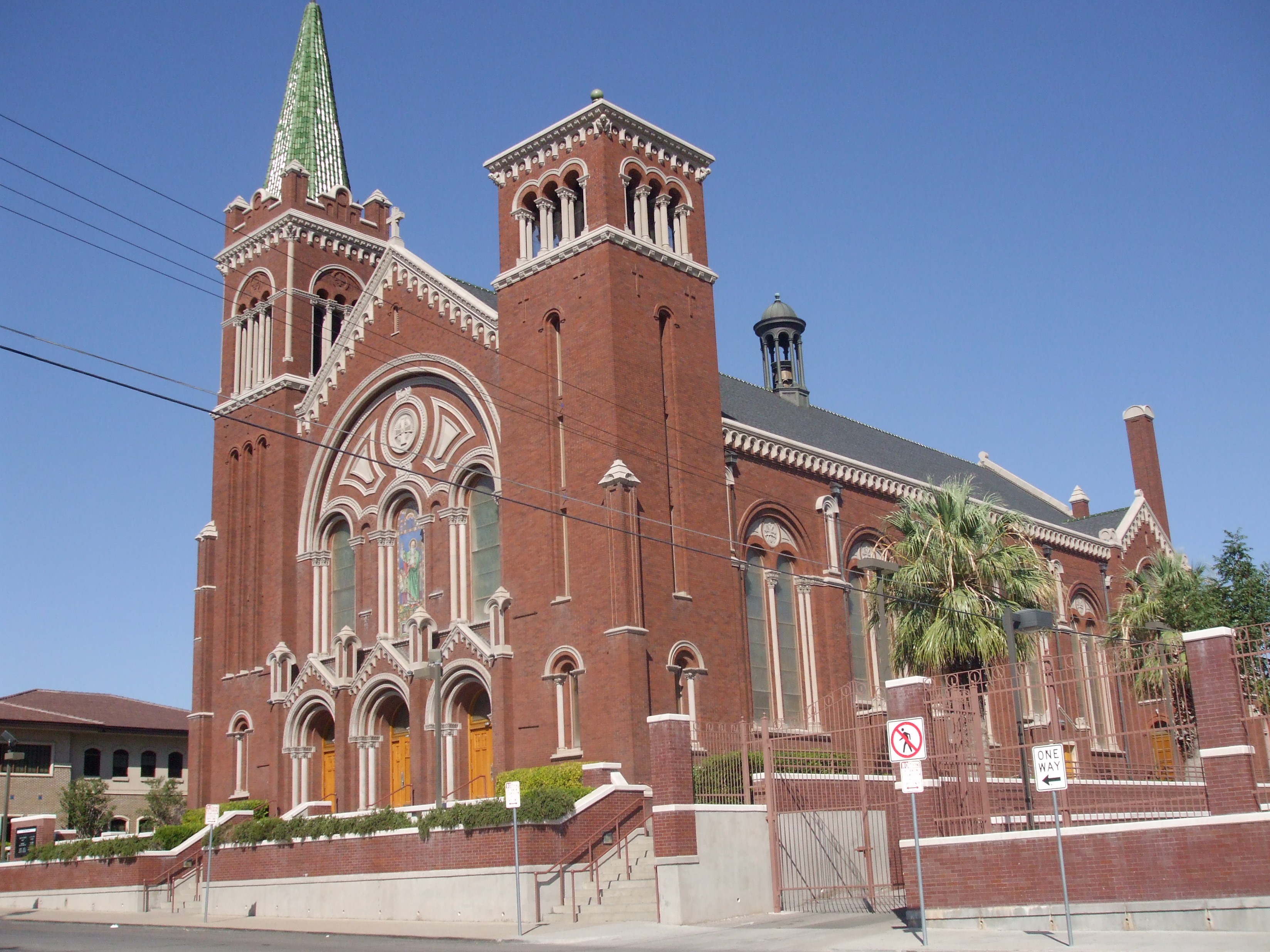
No, this isn't a trick question. That's a church, St. Patrick's Cathedral in El Paso, Texas, to be exact. What do you do in a church?

That's right, you pray. Now, what is this building?
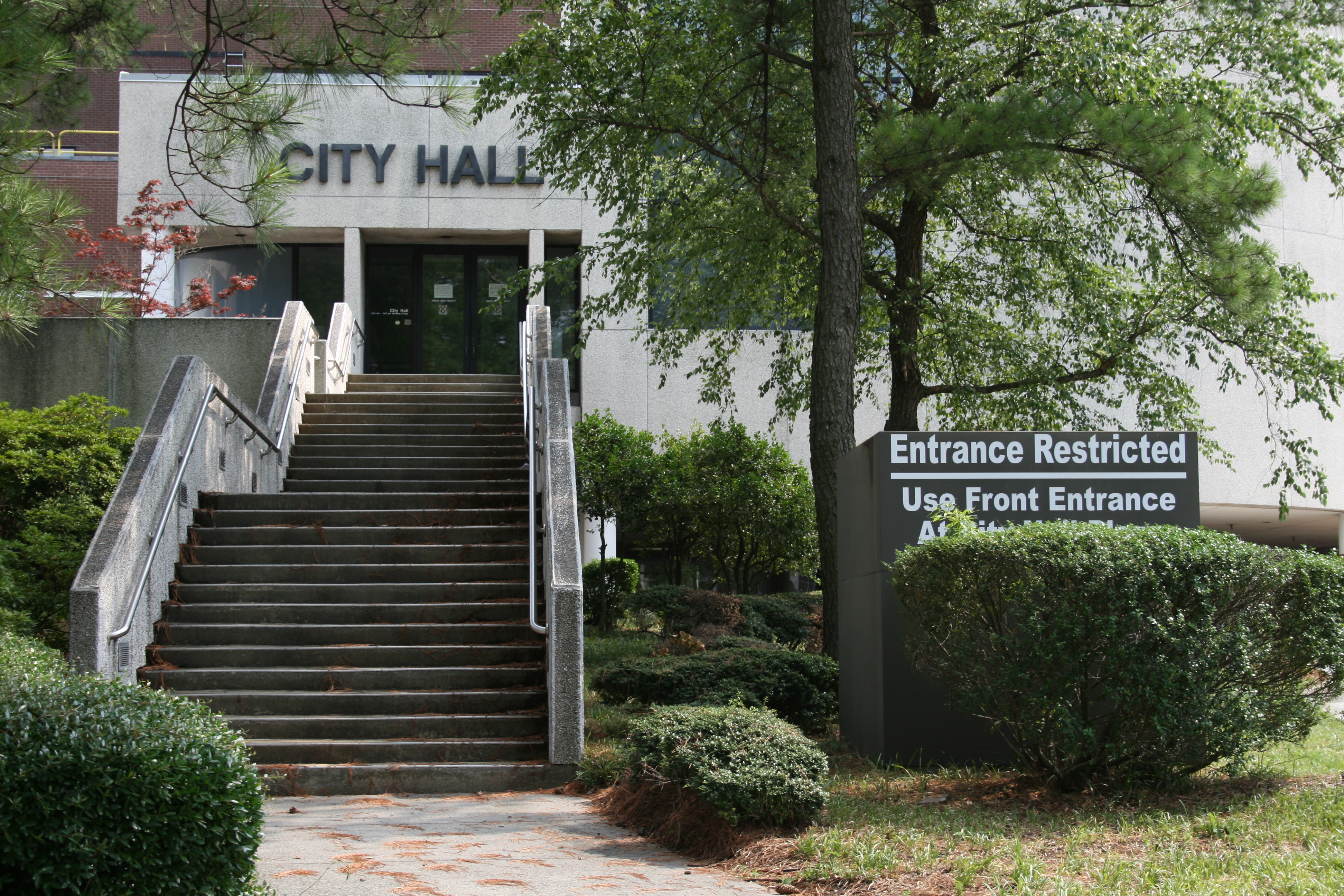
Okay, I picked a picture with kind of a clue in it. This is the City Hall of Durham, North Carolina. And what do you do in a city hall?
That's right, you govern a city, like the Minneapolis City Council is doing above.
These are not trick questions. Nor are they very difficult.
Notice, if you will, how the two buildings are different, and built for doing different things in. The church is for worship, for prayer, for religious activities. The city hall is for government.
What is appropriate in one building is not appropriate in others. Why is this simple consequence of taxonomy (City Hall is not a church) so often ignored? Even here in the very city in which I live!
If a legislator wants to pray before a governmental meeting, there is nothing stopping her from doing so. Even if some kinds of generic legislative prayers are allowed (and prayers that mention specific deities, like Jesus, are not) isn't it at least as important a question as to whether it's appropriate to incorporate prayer into a governmental meeting? City Hall is for the public and it is there to provide a venue for doing the public's business.
I'm not just appealing to your loyalty to the Constitution here. I'm appealing to your sense of decency and appropriate public conduct. You don't see me going into churches and arguing about the law as if it were a courthouse. Wouldn't be appropriate behavior. So please don't go into a building where laws are made and start worshiping a deity. Whether or not the Constitution permits such a thing to happen, it isn't appropriate behavior.
No, this isn't a trick question. That's a church, St. Patrick's Cathedral in El Paso, Texas, to be exact. What do you do in a church?
That's right, you pray. Now, what is this building?
Okay, I picked a picture with kind of a clue in it. This is the City Hall of Durham, North Carolina. And what do you do in a city hall?
That's right, you govern a city, like the Minneapolis City Council is doing above.
These are not trick questions. Nor are they very difficult.
Notice, if you will, how the two buildings are different, and built for doing different things in. The church is for worship, for prayer, for religious activities. The city hall is for government.
What is appropriate in one building is not appropriate in others. Why is this simple consequence of taxonomy (City Hall is not a church) so often ignored? Even here in the very city in which I live!
If a legislator wants to pray before a governmental meeting, there is nothing stopping her from doing so. Even if some kinds of generic legislative prayers are allowed (and prayers that mention specific deities, like Jesus, are not) isn't it at least as important a question as to whether it's appropriate to incorporate prayer into a governmental meeting? City Hall is for the public and it is there to provide a venue for doing the public's business.
I'm not just appealing to your loyalty to the Constitution here. I'm appealing to your sense of decency and appropriate public conduct. You don't see me going into churches and arguing about the law as if it were a courthouse. Wouldn't be appropriate behavior. So please don't go into a building where laws are made and start worshiping a deity. Whether or not the Constitution permits such a thing to happen, it isn't appropriate behavior.
Labels:
Atheism,
Constitutional Law,
Government,
Link Love,
News,
Religion
May 15, 2010
Ravi Zacharias' Six Questions Answered!
At The Atheist Experience, I find a set of six 'questions' from Ravi Zacharias, an evangelical Christian apologist. Matt D. at Atheist Experience does a fine job on his own behalf and I commend his thoughts on the issues Zacharias raises to you. But I'm also offering my own stab at them, one that I hope is somewhat briefer while still being thoughtful enough to be meaningful.
The rest of Zacharias' "questions" are really arguments:
And for the fifteen thousandth time, Hitler was not an atheist.
Boiled down to its essence, Zacharias basically argues with his six questions as follows: "Existence without God would be a horrifying absurdity, therefore, God must exist." I can't think of any facet of that proposition which can be intellectually redeemed.
1. If there is no God, “the big questions” remain unanswered, so how do we answer the following questions: Where did everything come from, and why is there something rather than nothing? Why is there conscious, intelligent life on this planet, and is there any meaning to this life? Does human history lead anywhere, or is it all in vain since death is merely the end? How do you come to understand good and evil, right and wrong without a transcendent signifier? If these concepts are merely social constructions, or human opinions, where do we look to determine what is good or bad, right or wrong? If you are content within an atheistic worldview, what circumstances would serve to make you open to other answers?Zacharias pumps a lot of questions into this single question. Fortunately, all of them are susceptible of brief answers:
- Where did everything come from? Science doesn't know yet. And that's OK.
- Why is there something rather than nothing? Science doesn't know yet. And that's OK.
- Why is there conscious, intelligent life on this planet? Because it evolved here.
- Is there any meaning to this life? The question implies the word "transcendent" as a modified to the word "meaning" and the answer is no, there is not. There is only the meaning that we pick for ourselves. If the modifier is "objective," then yes, there is -- the transmission and propagation of the chemical sequences known as "genes" within the deoxyribonucleic acid embedded within our cells.
- Does human history lead anywhere, or is it all in vain since death is merely the end? False choice. Death is not necessarily the end of the human experience. Nor does death as the terminal experience of human existence (whether individual or collective) necessarily deprive that existence of meaning.
- How do you come to understand good and evil, right and wrong without a transcendent signifier? Through reason, empathy, and experience.
- If these concepts are merely social constructions, or human opinions, where do we look to determine what is good or bad, right or wrong? See the immediately previous answer.
- If you are content within an atheistic worldview, what circumstances would serve to make you open to other answers? (Query as to the grammar here; an "atheistic worldview" is not a question, but I understand what he's getting at -- what would make an atheist previously comfortable with his atheism question it?) Substantial evidence of the existence of an interventionist supernatural entity, viz. a prayer-induced spontaneous regrowth of an amputated human limb.
The rest of Zacharias' "questions" are really arguments:
2. If we reject the existence of God, we are left with a crisis of meaning, so why don’t we see more atheists taking their worldview more seriously like Jean Paul Sartre, or Friedrich Nietzsche, or Michel Foucault? These three atheists recognized that in the absence of God, there was no transcendent meaning beyond one’s own self-interests, pleasures, or tastes. The experience of atheistic meaninglessness is recorded in Sartre’s book Nausea. Without God, these three thinkers, among others, show us a world of just stuff, thrown out into space and time, going nowhere, meaning nothing.Existentialism requires that you explain and justify your own existence on your own terms and not resort to hiding behind fictions like a supernatural overlord. It seems natural that you would sneer at existentialism if you do not possess such a justification for yourself and your actions. If, on the one hand, an atheistic world view necessarily has as its only transcencent meaning other than "one’s own self-interests, pleasures, or tastes" then ultimately the justification for why one does action "X" is either the atheistic answer "because it pleased me to do so," or the theistic answer "because I believed that it pleased God that I do so," which ultimately is really the same thing as the atheistic answer because the theist takes pleasure in pleasing God. And who says that there aren't a lot of atheists who take the existentialists seriously? Understanding existentialism, at any level of sophistication, does not require that one become joyless.
3. If people don’t believe in God, the historical results are horrific, so how do we deal with the regimes of Hitler, Stalin, Mao and Pol Pot who saw religion as the problem and worked to eradicate it? Countless millions lost their lives under these godless regimes, regimes more influenced by Nietzsche’s concept of the ubermensch (superman) than they were by transcendent morality.If people do believe in God, the historical results are also horrific. If you are going to lay some of (but not all of) the genocides of the twentieth century at the feet of atheism, then you must answer for a dozen or so Crusades launched by Christianity, dozens if not hundreds of jihads launched by Islam, hundreds of pre-Nazi pogroms against Jews across Europe, the riots of religion that separated Pakistan and Bangladesh from India, the Wars of the European Reformation, and debatably, the massive extermination partially unwittingly perpetrated on Native Americans by European conquerors, most of whom were motivated by the desire to spread Christianity to the New World. Violence and death are at least as much the result of the presence of religion as its absence.
And for the fifteen thousandth time, Hitler was not an atheist.
4. If there is no God, the problems of evil and suffering are in no way solved, so where is the hope of redemption, or meaning for those who suffer? Suffering is just as tragic, if not more so, without God because there is no hope of it being rendered meaningful or transcendent, redemptive or redeemable, since no interventions in this life or reparations in an afterlife are possible. It might be true that there is no God to blame now, but neither is there a God to reach out to for strength, transcendent meaning, or comfort. There is only madness and confusion in the face of suffering and evil.This "question" presupposes that God is benevolent. If what you are concerned with is succor from suffering, then a malicious or even an indifferent deity is probably worse than no deity at all. And if what you are concerned with is succor from suffering, merely wanting a deity to provide that succor does not mean that such a deity really exists. I would like it very much if Santa Claus really did give toys and presents to good little boys and girls all over the world on Christmas Day. How marvelous that would be! But wanting it to be true does not make it so. In the original article, Matt D. points out also that succor is available from other people, and that the existence of suffering in a theistic universe raises questions about the true benevolence of God, which are also points worth considering.
5. If there is no God, we lose the very standard by which we critique religions and religious people, so whose opinion matters most? Whose voice will be heard? Whose tastes or preferences will be honored? In the long run, human tastes and opinions have no more weight than we give them, and who are we to give them meaning anyway? Who is to say that lying, or cheating or adultery or child molestation are wrong — really wrong? Where do those standards come from? Sure, our societies might make these things “illegal” and impose penalties or consequences for things that are not socially acceptable, but human cultures have at various times legally or socially disapproved of everything from believing in God to believing the world revolves around the sun; from slavery, to interracial marriage, from polygamy to monogamy. Human taste, opinion law and culture are hardly dependable arbiters of Truth.This is simply another way of rephrasing Zacharias' earlier question, "How do you come to understand good and evil, right and wrong without a transcendent signifier?" My answer remains the same: through reason, empathy, and experience. I'll also add that religion (which is not necessarily the same thing as belief in God in this context) has been uses as the justification for every one of the historical evils Zacharias mentions in his question, and indeed more than that. Religion, therefore, is at least as much a perpetrator of evil as a force to ameliorate it. God's existence (distinguished from religion) does not resolve the problem of evil, either, because we are left with Epicurus' quatrain about God and evil:
Is God willing to prevent evil, but not able? Then He is not omnipotent. Is He able, but not willing? Then He is malevolent. Is He both able and willing? Then whence cometh evil? Is He neither able nor willing? Then why call Him God?To be sure, Epicurus is a way of rephrasing the classic issue of the problem of evil, but at least in this argument, Zacharias has not dealt with that issue in any meaningful way.
6. If there is no God, we don’t make sense, so how do we explain human longings and desire for the transcendent? How do we even explain human questions for meaning and purpose, or inner thoughts like, why I am so unfulfilled or empty? Why do I hunger for the spiritual? How do we deal with these questions if nothing can exist beyond the material world? Atheists, particularly atheistic scientists go way beyond their scientific training when they depart from the “how” questions to prognosticating about the “why” questions. Even terms like “natural selection” seems a misuse of words, since only an intelligent being can assess options and choose. How do we get laws out of luck, or predictable processes out of brute chance? If all that makes us different from animals is learning and altruism, why do the brutish still widely outnumber the wise in our world?This question is packed to the gills with false premises. Even if there is no God, human beings make plenty of sense when understood for what they are: animals which are the current product of an ongoing process of evolution which has produced a confluence of self-awareness, tool-building, logical thought, long-term memory, and opposable digits as traits assisting survival of the organism. Like many apologists do, Zacharias again confuse the desired answer to a question with its premise. His desire for a transcendent purpose to life (which exists, or does not, independent of his desire for it to exist) is universalized, incorrectly; his lack of ability to imagine a world without such a transcendent purpose is universalized, incorrectly; his failure to discern that human existence, while perhaps more complex than that of a "lower" animal, is really no different than that of any other species of social animal, is universalized, incorrectly. Indeed, Zacharias presumes that free choice exists, which is a far from certain proposition and one of which I have grown increasingly dubious.
Boiled down to its essence, Zacharias basically argues with his six questions as follows: "Existence without God would be a horrifying absurdity, therefore, God must exist." I can't think of any facet of that proposition which can be intellectually redeemed.
Labels:
Atheism,
Ethics and Morality,
Evolution,
History,
Link Love,
Philosophy,
Religion
May 5, 2010
An Atheist On The Court?
Marc Cooper writes in today's Fish Wrapper that the right pick to the Supreme Court to replace John Paul Stevens would be an open atheist. He confines himself to making some obvious points about how one's religious beliefs do not and ought not be considered to define one's actual civic virtues, and worries that the strict separation demanded by the Constitution has fallen into light regard today. Still, for all the headline-grabbing cachet of Cooper's column, I've got three simple sentences in response:
Not. Gonna. Happen.
Here's why. First, President Obama himself is -- or at least publicly identifies as -- a deeply religious man; he wrote in his autobiography about powerful personal religious experiences, like finding Jesus and entering the fellowship of an active church engaged in many charitable works intended to benefit the community. He has also indicated that he cares about a judge's ethical and emotional makeup, and will look for someone whom he sees as being cast from a similar sort of fiber as himself. This excludes a nonbeliever almost a priori.
Second, while Obama has thrown a few bones of recognition and inclusion to non-believers, both the depth and breadth of his core political support groups are based in no small part on being identified with religious people. Contrary to what a few True Believers insist about him being a secret Muslim, the vast majority of people in the country take him at his word for his religious identification and like him more because of it. At the same time, atheists are the most despised minority in America, and Obama has been careful to not get too close to them in making his public statements. When representatives of the Secular Coalition for America were invited to the White House, for instance, they were briefed by a lower-level staffer and the President himself was nowhere to be found. This is not so big a slight, seeing as a group of secularists had never before been invited to the White House at all, but let's not mistake it for a regular seat at the table, which is something Obama lacks the political flexibility to offer.
Third, there is Jeffrey Toobin's taxonomy of Supreme Court jurisprudence. There are two kinds of cases the Supreme Court hears: first, there are cases involving abortion rights, and second, there is everything else. Both parties have their opposing litmus tests on this issue and even though everybody winks at this fact, let there be no doubt that if there is an overriding attribute Obama is looking for in a Supreme Court Justice, it is to vote against further erosion of abortion rights.
Finally, let's not forget what it is that a Supreme Court Justice is supposed to do -- understand and apply the Constitution to particular cases, in such a manner as to extract important principles and guide the future development of the law. At its core, the Supreme Court is a court of Constitutional law. The individual religious outlook of a Justice is no more important to his or her ability to do that job than is the Justice's race or eye color. Religious belief is simply not as important as the ability to understand the implications of complex Constitutional arguments and the ability to distill the policies and concepts in play down into usable legal rules.
With that in mind, let's take a look at a pretty good assessment of the the short list:
I haven't done any deep research into any of these possibilities to determine their religious identification. But from this list, it would seem that religious identification simply isn't a big factor in the first place. So, who on this list is Cooper trying to choose?
Not. Gonna. Happen.
Here's why. First, President Obama himself is -- or at least publicly identifies as -- a deeply religious man; he wrote in his autobiography about powerful personal religious experiences, like finding Jesus and entering the fellowship of an active church engaged in many charitable works intended to benefit the community. He has also indicated that he cares about a judge's ethical and emotional makeup, and will look for someone whom he sees as being cast from a similar sort of fiber as himself. This excludes a nonbeliever almost a priori.
Second, while Obama has thrown a few bones of recognition and inclusion to non-believers, both the depth and breadth of his core political support groups are based in no small part on being identified with religious people. Contrary to what a few True Believers insist about him being a secret Muslim, the vast majority of people in the country take him at his word for his religious identification and like him more because of it. At the same time, atheists are the most despised minority in America, and Obama has been careful to not get too close to them in making his public statements. When representatives of the Secular Coalition for America were invited to the White House, for instance, they were briefed by a lower-level staffer and the President himself was nowhere to be found. This is not so big a slight, seeing as a group of secularists had never before been invited to the White House at all, but let's not mistake it for a regular seat at the table, which is something Obama lacks the political flexibility to offer.
Third, there is Jeffrey Toobin's taxonomy of Supreme Court jurisprudence. There are two kinds of cases the Supreme Court hears: first, there are cases involving abortion rights, and second, there is everything else. Both parties have their opposing litmus tests on this issue and even though everybody winks at this fact, let there be no doubt that if there is an overriding attribute Obama is looking for in a Supreme Court Justice, it is to vote against further erosion of abortion rights.
Finally, let's not forget what it is that a Supreme Court Justice is supposed to do -- understand and apply the Constitution to particular cases, in such a manner as to extract important principles and guide the future development of the law. At its core, the Supreme Court is a court of Constitutional law. The individual religious outlook of a Justice is no more important to his or her ability to do that job than is the Justice's race or eye color. Religious belief is simply not as important as the ability to understand the implications of complex Constitutional arguments and the ability to distill the policies and concepts in play down into usable legal rules.
With that in mind, let's take a look at a pretty good assessment of the the short list:
- Martha Minow, dean of Harvard Law School
- Elena Kagan, Solicitor General, former Harvard Law dean
- Sid Thomas, Montana federal appeals court judge
- Merrick Garland, federal appeals court judge, Washington DC
- Jennifer Granholm, Michigan governor
- Diane Wood, Chicago-based federal appeals court
- Janet Napolitano, Secretary of Homeland Security
- Leah Ward Sears, former Chief Justice, Georgia Supreme Court
- Ann Claire Williams, federal appeals court judge, Chicago
I haven't done any deep research into any of these possibilities to determine their religious identification. But from this list, it would seem that religious identification simply isn't a big factor in the first place. So, who on this list is Cooper trying to choose?
Labels:
Atheism,
Constitutional Law,
Courts,
Government
May 4, 2010
The Mojave Cross Stays
I have been absolutely swamped at work so it's been a little difficult to find time to analyze the Salazar v. Buono case. Hopefully once I get through trial season and regain my off-work focus, I'll be able to be a more frequent writer. And this case is an absolute mess. This excerpt from the syllabus demonstrates that:
I wouldn't do this with every case; normally I'd just look at the majority and the dissent the way I did a few weeks ago with Newdow v. Rio Linda case from the Ninth Circuit. Perhaps the best way to look at the case is to make a chart showing the positions taken by each of the nine Justices and show where the Court is at.
Notable from Kennedy's opinion is his statement that "The Constitution does not oblige government to avoid any public acknowledgment of religion's role in society." Five Justices – the four dissenters and Justice Alito – all agree that Congress quite transparently wants the cross to remain standing. Alito, unlike his Brethren in dissent, has no real problem with that.
I'm also gratified to see Justice Sotomayor voting with the dissent. Much has been made that Justice Sotomayor is Catholic and her Brother Justices who are also Catholic -- Roberts, Scalia, Kennedy, Thomas, and Alito -- all seem to have visions of a very weak separation between church and state. I had been apprehensive of her opinions on religion-government issues based on a case she heard while on the Second Circuit. Here, though, she seems to have signed off of the strictest separation opinion available, making the dissenting opinion the one that obtained the most votes and articulated the most coherent theory.
With that said, although I disagree with the result he reaches, I must say that I found Justice Alito's opinion to be persuasive, direct, and wonderfully-written. His talents as a jurist really show through.
But equally notable is the fact that in order to permit the Government to take action to maintain the cross, Justice Kennedy must step out of his role as a judge and step into the role of art critic. His intensely context-driven approach tries to have it both ways – to say that yes, the cross is a religious symbol and that's okay, the government does not have to pretend religion does not exist and does not provide people with powerful emotional experiences, and at the same time to say no, this cross, on this rock, in this desert, in this setting, with this history, is not a religious symbol but instead is a symbol of remembrance of the noble dead of our nation's wars now gratefully consigned to our history. To preserve the religious symbol, in other words, he must drain it of religious significance.
If I were a Christian, I'd find that notion more than a little bit disturbing. I only get my religion recognized by the government when the religious symbols lack religious content?
But I'm not a Christian, so instead I find it more than a little bit dishonest. Are we supposed to all collectively wink at the religious significance of the cross and pretend that it isn't a symbol of Christianity? I completely agree that the cross is a powerful symbol that can be used as a symbol of death and remembrance, as a marker on a grave, and is very effective at communicating that idea. But at the same time, it's inextricably intertwined with, inherently the same as, the symbol of the death of a particular man, Jesus, which is one of the central events in the mythology of Christianity. You can't separate out the secular and religious elements of this symbol.
As a lawyer and I find the idea of judges acting as art critics more than a little disturbing. Why does Justice Kennedy's personal interpretation of this cross, on this rock, in this patch of desert, with this history behind it, matter? How is Justice Kennedy's opinion about those facts any better than mine, or yours, or Pastor Joe's, or Rabbi Klein's, or my dog's? At minimum, if we're going to engage in a judicial inquiry about the artistic content and messages expressed by a particular piece of art, well, let's hear from some experts with training and experience in interpreting art. Let's hear from art critics, art history professors, and actual artists.
The big issue in the case is the continued vitality of the "endorsement test." It seems to me that the test is still valid, although it is in significant danger. The Court adopted the "endorsement test" in a case called Santa Fe v. Doe, which had to do with student-led prayers before high school football games in Texas. Under that test, an Establishment of religion is found when a reasonable, objective observer, who is aware of not only the wording of a particular governmental policy but also its history, the intent of the body that adopted the policy, and the way that the policy is actually implemented, would look at all of the relevant facts and conclude that the government was endorsing a particular religion by saying to its adherents that they were favored or part of the "in" group and people who did not subscribe to the religion were part of the "out" group.
The plurality stopped short of saying that the "endorsement test" is not the appropriate way to decide whether an Establishment has happened or not. It actually went through the motions of applying the test to the facts of this case and finding no endorsement. Both dissents explicitly adopted and applied the test and found an endorsement. Only Scalia's opinion (joined by Thomas) did not address the issue of endorsement. But Scalia and Thomas are on record as disapproving of the endorsement test and opinion that it is not really the law at all. Roberts and Alito addressed the test but did not agree that it was the law. So as many as five Justices seem to think that it isn't the law; but seven out of the nine Justices actually applied the test.
It is with respect to this issue that we must most carefully look at whoever it is that President Obama nominates to replace Justice Stevens.
I'm headed out to Las Vegas tomorrow. If there's time, maybe I'll take a moment to see if I can actually see the thing. I doubt I'll have time to drive down to the cross to see it up close, though -- it's something like twenty miles south of the rest stop on I-15 near Cima Road, and The Wife and I have to pick up tickets to see Penn & Teller so there is a timetable.
KENNEDY, J., announced the judgment of the Court and delivered an opinion, in which ROBERTS, C. J., joined, and in which ALITO, J., joined in part. ROBERTS, C. J., filed a concurring opinion. ALITO, J., filed an opinion concurring in part and concurring in the judgment. SCALIA, J., filed an opinion concurring in the judgment, in which THOMAS, J., joined. STEVENS, J., filed a dissenting opinion, in which GINSBURG and SOTOMAYOR, JJ., joined. BREYER, J., filed a dissenting opinion.The factual background is interesting and important to some of the Justices. Back in the 1930's, some private citizens put up a cross on this rock outcropping in a remote part of California's Mojave Desert as a memorial to the veterans who died in the Great War. (They didn't yet call it World War I, because World War II hadn't happened yet.) Later, this land became part of the Mojave National Preserve and fell under Federal management. The cross has fallen or been torn down many times, and rebuilt each time by private citizens under the loose organization of a local chapter of the Veterans of Foreign Wars. Some people gather there every Easter for religious services. For a time, there was a plaque there indicating that the cross was a war memorial but it is not there now. When an employee of the National Park Service complained that he didn't think it was right that the Federal government displayed a religious symbol, he filed suit and for a time the Courts ordered that the cross be "not displayed," with the result that the cross was put under plywood boards that were removed by volunteers for the Easter services and then replaced. Seeking to maintain the cross became a minor political cause, and Congress eventually decided to take action – first designating the cross a national monument and then authorizing a swap of the one-acre parcel of land upon which the cross sits to the VFW in exchange for a five-acre parcel the VFW would dedicate to the Mojave National Preserve, thus enlarging the preserve by four acres and allowing the VFW to maintain the cross. The question was whether this act of Congress authorizing the land swap, obviously intended to allow the cross to remain on display, was constitutional and if not, what the remedy should be.
I wouldn't do this with every case; normally I'd just look at the majority and the dissent the way I did a few weeks ago with Newdow v. Rio Linda case from the Ninth Circuit. Perhaps the best way to look at the case is to make a chart showing the positions taken by each of the nine Justices and show where the Court is at.
Issue? | John G. Roberts (Plurality, concurrence) | John Paul Stevens (Principal Dissent) | Antonin Scalia (Concurrence) | Anthony Kennedy (Plurality) | Clarence Thomas (Joins Scalia) | Ruth Bader Ginsburg (Joins Stevens) | Stephen Breyer (Second Dissent) | Samuel Alito (Plurality, concurrence) | Sonia Sotomayor (Joins Stevens) |
Does Buono have standing to challenge the cross in the first place? | Yes. | Yes. Congress clearly passed this law to dodge enforcement of a prior injunction in Buono's favor, and Buono can pursue enforcement of that injunction today. | No. He has standing only to prevent the cross from being displayed on Federal land. | Yes. He had standing to challenge the cross being there in the first place, so he now has standing to challenge the new law. | No. | Yes. | Yes. In essence, agrees with Kennedy that Buono's earlier standing to sue is still in effect for this case. | Yes. | Yes. |
What remedy is Buono entitled to if he wins? | Joins Kennedy. | Enforcement of the injunction as it is properly understood, which requires that the cross come down and not go back up. | Nothing; he cannot win because he has not been harmed by the land swap. | A new injunction preventing the land swap. | Joins Scalia | Joins Stevens | An injunction requiring the cross to be taken down. | Joins Kennedy | Joins Stevens |
Does the new law require a new inquiry into whether the cross can stay or not? | Joins Kennedy. | No. The cross was unconstitutional before and the new law is specifically written to foster display of the cross, which itself violates the Constitution. | No. The cross cannot be on Federal land and the land swap makes the land non-Federal, so no further inquiry is necessary. | Yes. The new law is a new circumstance and the courts should presume Congress did not intend to violate the Constitution. | Joins Scalia | Joins Stevens | No. The court already decided that the cross violates the Constitution and does not need to address that issue again. | Joins Kennedy | Joins Stevens |
Is the length of time that the cross has stood in the desert important? | Joins Kennedy. | Yes. The fact that the government had it on display on Federal land for so long irretrievably conveys a message of endorsement of Christianity by the Federal government, even if the land is later transferred to a private party. | No. What's important is that the cross is either on Federal land or non-Federal land; the land swap would result in the cross being on non-Federal land in the future and that's all we care about. | Yes. Since the cross has been there for more than 70 years without challenge, it is part of the public consciousness and removal of it now would evidence hostility to religion by the government as well as disrespect for the war dead. | Joins Scalia | Joins Stevens | Yes, but there is no need to inquire into that issue further because it has already been taken into consideration by earlier decisions finding that this cross violates the Constitution. | In essence, joins Kennedy | Joins Stevens |
Is a "Latin Cross" always a religious symbol? | Joins Kennedy. | Yes; sometimes it has a dual meaning as a symbol of remembrance, but it always has some degree of religious content. | Did not address this issue. | No. Sometimes it can be a symbol of death and remembrance, even as to the dead who are not Christian. | Joins Scalia | Joins Stevens | Did not address this issue. | In essence, joins Kennedy | Joins Stevens |
Does the opinion of a "reasonable observer" about whether the cross constitutes an "endorsement of religion" by the government matter? | Joins Kennedy | Yes. And that observer would look at all the circumstances and conclude that Congress intentionally passed this law to keep the cross on that rock and thus advance the cause of Christianity. | Did not address this issue. | Probably not. But even if it did, that reasonable observer would find that the cross in this instance is a war memorial and not an object of religious significance. | Joins Scalia | Joins Stevens | Yes. The government obviously intended to have the cross on public display after the land swap and this conveys an endorsement of religion. | No reasonable observer seeing the government transfer ownership of the cross to a private entity could conclude that the government is endorsing Christianity. | Joins Stevens |
Can the land swap proceed? | Yes. Requiring the Park Service to tear down the cross, then transfer the land to the VFW, which will undoubtedly put it back up and be a private display, is asinine, so it's OK to just transfer the land as-is. | No. There is no need for further fact-finding; we can tell what Congress did and why it did it, and the land swap would violate the Constitution so it should be enjoined here and now. | Yes. It must proceed in order to comply with the injunction and the law. | Maybe. We can't know for sure what will happen after the land transfer or how the transfer will be understood, so more facts have to be developed at the trial court level. | Yes. Joins Scalia. | No. Joins Stevens. | No. The original injunction prohibits it. | Yes. And it can proceed right now, since Congress has selected from one of many different possible appropriate means to avoid the government maintaining the cross while still achieving the political objective of having the cross stay up on the rock. | No. Joins Stevens. |
Is any additional information necessary? | Yes. Joins Kennedy. | No. Congress' intent is clear, and it violates the Constitution. | No. Buono has not been harmed by the proposed land swap. | Yes. More information about Congress' intent and what the VFW will do needs to be put in the record. | Yes. Joins Scalia. | No. Joins Stevens. | No. Essentially agrees with Stevens. | No. Of course the VFW is going to keep the cross up, and Congress wanted that to happen; it's OK that Congress wanted the cross to stay up. | No. Joins Stevens. |
Notable from Kennedy's opinion is his statement that "The Constitution does not oblige government to avoid any public acknowledgment of religion's role in society." Five Justices – the four dissenters and Justice Alito – all agree that Congress quite transparently wants the cross to remain standing. Alito, unlike his Brethren in dissent, has no real problem with that.
I'm also gratified to see Justice Sotomayor voting with the dissent. Much has been made that Justice Sotomayor is Catholic and her Brother Justices who are also Catholic -- Roberts, Scalia, Kennedy, Thomas, and Alito -- all seem to have visions of a very weak separation between church and state. I had been apprehensive of her opinions on religion-government issues based on a case she heard while on the Second Circuit. Here, though, she seems to have signed off of the strictest separation opinion available, making the dissenting opinion the one that obtained the most votes and articulated the most coherent theory.
With that said, although I disagree with the result he reaches, I must say that I found Justice Alito's opinion to be persuasive, direct, and wonderfully-written. His talents as a jurist really show through.
But equally notable is the fact that in order to permit the Government to take action to maintain the cross, Justice Kennedy must step out of his role as a judge and step into the role of art critic. His intensely context-driven approach tries to have it both ways – to say that yes, the cross is a religious symbol and that's okay, the government does not have to pretend religion does not exist and does not provide people with powerful emotional experiences, and at the same time to say no, this cross, on this rock, in this desert, in this setting, with this history, is not a religious symbol but instead is a symbol of remembrance of the noble dead of our nation's wars now gratefully consigned to our history. To preserve the religious symbol, in other words, he must drain it of religious significance.
If I were a Christian, I'd find that notion more than a little bit disturbing. I only get my religion recognized by the government when the religious symbols lack religious content?
But I'm not a Christian, so instead I find it more than a little bit dishonest. Are we supposed to all collectively wink at the religious significance of the cross and pretend that it isn't a symbol of Christianity? I completely agree that the cross is a powerful symbol that can be used as a symbol of death and remembrance, as a marker on a grave, and is very effective at communicating that idea. But at the same time, it's inextricably intertwined with, inherently the same as, the symbol of the death of a particular man, Jesus, which is one of the central events in the mythology of Christianity. You can't separate out the secular and religious elements of this symbol.
As a lawyer and I find the idea of judges acting as art critics more than a little disturbing. Why does Justice Kennedy's personal interpretation of this cross, on this rock, in this patch of desert, with this history behind it, matter? How is Justice Kennedy's opinion about those facts any better than mine, or yours, or Pastor Joe's, or Rabbi Klein's, or my dog's? At minimum, if we're going to engage in a judicial inquiry about the artistic content and messages expressed by a particular piece of art, well, let's hear from some experts with training and experience in interpreting art. Let's hear from art critics, art history professors, and actual artists.
The big issue in the case is the continued vitality of the "endorsement test." It seems to me that the test is still valid, although it is in significant danger. The Court adopted the "endorsement test" in a case called Santa Fe v. Doe, which had to do with student-led prayers before high school football games in Texas. Under that test, an Establishment of religion is found when a reasonable, objective observer, who is aware of not only the wording of a particular governmental policy but also its history, the intent of the body that adopted the policy, and the way that the policy is actually implemented, would look at all of the relevant facts and conclude that the government was endorsing a particular religion by saying to its adherents that they were favored or part of the "in" group and people who did not subscribe to the religion were part of the "out" group.
The plurality stopped short of saying that the "endorsement test" is not the appropriate way to decide whether an Establishment has happened or not. It actually went through the motions of applying the test to the facts of this case and finding no endorsement. Both dissents explicitly adopted and applied the test and found an endorsement. Only Scalia's opinion (joined by Thomas) did not address the issue of endorsement. But Scalia and Thomas are on record as disapproving of the endorsement test and opinion that it is not really the law at all. Roberts and Alito addressed the test but did not agree that it was the law. So as many as five Justices seem to think that it isn't the law; but seven out of the nine Justices actually applied the test.
It is with respect to this issue that we must most carefully look at whoever it is that President Obama nominates to replace Justice Stevens.
I'm headed out to Las Vegas tomorrow. If there's time, maybe I'll take a moment to see if I can actually see the thing. I doubt I'll have time to drive down to the cross to see it up close, though -- it's something like twenty miles south of the rest stop on I-15 near Cima Road, and The Wife and I have to pick up tickets to see Penn & Teller so there is a timetable.
Labels:
Atheism,
Constitutional Law,
News,
Religion
Subscribe to:
Posts (Atom)

 Posts
Posts