Showing posts with label Europe. Show all posts

January 20, 2011

Multi-Lingual Legislatures

So far as I had known, the only multi-lingual deliberative body was the United Nations' General Assembly. But it turns out that the Senate in Spain is a forum in which legislators desire to speak not only the primary language of the nation, Spanish, but also Catalan, Galician, Valencian, and Euskara (the language of the Basque), and the nation includes many speakers of Aragonese, Asturian and Leonese.

One suspects that in the areas near Portugal, Portuguese is also a commonly-spoken language, that English is spoken near Gibraltar, and that near the northern border there is a fair amount of French going on too. That's eleven languages in a country smaller than Texas, five of which are spoken on the floor of the nation's legislature. When The Wife and I visited Barcelona, we saw many more Catalan flags flying than Spanish, and most people spoke Catalan (sounded like Spanish with a lisp to me) and their eyes narrowed just a bit when I spoke Spanish. Yet somehow there does seem to be a common identity, even if many peoples' primary identities are regional rather than national.

The BBC maintains that nearly all Spaniards speak Spanish as a first or second language, however; so the protest that there is a common language and therefore a common ability to communicate and discuss affairs of government is there. I suppose I can understand that spending €12,000 a day on translators who are not really necessary is a waste and people might get a little peeved about that. But really, is it so bad? All told the translators for the Spanish Senate probably cost something around a million Euro a year or so -- and Spain's money problems are much, much deeper than that.

November 11, 2010

The Real Villains

Sometimes I wonder why exactly I can't find it in my heart to condemn Islam so starkly, clearly, and powerfully as Pat Condell:
Then I remember the answer: what Condell is describing here isn't congruent with my own personal experience with Muslims. I've had Muslim clients, I've had Muslim friends, I've had Muslim attorneys as adversaries in cases I've handled, I've hired Muslims as expert witnesses in cases I've handled. In all those experiences, some of them have been friendly and nice, some of them have been kind of jerks and seemed untrustworthy, and some of them have been basically unremarkable. Many of them are immigrants from other parts of the world to the United States and of these, some have adapted better to the culture here than others. Some of them are smart, others not so much.

Put another way: in my own firsthand experience, the Muslims I have dealt with have acted pretty much like any other group of people one might care to identify. Demonization of them is not congruent with my own experience.

Like any other group of people, some of them are going to be assholes. Some of these assholes are going to be assholish about their religion and if one focuses on the media (particularly a partisan press) one might get the impression that there are a lot of assholish fundamentalist Muslims out there. And indeed, there are fanatics and some of those fanatics are dangerous and willing to use violence to achieve their ends. The word that comes most readily to mind when describing people within a society who use violence to achieve their ends is "criminals." I believe criminals should be treated like criminals and their religion is not the primary reason why I condemn criminals -- their harmful, lawless behavior is.

Now, bear in mind that Condell's soliloquy here addresses an issue of what kind of behavior should and should not be criminalized. The root of what Condell is talking about in the video above is not criminal behavior by Muslims, nor should it be. It is assholish behavior by them. It is beyond rude and arrogant for a Muslim to think that he or she can live in and enjoy the benefits of a free society and still make use of the power of the government to prevent themselves from being offended by something someone else has to say. Freedom of speech and freedom of religion does not mean freedom from criticism. Freedom of speech means that the government tolerates the offensive things that people say.

Pat Condell is and ought to be free to condemn Islam without fear of governmental reprisal. That is what freedom of speech means. He also ought to be free from the fear of violent reprisal for his statements. That is what it means to be part of a peaceful, law-abiding society. If something in Condell's speech offends you, you have two primary options which are acceptable in a free society: you may either 1) ignore him, or 2) rebut him.

Same as the Muslims who don't like hearing their backwards religion criticized.

What I fear gets lost in a polemic like the one above is the proper focus of Condell's diatribe. The real villains in the situation he's describing in Austria are not the Muslims. They are the governmental officials who are punishing free speech, who invoke the judicial power of their nation to prosecute someone for the "crime" of criticizing someone else's religion. In a nation that purports to respect freedom and individual rights, there is no other option to the government but to tolerate someone criticizing Islam. The Muslims are availing themselves of a governmental remedy that ought not to exist. It ought to be very obvious that the remedy for speech they dislike is more speech.

I do not think all of the criticisms and condemnations of Islam are valid. I think critics of Islam paint with too broad a brush -- as though a critic of Christianity were to claim that every Christian is, wants to be, or at least admires and supports, people who assassinate abortion doctors. A Christian can condemn both abortion and the people who murder doctors who perform abortions; the vast majority of Christians condemn both.

Is this a logical and consistent position for them to take? I don't much care, because real human behavior with respect to religion is that people pick and choose what commands of their holy books and clerical leaders they will follow and which ones they will ignore. The overwhelming amount of the time, they opt for morally good behavior.

So are there violent, awful, morally indefensible passages in the Koran. Damn skippy there are. Are there Muslims who nevertheless believe in an act upon these morally indefensible passages? Sadly, yes. Those people are, as I mentioned above, "criminals." They should be treated like criminals. Their coreligionists, however, do not deserve to be treated like criminals until and unless they too commit criminal acts. And those in charge of the governmental powers need to be careful about the kinds of acts that they criminalize.

If I believed in God, I would thank Her that I am blessed to be a citizen of a country with a strong Constitutional guarantee of free speech. A prosecution against someone for speaking their mind about a social issue of the day here would quickly run up against a First Amendment challenge and the prosecuting authorities would be scrambling, hard, to justify their actions. If they pressed on, they would earn the rightful condemnation not only of those who agreed with the defendant's political point of view, but others who would see creeping totalitarianism. Witness how Ezra Levant is a hero -- not for criticizing Muslims, but for criticizing and standing up to his own government:
So. Why don't I take on the evils of the Muslim faith? Because it is the abuse of government power which most offends me. Frankly, I expect that a manual of social mores come out of the late Bronze Age Middle East is going to contain all manner of utterly morally indefensible things, and that people who insist on taking those obsolete visions of society literally are going to act in morally indefensible ways.

Those sorts of evildoers can best be kept on the fringes of society where they belong is not through making sure that "their side" always loses in a political fight. The best and most enduring way to keep them out of power, keep them out of positions where they can do real harm to our society, keep them from actually imposing their views on those who do not wish to subscribe them, is to consistently and with principle insist that the government honor as inviolable, and to safeguard as the highest objective of its existence, the civil liberties of the individual.

Those liberties, our best and most enduring protections against the evil theocracy that a small number of fanatic, literalist Muslims would impose on the rest of us, will not be toppled through military conquest. Those liberties can, however, erode. The forces that erode them will not be forces that are obviously and apparently trying to subvert and transform American society. Rather, they will and can only be those forces that claim to be protecting, defending, and conserving that society.

To claim that this is a "Christian nation" and therefore that Christianity is entitled to special, favorable treatment by the government takes away the bulwark of separation of church and state. What will the Christian nation advocates claim if and when Muslims outnumber them at the ballot box and suddenly America is proclaimed to be a "Muslim nation?" They will have already established that the government may favor the majority's religion -- and should they then find themselves in the minority, there will not be the Constitutional guarantee against Establishment of a religion to protect their rights.

The real villains in Pat Condell's diatribe are not the Muslims who complained loudly about being offended that someone in Austria publicly explains why they dislike Islam. The real villains in Ezra Levant's videotaped discovery are not the imams who filed complains with the Alberta Human Rights Commission. The real villains are those who would involve the government in those kinds of issues in the first place. We protect the rights of unpopular minorities not because we like what the minorities do, not because we would make them elites, not because we desire to see democracy subverted or overturned. We protect them because we must limit the power of the government, whether that power is used to an unpopular end or a popular one.

Why don't I condemn Muslims more stridently than I do? Because as awful as 9/11 was, our nation is much too resilient and powerful to collapse because a few buildings were destroyed and some innocent people were murdered. Only we have the power to really destroy ourselves, and such destruction will not be an overt attack but rather a metamorphosis. The real threat is in our own city halls and statehouses, in Congress and the White House, at our own ballot boxes -- a short-sightedness about the expediency of government action to address that which is unpleasant today, without regard for the future disasters that we invite by setting aside the safeguards to our liberties. An intelligent respect for everyone's Constitutional rights, and an independent judiciary to safeguard them, are the best defenses we have available.

October 6, 2010

Silly Anti-Hapsburg Laws

I guess maybe to some people in Europe, it's not so silly to have laws that exclude the descendents of the former royal and noble families from becoming heads of state, but it seems rather silly to me that someone who can run for a country's Parliament and therefore theoretically become its Prime Minister and actual head of government cannot also run for President and become the country's honorary public figurehead:
A descendant of the Habsburgs is taking Austria to the European Court for Human Rights for not allowing him to run for president, his lawyer said Tuesday.
Ulrich Habsburg-Lothringen could not become a candidate in April 25 elections because he lacked the required number of signatures and Austrian law bars members of all ruling or former ruling families from running for the largely ceremonial post.
The Habsburg dynasty was once Europe's most influential royal house and held power from the 13th to the early 20th centuries.
The ban - which only applies to the presidency and is enshrined in the constitution - dates back to 1919 when Austria became a republic after centuries of monarchic rule. It was meant to quash any aspirations to reclaim the throne by members of the former royal family.
The complaint filed with the Strasbourg-based court argues that the ban violates Habsburg-Lothringen's human right to participate in democratic elections, said his lawyer, Rudolf Vouk.

Dr. Habsburg-Lothringen seems like a decent enough fellow on his own website; while there is plenty of blue blood in his veins it seems as though such money as he has is the result of what in America we would call a "small business" as a tree farmer, supplemented with work as a civil engineer and a raw materials purchasing agent for a paper plant.  His politics look to be well within the spectrum of socially-acceptable opinions of his nation, and he even has a blog! It's no more or less crankier than anyone else's; he's annoyed that the accident of his parentage excludes him from running for a particular office.

In America, we have both a ban on hereditary titles or grants of nobility, and a ban on laws that work a corruption of blood. These both seem like eminently fair and reasonable policies for all countries in this modern era of self-government. It's not Dr. Habsburg's fault that his ancestors were nobility. He is a citizen of his nation, he pays his taxes, he seems to have broken no laws. Maybe it's none of my business because I'm not Austrian, but if I were, I'd say, if he is otherwise eligible to run for President of his country, let him stand along with with his peers and solicit the approval of his fellow-citizens.

Since he can't even gather 6,000 signatures to be otherwise eligible to run, I don't think there's much danger that a Habsburg will actually be President of Austria anyway.

Hat tip to Robert Farley.

September 16, 2010

You Can Drive I-94 Faster

High speed rail between Milwaukee and Madison is projected to reach speeds in excess of 79 miles an hour.  Ooh. Aah.

Your tax dollars at work.  $810 million of it, or about one-tenth of the total high-speed rail dollars in the stimulus bill, to be spent so a train can go from Milwaukee to Madison at freeway speeds.

Meanwhile, California's debt-financed high-speed rail transport project has yet to lay a single track, is over ten billion dollars short of the money needed because people forgot to account for inflation when they asked the voters for bonds, and will need to charge fares higher than commuter flights for transit between the two biggest economic hubs of the project, San Francisco and Los Angeles.

Which is all a damn shame, because I've seen in Europe just how awesome a real high-speed train line can be, how it can spur tourism and economic activity. But our friends in Europe invested in rail at the right time; we made other choices about how to invest in our infrastructure.

So now high speed rail in the U.S. is "Reinvestment in America."  Are you feeling' in yet?

May 27, 2010

Whole Lotta Nothing Going On

As a colleague put it to me yesterday, it's amazing the amount of nothing that is happening in the world.

It seems that there is a lot of fruitless effort to do something about the oil spill in the Gulf of Mexico.  In the more good news department for the gulf states, hurricane season is almost here.

There is surprisingly little fuss over a Supreme Court nomination and the Republicans' threats in Congress to filibuster repeal of Don't Act, Don't Tell seem almost desultory (and are likely not well-advised in the long run).  So not much going on in Washington.

If North Korea had torpedoed one of our boats, we wouldn't be sitting around wringing our hands doing nothing, but it wasn't our boat that got torpedoed, it was South Korea's and as best I can tell, the only real response seems to be a firmly-worded scolding aimed in Lil' Kim's general direction.

Southern Europe spirals in to debt and the world market doesn't like it but deals.

And California's state government continues to slide deeper towards oblivion as the state's leaders, in keeping with the general theme of the news, stand by doing nothing meaningful about it, and those who would lead the state in the future offer no real or meaningful alternatives.

Which is all okay from a blogwriting perspective, at least at the moment.  For the time being, I've really got enough insomnia-inducing stressors on my mind as it is, stuff which I typically don't write about here very much if at all.

May 24, 2010

Athens Envy

Speaking as a citizen of the state of California, I look up to the political leaders running the show in Sacramento, and wish, longingly and wistfully, for the comparative financial wisdom, fiscal restraint, and prudent monetary policies that are the hallmarks of modern Greek democracy.

April 23, 2010

Blame It On The Soviets For Going Away

A random thought from a psychologist:  If it seems that our country's political discourse has grown increasingly polarized, intractable, and hostile, blame the Soviet Union for it. 

Specifically, blame the Soviets for collapsing and depriving us of a meaningful enemy.  If we have a common enemy, a common repository for our instinctual aggression and hostility, then whatever differences we have amongst ourselves will pale in comparison and be kept within the realm of manageable political disagreements. 

But each of us has 'X' amount of hostility, aggression, and need for dominance within ourselves, and that holds true for our elected officials, opinion leaders, and everyone else who is making decisions or even simply involved in politics through self-selection.  Since they don't have the Soviets to rally against, their aggression has to find an outlet elsewhere in the form of conflict. 

Thus the viciousness with which we aim rhetoric at people little more threatening than common criminals (now re-named "terrorists") and the venomous state of internal political discourse.  There must be conflict, there must be aggression, there must be a struggle for dominance -- that is built in to being human.  Freud calls it the "id" and Jung calls it the need for the "Other."  So since we have no external enemies against whom we may direct these aggressive impulses, we find new enemies and the only sources of conflict visible are internal disagreements.  Thus, liberals and conservatives scarcely even recognize one another as being loyal to America anymore.

I'm not entirely sure I buy it.  Europe has nasty politics, but Europeans for the most part recognize it as "just politics" and maintain national identity and cohesiveness.  Europeans are just as human as the rest of us, and there isn't a lot of political expression of aggression within Europe, either external or internal, that compares to what can be seen in the U.S.  Consider the leaders of Europe's largest national economies -- Angela Merkel, Gordon Brown, Dmitriy Medvedev, Nicholas Sarkozy, and Silvio Berlusconi.  Of them, only Berlusconi has any discernibly aggressive qualities in his public personality, which in his case manifest not in fiery rhetoric but rather in a mercurial pattern of sexual excess and casual corruption.  The others are dull technocrats.  And before you protest that it's Putin, not Medvedev, running the show in Russia, recall that Putin has his technocratic side as well (although I'll concede he demonstrates more aggression than Medvedev in his public persona).

Still, it's an interesting idea to chew on for a while.

April 15, 2010

Eyjafjallajokull Dirigibles

A volcano in Iceland, which last erupted for fourteen months straight and bears the utterly unpronounceable name Eyjafjallajokull, has begun erupting again, and scattered ash over most of Europe.  Because this volcano's ash contains a high silica compound, if it gets in to an airplane's engine intake, the silicon will melt and cause the engine parts to seize up, causing what airlines clinically call "major asset loss."

On NPR today, I heard an interview with a guy in Oslo who needed to travel to London, and he was trying to figure out how to take a train from Oslo to Stockholm to Copenhagen to Brussels to London and figured that he could get there in about thirty hours.  Getting back home, well, he hadn't figured that out yet.

So The Wife and I got to talking about what a realistic alternative might be, given that airplanes are, for the time being, simply not safe to fly in Europe.  "Airships," was her answer, and I thought, "Yeah, that's right!"  I thought I had heard that modern airships can sustain ground-speed equivalents of about 60 mph, but a little research shows at least one claim that the Hindenburg got up to 100 mph when it had a tail wind.

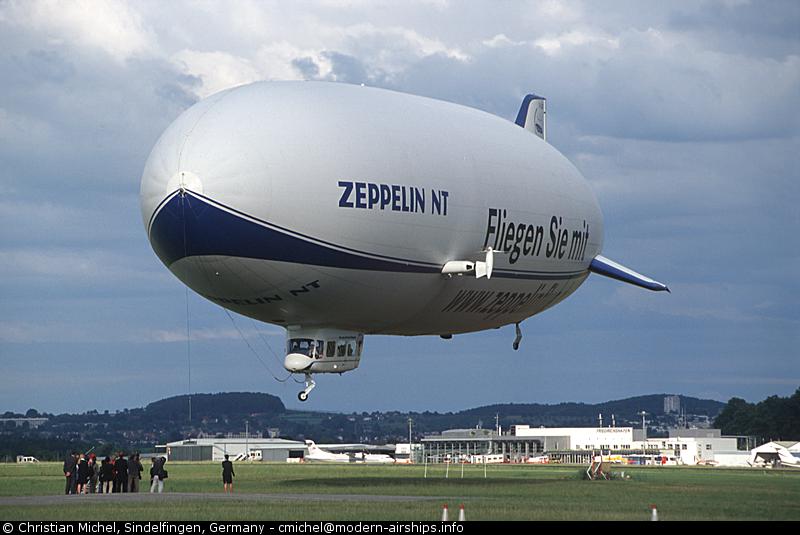
A blimp is an airship without a rigid structure to its bag and relies on pressure differentials with the outside atmosphere to keep the shape of the bag in place.  A "blimp" is usually contrasted with a "zeppelin," which is actually a name for the product of a manufacturer, Zeppelin Luftschifftechnik of Friedrichshafen, Germany, which makes rigid-framed dirigibles.  It resumed commercial passenger flight (for sightseeing, mainly) on August 15, 2001 in Germany, Switzerland, and Japan.  The Zeppelin NT advertises an operational range of 900 kilometers and a top sustainable speed of 125 kilometers per hour, or 485 miles at 78 mph -- and it seats twelve passengers.

So for the guy trying to get from Oslo to London, alas, current airship technology won't do.  But it can be done -- the Graf Zeppelin circumnavigated the globe, with stops along the way in major cities.  The direct route is about 780 miles, or more than half again the Zeppelin NT's range, and with only twelve passengers on board, the trip would be prohibitively expensive.  Still, ten hours in an airship would be better than thirty hours on a train, if those twenty hours are valuable enough to be worth purchasing.

February 23, 2010

Turkish Democracy

One of the countries I keep a close eye on internationally is Turkey.  It's not just that there are plenty of predictions that Turkey will rise to global prominence over the course of this century, or that as one of the few NATO members (and possible EU members) that is primarily Muslim its existence is a powerful signal that the West is not engaged in a religious crusade.  Or that the political relationship between Turkey and my own nation is a murky, complicated stew of social tensions and affinities.  It's also that Turkey is a crossroads of visions for the future -- it straddles the competing impulses of secular liberalism and theocracy, and if it goes down the second of those roads, it will do so by democratic means.

So it's big news to hear that an alleged coup by the secularist military seems to have been suppressed with the simultaneous arrest of more than fifty top commanders of the Turkish military.  Obviously, these generals and admirals haven't had a chance to give their side of the story yet, and some of the claims are more than a little bit wild, like the one that they were planning to shoot down a Turkish jet and blame it on the Greeks to incite a war and thus seize power.  It's no secret, though, that the military would have preferred a more secularist government to take power; the current Prime Minister of Turkey is from an openly religious political party.

Seems to me that the best way to do that would be to win an election rather than stage a coup.  Which may be a factor in the decision to arrest these men -- the incumbents may be trying to discredit their opposition rather than out-argue them in the political arena. 

There has been some silly talk of military action in the political arena here, but it's been mostly fringe stuff and the promise of the political pendulum's incipient swing back to the right in this year's elections seems to have silenced that stuff.  That's because we are fundamentally committed to democracy in the U.S. and we hope that our allies, like Turkey, are too. 

It's interesting to note, though, that both sides of this dispute in Turkey will claim to have been acting in the interests of a democratic Turkey despite both being basically non-democratic in their thinking.  A religious party ultimately winds up advocating the adoption of theocratic rules and principles to underlie its lawmaking and bolster its claim to legitimacy.  But like the western Bible, the Koran is a fundamentally non-democratic document.  And of course the military is a fundamentally non-democratic institution.  "Democracy" may well be a gloss on the more abstract political idea of "legitimacy."

At the end of the day, though, Turkey must choose for itself a path for its future.  While it is not clear that Turkey can be integrated into the EU, the potential for that as a means to solidify Turkey's commitment to the west and the rule of law and democratic government and ultimately secular government is tremendous.  We should wish Turkey well in those efforts.  Along the way, Turkey will become enriched and the lives of ordinary Turkish people will improve, but the Turks' historical rivalry with Greece will need to be reduced to soccer matches and the occasional international lawsuit over control of Aegean islands used mostly for tourism.  Down that path is a Fukuyama-ist future of long-term economic prosperity highlighted mainly by rather dull trade disputes and political balancing of environmental protection against the expansion of industrial and service-sector economic growth, a world in which big decisions will be resolved by lawyers and businesspeople and but for language differences, Turkey looks a lot like the United States or France or Germany.

But there is another path, one that looks east of Ankara rather than west of Istanbul.  Down this road, Turkey cools and ultimately severs its military relationship with NATO and decides to go its own way economically outside of the EU.  Instead, it enters into a de facto but unannounced partnership with Iran and Russia to contain expanding U.S. power in the middle east, centered in a democratic Iraq and a democratizing Jordan, seeking to eclipse Saudi prominence in wealth and religious prestige, while using diplomacy to dance around the military power of Israel.  The ultimate goals in this path is to first become the open regional leader and then to lure Iraq out of the geopolitical orbit of the U.S. and create a coalition of nations between the Mediterranean and the Persian Gulf such that supported by this regional alliance, Turkey becomes not just a regional leader but a global power in its own right.  Down that path ultimately lies a significant war once this coalition sufficiently contains its back doors in Arabia, North Africa, and Persia, and looks to southeastern Europe as its final avenue of expansion.

December 12, 2009

Weekend Weirdness, Volume IX

LOLCats -- annoying the hell out of you since 1929!

After Japanese stereoscopic photography was rediscovered, so was the lost art of stop-motion photography, this time by disaffected Spanish college students

Living on a cliff:  probably not a good idea for the vision-impaired or families with small children, but it does allow strangers from around the world to visit your home town and take pictures of your house.  If you're, you know, European.

Origins of common superstitions.  Does anyone believe in this stuff anymore?

Not so much weird as very gratifying to see -- a photograph from a dance in 1944 sponsored by a Federal workers' union.  Notice that white ladies are dancing with black soldiers and everyone seems to be having a good time.  Perhaps less gratifying: you are never more than 145 miles from a McDonald's, anywhere in the continental United States.

The best beer cozies available -- link also contains reports of science experiments concerning flammable jell-o shots and an NSFW inquiry about what happens when you wear 625 condoms at once.  Seriously, you know you can't resist this one.

Pac-Man: The Movie.  Or, if you prefer, a whole bunch of movies fraught with anxiety about female sexuality.

November 9, 2009

The Day Harald Jäger Ended European Communism


On November 9, 1989, an obscure post commander in the (perversely-named) German Democratic Republic named Harald Jäger, perhaps unwittingly, ended European Communism as a global political force, setting in motion unleashing a chain of events that led to the collapse of the Soviet Union.

Earlier in the day, a spokesman for the Politboro, Günter Schabowski, received a note just before briefing a few members of the press.  The note indicated that the East German government would be easing some travel restrictions for Berliners, to appease protestors.  When asked when those eased travel restrictions would go into effect and liberalized visas to the west would be issued, the confused and apparently misinformed Schabowski said, “As far as I know, immediately, without delay,” and the word got out to some people who very much wanted to go visit their families on the other side of the Berlin Wall.  They began lining up at border crossings and demanding to go across.

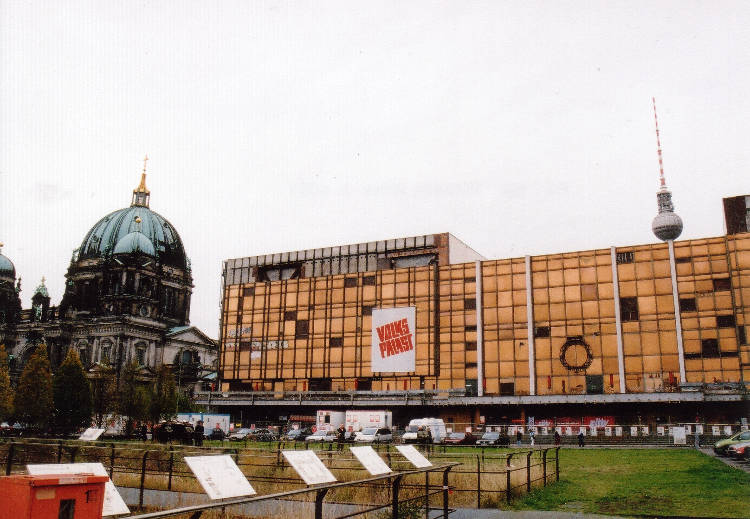
There was no such policy; Schabowski had been given a garbled instruction to indicate that the Politboro was considering more liberal travel visas but no decision had been made by the Soviet stooges who were running the show in Europe's most ugly governmental building.

Harald Jäger was the post commander for the GDR at the Bornholmer Gate, which is not as well-known as the Brandenburg Gate or Checkpoint Charlie, but was one of several authorized crossing-points in the Berlin Wall.* Jäger's role in these events is succinctly described by Dana at Edge of the American West:

In a nearby possible world, this story ends with a bloody riot. Armed guards shoot the boldest of the misinformed citizens; the uninjured retaliate. Guards are killed, the police put down the riot, and the Wall stands, not forever, but for a little while longer as the Soviets eased into openness.

In this world, Harald Jäger, in command at the Bornholmer Gate, decided not to shoot. He called his superiors, who of course had heard of no such policy change, and faced with the gathering, chanting crowds, decided to let a few cross the border; by midnight, he simply opened the gate to all, not taking names or checking identification.

What happened next seems to be well-known history but especially if you are still in your twenties, it's going to be difficult for you to understand just how momentous it was. The crowds of East Berliners were heard and West Berliners also gathered at the wall. Seeing that the GDR's guards were doing nothing to stop them from crossing, more went across, then in the crush a group of Berliners removed a gate, and from there a kind of mania took hold. Ordinary people began to literally tear down the Berlin Wall, brick by brick, one fist-sized lump of ugly gray concrete decorated with graffiti after another.

If East Germany's political leaders had their acts together, they'd have put a stop to this, Dana's sour description of the alternative world was what would have happened.  By letting the easterners cross the border, Harald Jäger was putting his career and maybe his very life at risk.  If this had been 1988 instead of 1989 -- or if the GDR's government had been able to get its act together -- Jäger would have been court-martialled for dereliction of duty and possibly executed as a deterrent to others in similar positions.

But they didn't have their act together.

East Germany's political leaders were paralyzed by a deep economic failure that their political ideology had told them was not even possible and which their politically-slanted educations had not armed with tools to address.  They were still reeling from the political success of Solidarity in next-door Poland, stunned that the ordinary people of an enlightened Socialist regime would so thoroughly reject Communism in the face of its political promises and overwhelming power.  So when the East Berliners showed up and demanded that they be allowed to see their cousins in the west because of a bureaucratic mistake, the sad old gray men driving a rusted tank the wrong way down history's path simply had no way to really understand even that such a thing could happen in the first place, much less what to do or what orders to give.

So Harald Jäger's instruction to let the people pass stood in place. The border guards did not shoot. Most likely, they hated the wall as much as any other German did. Most likely, they envied the prosperity and freedoms of the West as much as did the citizens they were supposed to be controlling. In some cases, they joined in the efforts to break through the wall and tear down the division in their city, in their nation, their world.

The Germans tearing the wall down chanted "Wir sind das Volk!" ("We are the people!") and the leaders of the Second World trembled and dithered. Within weeks, Solidarity was openly challenging the legitimacy of a paralyzed Communist dictatorship in Poland that had kept power after Solidarity had won overwhelming majorities in the first elections of their kind earlier in the year.  The Velvet Revolution brought down the Czchoslovakian government. Hungary had also bowed to popular demands for actual multi-party elections earlier in the year, and the government there also faced the inevitable.  The Soviets yanked their stooge Todor Zhikov from power in Bulgaria.  In Romania, Nicolae Ceauşescu held on to power after it had rotted and suffered a violent end.

The Fall of the Wall was perhaps the high-water mark and the most visible symbol of the Revolutions of 1989.  It was not the start; the movement started with Lech Walesa in Poland in 1981.  It was not the end; that happened on December 26, 1991, when the Soviet Union dissolved, spinning off its constituent republics into autonomous nations and ending the bi-polar world that two generations had grown up with.  But today the event is being largely ignored.  There will be a ceremony with a few celebrities at Bornholmerbrucke, and U2 gave a free concert at the Brandenburg Gate Saturday.  The President of the United States may note the anniversary in a public address, or he may not.

And it's not just we in the USA who are studiously ignoring what ought to be an important anniversary -- the Germans themselves have given the moment scant attention. "Tourists don't visit Bornholmer Strasse and the locals who use the bridge don’t pay the place much mind, so no one much notices that the unlit plaque is impossible to read after dusk." They can perhaps be forgiven for this; they've spent the past twenty years integrating the eastern provinces of their split nation into a single political and economic unit, while struggling with the heavy legacies of the history that caused Germany to have been split in the first place. Along the way, they've also become the heavy-hitters and the first among equals within the European Union.

And perhaps we can be forgiven a little bit, too -- 1989 was a time before the media had adopted "narratives" to allow us to interpret events and the man most identified with bringing down Communism, Ronald Reagan, was out of office and therefore not personally presiding over the Fall of the Wall. So historically short-sighted are we Americans that Reagan's departure from office a mere ten months previous was not associated with the momentous events that started in Berlin twenty years ago today. But it was Ronald Reagan who dealt the knockout blow to the Soviet Union by forcing it to spend itself into oblivion to compete with the USA in the military sphere. While it took that giant a year or more to stagger, totter, and fall from the force of those blows, fall it did. Mikhail Gorbachev, for his part, gets credit for realizing what was happening and ensuring that it would happen peacefully and not with the military seizing power and doing what a military does when it has no other option. Gorbachev was informed by a deep sense of history in his actions.

But at the end of the day, the Revolution of 1989 was the work of the eastern European people, not the work of Gorbachev or Reagan. It began with Harald Jäger -- a man who decided to exercise his humanity in the face of a senseless bureaucratic mistake.  For all of the problems Europe and Russia have had to confront since then, the world is a better, safer place because of it.

* Bornholmerbrücke can be seen at Google Earth coordinates 52.55488 N, 13.398274 E.  The gate was on the east side of the bridge along Borhnolmerstraße.

September 1, 2009

When The Poles Invaded Germany

When thinking about the Nazis, we tend to think of them as utter and complete scumbags, sociopaths and criminals all. This is correct, but it's not only because of the death camps. Take a wander over to The Edge of the American West and read about Operation Fall Weiß.

It's no coincidence that Operation Fall Weiß happened eight days after the announcement of the the Molotov-Ribbentrop Pact on August 23, 1939, which was unquestionably Hitler's master stroke in diplomacy. With the stroke of a pen, Hitler was able to close off a front and shift the balance of power in Europe such that he suddenly had enough assets to credibly mount a war of conquest. And, like Caesar and Pompey twenty centuries previously, carve out for himself a big chunk of land to take for his very own.

To provide a moral gloss on his planned invasion of Poland was the really audacious part of his plan. On August 31, 1939, SS troops dressed in Polish uniforms and "invaded" a German radio station near the border, "killing" innocent civilians and a few border guards along the way. "Casualties" were left behind dressed in both Polish and German uniforms. In fact, the "casualties were political dissidents and Jews who had been freshly murdered. Hitler appeared before the Reichstag the next day (seventy years ago today), dressed in a bloody coat, which he claimed had belonged to one of the German guards who had died defending against the unprovoked invasion by Poland, and vowed that "from now on, bombs will be met with bombs." The Anschluss had come to Poland.

Now, the western powers had finally had enough at this point. War was declared in response to Hitler stepping up to take "his" half of Poland. And thus on September 1, 1939, the Second World War began.

The thing of it is, if it were stage-managed well enough, Operation Fall Weiß might have fooled a gullible press even today. Given the lack of ubiquity of cameras and internet links in 1939, who knows? There might be people who even today would apologize for the misunderstood, maligned, peace-loving Nazis.

Oh, wait, there are. That article, at least, should be an acid test for separating the sane ones from the crazies.

January 14, 2009

Nothing Stings Quite Like The Truth

The Czech Republic began its six-month term as the rotating host nation for the EU Presidency in January. So that means that bureaucrats, lawyers, legislators, and other politicians from around Europe are all traveling to Prague to conduct business. And when they do, they're seeing art that the Czechs have placed on public display, including the piece by David Cerny which is the subject of this article.

Cerny's piece, "Entropa," provides a graphical description of various EU countries. Except for the UK, which is conspicuous by its absence (reflecting Britain's vacillation about joining its continental sister nations and adopting use of the Euro). Some of it is immature, like the depiction of Romania as a Disneyland-style Count Dracula-themed roller coaster ride. But my favorite piece has to be France: "Grève" is French for "On strike." Which it seems someone in France always is, causing all sorts of annoyances when you want to do things in or concerning France like, say, send mail or buy something. But what can you do? Thirty-four hour work weeks, free health care, and mandatory month-long vacations are simply not enough for the oppressed and hardworking French laborer. Vive le prolétariat.

Oh, sure, he could have depicted France as a hexagon or a fleur-de-lis or used Marianne. But that's been done. This is much more contemporary -- and, bitingly accurate, which makes it funny.

July 13, 2008

Update On The War On Drugs

Pot. Ganga. Weed. Chronic. Cannabis. The Sacrament. Hash. Skunk. Dope. Bud. Roach. Four-Twenty. Doobage. Reefer. Grass. Herb. Wacky Tobacci. Mary Jane. The list of euphemisms is thousands of entries long, but you know what I'm talking about -- marijuana, that ubiquitous scourge of modern civilization. Well, "scourge" may not be so accurate, it's sure as hell ubiquitous.

Turns out, your average American is more likely to have tried pot than your average Dutchman, or indeed any person of any other nationality on the planet. So much for the idea that legalization necessarily creates greater use of the stuff -- pot's been legal in "coffee houses" in Holland for decades, but you're more likely to have sampled the stuff if you live here in the States, where it is (theoretically) illegal.

I don't use pot. I've smoked it once -- I took a hit from a friend's spliff at a party back in school, and immediately got a splitting headache and experienced no pleasure at all. I haven't had any interest or curiosity since. But obviously, some people do get high from smoking it, even if I apparently lack the skill necessary to smoke pot right.

But even though I don't use pot, it seems that the fervent legalization advocates (who all, it seems, actually do use it regularly despite the nominal illegality of the substance) have got basically all the cards in their favor if you look at the issue rationally. Smoking pot is really not any more harmful than smoking tobacco -- yeah, smoking a lot of it can make you kind of dumb, and people who do nothing with their lives but smoke pot and talk about how great smoking pot is are both tedious and annoying. But query if such a habitual pot-smoker was all that smart or interesting to begin with. I know several people who spark up occasionally and are very, very intelligent and quick-witted.

That's not to say that it's good for you (in most cases) to smoke pot; but it's not good to smoke cigarettes or to drink alcohol, either. Nor would I believe anyone who said it wasn't addictive. I might believe someone who used it but claimed to not be addicted. But here's the big question -- so what? What business is it of the government's to tell you whether you can smoke it in the first place? I agree that in theory the government has the power to regulate or ban it, but the government theoretically has the power to nationalize residential housing, or to criminalize the consumption of cheeseburgers. That wouldn't make doing those things either sound public policy, an affordable undertaking, or more importantly, the right thing for a government of supposedly free people to do.

And I know perfectly well that "medical marijuana prescriptions" are in most cases simply bullshit scrips that candyman doctors write because they know that pot is no more harmful than anything legal their patients might consume. It doesn't take too much shopping for doctors to find a candyman, and in the grand scheme of things, a marijuana scrip is probably less harmful than some of the other prescriptions for "legal" drugs to which doctors get their patients addicted.

In the meantime, the Federal government spends about thirteen billion of dollars a year trying to inderdict the cultivation, importation, distribution, and consumption of illegal drugs, including marijuana. That money could be either diverted to other uses (whether law enforcement or otherwise) or better yet simply cut out of the budget altogether so as to reduce the deficit. We get some interesting information as a result of all that money -- for instance, we learn that the largest national cultivator and producer of marijuana is (drum roll, please) the United States, that marijuana is the largest cash crop produced in the United States as measured in both overall production and profitability, that THC content (that is to say, quality as measured in the form of potency) is increasing, and that global production increases even as global demand declines. So there is more of the stuff than there ever has been before, and it's getting cheaper all the time.

What this tells me is that trying to stop the marijuana trade by outlawing it is a massive exercise in futility. Anyone who wants to get pot will be able to do so with remarkable ease and almost anyone can afford to smoke. I don't know the street price of the stuff (like I say, I'm not a user) but considering that a lot of people with limited economic means find a way to buy and smoke the stuff, it can't be that much more expensive than tobacco or liquor, for which there always seems to be enough money.

And we have an instructive example of what happens when a substance that is the subject of such high demand and low cost is banned -- Prohibition. Booze became cheaper and more plentiful when it was criminalized in the 1920's. The same thing has happened with illegal drugs, particularly with pot.

Legalization would not solve every drug-related problem. It would replace our existing problems with a new set of different problems. But I'm no longer convinced that one of those problems would be a permanent increase in consumption of the stuff. Anyone who wants it gets it and smokes it already. And I'm also confident that we have a social and governmental infrastructure that can at least tackle, if not control, the problems that legalization would create -- we have the ability to control and tax the manufacture and sale of tobacco, for instance, so some interdiction money could be diverted to expanding those resources as marijuana moved off the street corners and into the 7-11 to be sold alongside the Marlboros.

We'd be better off if we stopped trying to criminalize the stuff and instead worked with and not against the market. Because the market is going to win every time.

June 14, 2008

On The Difficulties Of Adopting A European Constitution

Ireland voted against the Lisbon Treaty a couple days ago, scotching efforts to knit the European Union ever closer to a single political entity, a United States of Europe. Irish voters saw too many downsides to Lisbon, too many infringements on their individual lifestyles. Likely each voter had their own reason, and many Irish voted for the treaty, but the result was what it was.

The hand-wringing comes from the issue that Ireland represents less than 1% of the EU's population, and particularly EU advocates are suggesting that giving so small a proportion of people the right to have their way is profoundly anti-democratic.

But the EU is not like the USA. From the beginning of its revolutionary origins, there was a sense of commonality between the various American colonies, a sense of solidarity and mutual identity. People in Virginia took it personally when Boston's residents were shot by the redcoats. Philadelphians saw a threat to themselves and their way of life when North Carolina merchants had their cargo seized by the Royal Navy. This is not the case in the EU -- while Europeans identify with one another much more than they ever have at any point in history, Europeans still think of themselves as citizens of their nations first, and citizens of the EU second. What happens to a Spaniard is not necessarily something a Swede is going to identify with on a personal or emotional level they way it would if it had happened to another Swede. Canadians do not think of themselves as NAFTA citizens first and Canadians second; so too does someone born in Munich think of herself as a "German" first and an "EU citizen" second.

Politicians have had visions of a United States of Europe since at least Winston Churchill, and probably you could go back to Metternich. And other leaders have dreamed of a united Europe brought together under the sword and rifle; Napoleon and Hitler most prominently among them in the modern era, and Charles V and Charlemange most successfully. But if something like a united Europe is ever going to come about through democratic means, it must do so on a nation-by-nation basis, and everyone involved must see some advantage to coming together. The Irish get to say, "Hey, that might look really good in Paris and Milan, but it doesn't make much sense to us."

So EU advocates need to appeal to nations as well as to Europe as a whole. If Ireland doesn't get a decisive vote, then Ireland's sovereignty lacks meaning, and the more populous EU nations (France, Germany, the UK, Spain, and Italy) are simply imposing their will on the rest of Europe. The EU politicians make the mistake of thinking that all Europeans already think like them, in pan-European terms. They've lost sight of the fact that democracy consists of individual people, making individual choices, about what is in their individual best interests.

My real question: Adoption of things in the EU doesn't have to require the unanimous consent of every member nation. The British opted out of using the Euro, for instance, and kept the Pound Sterling because that works better for them. It's an inconvenience for EU citizens traveling to the UK, but they deal. Why couldn't some nations adopt and bind themselves to the Lisbon Treaty while others could not? Let's say only the Five Big Dogs in the EU signed on to Lisbon and the other EU nations didn't. If politicians in Sweden saw that Germany was doing better because of Lisbon, they'd get Sweden to sign on to it. That's the model used here in the USA -- a little thing I like to call federalism. Europeans are smart enough to understand this idea.

Another question: why are the various elections for EU referenda staggered around the various nations on various dates? Seems to me that staggering elections for various localities made sense in the days when information traveled from place to place on horseback, but now that the Euros have the internet and cell phones, it seems to me that every country could vote on the same day.

April 17, 2008

Is It The 1970's Again?

No bell-bottom sightings at this time, but I'm starting to see more similarities than differences. Consider:

The dollar is weak. Monopoly-money weak.

We're in a lingering, indecisive, expensive, and still-dangerous tail end of a protracted foreign war, in which the definition of "victory" has changed multiple times and for which there appears to be no acceptable termination strategy.

Real estate isn't worth the paper it's printed on. The housing industry -- real estate sales, new home construction, and everything associated with it -- is at the lowest point it's been in twenty years. The stock market has five straight days of SUCK for every day the bulls win.

Our allies in Europe mistrust us.

Mid-level jobs, suitable for people of ordinary levels of education and experience and willing to accept high-level blue-collar wages, are fleeing the country.

We're looking at a serious wave of inflation that our economic leaders can do nothing to stop -- because they can't make interest rates be both high (so that money actually has value) and low (so that people can actually get it to use) at the same time. At the same time, we're entering a recession. There's a name for this phenomenon: stagflation.

Oil and products made from it are suddenly ludicrously expensive. American auto manufacturers, however, continue to crank out big, gas-guzzling supervehicles despite consumer demand for smaller, more fuel-efficient means of transportation.

A whole wave of college kids who earned their chops protesting the war and the policies of conservative adults find themselves somehow aimless and angst-ridden with a centralized focus for their anger evaporating.

Movies are adopting themes of paranoia rather than patriotism. Members of our creative class are fleeing the country.

The likeliest next President is a Democrat, campaigning on a platform of somewhat nebulous "change" that is more much emotional than it offers substantial policy changes, making heavy reliance on his personal religiosity, but who first must survive a bruising primary battle with a pillar of the party of doubtful personal integrity, and then will have a huge general-election advantage against a Republican who, through no particular fault of his, will have to carry the previous administration's water and thus take the heat for how much things suck right now.

We're debating about whether we should build nuclear power plants.

America fears losing its place of global dominance to a secretive nation controlled by Communists who think nothing of brutally repressing their own people to present a sanitized but obviously false vision of their nation to the world, yet who also seem to preside over a nation starting to move up a long-term economic upswing.

At the same time, we're terrified of what several thousand illegal immigrants from Mexico might to do to our economy.

Am I right? Is this 1975? I was a little bit on the young side, but the general consensus seems to be that for the most part, the 1970's sucked. How do we make it not be like that again? Or is it too late?

February 27, 2008

A Buck Fiddy

Today marks the first time that the Euro has traded for $1.50 in U.S. money. That's right, a buck fifty buys you only a single Euro. This is not good news for Americans planning to live abroad right at this exact moment. It also means that the dollar will need to strength significantly, or I will have to win the Lotto, before I can go visit my cousins in Italy again.

They, on the other hand, might be able to afford a trip here if they can only scrape together enough money for the airfare. After all, the exchange ratio works two ways, and to them, a dollar would only cost seventy-five cents. It would be fun to show the suddenly-rich Italians around Los Angeles, and good language practice for me. "Sì, questo è il luogo dove ha ottenuto un travestito en l'auto de Eddie Murphy." "Te piace il cane de Dodger?" "No, sarebbe scortese chiedere Signora Hilton per il suo sopra del' bikini. Non importa che lei è ubriaco. Dobbiamo invece avere alcune sushi."

February 9, 2008

The Weakening Dollar, or, Looks Like A Long Time Until We Can Go Back To Europe

It's a measure of the relative economic strengths of a country as to which nation's currency enjoys wider acceptance. This makes it very disturbing to see that stores and restaraunts in New York City have begun accepting payment in Euros.

Historically, it was hugely to the advantage of the United States since the end of World War II to have the U.S. dollar be the preferred currency for the rest of the world. Before that, the British enjoyed a century of economic power reflected in the fact that the Pound Sterling was almost universally accepted. Before that, there were Guilders and Ducats and Florins -- which were accepted as legal tender for transactions as far away as China and India.

Now, though, a sustained poor fiscal policy -- and the manipulation of our monetary policy to make up for it -- has weakened the U.S. Dollar so much that in the very citadel of American capitalism, a foreign currency is becoming welcome.

Senators McCain, Clinton, and Obama -- how do you plan to make the dollar strong again? Or do you even care?

December 19, 2007

Iconography Issue

Let’s say I were to project into the future a quintipolar world – one in which there were five primary centers of military and economic power (what we today call “superpowers”). Those powers would be the United States of America, the European Union, China, Russia, and India.

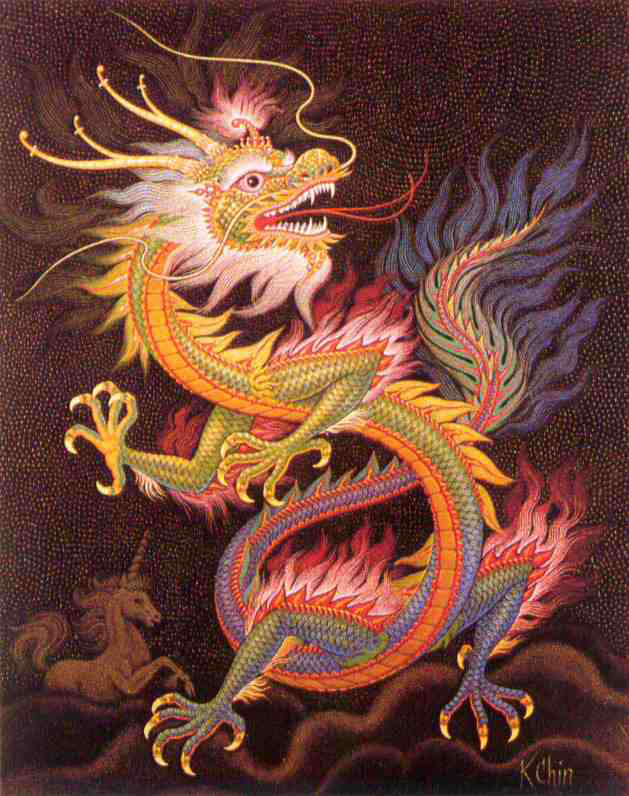
In drawing an iconographic image of that world, I could represent the USA with an eagle. Russia is a bear, of course, and China is a dragon. It's an easy call to go along with this theme by representing India with an elephant. But what animal (either mythical or real) would I use to represent Europe?

A boring ring of twelve gold stars isn't the same kind of icon as the other four, which are animal figures. It's not nearly as interesting, and it breaks up the animal-icon theme.

My first thought is a lion. England’s traditional animal icon is King Richard’s gold lion. The Czech Republic is a white lion with two tails. Lions are associated with Sweden, Finland, Bulgaria, Denmark, and Norway, too. Problem is, there haven’t been lions in Europe for more than two thousand years since the Romans hunted European lions to extinction.
Eagles are popular, too, especially east of the Rhine and north of the Danube; you find eagles symbolizing or appearing on coats of arms for Germany, Poland, Czech, Austria, and Hungary. But I can't use an eagle, because I've already used it for the USA.

So now I’m guessing the right symbol could be a griffin – a mythical beast that is half lion, half eagle. Of course, that's too similar to St. Mark's lion, the symbol of Venice, so anyone who has a rivalry with Italy – and lots of Italians who might prefer, say, the Roman she-wolf – will also not like this.

Now, there’s a whole host of other national symbols – animal and otherwise – that compete with the various lions and eagles. There are bulls, roosters, horses, owls, and rams all over Europe. Other countries are a little bit more challenging. Ireland’s symbols are a cloverleaf and a harp. France is either the fleur-de-lis or MarianneMarianne may be the sexiest national symbol on the Continent, but she's not an animal and she certainly doesn't represent all of Europe. And because the theme is animals, Europa herself is not a good choice. Neither is Europa's lover Zeus, disguised as a white bull, since Zeus himself is not the symbol of Europe.

The real problem is that the EU is so modern, technocratic, new, and dull that it simply hasn't yet evolved its own set of symbols. So maybe the only really accurate symbol is that boring circle of stars.

So, is Europe a lion, a griffin, or what?