Sailors in the South Pacific nation of Tonga have discovered a new island. A really new island -- three months ago it wasn't there. The picture was taken from this article which is worth reading for the additional picture of the miles-wide pumice raft. The blog of the people who chartered the yacht can be read here; it has lots of photographs of the emerging island and other natural phenomena around the area.
November 9, 2006
How Cool Is This?
Sailors in the South Pacific nation of Tonga have discovered a new island. A really new island -- three months ago it wasn't there. The picture was taken from this article which is worth reading for the additional picture of the miles-wide pumice raft. The blog of the people who chartered the yacht can be read here; it has lots of photographs of the emerging island and other natural phenomena around the area.

 Labels:
Cheerful For Once,
Travel
Going Back To The Well One Last Time
I wanted to leave the Ted Haggard thing alone. I mean, I'd done more than enough already. But then I saw the story on FARK. Ted Haggard, who fell from an astonishing height of power and prestige after confessing to unspecified "sexual immoralities" (he was accused of having a years-long drug-tainted relationship with a male prostitute), has decided to go into rehab. Christian rehab. This apparently consists of having "...godly men who are clean themselves insert themselves in the life of the one who is struggling," with much laying of hands.
You know, having a bunch of guys "insert themselves" and "lay hands" on him doesn't sound like it's going to remediate homosexual behavior.
Okay, cheap-shot jokes based on statements taken out of context are beneath me, you might say. Apparently, you'd be incorrect if you did say it. But sometimes these things just write themselves.
Seriously, I must query as to whether the course of rehabilitation he's going to receive is that much different than the typical twelve-step program for redirecting addictive behavior -- one never stops being an alcoholic, for instance; one can controls the addiction but the addiction doesn't go away. Twelve-step programs don't claim to "cure" the addict. They claim to help the addict "recover." The twelve-steppers I've known seem to have a lot of things in common -- their addictions seem to be diverted from the harmful activity to a more harmless one (typically a religious affiliation or, if that is lacking, the twelve-step support group itself); the addict attempts to meld his personality and recreational activities into the twelve-step support group; and they all seem to drink prodigious quantities of coffee, even if their underlying addiction was not drinking.
This does not seem to be a traditional AA-style, twelve-step program, but it's way better than nothing. It's undeniably good that he's seeking reconciliation and forgiveness after admitting that he had a problem. Christianity teaches that there is redemption even for the worst sinner. I believe in second chances, particularly for those who learn from their humbling mistakes. Certainly I've made serious mistakes of my own in the past and needed some breathing room and time to bounce back; why shouldn't this guy be any different than that?
So it's time for me to dispense with the schadenfreude and to wish (former Rev.) Ted Haggard the best for as complete and speedy a recovery as can be possible and a reconciliation with his family.
You know, having a bunch of guys "insert themselves" and "lay hands" on him doesn't sound like it's going to remediate homosexual behavior.
>>cue rimshot sound effect<<
Okay, cheap-shot jokes based on statements taken out of context are beneath me, you might say. Apparently, you'd be incorrect if you did say it. But sometimes these things just write themselves.
Seriously, I must query as to whether the course of rehabilitation he's going to receive is that much different than the typical twelve-step program for redirecting addictive behavior -- one never stops being an alcoholic, for instance; one can controls the addiction but the addiction doesn't go away. Twelve-step programs don't claim to "cure" the addict. They claim to help the addict "recover." The twelve-steppers I've known seem to have a lot of things in common -- their addictions seem to be diverted from the harmful activity to a more harmless one (typically a religious affiliation or, if that is lacking, the twelve-step support group itself); the addict attempts to meld his personality and recreational activities into the twelve-step support group; and they all seem to drink prodigious quantities of coffee, even if their underlying addiction was not drinking.
This does not seem to be a traditional AA-style, twelve-step program, but it's way better than nothing. It's undeniably good that he's seeking reconciliation and forgiveness after admitting that he had a problem. Christianity teaches that there is redemption even for the worst sinner. I believe in second chances, particularly for those who learn from their humbling mistakes. Certainly I've made serious mistakes of my own in the past and needed some breathing room and time to bounce back; why shouldn't this guy be any different than that?
So it's time for me to dispense with the schadenfreude and to wish (former Rev.) Ted Haggard the best for as complete and speedy a recovery as can be possible and a reconciliation with his family.
November 8, 2006
I Ought To Be A Pundit
 Instapundit and Volokh have both offered the same opinion I did last night -- had the Republicans made any meaningful kind of an effort to keep libertarian-inclined voters within the fold, they would not now be wailing and gnashing their teeth over the loss of Congress to Nancy Pelosi and Ted Kennedy. To be fair, both Prof. Reynolds in Tennessee and Prof. Zywicki in Virginia have been saying these sorts of things (as have I) for quite some time. Difference is, I'm not a correspondent on a top-ten blog and I'm not a law professor at a major university. But the Loyal Readership does seem to be growing; I've been averaging nearly 100 hits a day, possibly fueled by the election.
Labels:
2006 Election,
Blog,
Link Love
Opposition Softening
If you take a look at the list of ballot propositions and initiatives that CNN thought were important, you'll find eight attempts to ban same-sex marriage, either by law or by amendment to state constitutions. Seven of the eight passed. Bear in mind that same-sex marriage bans are supposed to be a wedge issues, intended to fuel church-based GOTV drives for Republicans.
But look at the margins and the results:
This "wedge" issue seems to have not worked very well for Republicans, at least at the statewide levels, where it was used. In only one case, Virginia, did partisan control of the contested seat change, and that by only the slimmest of margins, under .3% of the overall vote. I bear in mind, however, that this was a very strong election for Democrats because of other issues, which perhaps could have the effect of depressing support for same-sex marriage bans. But the fact that the issue is now seen as more partisan than it was in the past is testament to its incorporation into the toolkit of theocratic politicos.
Personally, I'm still mystified at why it is that anyone would care if two unrelated gay adults wanted to get married. But my intent here is not to argue the merits of the issue, but rather trying to analyze how the issue plays out in electoral politics.
The margins of opposition to this issue have fallen quickly. I recall as recently as 1998 that something like 95% of Americans opposed same-sex marriage. (It mystified me then, too.) Only Tennessee and South Carolina posted numbers even approaching that stridency of opposition eight years later. What must have seemed a strange and bizarre idea in 1995 is becoming easier for people to grasp. And as a few more liberal states have adopted same-sex marriage or domestic partnership laws, it has become clear that no particular harm has arisen from this.
Voters are not stupid and their impulse is to do what is good and right. As voters realize that letting gays marry doesn't alter their lives in any material way, and that it doesn't even cost any appreciable amount of money, more of them will be inclined to overcome the "ick factor" and say, "Hey, live and let live; how two people choose to live together just plain isn't any of our business."
We're not there yet. But the issue is losing electoral force for those who would rally personal prejudice, perhaps cloaked and legitimized by religion for some, to lend its ugly support to partisan politics.
But look at the margins and the results:
Arizona: 49% (results still incomplete, appears to be a rejection of the ban). Elected Republican Senator and Democratic Governor.
Colorado: 56% (also rejected, 47%-53%, a different ballot initative which would have established domestic partnerships). No Senate election, elected Democratic Governor.
Idaho: 63%. No Senate election, elected Republican Governor.
South Carolina: 78%. No Senate election, elected Republican Governor.
South Dakota: 52%. No Senate election, elected Republican Governor.
Tennessee: 81%. Elected Republican Senator and Democratic Governor.
Virginia: 57%. Elected Democratic Senator, no gubernatorial election.
Wisconsin: 59%. Elected Democratic Senator and Democratic Governor.
This "wedge" issue seems to have not worked very well for Republicans, at least at the statewide levels, where it was used. In only one case, Virginia, did partisan control of the contested seat change, and that by only the slimmest of margins, under .3% of the overall vote. I bear in mind, however, that this was a very strong election for Democrats because of other issues, which perhaps could have the effect of depressing support for same-sex marriage bans. But the fact that the issue is now seen as more partisan than it was in the past is testament to its incorporation into the toolkit of theocratic politicos.
Personally, I'm still mystified at why it is that anyone would care if two unrelated gay adults wanted to get married. But my intent here is not to argue the merits of the issue, but rather trying to analyze how the issue plays out in electoral politics.
The margins of opposition to this issue have fallen quickly. I recall as recently as 1998 that something like 95% of Americans opposed same-sex marriage. (It mystified me then, too.) Only Tennessee and South Carolina posted numbers even approaching that stridency of opposition eight years later. What must have seemed a strange and bizarre idea in 1995 is becoming easier for people to grasp. And as a few more liberal states have adopted same-sex marriage or domestic partnership laws, it has become clear that no particular harm has arisen from this.
Voters are not stupid and their impulse is to do what is good and right. As voters realize that letting gays marry doesn't alter their lives in any material way, and that it doesn't even cost any appreciable amount of money, more of them will be inclined to overcome the "ick factor" and say, "Hey, live and let live; how two people choose to live together just plain isn't any of our business."
We're not there yet. But the issue is losing electoral force for those who would rally personal prejudice, perhaps cloaked and legitimized by religion for some, to lend its ugly support to partisan politics.
Labels:
2006 Election,
Domestic Politics,
Same-Sex Marriage
Rasputin Falls
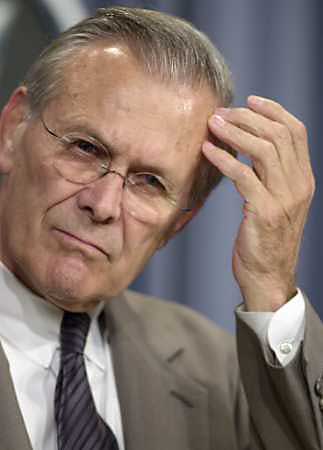 In 2001, the explicit warnings of Colin Powell that we were being fed a line about invading Iraq were ignored, and the President put his faith in Donald Rumsfeld's assurances that Iraq could be converted into a steadfast ally formed the basis of the central feature of George W. Bush's presidency -- overshadowing even 9/11.
Then, a graphic demonstration that Ahmed Chalabi's honeyed predictions about a glorious post-war Iraq, poured into the Administration's ear via Donald Rumsfeld, was not true, was not enough to shatter the President's steadfast faith in his Secretary of Defense.
After that, widespread criticism that not enough boots were on the ground to complete the mission of pacifying Iraq was not nearly enough to break Bush's loyalty to Rumsfeld.
The President has never once deviated from the cognitive dissonance of the Secretary of State's insistence that great resources are being placed into the hunt for Osama bin Laden, while also insisting that finding him is really not all that important. It obviously can't be both -- either it's worth it to invest a lot of resources in finding and killing the guy, or it's not.
Subsequently, the apparent impotence of the United States to respond to military challenges from North Korea and the proxies of Syria and Iran were not a demonstration to the man in charge that something was amiss in the Pentagon.
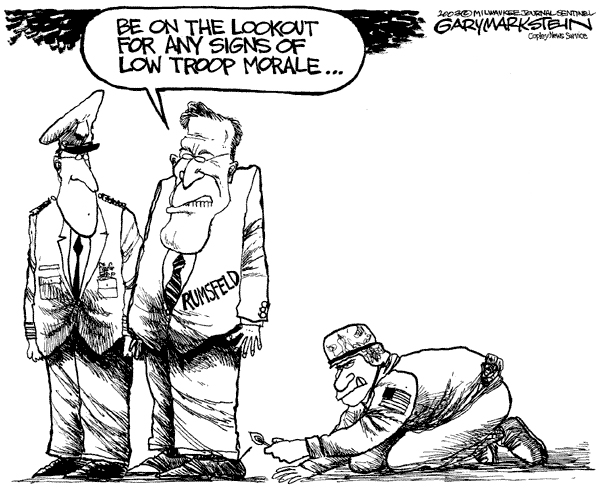 Neither was the call by an assortment of Congressional leaders from both parties and recently-retired generals, and the apparent behind-the-scenes critiques of serving general officers, for the resignation of the civilian leader of the military. Instead, we heard a drumbeat of praise and support from the White House, the equivalent of "You're doing a great job, Rummy."
The unprecedented editorial of the military newspapers calling for Rumsfeld's removal from power also failed to convince the President that one of his principal advisers was letting him down. As recently as Sunday night, George Bush insisted that Donald Rumsfeld was going to serve as Secretary of Defense until Bush's successor took office.
But let it not be said that George W. Bush is completely dense. The American public throwing the GOP's majority in Congress out on its ear was a sufficiently clear message to the President for it to dawn on him that, indeed, something has gone terribly wrong. And so this morning, Rumsfeld was resigned from the Administration, to be replaced by another old Bush friend from Texas, a man with an intelligence and administrative background who seems qualified for the job.
What I wonder now is whether Bush thinks that sacrificing Rumsfeld will be enough to placate the public. Obviously, it won't; the American people want to see something different being done and made that desire well-understood. Voting out Lincoln Chafee, a Republican who voted against the war, in favor of Sheldon Whitehouse, a Democrat who voted for it, is as clear a sign as I can think of that the American people are resentful of being misled about the WMD's, displeased with the continuing violence in Iraq, and nervous about the overextension of our military caused by the ongoing misadventure in the cradle of civilization. What alternative it is the people want to see is unclear -- but what is clear is that we want something different with regards to the war, because what Rumsfeld has been having the military do for the past six years is simply not working.
Here's hoping that the incoming Secretary of Defense, Robert Gates, is able to put together a better plan, one with a credible exit strategy and an endgame that is at least marginally acceptable to our economic, diplomatic, and security interests.

November 7, 2006
I Think It's My Fault
 Karl Rove and his incredible Republican Turnout Machine have some big-time egg on their faces. And I'm to blame. Well, sort of. And only partially.
I think that the better-than-I-expected Democratic results -- they've taken the House and, as I write, are leading in the three remaining contested Senate races, which would give them a one-seat majority in the Senate -- have two causes:
1. A lot of people, myself included, have grown disgusted with the lack of any kind of discernable progress in the war. Every time the news comes on, it seems that something new and awful has happened in Iraq; Afghanistan is slipping; there appears to be no way out and no solution that is even marginally to our advantage. This has taken away the Republicans' credibility on the issue of national security and terrorism -- whatever mandate they might have had to lead on that issue has evaporated. This does not translate into a Democratic mandate -- just a rejection of the path that we are on right now and a demand for change.
2. A lot of Republicans, myself included, have grown disgusted with the lack of any kind of fiscal restraint on the part of a don't-tax-but-spend-anyway Congress. It's astonishing that Democrats have gained greater credibility with the issue of the economy and the role of the government in the economy. But that's what's happened, because the Republicans as a group have simply abdicated the role of guardians of the Federal budget.
I cannot help but think that if Republicans had found room for a more libertarian-oriented agenda, or even one that was simply more more budget-conscious, they could have avoided this. Libertarians would have counseled more caution in starting a ludicrously expensive war; and objected strenuously to increasing spending without increased taxes to offset them (while preferring to do neither).
We'll never know for sure, of course. But you want proof? Look at Montana -- if the Republicans had kept the libertarian vote, would that have made the difference? In Missouri, if you add half the votes for the libertarian candidate to Jim Talent's vote total, and the Senate would have stayed in Republican hands.
But no. "Libertarian budget hawks aren't part of the "base," so screw them and the things they want. Besides, who are they going to vote for anyway, the Democrats? Gimme a break." Does that little mantra sound familiar to anyone?
Think about that for the next couple of years, Karl.
Labels:
2006 Election,
Domestic Politics
A Look Back
I wrote before that I was predicting the most closely-divided Congress in history to be seated this January. But a little research reveals that, in fact, that is not possible. It would not be possible to get closer results than the Seventy-Second Congress, which was elected in 1930 and sat from 1931 to 1932, which will hold the record for the most closely-divided Congress for all of American history.
Recall that the Great Depression began in mid-1929, and so the national economy was in a terrible downslide. Recall that Herbert Hoover was President, and the very unhappy economy was a primary cause for the uncharismatic Hoover's increasing unpopularity. The Republicans' commanding majority in both the House and the Senate evaporated.
The result of the House elections in 1930 was as follows:
Republicans: 218 seats
Democrats: 216 seats
Farmer-Labor: 1 seat
The lone representative from the Minnesota Farmer-Labor party caucused with the Democrats, and indeed the two parties later merged. But, for the majority of the Congress, Democrats controlled the House of Representatives. By November 24, 1931, two Republican incumbents had died and special elections were held that resulted in those seats being taken over by Democrats, leaving the seat count at:
Democrats: 218 seats
Republicans: 216 seats
Farmer-Labor: 1 seat
Michael Barone tells the story here; it is quaint in that it shows a high degree of concordance and bipartisan respect between the Republican initially elected speaker (Nicholas Longworth of Ohio) and the Democrat who replaced him in mid-session (John Nance Garner of Texas, who went on to become Vice-President of the United States). It's too bad that kind of bipartisanship has all but vanished in this polarized age; we're supposed to be happy that the party leaders are civil to one another.
On the Senate side, the result of the election left this balance of power:
Republicans: 50 seats
Democrats: 49 seats
Farmer-Labor: 1 seat (caucusing with Democrats)
So, keeping in mind that the Farmer-Labor party was basically a one-state populist wing of the Democrats, we see that in 1931, the Senate was evenly split and the House controlled by a single vote -- a vote which changed during the session of Congress.
We might tie that result tonight (or rather, over the course of the next week; some races simply will not be called tonight and those will determine the balance of power) but the 1930 elections sent to Washington a Congress divided as mathematically close to an even split as is theoretically possible.
Labels:
Domestic Politics,
History
November 6, 2006
My Good Deed For The Day
Leaving court this morning, I noticed a piece of paper -- neat and trifolded -- under the wheels of my car. I looked at it again, and it was some guy's pay stub. There are lots of reasons why a pay stub might be in court -- it might be evidence, it might be for a debtor's exam, it might be for a child support hearing, who knows?
But I remembered that there are certain kinds of people you will find in a courthouse, every day. Lawyers, judges, clerks, and cops. Oh, and criminals. Lots of criminals. Identity theft is a pretty bad thing to have happen to you and there's a lot of information on a pay stub which an unscrupulous thief could use to his advantage.
So I took it back to the office (yes, I ran a conflict check on it and he wasn't in our database at all) and I mailed it back to the address on the stub. Whether the guy was a debtor, an upstanding citizen, or a third party, he shouldn't have his personal information out on the parking lot where criminals could have easy access to it. Seemed like the right thing to do.
Labels:
Cheerful For Once
Election Liveblogging?
Not here. I'll make one or two posts, maybe, but I'm going to save most of my thoughts on the election until after returns are in. If you want minute-by-minute returns, watch the networks, or any of a number of websites. No one is really going to care about my momentary thoughts about the returns -- so better to provide thoughts on the real results.
I've already made my prediction (Republicans will keep the House by 5 seats, and the Senate will split, 50-50) , and given the near hysteria the media is feeding everyone over the expected Democratic landslide, it's a pretty bold prediction.
Besides, I suspect that most of the liveblogging is being outsourced anyway. I'll leave that sort of thing to the cheaper labor available in India.
I've already made my prediction (Republicans will keep the House by 5 seats, and the Senate will split, 50-50) , and given the near hysteria the media is feeding everyone over the expected Democratic landslide, it's a pretty bold prediction.

Besides, I suspect that most of the liveblogging is being outsourced anyway. I'll leave that sort of thing to the cheaper labor available in India.
Labels:
2006 Election,
Blog
Bad Ruling From Court
When you file a lawsuit, you need to serve the complaint on the defendant. Then, you need to file what's called a "proof of service" with the court, to prove that you've served the defendant. The court will normally schedule a hearing to make sure this has been done. In theory, the plaintiff has thirty days to serve all of the defendants.
I had to file a lawsuit for one of my clients in Stinking Bakersfield, because he lives in Kern County. So I need to serve all of the defendants. I filed a statement of my progress (4 out of 5 defendants served, the next one to get served next week) and asked that the hearing be taken off calendar. Not only did the court in Stinking Bakersfield say "no," the judge also said I had to make my appearance in person and could not phone in the appearance to tell the judge that yes, indeed, my process server will get that last defendant served next week.
It's a 90-mile drive from the Rented Mansion In The Desert to Stinking Bakersfield. And if you've never been there, let me assure you that Stinking Bakersfield is the beauty spot of California. Keep your Yosemite, your San Francisco, your Big Sur and your Santa Barbara. I don't need no San Diego or Death Valley or none of your boring old Sierra Nevada mountains. No, I can go to Stinking Bakersfield in an easy, two-hour drive through the desert, and see things like this:

Eat your heart out, Tennesseans!
Labels:
California,
Law,
Tennessee

November 5, 2006
Anti-Religion and Unintended Consequences
This week's cover article in Time magazine and the results of a recent survey on the extent of religious faith in America got me thinking.
I've been critical of anti-scientific thinking for some time now. One of the books that has had the most influence on my world view was Carl Sagan's The Demon-Haunted World. And in the great debate about whether science and reason should rule the world rather than faith and religion, I am a partisan of the science camp, and not much of a reconciler. This book ought to be mandatory reading for seventh-graders.
Still, I was recently upset over an arrogant, disparaging series of statements and interviews by Sagan's successor as the hero of the scientific popularization movement, Richard Dawkins. Evolutinary biology has taken the most direct hits of any facet of scientific learning from the antiscience crowd ever since Darwin's theory of evolutionary adaptability surpassed Lamarck's spontaneous mutation theory. Dawkins is a tremendous popular ambassador of his discipline and one could hope for no finer explanations of the overwhelming scientific evidence that evolution, in its broad strokes, is as convincing a theory as that of gravity. But one could hope for a more tactful person -- or at least a more tactful approach -- to forcefully explain why religion is unnecessary and fundamentalist religion is dangerous. Maybe some level of getting in peoples' faces is necessary to achieve that goal, but I continue to question that.
The reason is that I see so many people around who do religion the right way. They understand the moral guidance that it offers and they try their best to enact it in their lives. They don't get in my face about my beliefs or actions; rather, they live their lives well and teach by quiet example. And their examples are powerful demonstrations of the ability of religion to do good. And it crosses sectarian lines -- I have protestant friends, Catholic friends, Jewish friends, a former client who is Muslim, and more recently, a Buddhist monk. Now, this assortment of so many good, exemplary people of such diverse backgrounds of faith suggests that being good has nothing to do with whether one believes in God and if so which way God is worshipped. What it suggests to me is that religions, as institutions of social control, necessarily must adopt and advance a constructive and positive set of moral guidelines for their followers.
It also suggests to me that most people want to be good. That is cause for hope. It is really fundamentalism and the antiscience that goes along with it -- the rejection of the role of rationality in favor of adherence to the literal truth of a collection of bronze age myths about sky gods and warrior-kings -- that gets me upset. I really don't have a problem with people who look into these old stories and glean what is valuable and relevant to today's society from them. That, it seems to me, is an entirely worthwhile and important task. Perhaps we don't need to use those particular sources, but I'm a big one for understanding the importance of history.
Still, I don't recall seeing that much prominence given to religious doubt and skepticism in the widespread culture until very recently. Until recently, I've seen a lot of surveys that point very much in the opposite direction, and a single survey is often not very reliable evidence. Perhaps what's going on has its roots in politics and the incautious remarks of our national leaders to promote the "Global War on Terror" ("global" meaning "mostly confined to Afghanistan and Iraq").
George W. Bush rose to power unashamedly on the votes of evangelical Christians, bringing out into the open a phenomenon that had been coming to a boil for about twenty years. He has governed as one of them. He has labored mightily to coordinate his political support to lean heavily on these voters. In our country's hour of need and despair, he used their code words and appealed to their faith as the primary means to rally the country. Since then, he has continued to go to that well to seek assurances and legitimacy for his policies.
You may recall the President's use of the word "crusade" in the days following 9/11. Following the cue of our leaders, people across the country -- largely but not exclusively political conservatives and evangelical Christians -- began a campaign of criticism against Islam. The phrase "Religion of Peace" has turned in to something of a joke, and translations of the more violent and intolerant portions of the Koran to illustrate how Islam is on a theological collision course with the Christian West are easy to find. These same people, and there are now quite a lot of them, pooh-pooh the existence of "moderate" Muslims and reject the idea that Islam can ever become reconciled with other religions to the point that peaceful co-existence is possible.
I'm not going to challenge the merits of those thoughts here. But instead, perhaps the criticism being aimed at Islam from the RR corner has had an unintended side effect -- it has caused skepticism of religion, in a generalized sense, to increase. After all, if Islam is such a bad religion, what is it about Islam that makes it bad? Those bloody, terrible portions of the Koran sound not all that unlike the more unpleasant and violent parts of the Old Testament. The bizarre mysticism and prohpecies of other portions of the Koran don't seem that different from the Revelation of Saint John (which features, among other absurdities, a returned Messiah with seven swords for a tongue).
A lot of people, from whatever background, have noticed along with me that there are good folks everywhere who subscribe to any number of world views. The disconnect between good moral behavior and religiosity ought to be apparent to everyone. So it would be ironic indeed if the result of his polarizing appeals had the effect of diminishing the strength of religion generally.
I
I've been critical of anti-scientific thinking for some time now. One of the books that has had the most influence on my world view was Carl Sagan's The Demon-Haunted World. And in the great debate about whether science and reason should rule the world rather than faith and religion, I am a partisan of the science camp, and not much of a reconciler. This book ought to be mandatory reading for seventh-graders.
Still, I was recently upset over an arrogant, disparaging series of statements and interviews by Sagan's successor as the hero of the scientific popularization movement, Richard Dawkins. Evolutinary biology has taken the most direct hits of any facet of scientific learning from the antiscience crowd ever since Darwin's theory of evolutionary adaptability surpassed Lamarck's spontaneous mutation theory. Dawkins is a tremendous popular ambassador of his discipline and one could hope for no finer explanations of the overwhelming scientific evidence that evolution, in its broad strokes, is as convincing a theory as that of gravity. But one could hope for a more tactful person -- or at least a more tactful approach -- to forcefully explain why religion is unnecessary and fundamentalist religion is dangerous. Maybe some level of getting in peoples' faces is necessary to achieve that goal, but I continue to question that.
II
The reason is that I see so many people around who do religion the right way. They understand the moral guidance that it offers and they try their best to enact it in their lives. They don't get in my face about my beliefs or actions; rather, they live their lives well and teach by quiet example. And their examples are powerful demonstrations of the ability of religion to do good. And it crosses sectarian lines -- I have protestant friends, Catholic friends, Jewish friends, a former client who is Muslim, and more recently, a Buddhist monk. Now, this assortment of so many good, exemplary people of such diverse backgrounds of faith suggests that being good has nothing to do with whether one believes in God and if so which way God is worshipped. What it suggests to me is that religions, as institutions of social control, necessarily must adopt and advance a constructive and positive set of moral guidelines for their followers.
It also suggests to me that most people want to be good. That is cause for hope. It is really fundamentalism and the antiscience that goes along with it -- the rejection of the role of rationality in favor of adherence to the literal truth of a collection of bronze age myths about sky gods and warrior-kings -- that gets me upset. I really don't have a problem with people who look into these old stories and glean what is valuable and relevant to today's society from them. That, it seems to me, is an entirely worthwhile and important task. Perhaps we don't need to use those particular sources, but I'm a big one for understanding the importance of history.
III
Still, I don't recall seeing that much prominence given to religious doubt and skepticism in the widespread culture until very recently. Until recently, I've seen a lot of surveys that point very much in the opposite direction, and a single survey is often not very reliable evidence. Perhaps what's going on has its roots in politics and the incautious remarks of our national leaders to promote the "Global War on Terror" ("global" meaning "mostly confined to Afghanistan and Iraq").
George W. Bush rose to power unashamedly on the votes of evangelical Christians, bringing out into the open a phenomenon that had been coming to a boil for about twenty years. He has governed as one of them. He has labored mightily to coordinate his political support to lean heavily on these voters. In our country's hour of need and despair, he used their code words and appealed to their faith as the primary means to rally the country. Since then, he has continued to go to that well to seek assurances and legitimacy for his policies.
You may recall the President's use of the word "crusade" in the days following 9/11. Following the cue of our leaders, people across the country -- largely but not exclusively political conservatives and evangelical Christians -- began a campaign of criticism against Islam. The phrase "Religion of Peace" has turned in to something of a joke, and translations of the more violent and intolerant portions of the Koran to illustrate how Islam is on a theological collision course with the Christian West are easy to find. These same people, and there are now quite a lot of them, pooh-pooh the existence of "moderate" Muslims and reject the idea that Islam can ever become reconciled with other religions to the point that peaceful co-existence is possible.
IV
I'm not going to challenge the merits of those thoughts here. But instead, perhaps the criticism being aimed at Islam from the RR corner has had an unintended side effect -- it has caused skepticism of religion, in a generalized sense, to increase. After all, if Islam is such a bad religion, what is it about Islam that makes it bad? Those bloody, terrible portions of the Koran sound not all that unlike the more unpleasant and violent parts of the Old Testament. The bizarre mysticism and prohpecies of other portions of the Koran don't seem that different from the Revelation of Saint John (which features, among other absurdities, a returned Messiah with seven swords for a tongue).
A lot of people, from whatever background, have noticed along with me that there are good folks everywhere who subscribe to any number of world views. The disconnect between good moral behavior and religiosity ought to be apparent to everyone. So it would be ironic indeed if the result of his polarizing appeals had the effect of diminishing the strength of religion generally.
November 4, 2006
The Antelope Valley, In Red And Blue
This was news to me. I knew that there were more Democrats here in the Antelope Valley as a result of demographic and economic change here -- mainly people moving up from Los Angeles to be able to afford houses. But I would have never thought that Palmdale would ever be a Democrat majority city.
Labels:
California,
Local Politics
The Verdict
 Early in the morning, the verdict in Saddam Hussein's first trial will be handed down. The trial has been tragic political theater on a grand scale. The verdict, and the reaction of the Iraqi people to it, will be most insightful.
No one doubts that Saddam should be found guilty of all sorts of crimes against humanity and ordering murders, and that he deserves death, which is better than he gave most of his victims. Well, no one in the United States, that is. That is why Baghdad has been locked down until further notice.
One wonders if, given the absolutely chaotic three years that the Iraqi people have survived, they see Saddam as a figure of authority and stability rather than as a criminal and sociopath of astonishing dimenson. Nevertheless, when the inevitable violence breaks out, if it is extensive, it could wind up affecting the election on Tuesday.
Labels:
Domestic Politics,
International Politics,
Saddam
Bachelor Day
 The Wife was away all day, at a Toastmasters conference. She got up before the sun (no mean trick in early November) and is still out of the house. So what did I do with my bachelor day? Lots of scotch and stogies? Poker with the boys? Shopping for boats or high-end stereo equipment?
Sad to say, not much exciting. I played Civilization for a while, I cleaned up the accumulated dog shit in the back yard, I went grocery shopping, I cleaned the kitchen and bathroom fixtures, I vacuumed the carpets, I played with the dogs, I listened to some music on the cable TV music stations, I did my laundry, and now I'm sitting down with the computer to survey college football scores and politics. I see Tennessee lost in the last minute, and it looks like that's what's happening to Harold Ford, too. I'm not sure if I should take heart or be disheartened by that.
But I'm not particualrly disheartened by a pedestrian Saturday by myself. I would rather have a nice, comfortable domestic life than a wild bachelor existence -- when I was single, it wasn't all that great anyway. My only real concession to not having The Wife around today was that I made turkey tacos for dinner; The Wife doesn't care for them for some mysterious reason. Fresh tortillas make a difference.
Labels:
Domestic Politics,
Sports,
The Wife
November 3, 2006
Meeee-eeee-eeee and Mr. -- Mr. Jones
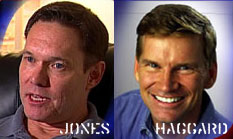 Me and Mr. Jones, we got a thing going on,
We both know that it's wrong
But it's much too strong to let it cool down now.
Oh, when I have money I call him up.
I leave a message on his machine.
Just two bills out from the church's donations,
And he gonna massage me all over the place.
Mee-eee-eee and Mr., Mr. Jones, Mr. Jones, Mr. Jones,
Mr. Jones gonna sell me meth to look at but not snort,
Oh, I know that it's wrong,
But it's much too long for me to cool down now.
I gotta be extra careful
that I don't get found out, now
Cause 14,000 people and the President look to me for moral guidance and quasi-political leadership, oh yeah.
Me, me and Mr., Mr. Jones, Mr. Jones, Mr. Jones,
Oh, we got a thing, a thing going on,
Drugs and gay sex are so much fun,
The temptation's too strong for me to let go of it now.
Well, it's time for me to go home to my wife,
I'll take the drugs with me and smile inside,
Now he'll go his way and I'll go campaign against gay rights,
And tomorrow we'll meet the same place, the same time.
Me and Mr. Jones, Mr. Jones, Mr. Jones.
Labels:
2006 Election,
Scandal
November 2, 2006
Hot Gay Evangelical Sex (Updated 2x)
It's interesting to note that the very arrogant preacher whom I saw in the Richard Dawkins video rightly call Prof. Dawkins on the carpet for arrogance is now caught up in allegations of having paid for gay sex. Apparently his accuser, the alleged prostitute, got mad when he saw his regular john taking a position advocating in favor of Colorado's Amendment 43, which would enshrine Colorado's Defense of Marriage Act in Colorado's state constitution.
Reverend Haggard denies the allegations completely and he is entitled to the presumption of innocence. The timing of the revelation, coming so close as it does to election day, makes its veracity somewhat suspect. But it's interesting that so many news sources are carrying it -- I suppose the idea that someone so prominent as a minister who regularly preaches to the President being involved in salacious gay sex is just too juicy a story to pass up if it turns out to be true. The story of the giant being toppled is one we see again and again.
For myself, I could believe this sort of thing being true. But I'll need more than an accusation to get behind it. For the time being, I'm going to assume the good Reverend is innocent and the victim of a very cruel accusation motivated by politics. His only mistake has been to take such a prominent and strident public position so as to attract this sort of attention.
UPDATE: Rev. Haggard has admitted "some guilt" but not the entire battery of accusations. That's the additional evidence I needed to shift away from the presumption of innocence. This morning's admission of "some guilt" when confronted with the allegation of a three-year affair with a call boy, seems fundamentally incompatible with Haggard's statement last night of "I've never had a gay relationship with anybody. I'm steady with my wife. I'm faithful to my wife." Look, when you make a mistake and get caught, the only thing to do is to buy it, all, immediately, in this case that being something like: "I've made mistakes in my life, and this was been one of them. I'm a sinner and I've asked for God's forgiveness. I'm asking for my wife's forgiveness, and for my congregation's forgiveness. I know I'll spend the rest of my life trying to make amends for what I've done." But that wasn't the reaction -- first there was outright denial and now there's "some" (but not "complete") guilt. If even some of this is true, does it matter all that much what part isn't? No, after this, I'm siding with Salsola's earlier comment and I must admit feeling a certain degree of satisfaction in seeing a hypocrite exposed for what he really is. Stay tuned for more developments. (7:15 a.m. Friday, November 3, 2006)
(UPDATED UPDATE): "Some guilt" apparently means "I bought meth from the guy, but I didn't use it; I paid for massages from the guy but didn't have sex with him." Yeah, right. Bill Clinton never inhaled, and he never had sexual relations with that woman. (1:33 p.m. Friday November 3, 2006)
Labels:
2006 Election,
Religion,
Same-Sex Marriage,
Scandal
Absolute Chaos
This morning, Iraqi Prime Minister Nuri Kamal al-Maliki (who earlier warned America that he was "not your man in Iraq") bowed to pressure from the warlord Moktada al-Sadr, and ordered American troops to lift their checkpointed seige of Sadr City, a Shiite slum to the northeast of Baghdad. The seige had been imposed after an American solider of Iraqi descent, who had been visiting his Iraqi civilian wife, was kidnapped and a group known to be affiliated with al-Sadr announced that they were holding the soldier hostage.
Read all about it in the Washington Post and the New York Times. Niether Faux News nor CNN have not made the connection between the kidnapping of the soldier and the easing of the crackdown on Sadr City -- come to think of it, didn't that part of Iraq used to be called "Saddam City?" Andrew Sullivan thinks there are nuances here, but frankly, I can't see them. Yes, there is a need to defer to the civilian government of Iraq, but whatever happened to "no man left behind"?
Oh, and before I forget, we've uncovered substantial evidence that Hezbollah, backed by its sponsors Syria and Iran, is now trying to stage a coup to overthrow the moderate government of Lebanon. Thus we see the wages of a war interrupted by unthinking bureaucrats incapable of distinguishing right from wrong exercising their power to cluck disapprovingly -- which is what they will do when the coup happens. I used to think the United Nations was mostly harmless but this makes me wonder -- there's no massive conspiracy to subjugate the world to a unified government there, to be sure, but there's also no ability to discern reality, and that can be dangerous, too.
And what are we doing about all of this here in the states? Chuckling over John Kerry's gaffe, because it seems to have helped the Republicans' chances of maintaining control over Congress.
November 1, 2006
Time To Go On Record
 So here's my prediction: contrary to the popular media's predictions, I say that the Republicans will retain control of the House. It will be close -- very close. 220-215. The Republicans will select a new Speaker, who will be either the existing majority leader, John Boehner, or David Drier.
Neither party will have control of the Senate. It will split, 50 seats Republican, 50 seats Democrat. In the four disputed seats, Democrats Menendez (New Jersey) and McCaskill (Missouri) will win; Republicans Corker (Tennessee) and Allen (Virginia) will win. The Tennessee race will be within one percentage point and will not be declared until about a week after the election. There will be numerous allegations of fraud and illegal election conduct. There will also be a big problem with Tennessee's paperless electronic voting machines, which the losing candidate, through proxies, will complain bitterly about being manipulated against him and throwing the race to the winner.
We'll see how well I do in a week!
Labels:
2006 Election
Subscribe to:
Posts (Atom)

 Posts